
Desk briefing
A Better Carbon Claim Begins in the Factory
Interface’s shift towards direct reductions and material innovation shows why climate leadership must connect capital allocation, product design and precise claims.
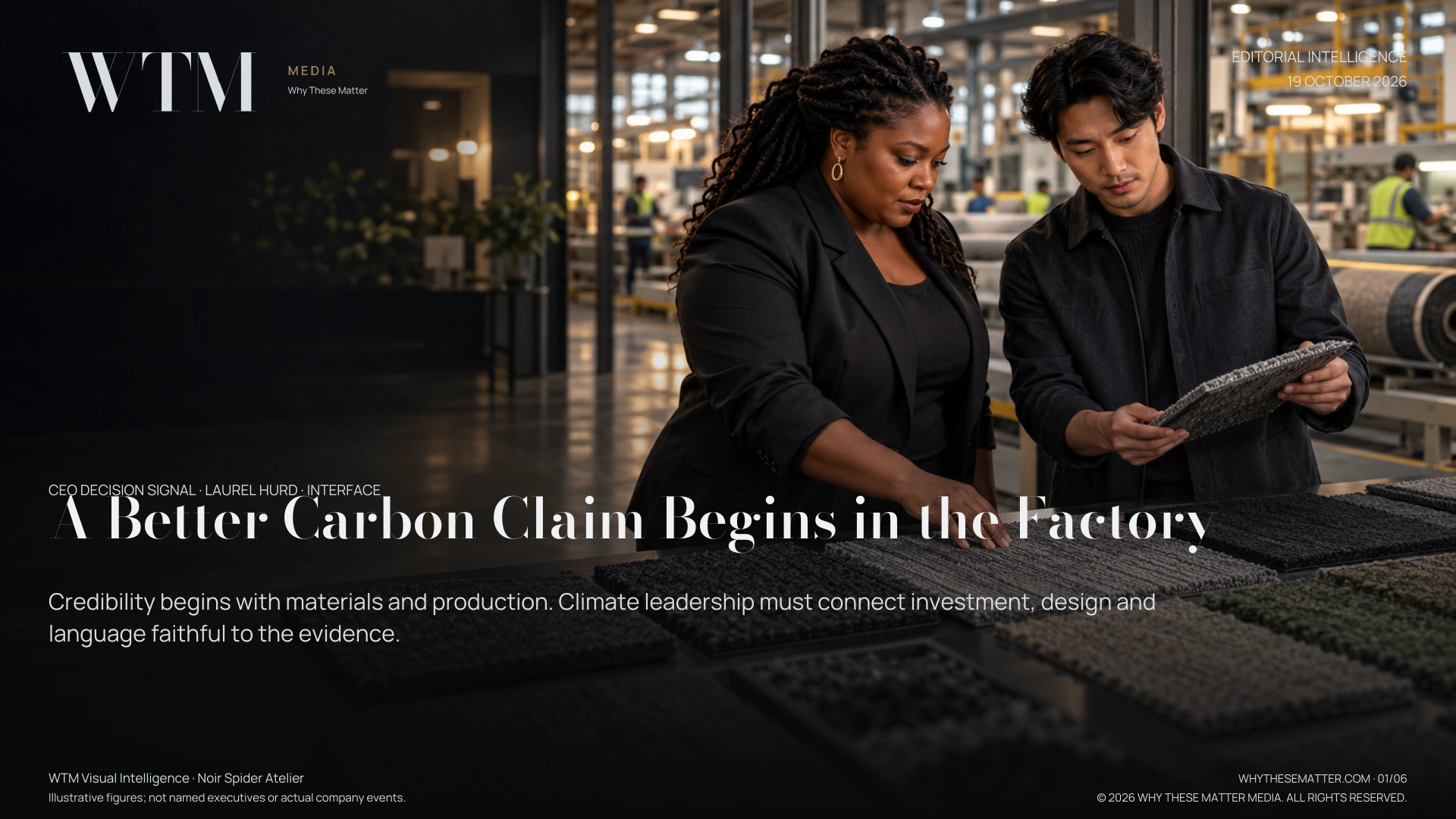
WTM Visual Intelligence · Noir Spider Atelier
The decision
Redirect resources towards direct emissions reduction and carbon storage, then make claims that match the measured boundary.
From the desk
NEWS CHECK · 19 OCTOBER 2026 (EASTERN TIME)
No material update verified at this check that changes the briefing’s premise. Interface’s 16 June 2026 Impact Report release and the European Commission’s currently applicable guidance remain the latest material primary sources used here. Laurel Hurd’s role as President and Chief Executive Officer was rechecked on 19 October 2026. The downloadable Visual Intelligence PDF retains its separate 15 October research recheck and does not contain this 19 October news check.
WTM public-source analysis. This is not a WTM interview, a statement supplied to WTM, or an endorsement.
Interface announced that, beginning in 2025, it would redirect former offset investments towards projects intended to reduce emissions and store carbon within its operations and supply chain. Its stated ambition is to become a carbon-negative enterprise by 2040 without offsets. This is a strategy and a future goal, not evidence that the enterprise has already reached that position. [1]
The CEO decision signal under Laurel Hurd is therefore an allocation choice. Resources are directed towards altering the system that produces the footprint. WTM’s interest lies in whether that choice becomes repeatable operational improvement, with enough disclosure to distinguish a promising project from an achieved result.
WTM systems assessment
In its June 2026 release accompanying the 2025 Impact Report, Interface reported adding captured carbon to carpet-tile manufacturing and introducing a rubber flooring prototype described as carbon negative from cradle to gate. The release separately reported a four per cent reduction in its total product portfolio footprint against the previous year. This is a company-reported portfolio statement, not a finding that total enterprise emissions fell by four per cent. [2]
The design opportunity is meaningful: materials can be selected and combined with their carbon consequences in view. But the relevant assessment must specify the product, the amount or functional unit, the lifecycle stages and the assumptions. A favourable number without those details gives a buyer too little information for a responsible comparison.
Double ROI™ tests both the business case and its credibility. Return on Investment considers performance, cost, customer relevance and avoidable waste. Return on Integrity considers whether claims are accurate, limitations are accessible and affected people can question the account. A successful result should make the organisation more useful and more trustworthy.
Read the portfolio headline alongside the Impact Report’s cradle-to-gate, sales-weighted product basis. Category results differ; the statement is not interchangeable with an enterprise-wide absolute-emissions reduction. [6]
Why These Matter
Interface’s case illustrates why environmental leadership should be examined through capital allocation and design decisions. The most useful signal is a willingness to change the operation that creates the footprint. The most useful evidence is a clear account of what those changes achieve, including where progress remains incomplete.
The company’s public commitments and reported innovations warrant attention without requiring uncritical endorsement. WTM has not audited its lifecycle calculations or independently verified every reported reduction. Readers should be able to recognise that limit while still using the case to ask more demanding questions of their own organisations.
Sources & publication notes
Research recheck: 19 October 2026 (Eastern Time). Edition date: 19 October 2026. Statements attributed to companies are not independently tested outcomes. Human editorial responsibility: Kelly Dowd, MBA, MA.
[1] Interface commits to absolute emissions reduction efforts · 2024 announcement; changes beginning in 2025. Strategy and target, not achieved enterprise-wide carbon negativity.
[2] Interface 2025 Impact Report release · 16 June 2026. Corporate report summary; product and enterprise boundaries differ; no independent WTM lifecycle audit.
[3] Interface executive leadership · Company leadership listing and June 2026 report rechecked 19 October 2026 (Eastern Time). Laurel Hurd is listed as President and Chief Executive Officer; no interview or endorsement implied.
[4] European Commission sustainable consumption guidance · Current guidance rechecked 19 October 2026 (Eastern Time); application 27 September 2026. General editorial explanation; national implementation and precise claims need separate assessment.
[5] European Commission old-stock transition guidance · June 2026 common understanding; current page rechecked 19 October 2026 (Eastern Time). Not an exemption for all pre-existing claims or a ruling on Interface products.
[6] Interface 2025 Impact Report · Published 2026; product carbon-footprint basis, printed page 22. Company-reported product metrics are not a WTM lifecycle audit or an enterprise-wide emissions result.