
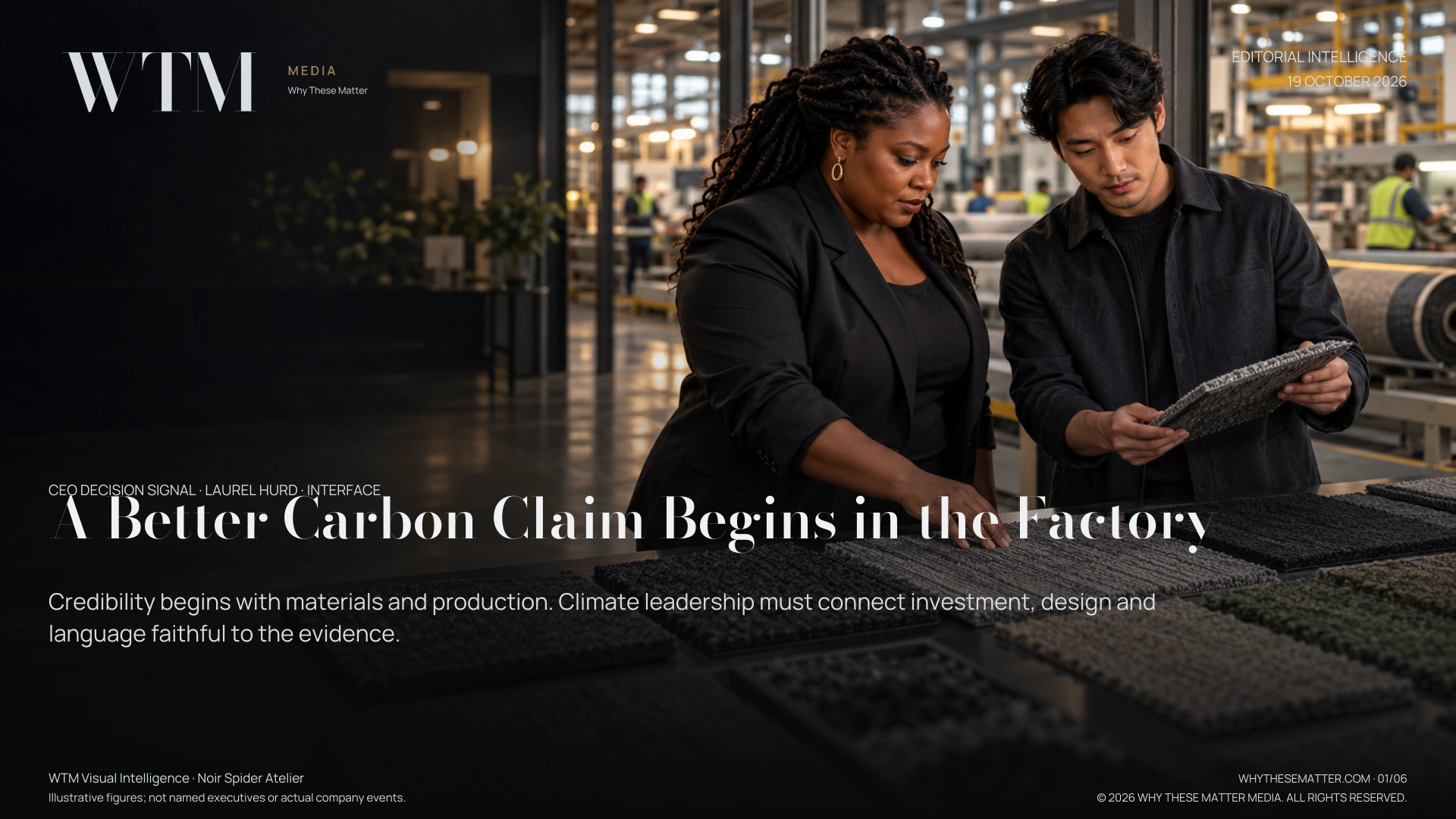
Interface’s carbon strategy raises a practical question for every design-led business: what must change inside the operation for the public claim to deserve trust? WTM examines material innovation, lifecycle boundaries and the EU’s newly applicable consumer rules.
Interface’s shift towards direct reductions and material innovation shows why climate leadership must connect capital allocation, product design and precise claims.
Edition: 19 October 2026 · Kelly Dowd, MBA, MA · 8 MIN READ. Research rechecked 19 October 2026 (Eastern Time).
News check · 19 October 2026 (Eastern Time). No material update verified at this check that changes the article’s premise. Interface’s 16 June 2026 Impact Report release and the European Commission’s currently applicable guidance remain the latest material primary sources used here. Laurel Hurd’s role as President and Chief Executive Officer was rechecked on 19 October 2026. This is public-source analysis, not a WTM interview or endorsement. The downloadable Visual Intelligence PDF retains its separate 15 October research recheck and does not contain this 19 October news check.
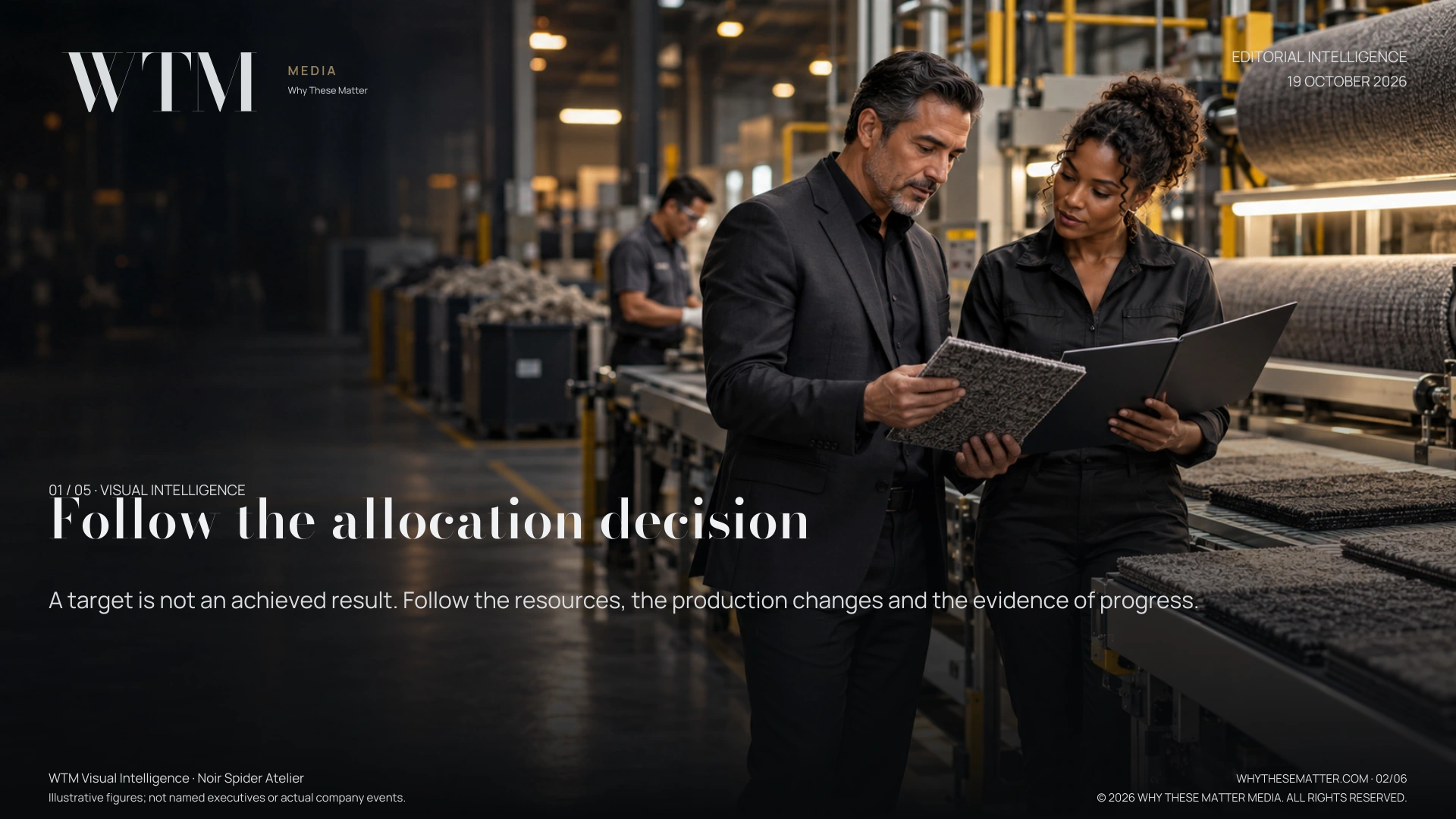
An environmental claim reaches the customer as language, but its credibility begins with decisions about materials, energy and production. A marketing team can make those decisions understandable. It cannot substitute for them. The useful leadership question is what changed inside the business before the sentence appeared on the product page.
Interface announced that, beginning in 2025, it would redirect former offset investments towards projects intended to reduce emissions and store carbon within its operations and supply chain. Its stated ambition is to become a carbon-negative enterprise by 2040 without offsets. This is a strategy and a future goal, not evidence that the enterprise has already reached that position. [1]
The CEO decision signal under Laurel Hurd is therefore an allocation choice. Resources are directed towards altering the system that produces the footprint. WTM’s interest lies in whether that choice becomes repeatable operational improvement, with enough disclosure to distinguish a promising project from an achieved result.
The distinction avoids a false simplicity. A company can have a useful innovation, a demanding target and substantial remaining emissions at the same time. None of those facts cancels the others. Readers need an account that holds them together, rather than moving directly from a good product example to approval of the entire institution.
An ambitious target can organise work across departments. It can also become detached from near-term decisions if responsibility and evidence remain unclear. A board should ask which investments advance the target, which do not, and what would cause management to revise the plan. The discipline is in the choices made before the deadline.
For a design-led business, this is particularly important. A beautiful material can communicate care immediately, while its environmental effects unfold elsewhere and over time. Responsible leadership must connect the visible experience to the less visible production conditions. The customer should not have to infer the environmental story from the appearance of the object.
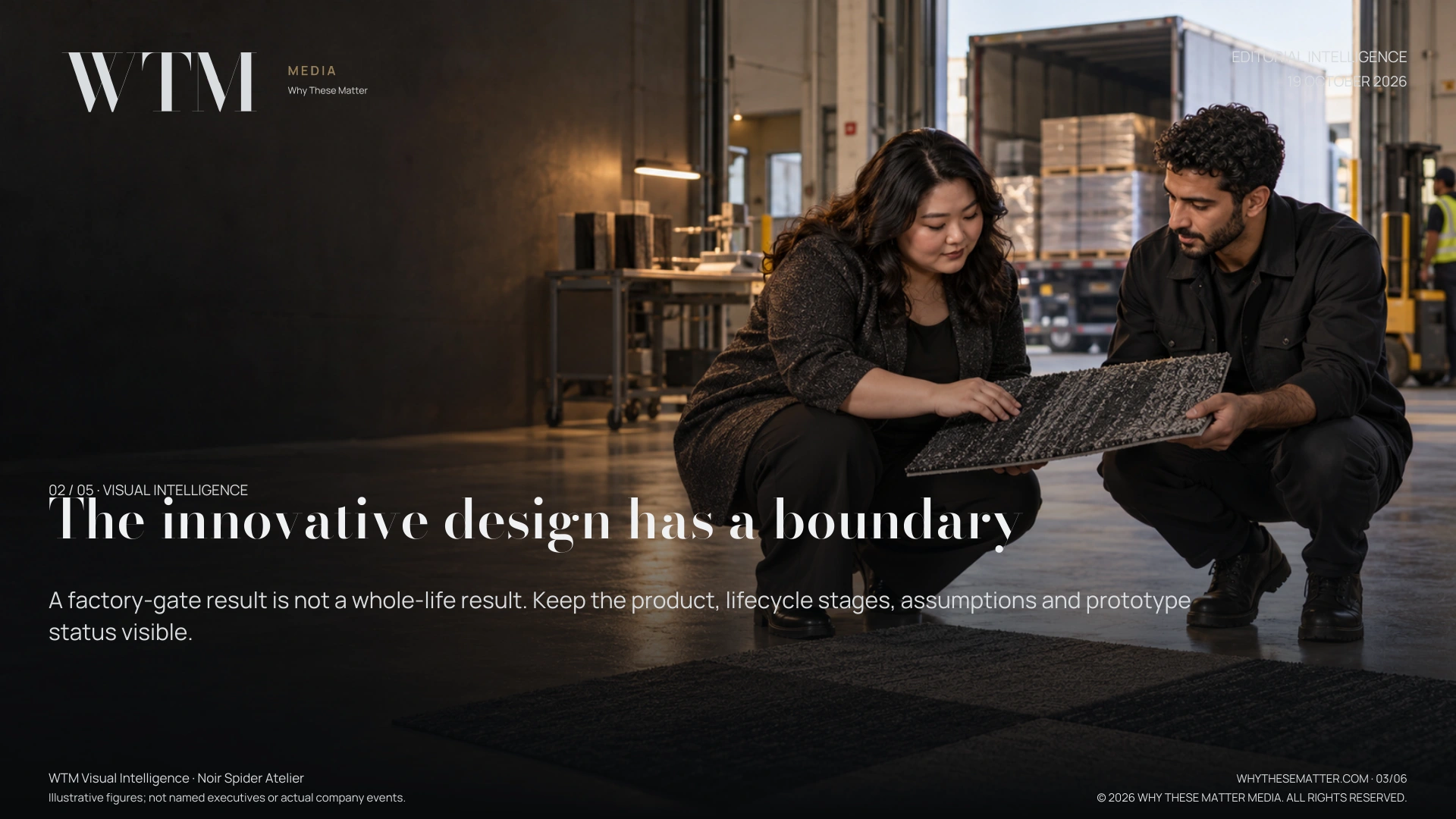
In its June 2026 release accompanying the 2025 Impact Report, Interface reported adding captured carbon to carpet-tile manufacturing and introducing a rubber flooring prototype described as carbon negative from cradle to gate. The release separately reported a four per cent reduction in its total product portfolio footprint against the previous year. This is a company-reported portfolio statement, not a finding that total enterprise emissions fell by four per cent. [2] The report specifies product carbon footprints per square metre on a cradle-to-gate, sales-weighted basis. It also reports different year-on-year movements by product category, including an increase for LVT; the portfolio headline must not be read as uniform improvement in every line. [6]
Cradle to gate describes a defined portion of a product’s life, ending at the factory gate. A claim within that boundary does not, by itself, establish the result after transport, installation, use and disposal. The boundary is part of the meaning of the claim. Removing it can change what a reader reasonably understands.
The design opportunity is meaningful: materials can be selected and combined with their carbon consequences in view. But the relevant assessment must specify the product, the amount or functional unit, the lifecycle stages and the assumptions. A favourable number without those details gives a buyer too little information for a responsible comparison.
The prototype qualification matters as well. A demonstrated formulation is not the same as widespread commercial delivery under ordinary project conditions. This editorial does not establish that every reported prototype is available in every market. Specifiers should check the exact product and current technical documentation before incorporating a claim into a building proposal.
There is an important counterargument to simplistic environmental optimisation. Flooring must perform its intended function, including durability, maintenance and suitability for the setting. A lower-impact material that requires premature replacement may create a different overall result. This is a reason to assess the whole service provided, not a finding against the products discussed here.
WTM’s design assessment is consequently precise: material innovation is promising when its performance can be evaluated within an explicit boundary and a realistic use case. The public claim should travel with those conditions. That keeps the innovation intelligible without asking a single favourable characteristic to carry the entire sustainability argument.

The European Commission states that the Empowering Consumers for the Green Transition Directive entered into application on 27 September 2026. It addresses consumer information about durability and reparability and strengthens protection against misleading environmental practices. This is a recent regulatory development relevant to the wider market, not a finding about Interface’s compliance. [4]
The connection to design is practical. If a claim needs clear support, the organisation must be able to retrieve the evidence behind it. Product development, procurement and communications need a shared account of what is being claimed. Otherwise, a carefully qualified technical result can become an unqualified promise as it passes between teams.
The Commission also describes a coordinated approach to older stock and genuine transitional difficulties. That guidance should not be read as a blanket permission to retain misleading language. Nor should a general editorial imply that enforcement is identical in every national context. Specific implementation and the particular commercial practice remain relevant. [5]
WTM’s recommendation is to treat the evidence behind a claim as maintained product information. Assign an owner, a version and a review date. When a supplier changes a material or process, check whether the public wording still holds. This proposed practice helps keep the relationship between evidence and communication visible.
There is a human advantage to such clarity. A customer can make a more informed comparison when a company explains what its environmental claim covers and what it leaves out. This may be less theatrical than a sweeping adjective. It is considerably more useful to someone choosing materials for a project with real constraints.
The immediate leadership task is to connect each public claim to a current body of evidence. That remains useful even when the regulatory details differ between markets. A business should know what it means, what supports it and who can correct it. Precision works best when it is an operating habit rather than a response to criticism.

A specifier should start with the required service: the setting, expected use, maintenance and replacement assumptions. Then compare suitable products using compatible evidence. A number that appears favourable may not be comparable if another product uses a different unit or lifecycle boundary. The purchasing process should make those differences visible before ranking options.
Ask for the relevant environmental product declaration where one exists, and read its scope. Such a document can organise evidence, but its presence alone does not mean a product is environmentally superior for every application. Check what is declared, which assumptions were used and whether the document matches the actual product being considered.
The commercial decision should include longevity and practical recovery routes. Who will maintain the material? Can part of the installation be replaced? Is a take-back arrangement available for this location and quantity? These questions turn a circularity aspiration into a delivery discussion. An advertised programme is useful only if the project can actually use it.
For executives, a bounded review of one product family can expose the largest gap between operations and messaging. Map the claim to evidence, identify the responsible team and decide what needs changing. The result might be better wording, a different material or an investment in measurement. Each is more concrete than issuing another general pledge.
Double ROI™ tests both the business case and its credibility. Return on Investment considers performance, cost, customer relevance and avoidable waste. Return on Integrity considers whether claims are accurate, limitations are accessible and affected people can question the account. A successful result should make the organisation more useful and more trustworthy.
The Four A’s suggest a practical sequence: recognise the evidence gap, accept the limitation, align decisions and communication, then give a named person authority to act. This is a management recommendation, not proof that a particular company has completed the sequence. Its value lies in making responsibility difficult to evade.
Interface’s case illustrates why environmental leadership should be examined through capital allocation and design decisions. The most useful signal is a willingness to change the operation that creates the footprint. The most useful evidence is a clear account of what those changes achieve, including where progress remains incomplete.
The company’s public commitments and reported innovations warrant attention without requiring uncritical endorsement. WTM has not audited its lifecycle calculations or independently verified every reported reduction. Readers should be able to recognise that limit while still using the case to ask more demanding questions of their own organisations.
The lesson also applies to media. When a publication compresses a qualified product claim into an absolute headline, it can remove the information a reader most needs. Editorial independence includes resisting that compression. A story can recognise an innovation and scrutinise its boundary in the same paragraph.
For 2027, the consequential question is whether environmental ambition becomes a routine method of making and comparing products. Watch for transparent implementation, current evidence and commercially available options appropriate to real projects. These are future indicators to examine, not outcomes that this edition claims to have observed.
Use a short claim record: exact wording, product, functional unit, lifecycle boundary, evidence owner and review date. Add the conditions that would invalidate it. This original WTM tool is intended to improve decisions; it is not a legal compliance certificate, an environmental certification or a substitute for a project-specific assessment.
A better carbon claim begins in the factory because that is where important choices become material. It survives in public only when the language remains faithful to the evidence. The institution that can maintain both disciplines offers something valuable: progress a reader can understand without first surrendering their judgement.
[1] Interface commits to absolute emissions reduction efforts · 2024 announcement; changes beginning in 2025. Strategy and target, not achieved enterprise-wide carbon negativity.
[2] Interface 2025 Impact Report release · 16 June 2026. Corporate report summary; product and enterprise boundaries differ; no independent WTM lifecycle audit.
[3] Interface executive leadership · Company leadership listing and June 2026 report rechecked 19 October 2026 (Eastern Time). Laurel Hurd is listed as President and Chief Executive Officer; no interview or endorsement implied.
[4] European Commission sustainable consumption guidance · Current guidance rechecked 19 October 2026 (Eastern Time); application 27 September 2026. General editorial explanation; national implementation and precise claims need separate assessment.
[5] European Commission old-stock transition guidance · June 2026 common understanding; current page rechecked 19 October 2026 (Eastern Time). Not an exemption for all pre-existing claims or a ruling on Interface products.
[6] Interface 2025 Impact Report · Published 2026; product carbon-footprint basis, printed page 22. Company-reported product metrics are not a WTM lifecycle audit or an enterprise-wide emissions result.
Public-source analysis, not a WTM interview or endorsement. WTM Visual Intelligence · Noir Spider Atelier. Illustrative figures; not portraits of the named executives or records of actual company events.
© 2026 WHY THESE MATTER MEDIA. ALL RIGHTS RESERVED.
Why These Matter - WTM MEDIA is an independent editorial platform exploring the forces shaping our world—through people, culture, commerce, design, systems, and governance. Connecting the dots between today’s headlines and tomorrow’s realities.