Flying Without Aircraft Is Already Here
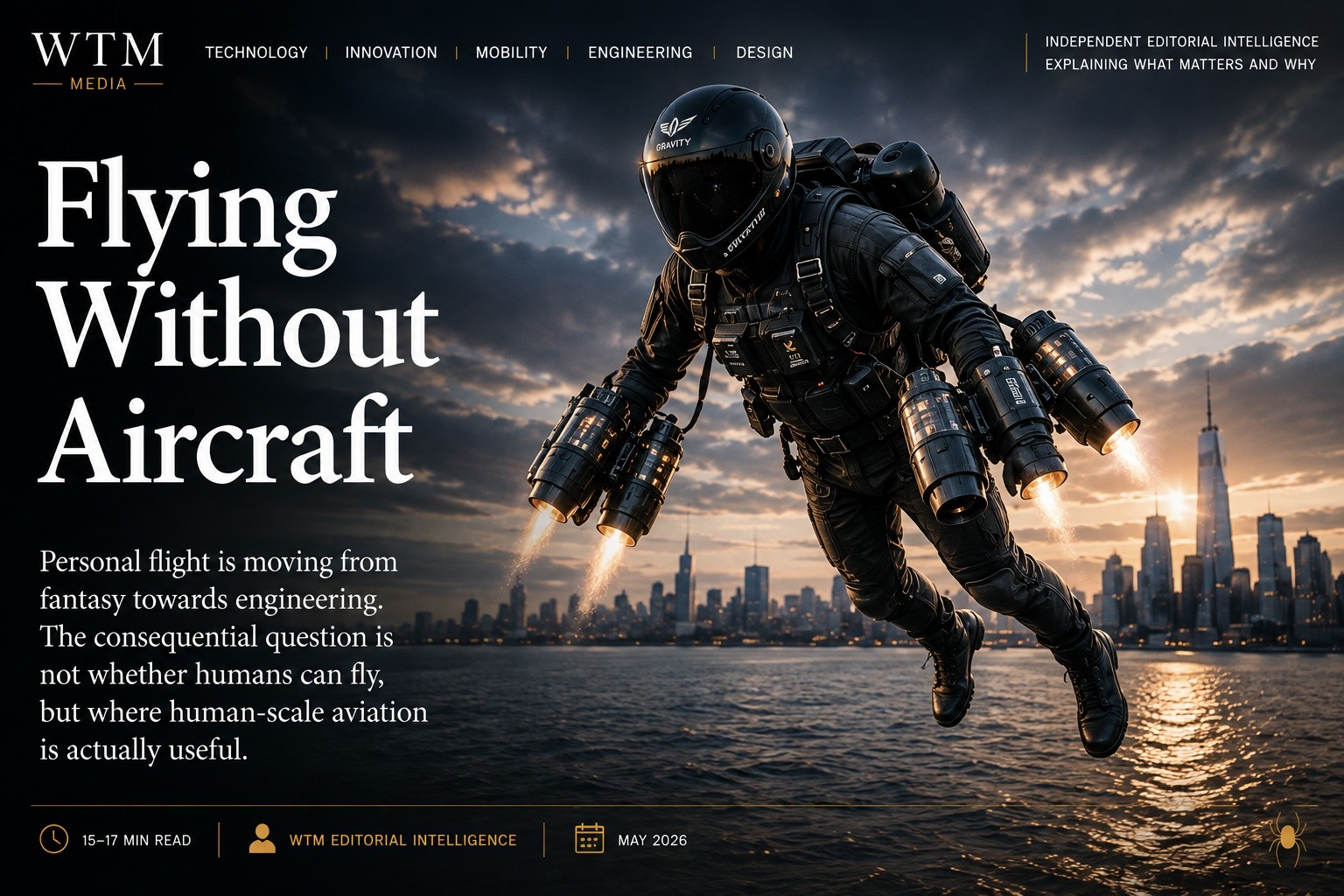
For most of aviation history, human flight has required an aircraft: a machine large enough to generate lift, carry fuel, accommodate passengers, and surround its occupants with an engineered structure. Emerging personal-flight technologies are beginning to loosen that relationship. Jet suits, powered wings, compact electric vertical-lift systems, autonomous drones, and increasingly sophisticated flight-control technologies suggest that aviation may eventually encompass machines worn, mounted, or summoned rather than conventionally boarded. The viral spectacle is irresistible. A person rises from the ground, accelerates over water, and appears to have acquired a superpower. Yet spectacle obscures the engineering. Human-scale powered flight confronts brutal constraints involving energy density, heat, noise, stability, endurance, payload, weather, redundancy, training, regulation, and the consequences of mechanical failure. A technology can fly successfully and still be unsuitable for mass transportation. That distinction is central to understanding personal aviation. The most plausible near-term applications are unlikely to involve commuters casually flying between homes and offices. Specialist environments — emergency response, defence, offshore infrastructure, inaccessible terrain, inspection, rescue, and certain industrial operations — provide a more credible pathway because the economic value of reaching somewhere quickly can outweigh the technology’s considerable limitations. The deeper development, however, extends beyond jet suits. Aviation is becoming computational. Sensors can stabilise machines faster than human reflexes. Software can continuously adjust thrust. Lightweight materials reduce mass. Autonomous navigation increasingly separates piloting from constant manual control. Electric propulsion enables aircraft configurations that would have been impractical under traditional mechanical architectures. The result is not necessarily the death of the aeroplane. Commercial aircraft remain extraordinarily efficient at moving large numbers of people over long distances. Instead, aviation may be fragmenting into a richer ecosystem: aircraft for distance, drones for autonomous logistics, eVTOL systems for specialised regional movement, and wearable or highly compact systems for particular human-scale missions. The important question is therefore no longer simply, “Can a person fly without an aeroplane?” We already know that certain machines can make that possible. The better question is: when does removing the aircraft make flight more useful?