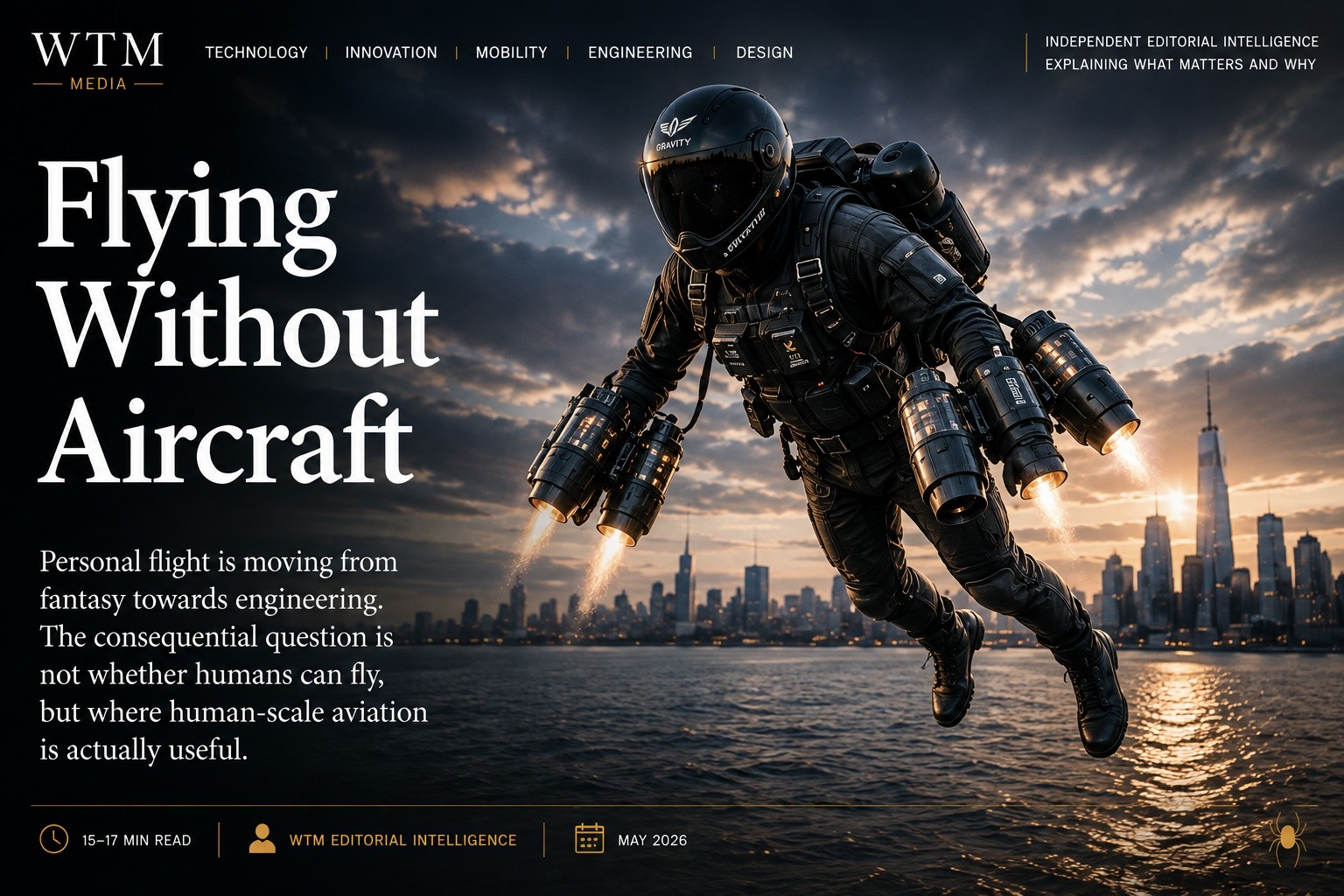
For most of aviation history, human flight has required an aircraft: a machine large enough to generate lift, carry fuel, accommodate passengers, and surround its occupants with an engineered structure. Emerging personal-flight technologies are beginning to loosen that relationship. Jet suits, powered wings, compact electric vertical-lift systems, autonomous drones, and increasingly sophisticated flight-control technologies suggest that aviation may eventually encompass machines worn, mounted, or summoned rather than conventionally boarded. The viral spectacle is irresistible. A person rises from the ground, accelerates over water, and appears to have acquired a superpower. Yet spectacle obscures the engineering. Human-scale powered flight confronts brutal constraints involving energy density, heat, noise, stability, endurance, payload, weather, redundancy, training, regulation, and the consequences of mechanical failure. A technology can fly successfully and still be unsuitable for mass transportation. That distinction is central to understanding personal aviation. The most plausible near-term applications are unlikely to involve commuters casually flying between homes and offices. Specialist environments — emergency response, defence, offshore infrastructure, inaccessible terrain, inspection, rescue, and certain industrial operations — provide a more credible pathway because the economic value of reaching somewhere quickly can outweigh the technology’s considerable limitations. The deeper development, however, extends beyond jet suits. Aviation is becoming computational. Sensors can stabilise machines faster than human reflexes. Software can continuously adjust thrust. Lightweight materials reduce mass. Autonomous navigation increasingly separates piloting from constant manual control. Electric propulsion enables aircraft configurations that would have been impractical under traditional mechanical architectures. The result is not necessarily the death of the aeroplane. Commercial aircraft remain extraordinarily efficient at moving large numbers of people over long distances. Instead, aviation may be fragmenting into a richer ecosystem: aircraft for distance, drones for autonomous logistics, eVTOL systems for specialised regional movement, and wearable or highly compact systems for particular human-scale missions. The important question is therefore no longer simply, “Can a person fly without an aeroplane?” We already know that certain machines can make that possible. The better question is: when does removing the aircraft make flight more useful?


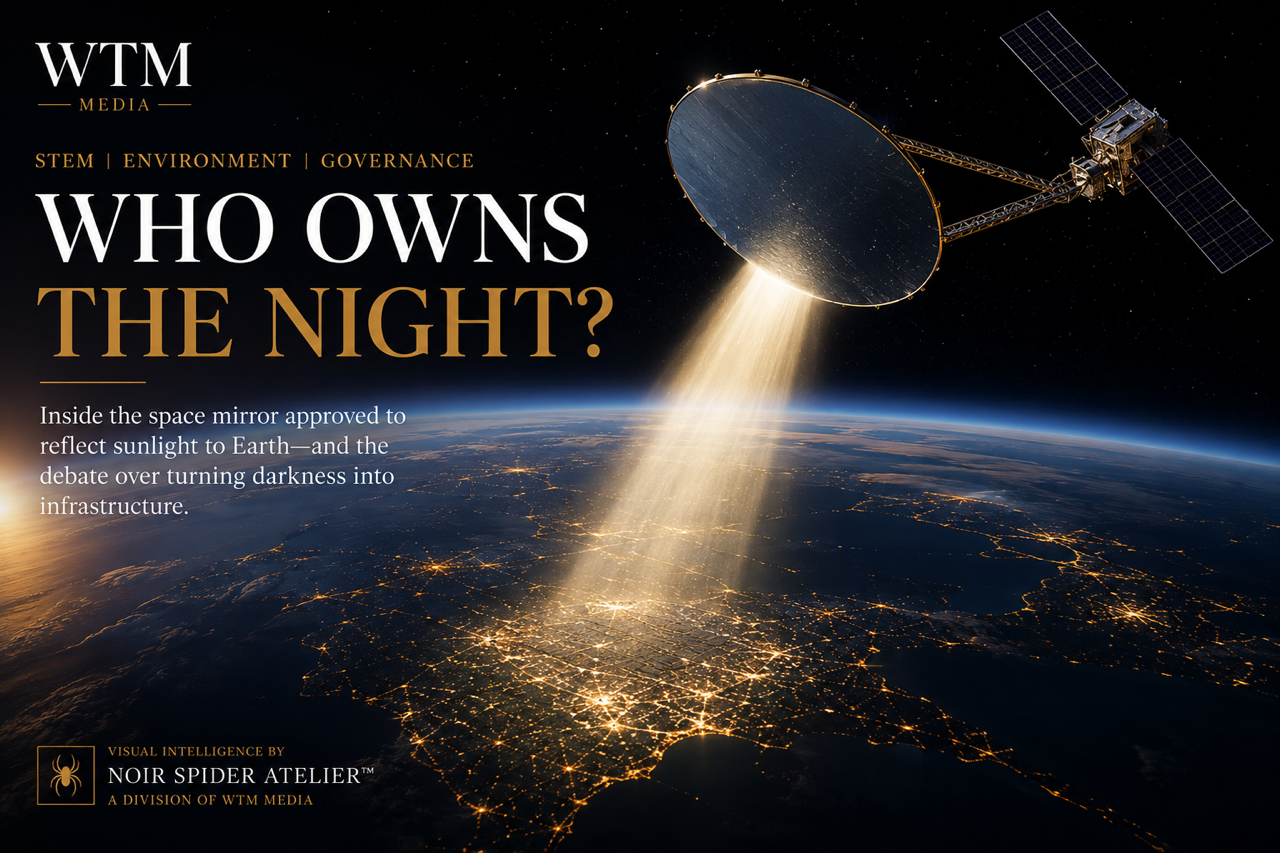
On 9 July 2026, the United States Federal Communications Commission granted Reflect Orbital conditional authority to deploy and operate Eärendil-1, a single experimental satellite designed to test whether a steerable, 18-metre reflector can redirect sunlight towards a targeted area on Earth after sunset. Supporters see a new form of infrastructure: controllable natural light that could extend solar-energy production, support emergency operations, and illuminate remote sites without installing poles, cables, or generators. Astronomers, dark-sky advocates, environmental organisations, and public-health specialists see a different possibility: a commercial precedent for altering a planetary condition that no company created, no nation owns, and countless species require. The immediate experiment is small. The question beneath it is not. Once darkness can be scheduled, directed, sold, and delivered from orbit, night ceases to be merely the absence of daylight. It becomes a governed resource. This is therefore not simply a story about an inventive satellite. It is a test of whether regulation can keep pace when commercial technology begins redesigning the natural environment itself.

For nearly four billion years, evolution operated according to a single principle: biological organisms adapted to changing environments through natural selection. Humanity may now be approaching the end of that era. Artificial intelligence, robotics, quantum computing, neural interfaces, biotechnology, and human augmentation are converging into a technological ecosystem unlike anything previously observed in evolutionary history. The significance extends beyond innovation. For the first time, a species has acquired the capacity to redesign itself. The next evolutionary transition may not emerge through genetics alone but through integration—human cognition enhanced by machine intelligence, biological systems connected to digital networks, and autonomous technologies capable of learning, adapting, and collaborating alongside their creators. The result may not be an improved version of Homo sapiens. It may be something fundamentally different. The question is no longer whether humanity will change. The question is whether humanity recognises that a new species may already be emerging.

Every breakthrough begins long before the breakthrough itself. Before a vaccine saves lives, before a new material reshapes industry, before artificial intelligence transforms work, someone simply became curious. They asked a question that everyone else overlooked. Human progress is rarely born from certainty. It begins with disciplined curiosity. Science is therefore not merely the production of knowledge; it is the systematic pursuit of better questions. Every laboratory, university and research institution exists because curiosity, when protected and cultivated, eventually becomes innovation. The distance between a question and its answer may span years or even decades, but history repeatedly demonstrates that one person’s search for understanding can become another person’s opportunity, safety or survival.

The discovery of a previously undocumented blue octopus near the Galápagos Islands offers more than biological intrigue. It provides a rare glimpse into one of evolution’s most extraordinary experiments in intelligence. Unlike mammals, birds, or primates, octopuses evolved sophisticated cognition along an entirely separate evolutionary pathway, demonstrating that intelligence is not a singular destination but a recurring solution to environmental complexity. Their ability to solve problems, manipulate objects, camouflage instantaneously, navigate uncertainty, and adapt to rapidly changing conditions challenges long-held assumptions about the nature of thought itself. At a moment when humanity is building artificial intelligence systems capable of increasingly sophisticated behaviour, the octopus serves as a reminder that intelligence emerges not from a single blueprint, but from the relentless pressures of adaptation. The discovery is not merely about a new species. It is about expanding humanity’s understanding of what intelligence can become.