A flying umbrella sounds like the sort of invention engineered primarily for social-media virality. A canopy hovers above its user, follows as they walk, and removes the small inconvenience of holding something over one’s own head. Charming, certainly. Civilisational breakthrough? Not quite. But the machine is interesting for precisely the reason the umbrella itself is not. The experimental system associated with Canadian engineer John Tse points towards a much larger design transition: robots are beginning to leave the category of objects we deliberately operate and enter the environment around us as responsive infrastructure. The umbrella is merely an unusually legible prototype of that future. Robotics has traditionally announced itself. Industrial robots occupy cages. Domestic robots are recognisable appliances. Drones require pilots, applications, controllers, or predefined missions. The next generation will increasingly sense context, understand intent, maintain spatial relationships, and act with less explicit instruction. A machine that knows where you are, understands that its purpose is to remain above you, and continuously adjusts itself as you move represents a rudimentary version of ambient robotics. That transition is being enabled by the convergence of computer vision, depth sensing, artificial intelligence, lightweight propulsion, localisation, batteries, edge computing, and increasingly capable autonomous-control systems. None is revolutionary in isolation. Their combination changes the relationship between people and machines. The profound question, therefore, is not whether anybody needs a flying umbrella. It is what happens when the physical world begins to follow, anticipate, reposition, and respond to us.
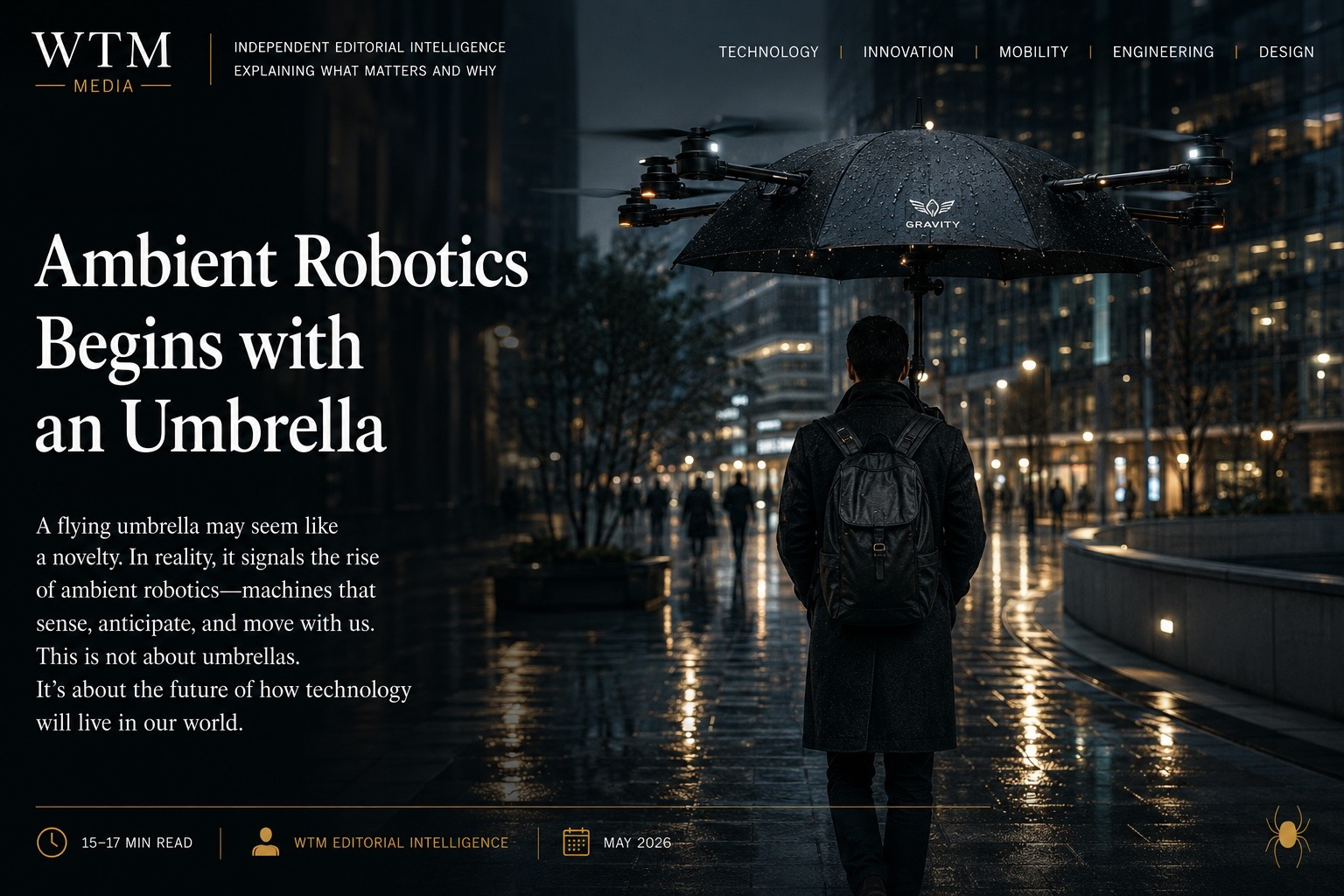
The umbrella has survived centuries of technological progress because it solves a wonderfully simple problem with almost insulting efficiency. Fabric, ribs, shaft, handle: done. It requires no battery, software update, satellite connection, operating system, or venture-capital pitch deck. Replacing the human hand with an autonomous flying platform is therefore difficult to defend on efficiency alone. Sometimes the stick wins.
That is precisely why the experiment deserves attention. Radical technologies often appear first in applications that seem excessive because prototypes are not merely products; they are questions made physical. The flying umbrella asks whether an autonomous machine can perceive a moving person, maintain an appropriate position relative to them, adapt as that person changes direction, and perform a continuous physical service without being manually controlled.
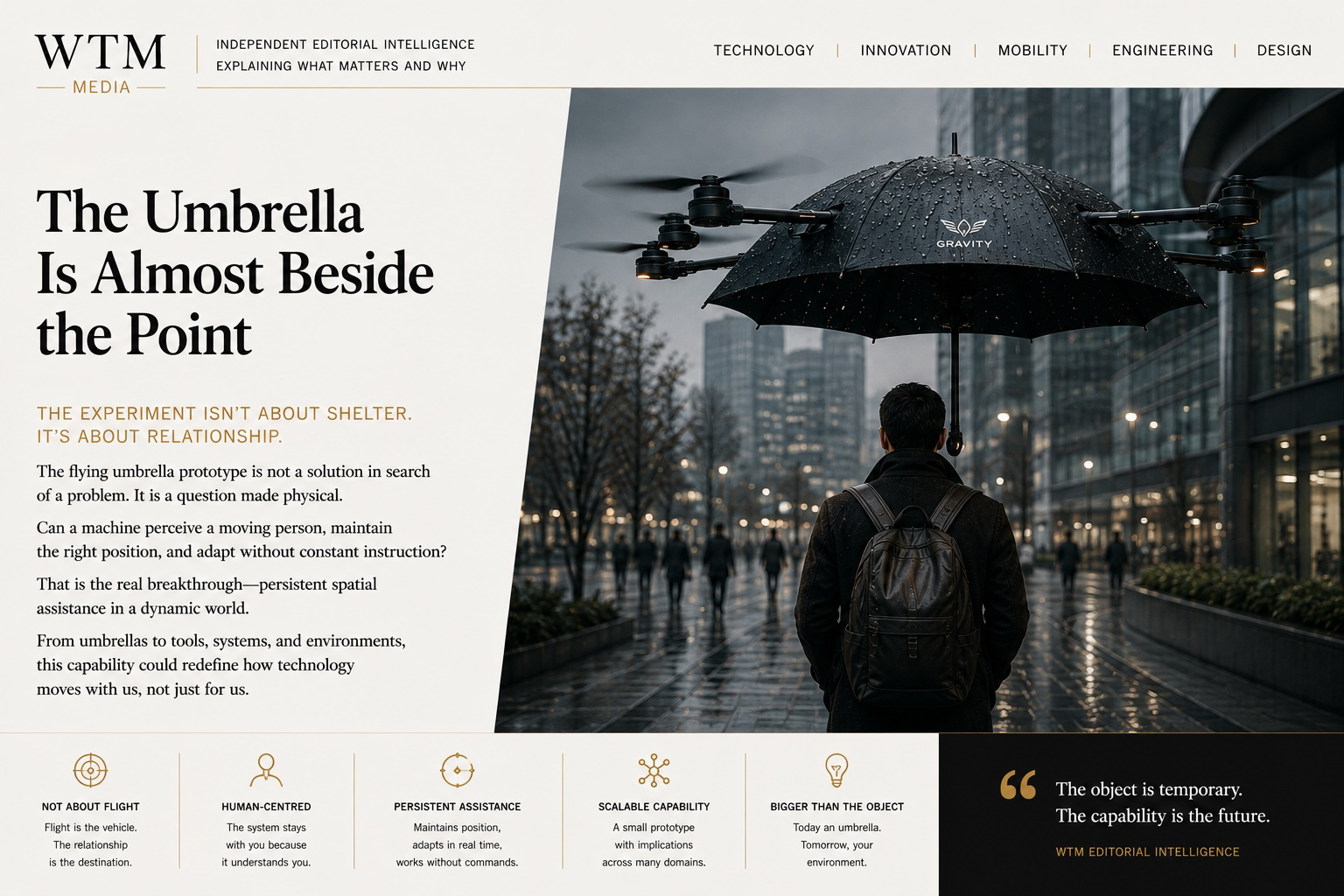
Once framed that way, the umbrella becomes considerably more consequential. The essential capability is not flight. Consumer drones already fly extraordinarily well. Nor is the important innovation shelter from rain or sun. The deeper capability is persistent spatial assistance: a machine remaining contextually connected to a human while both move through an unpredictable environment.
That is a different robotics problem from issuing a command and waiting for a machine to complete it. Traditional tools are passive until humans activate them. Many contemporary robots remain command-driven even when highly automated. Ambient robotics moves towards another relationship: the machine continuously interprets its surroundings and adjusts its behaviour without requiring repeated instruction.
Imagine transferring that principle away from umbrellas. A light follows a surgeon’s hands without being repositioned. A robotic carrier follows a construction worker across uneven terrain. A mobility aid anticipates the movement of an older person rather than merely responding after they move. A camera maintains useful positioning around an emergency responder. A temporary shade structure follows agricultural workers across a field. Suddenly, the slightly ridiculous umbrella becomes a prototype for an extremely serious interaction model.
Design history repeatedly rewards this kind of conceptual separation. The first version of a technology often attracts attention because of what the object is. The enduring value emerges from understanding what the system has learned to do. The flying umbrella matters only marginally as an umbrella. As a demonstration of machines learning to maintain useful relationships with moving humans, it becomes much harder to dismiss.
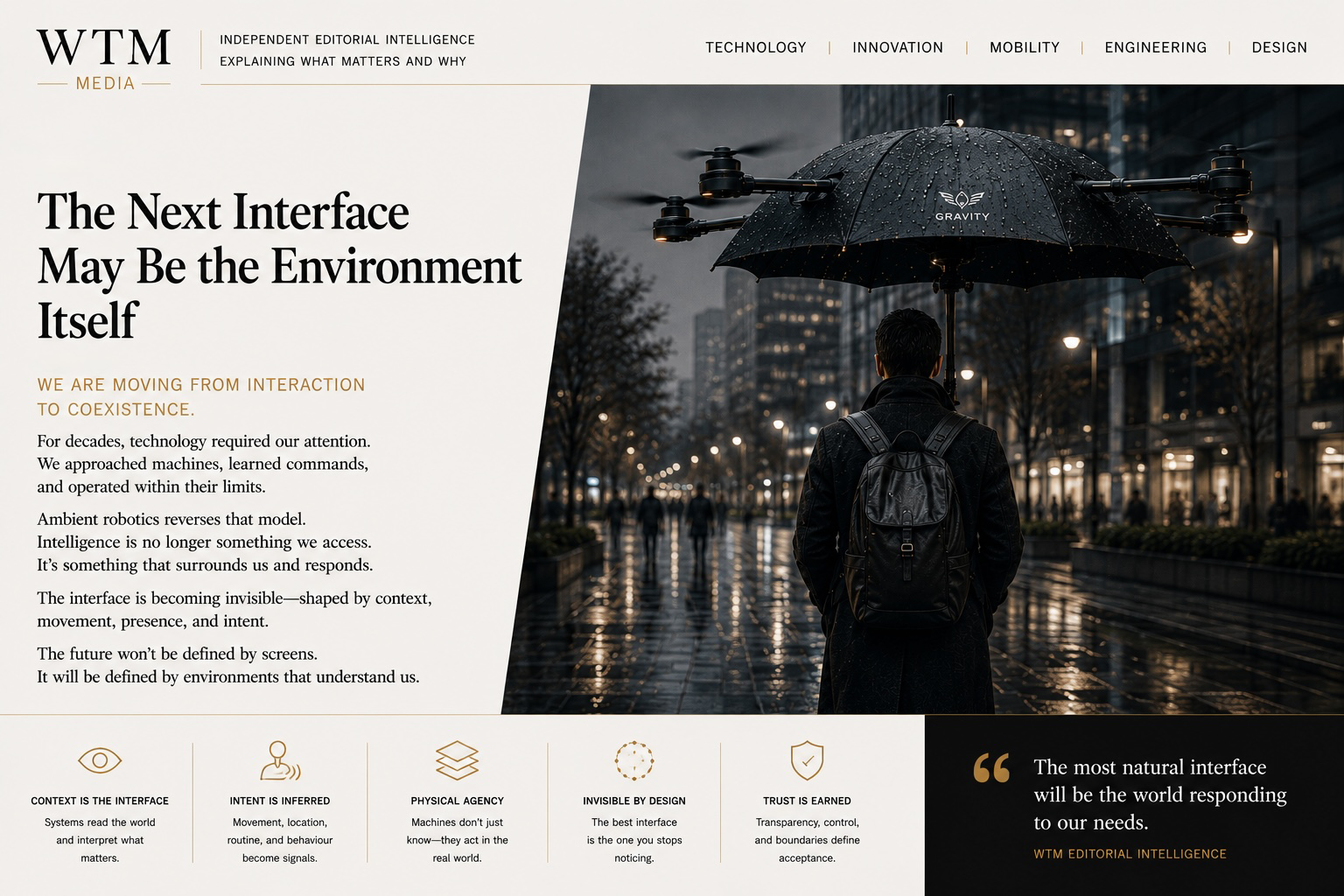
For decades, digital interaction has required humans to approach machines on their terms. We sat at keyboards, learned commands, clicked mice, tapped screens, downloaded applications, navigated menus, and memorised interfaces. Even smartphones, extraordinary though they are, require attention to migrate away from the physical environment and towards a rectangle of illuminated glass.
Ambient computing began challenging that arrangement. Sensors, smart speakers, connected buildings, wearable devices, and voice interfaces allowed computation to retreat from the foreground. Instead of sitting down at “the computer”, people increasingly interact with computing distributed throughout their surroundings. Robotics introduces physical agency into that same transition.
An ambient robot does not merely know something. It can alter the physical environment in response. That distinction is enormous. A thermostat senses temperature and adjusts a building system. An ambient robotic environment might also move partitions, reposition lighting, deliver objects, adjust furniture, transport materials, or physically accompany people according to changing circumstances.
For designers, this changes the meaning of interface. The interface no longer needs to be a screen. Distance can become an interface. Gesture can become an interface. Movement, gaze, location, routine, and environmental conditions can all provide signals from which intelligent systems infer what should happen next. The physical environment becomes computationally legible.
The engineering challenge is substantial because ambiguity increases as explicit commands disappear. If somebody presses a button labelled “close”, intent is relatively clear. If a robot infers that somebody probably wants a window closed because rain has started, confidence becomes part of the interaction. Intelligent environments therefore need not merely perception, but calibrated judgement about when to act, when to ask, and when to remain politely inert.
That last capacity may prove surprisingly important. The best ambient technology will not be the technology doing the most. It will be the technology that understands when intervention creates value. Human-centred automation requires restraint. A world filled with machines constantly anticipating incorrectly would not feel intelligent. It would feel like being followed around by several spectacularly incompetent butlers.
The transition from interface to environment consequently requires a new design discipline. We must stop asking only, “How does the person operate the machine?” and begin asking, “How should the machine behave around the person?”That is a subtler question involving psychology, architecture, robotics, ethics, accessibility, culture, and trust simultaneously.
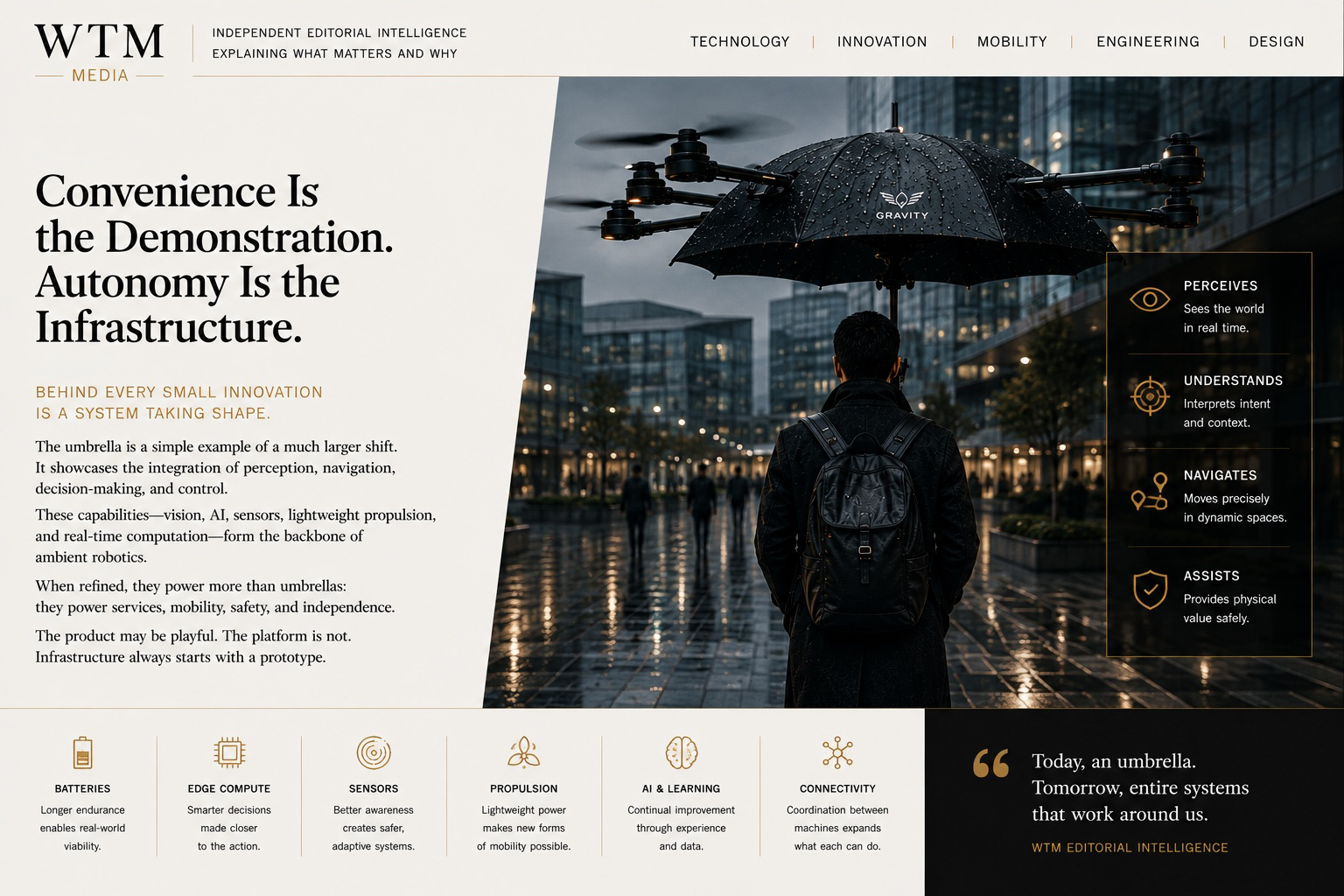
The most visible consumer robotics applications tend to emphasise convenience: vacuum the floor, mow the lawn, carry the groceries, follow the owner, deliver the package. Convenience sells because its value is immediately understood. Yet the underlying autonomous systems being developed for these modest tasks can become infrastructure for considerably more consequential applications.
Computer vision allows machines to recognise objects and interpret scenes. Depth sensors help establish three-dimensional relationships. Localisation systems determine where machines are relative to people and environments. Autonomous-control algorithms translate perception into movement. Edge computing enables decisions to occur locally rather than requiring every sensory input to travel to a remote server. Together, these capabilities allow machines to participate physically in dynamic spaces.
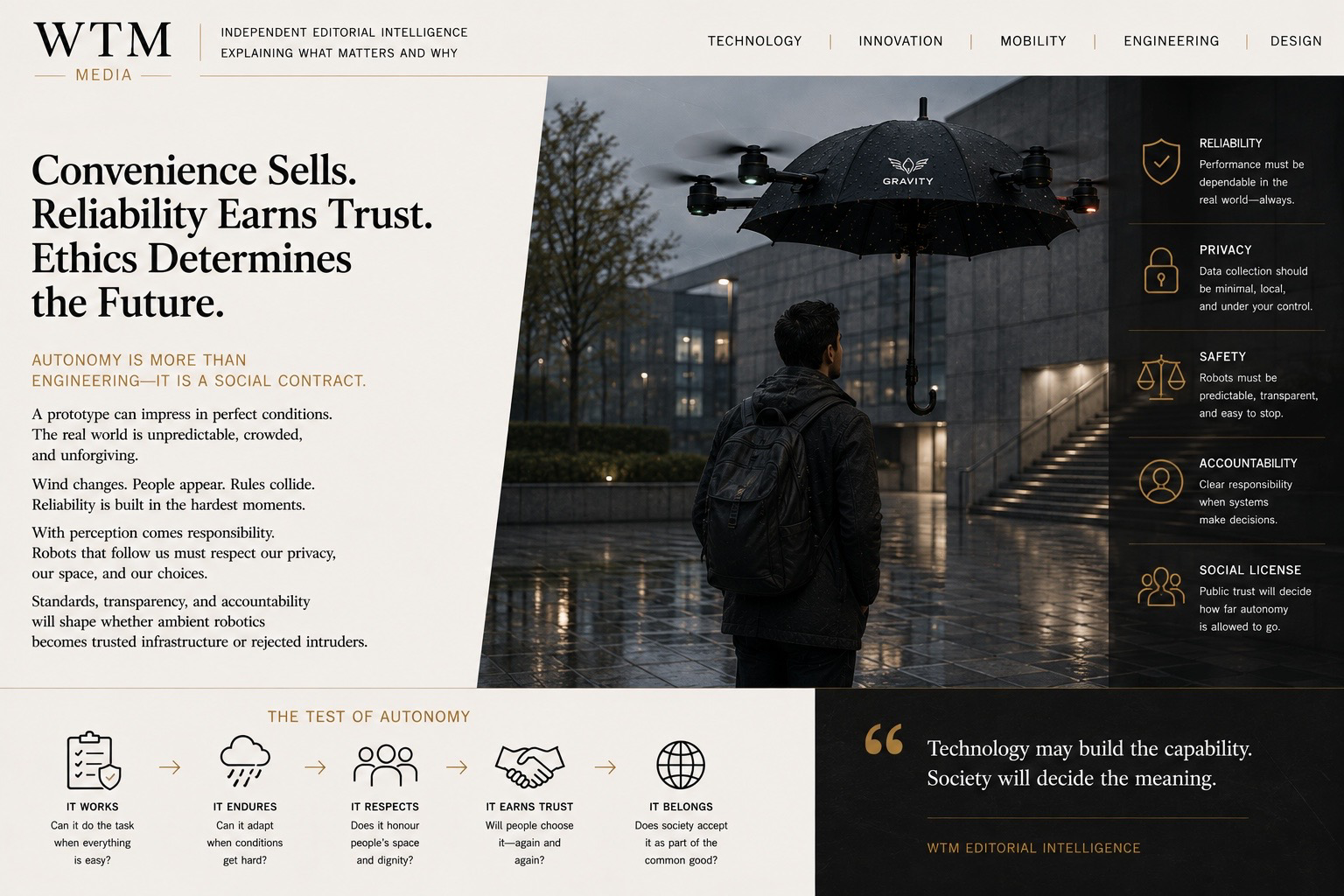
Reliability, however, is where demonstrations encounter reality. A flying umbrella functioning during a controlled experiment faces a different challenge from operating safely on a crowded pavement. Wind changes. Pedestrians appear. Trees, cables, buildings, vehicles, children, animals, and other machines occupy the same space. Rain can interfere with sensors and electronics. Battery performance changes. Communication can fail. The environment does not sign a contract promising to behave predictably.
The same problem confronts autonomous vehicles, delivery robots, warehouse systems, drones, and service robots. The final percentage points of reliability are often exponentially more difficult than the first impressive demonstration. A robot that succeeds 95 per cent of the time may be a remarkable laboratory achievement and an appalling public product. Physical autonomy requires a standard of trust that purely digital systems do not.
Privacy becomes equally structural. An ambient robot capable of following a person must perceive that person. Depending upon its architecture, it may process imagery, movement, location, proximity, or other environmental information. Once intelligent machines become persistent companions in public and private spaces, society must decide what they may sense, what they may retain, what they may infer, and who ultimately controls that information.
Ambient robotics will therefore advance through more than engineering. Standards, insurance, cybersecurity, accessibility, privacy law, public-space regulation, and social norms will determine whether these systems become trusted infrastructure or expensive nuisances. Autonomy is not simply a technical property. It is permission granted by a social system.
The first useful shift is conceptual: stop looking only for humanoid robots. Popular culture has trained us to recognise robotics through bodies — metallic people walking, speaking, carrying objects, or imitating human gestures. Yet many of the most consequential robots will not resemble us at all. They will resemble furniture, appliances, vehicles, building systems, tools, wearables, infrastructure, and perhaps umbrellas.
Second, watch for follow-me intelligence. The ability of a machine to maintain an appropriate relationship with a moving person has applications across healthcare, construction, logistics, hospitality, retail, accessibility, filmmaking, defence, agriculture, and domestic life. A system that can reliably follow may eventually learn to assist, carry, illuminate, protect, observe, guide, or collaborate.
Third, evaluate automation by friction removed rather than novelty added. A robotic product becomes valuable when it reduces physical effort, cognitive burden, danger, waiting, repetition, or dependence. Adding motors and artificial intelligence to an object does not automatically improve it. The conventional umbrella remains an excellent warning against technological vanity: sometimes automation solves a problem smaller than the automation itself.
Fourth, pay attention to accessibility. Ambient robotics may become particularly consequential for people whose bodies interact differently with conventional environments. Someone with limited mobility, impaired vision, reduced grip strength, or age-related physical constraints may derive substantially more value from responsive surroundings than an able-bodied early adopter seeking another gadget. Inclusive design can turn apparent convenience into genuine autonomy.
Fifth, demand legibility. People should understand what autonomous machines are sensing, why they are moving, what information they retain, how they can be stopped, and who is responsible when something fails. Physical AI cannot become a black box with propellers. Trust requires understandable behaviour, visible boundaries, and meaningful human authority.
The practical intelligence is straightforward: watch where robotics becomes boring. When autonomous behaviour disappears into ordinary objects and environments, adoption becomes more significant than spectacle. The technological revolution is mature not when everyone stares at the robot, but when people stop noticing that the robot is there.
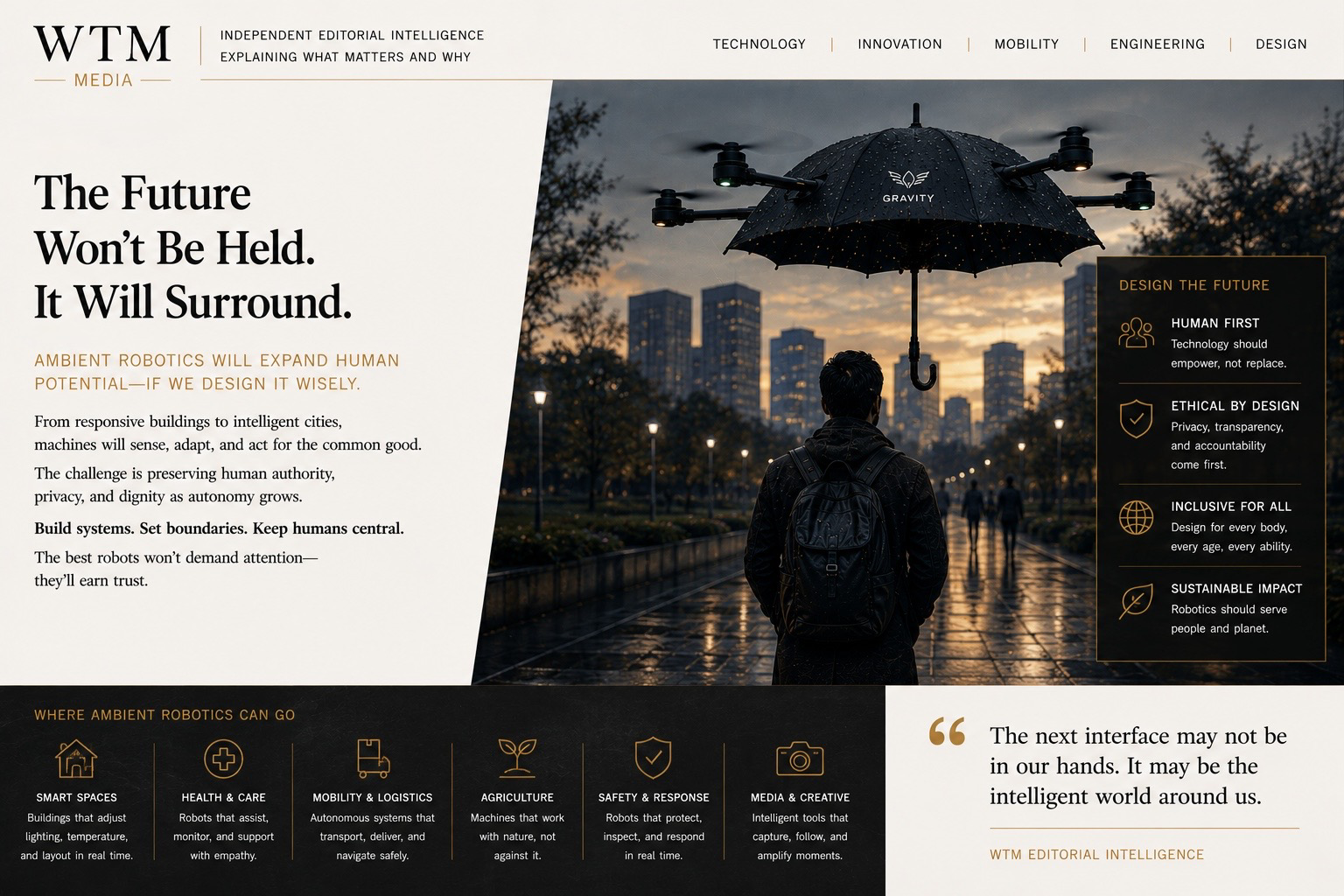
Every major computing transition has reduced the distance between intelligence and ordinary human activity. Mainframes required specialised rooms. Personal computers moved computation onto desks. Smartphones placed it in pockets. Wearables attached it to bodies. Ambient computing distributed it through homes, vehicles, and buildings. Robotics is beginning the next movement: giving distributed intelligence the capacity to act physically.
That progression changes design fundamentally. A building may no longer be merely a fixed arrangement of walls, furniture, lighting, mechanical systems, and circulation. It can become responsive architecture — sensing occupancy, adjusting conditions, repositioning components, assisting movement, managing resources, and learning patterns of use. Architecture and robotics begin to overlap.
The same convergence will occur across cities. Autonomous delivery systems, inspection drones, adaptive street infrastructure, robotic maintenance, mobility systems, responsive public spaces, and environmental sensing can collectively produce cities that behave less like static construction and more like dynamic systems. Whether those cities become humane or oppressive will depend upon decisions being made long before the technology becomes ordinary.
That is why seemingly whimsical prototypes deserve disciplined attention without exaggerated worship. The flying umbrella does not prove that umbrellas require disruption. It demonstrates that perception, autonomous flight, human tracking, and responsive behaviour can be assembled into an increasingly compact relationship between person and machine. The object is temporary. The capability can migrate.
And capabilities compound. Better batteries make robots more persistent. Better sensors make them more aware. Better AI makes them more interpretive. Better motors make them more capable. Better networks allow machines to coordinate. Better design makes their behaviour comprehensible. Each improvement may appear incremental, but systems change when increments begin reinforcing one another.
The central design challenge will be preserving human authority as machine initiative increases. Ambient robotics should expand human capability without quietly converting ordinary life into continuous surveillance or making people subordinate to inscrutable automated systems. Intelligence worthy of inhabiting our environments must understand not only how to act, but the boundaries within which it has permission to act.
Why this matters is larger than an umbrella. We are moving from a world in which humans operate machines towards one in which machines increasingly understand where we are, move alongside us, and respond to what is happening around us. The defining interface of the next technological era may not be something we hold at all. It may simply be the space around us becoming intelligent.
Visual Intelligence: Noir Spider Atelier™ — A Division of WTM Media
Editorial Direction: Kelly Dowd, MBA, MA
Copyright: © 2026 WTM Media. All rights reserved.

Why These Matter - WTM MEDIA is an independent editorial platform exploring the forces shaping our world—through people, culture, commerce, design, systems, and governance. Connecting the dots between today’s headlines and tomorrow’s realities.