
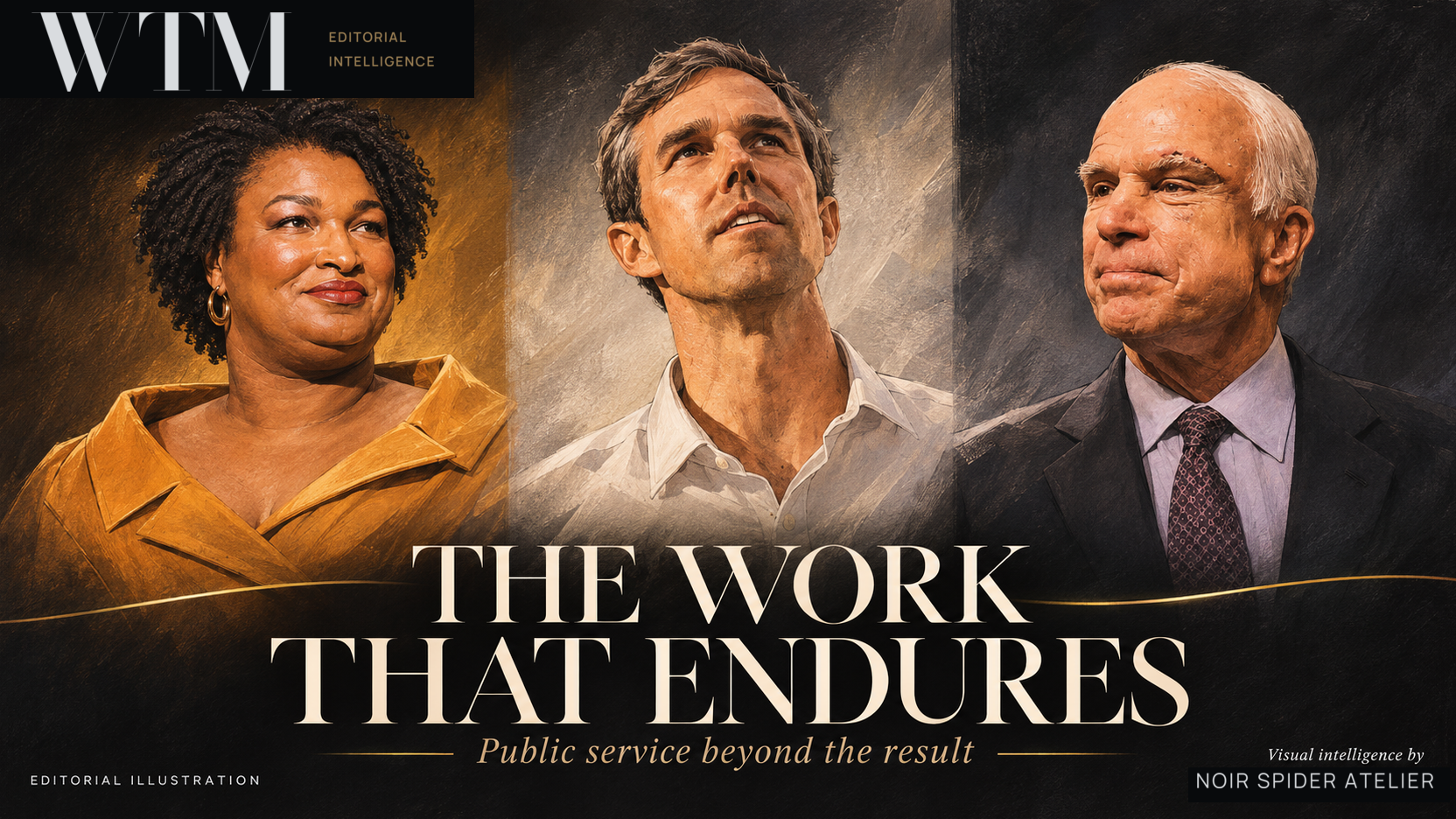
Electoral defeat can end a campaign without ending a contribution. Beto O’Rourke, Stacey Abrams and John McCain reveal why political legacies should be judged through decisions, consequences and the institutions that remain.
Beto O’Rourke Stacey Abrams and John McCain
WTM Media | Why These Matter
Electoral defeat can end a campaign without ending a contribution. Judging that contribution requires more than admiration: it requires attention to decisions, consequences and the institutions that remain.
Political memory prefers a single image. A candidate addressing a crowd. An organiser refusing to disappear after defeat. A senator confronting his own party.
Beto O’Rourke, Stacey Abrams and John McCain offer material for all three. Yet photographs compress careers that deserve a fuller reading. Each won elected office. Each also failed to win a higher office they sought. Their records raise a question that reaches beyond American politics: what makes public service valuable when ambition and electoral success diverge?
There is an immediate test of how seriously we approach that question. A social-media tribute to McCain, among the images that prompted this editorial, changes the wording of his farewell. The official statement warns against confusing “our nationalism with tribal rivalries”. The screenshot substitutes “patriotism” and omits “tribal”. It also presents the statement as a final attack on Donald Trump, although McCain never names him. Interpretation is legitimate; silently rewriting the source is not. McCain’s official farewell statement
That distinction should govern the wider assessment. Political affection can motivate inquiry. It should never replace it.

O’Rourke’s political foundations were local. Born in El Paso in 1972, he graduated from Columbia University, became a business owner, served on El Paso’s city council from 2005 to 2011 and represented Texas in the US House from 2013 to 2019. His career began well before his national visibility. US House historical biography
The 2018 Senate contest gave him a much larger audience. It also delivered a definite result: Republican Ted Cruz received 4,260,553 votes; O’Rourke received 4,045,632. Calculated from the official totals, their shares were approximately 50.89% and 48.33%, a gap of 214,921 votes. A close defeat remained a defeat. Texas secretary of state’s certified results
O’Rourke subsequently lost his 2022 campaign for Texas governor. These outcomes limit any claim that he converted national attention into a successful statewide governing mandate. They do not erase his earlier work. US House historical biography
The strongest evidence of his capacity for cooperation comes from congressional work on veterans. He collaborated with Republican Jodey Arrington on veterans’ transition to civilian life and with Republican Mike Coffman on mental-health provision for veterans with other-than-honourable discharges. The Texas Tribune’s examination also supplies a useful corrective to inflated achievement lists: 54 bills he sponsored or cosponsored became law, but only one with him as principal sponsor did so. Much of his contribution occurred through collective legislation. The Texas Tribune’s assessment of his bipartisan record This is less cinematic than a campaign rally, but more revealing of how minority-party legislators can influence government. Cooperation means finding a tractable problem, accepting shared ownership and securing something useful for people who need it.
His international outlook must be described with equal precision. In answers published by the Council on Foreign Relations during his presidential campaign, O’Rourke advocated rejoining the Iran nuclear agreement conditional on Iranian compliance, working with allies and combining engagement with China with pressure over human rights. These were proposed policies. They were never tested through an O’Rourke presidency. O’Rourke’s 2019 foreign-policy answers
His legacy therefore invites two different judgements. One concerns electoral strategy: why did prominence fail to produce statewide victory? The other concerns service: what did he accomplish in the offices he actually held? A serious account asks both.
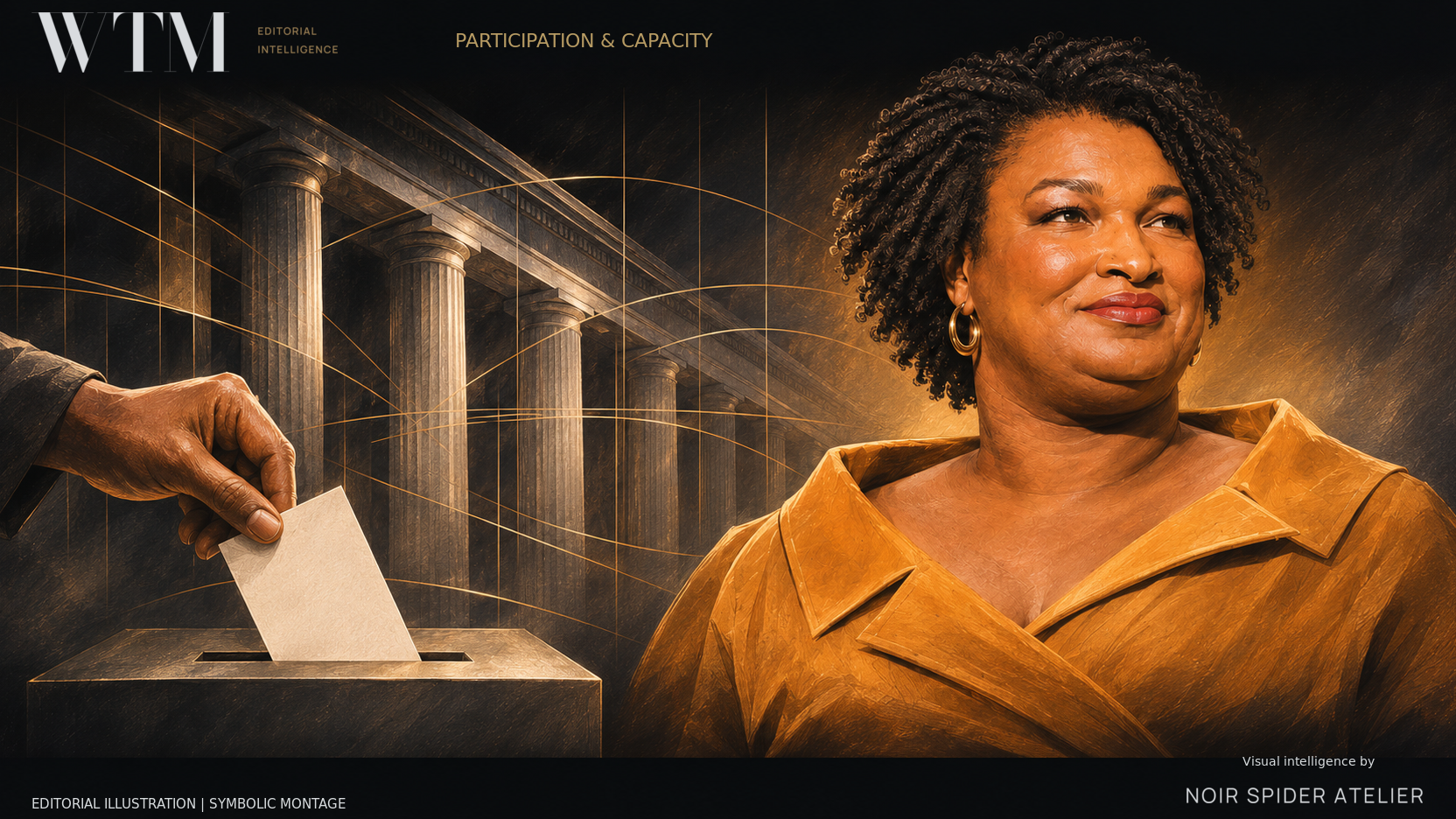
Abrams brought a different professional formation to politics. A tax attorney educated at Spelman College, the University of Texas’s LBJ School of Public Affairs and Yale Law School, she served eleven years in Georgia’s House of Representatives, seven as minority leader. In 2018, she became the first Black woman nominated for governor by a major US political party. National Democratic Institute biography Columbia’s Institute of Global Politics biography The nomination itself widened the historical field of representation. It did not confer executive authority: Brian Kemp defeated her in 2018 and again in 2022. Election record
Her legislative record complicates the idea that political conviction precludes bargaining. As minority leader, Abrams negotiated with Republican governor Nathan Deal over the HOPE higher-education funding programme. She also helped assemble opposition to a proposed tax restructuring, followed by a narrower bipartisan package. Governing’s contemporary profile The HOPE agreement also shows why “bipartisan” should begin an assessment rather than end it. The 2011 changes retained a scholarship tier without standardised-test requirements, but reduced its generosity. Full-tuition assistance under the Zell Miller scholarship carried higher academic and test-score thresholds. The compromise protected some access while imposing costs on students. Calling it simply a rescue omits the trade-offs. PolitiFact’s examination of the HOPE compromise
After her first gubernatorial defeat, voting access became central to her national role. She had founded the New Georgia Project in 2013 and later founded Fair Fight. Her organising belongs within a wider network of local groups, campaign workers and voters. Crediting one person with Georgia’s political changes would obscure that collective labour. Associated Press reporting on Georgia’s organising infrastructure
Her response to losing in 2018 also warrants care. Abrams acknowledged Kemp’s victory while refusing to describe her speech as a concession and challenging the fairness of the process. Neither saying she straightforwardly conceded nor implying that a court established she had won accurately captures the record. ABC News on her statements and the dispute In September 2022, a federal judge ruled for Georgia on all issues remaining at trial in the voting-rights lawsuit brought by Fair Fight Action and other plaintiffs. Some earlier claims had been resolved through legal changes or dismissed before trial. The judgement did not establish that Abrams had been deprived of a victory; nor should it be inflated into a universal finding that every concern about voting access was imaginary. Associated Press account of the ruling
There are institutional questions, too. In January 2025, the New Georgia Project and its affiliated action fund accepted a $300,000 fine for campaign-finance violations. Abrams had stepped down in 2017 and said she had no subsequent role. The consent decree contained no finding of improper coordination with her campaign. The organisations announced their closure in October 2025. These facts concern the durability and governance of institutions associated with her legacy; they should not be converted into unsupported allegations of personal misconduct. Associated Press on the fine Associated Press on the closures
Abrams’s international contribution is principally one of public argument and engagement rather than exercised national-security authority. At Chatham House in 2019, she discussed democracy and the political inclusion of groups whose experiences are often excluded from public debate. That is an international forum for ideas, not the equivalent of negotiating a treaty or directing foreign policy. Chatham House’s event and transcript Her lasting challenge is therefore institutional as much as electoral: can a movement turn attention into broad participation, and can its organisations sustain the standards, resources and trust that long-term work requires?

McCain’s public life operated on a different scale and over a longer period. A Naval Academy graduate and military pilot, he was a prisoner of war in Vietnam from 1967 to 1973. He served in the US House from 1983 to 1987 and the Senate from 1987 until his death in August 2018. He sought the Republican presidential nomination in 2000 and became the party’s nominee in 2008. Congressional biography Barack Obama defeated him in 2008, winning 365 electoral votes to McCain’s 173. His farewell later looked back on conceding that election as part of his service to the republic. The language matters because acceptance of defeat is one of the acts through which democratic institutions acquire legitimacy. National Archives election record McCain’s farewell
His reputation for working across party lines has concrete foundations. Campaign-finance legislation associated with McCain and Democratic senator Russ Feingold passed the Senate in 2002 by 60 votes to 40. Contemporary Senate announcement
His role in reconciliation with Vietnam is especially significant. When President Bill Clinton announced normalisation of diplomatic relations in July 1995, he explicitly credited McCain, John Kerry and other veterans for helping move the country beyond the conflict’s painful legacy. A former prisoner of war had used his authority to make engagement politically possible. He was part of a consequential collective effort. White House announcement of 11 July 1995
That record must sit beside his support for war in Iraq. McCain voted for the 2002 authorisation to use military force. Personal endurance and a capacity for reconciliation do not settle the merits of that decision. His foreign-policy legacy includes both. Official Senate roll call
The same discipline applies to his celebrated 2017 vote against the Affordable Care Act’s “skinny repeal”. McCain joined Republican senators Susan Collins and Lisa Murkowski and the Democratic caucus in defeating the proposal, 49–51. His vote was decisive, but so were theirs. A memorable gesture should not make the other participants disappear. NPR’s account of the vote
McCain’s example is strongest when it remains human: courageous, politically capable, sometimes independent and open to searching criticism. Turning him into an unblemished emblem would weaken the lesson.

These three careers cannot be placed on a single scale without qualification. McCain spent decades exercising federal power. O’Rourke’s record combines local government, congressional service and unsuccessful bids for higher office. Abrams’s combines state legislative leadership, electoral mobilisation and democracy advocacy. Their differences make the comparison useful.
First, office and influence should be distinguished. Winning an election grants authority that public attention cannot substitute for. Losing does not automatically nullify work already done.
Second, cooperation should be assessed through consequences. A handshake is evidence of contact. Legislation, services, access and implementation offer stronger evidence of achievement. Even then, compromise can distribute costs unevenly.
Third, democratic credibility requires consistency. Leaders deserve scrutiny over their response to defeat, their factual claims and the conduct of organisations associated with them. Supporters should not suspend those standards when the subject is someone they admire.
Finally, international seriousness requires a distinction between experience, advocacy and authority. A senator’s vote for war, a presidential candidate’s policy proposal and a state leader’s speech to an international audience are different forms of political action. Their consequences and evidentiary weight differ.
For WTM, the value of this comparison lies in the quality of judgement it invites. O’Rourke directs attention towards practical service beneath national visibility. Abrams directs it towards participation and the institutions needed to sustain it. McCain directs it towards the relationship between conviction, cooperation and responsibility for consequential decisions. A worthwhile political legacy leaves citizens with more than a figure to celebrate. It leaves them better equipped to judge the next person who asks for power.

For readers, the immediate value of these careers is a more reliable way to decide what deserves their trust. Before sharing a political tribute, follow its quotation to the original source and check what has changed. The altered wording of McCain’s farewell shows how a small substitution can reshape an argument. Keeping the source intact allows readers to debate its meaning without passing on a claim the speaker did not make.
When the next candidate asks for support, separate the office sought from the work already completed. O’Rourke’s close Senate defeat and later gubernatorial loss answer questions about electoral success; his congressional work on veterans answers a different question about service. Readers can use that distinction to ask candidates for specific achievements, their own role in securing them and the limits of what those achievements demonstrate.
Policy promises become easier to assess when readers ask who benefits, who bears a cost and what changes in practice. Abrams’s HOPE compromise offers a concrete example: retaining a route to scholarship assistance mattered, but reduced generosity and the requirements for full-tuition support mattered too. The useful habit is to examine the terms of a compromise before accepting its campaign description, especially when those terms may affect a household’s access to public support.
The comparison also helps readers recognise the people and institutions behind a celebrated result. O’Rourke’s veterans legislation involved colleagues; Georgia’s organising involved a wider network; the defeat of the 2017 healthcare repeal depended on a coalition. Looking beyond the most memorable figure makes it easier to identify whose work merits attention, which partnerships produced a result and what would need to remain in place for similar work to continue.
For anyone deciding where to give time, money or public support, institutional scrutiny is part of responsible participation. The New Georgia Project’s fine and eventual closure make governance and durability relevant questions, while Abrams’s earlier departure and the limits of the consent decree require care in assigning responsibility. Readers can ask an organisation how it manages resources and accountability without turning an association with a public figure into an unsupported allegation against that person.
Finally, these records give readers a way to compare political arguments without treating every kind of experience as interchangeable. McCain’s war vote, O’Rourke’s foreign-policy proposals and Abrams’s international engagement carried different responsibilities and consequences. Asking what authority someone actually exercised, what evidence supports their claims and how they handled the results makes the next endorsement, donation or vote a more considered choice. Admiration can remain part of political life while judgement rests on the record.
Visual provenance: WTM Visual Intelligence · Noir Spider Atelier. The accompanying visuals are AI-generated symbolic editorial montages. They do not depict documentary events or imply endorsements by the people portrayed
Why These Matter - WTM MEDIA is an independent editorial platform exploring the forces shaping our world—through people, culture, commerce, design, systems, and governance. Connecting the dots between today’s headlines and tomorrow’s realities.

article-support-3
Noir Spider Atelier

article-support-2
Noir Spider Atelier

article-support-1
Noir Spider Atelier

press-partnership
Noir Spider Atelier
press-reader-desk
Noir Spider Atelier

resource-access
Noir Spider Atelier
membership-example
Noir Spider Atelier

membership-tools
Noir Spider Atelier

membership-reader
Noir Spider Atelier
membership-public
Noir Spider Atelier
pathway-design
Noir Spider Atelier
pathway-institutions
Noir Spider Atelier
pathway-technology
Noir Spider Atelier