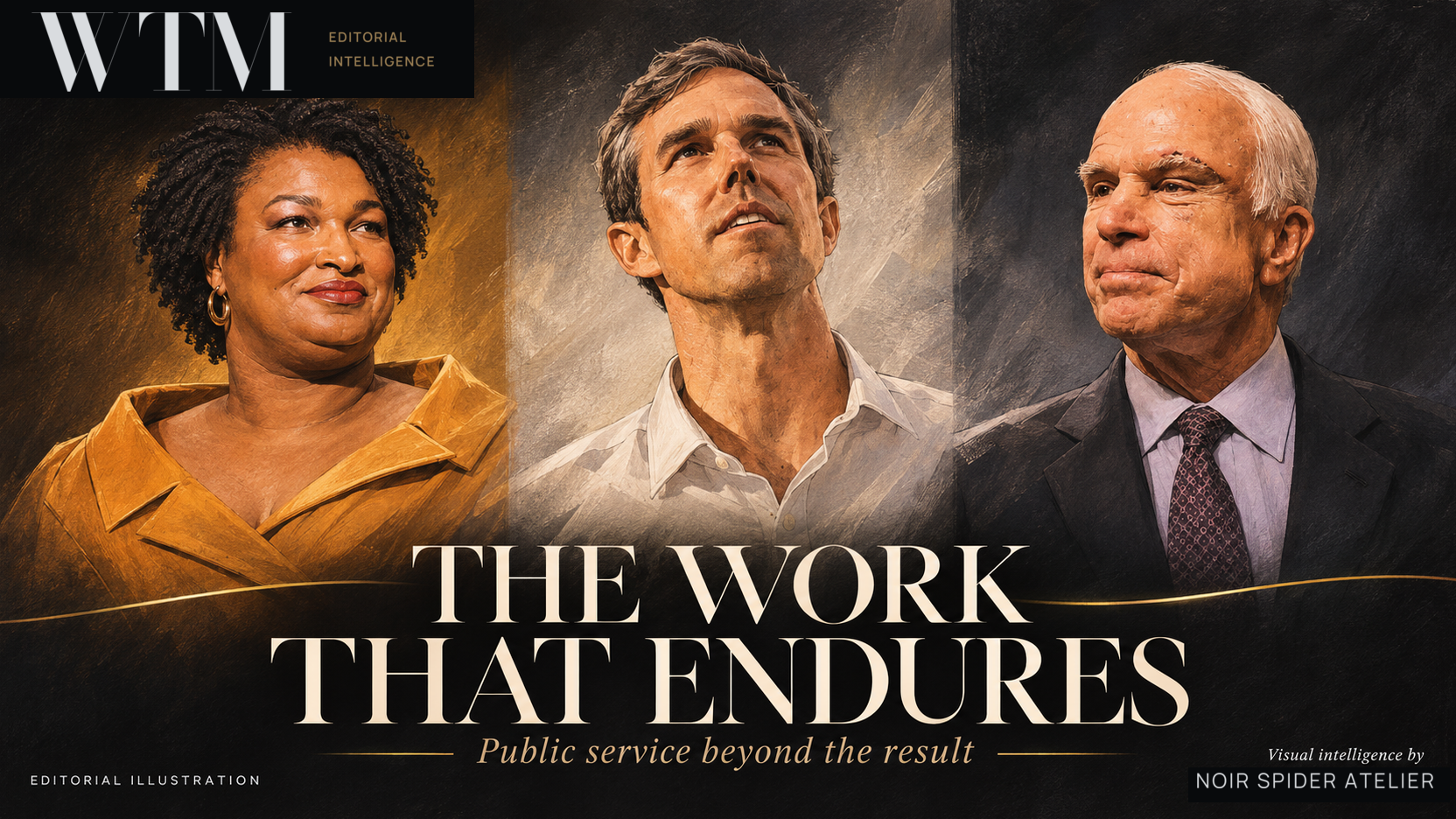

The 2026 election’s historic breakthroughs pose a practical test: can broader representation become shared public value? WTM examines the pathways into office, the authority leaders actually hold, and the responsibilities that turn a more diverse leadership class into accountable government. The next test arrives through decisions, public services and household costs.
WTM Systems Intelligence · Reporting cutoff: November 5, 2026, including CAWP’s 8:50 a.m. Eastern update. Election calls are media determinations, not official certification. Incoming offices and 2027 service are distinguished from offices already held. Refresh changing results before publication.
American leadership has never widened in a straight line. Nellie Tayloe Ross took office in Wyoming on January 5, 1925, becoming the first woman to serve as a state governor. More than a century later, a new record still commands national attention. That distance between a first breakthrough and broader access should sharpen our understanding of progress. A door can open for one person long before the route through it becomes ordinary for others. National Governors Association: Nellie Tayloe Ross.
The present milestone deserves precision. CAWP’s November 5 tally puts the incoming total at at least 17 women governors, or 34 percent: 15 elected this year and two continuing their terms. Fourteen are Democrats and three Republicans. This is a record number expected to serve simultaneously, rather than 17 newly elected governors. The distinction matters because political systems are shaped by continuity as well as turnover. An election changes part of the leadership structure while carrying much of the existing structure forward. CAWP’s current results.

The Senate supplies an important counterpoint. CAWP records 23 women assured of seats in the next Congress, with two women still in unresolved races, compared with 27 women currently serving. Even the higher possible outcome would represent a decline. A national story of progress therefore needs more than a single celebratory total. Gains at the executive level can coexist with losses in legislative representation, where different powers, career routes and electoral conditions apply. CAWP’s current results.
Party differences are part of this picture. CAWP’s initial analysis finds that Republican women’s representation will fall in Congress and statewide executive office even as Democratic women reach new records. That pattern raises different questions for the two parties. Democrats must demonstrate that an expanded leadership bench can govern effectively. Republicans must examine the opportunities they offer women to enter, compete and advance. Neither task is answered by treating women as a unified voting bloc or assuming that female officeholders share policy priorities. CAWP’s November 4 analysis.
WTM’s systems perspective begins before the ballot. Recruitment determines who is encouraged to run. Financing affects who can remain competitive. Party endorsements shape visibility. Professional networks influence access to experienced staff. Electoral rules establish the route into office. A responsible examination of this election asks which of those pathways became more accessible and which remain difficult. The results identify who passed through the system. Explaining why requires more evidence than the winners’ identities alone can provide.
That restraint is especially important when interpreting the public. One election cannot tell us that Americans have settled their arguments about gender, religion or belonging. Nor can a statewide victory establish that every supporter voted for the same reason. Economic pressure, candidate quality, local interests, party loyalty and constitutional concerns may intersect differently for different voters. The defensible conclusion is narrower and still significant: these candidates have demonstrated electoral possibilities that future candidates, parties and communities will now have to take seriously.
Governorships matter because they carry practical authority. Governors propose budgets, sign or veto legislation, make appointments and direct executive administration, within powers that differ by state. Those responsibilities connect leadership to the institutions people encounter every day. They also place limits on the idea of an all-powerful individual. Legislatures, courts, other elected officers and administrative systems shape what a governor can accomplish. A record in representation becomes consequential through those relationships, where ambitions meet law, money and execution. National Governors Association: governors’ powers and authority.
The potential contribution of a more varied leadership group is concrete. Someone who has navigated an inaccessible service may recognize a problem that a briefing overlooks. Experience in rural communities may expose a gap hidden by a statewide average. Familiarity with small employers, caregiving or public health may change which questions are asked. These are possible advantages of experience, not qualities automatically produced by an identity. Institutions benefit only when relevant knowledge reaches decisions and can be tested against evidence.

Representation should therefore be examined alongside influence. Who writes the first budget proposal? Who chairs the meeting where priorities are narrowed? Which advisers can challenge a preferred answer without losing access? Who has authority to correct a failed rollout? A leadership group may look more representative while its decisions remain concentrated in a narrow circle. Conversely, a leader can widen participation through appointments, consultation and transparent procedures. The important unit of analysis is the decision process, including who can meaningfully change its outcome.
The transition into government offers an early opportunity to assess that process. Appointments should be judged on experience, integrity, relevant perspectives and the responsibilities of the role. Public commitments should identify funding, legal authority and a plausible route to implementation. Procurement should expose conflicts of interest. Performance reports should show failures as clearly as achievements. These are standards every administration can be asked to meet. Applying them consistently prevents historic status from becoming either a protective shield or an excuse for a harsher test.
Economic trade-offs will make these standards tangible. A government may promise lower costs while facing competing demands for infrastructure, staffing and fiscal stability. An attractive benefit can be undermined by a difficult application process or a shortage of providers. A tax reduction can help some households while changing the resources available for shared services. Each proposal should make its distribution visible: who gains, who pays, when the change begins and what could prevent delivery. Good intentions do not remove those questions.
Equal standing also has value that cannot be reduced to an economic scorecard. People should not have to prove that their inclusion raises growth before they are entitled to compete for public office. The case for equal citizenship and the case for competent government reinforce each other, but neither should be made conditional on a group’s collective performance. A democracy can celebrate a wider range of leaders while holding each individual responsible for the decisions they actually control.
Michigan’s Senate result brings that principle into sharp focus. The Associated Press has called the race for Democrat Abdul El-Sayed over Republican Mike Rogers. AP identifies El-Sayed as the first Muslim elected to the U.S. Senate. The seat remains Democratic following Gary Peters’ retirement; it is a historic change in representation, not a party flip. Official certification is still a separate step: Michigan says its state canvassers must vote to certify results by November 23. AP reporting via KSL; Michigan Department of State.
The history should be described accurately. Keith Ellison was the first Muslim elected to Congress and entered the House in 2007, as the Library of Congress records. The Senate milestone concerns a different chamber, with a different statewide electorate and constitutional role. Article VI already prohibits a religious test for federal office. El-Sayed’s projected victory does not create that principle. It gives it a new and highly visible expression in an institution that had not previously included a Muslim member. Library of Congress: Solemn Oaths; U.S. Constitution, Article VI.

El-Sayed connected the identity debate to daily economic concerns in his victory remarks, saying that “my name and my faith are not why you can't afford your gas.” The line makes a political argument rather than establishing an economic diagnosis. Its useful challenge is to direct scrutiny toward the causes of public problems and the merits of proposed solutions. A candidate’s religion cannot substitute for examining a healthcare plan, a spending commitment or the consequences of a foreign-policy position. AP reporting via KSL.
A voter can oppose El-Sayed’s policy agenda, challenge his judgment or demand better explanations without questioning whether a Muslim belongs in the Senate. Supporters should be equally willing to scrutinize his record once he has one in office. The same standard belongs to Christian, Jewish, Hindu, atheist and other candidates. Protecting equal access requires room for vigorous disagreement. It also requires recognizing the difference between criticism of a person’s decisions and a claim that their identity disqualifies them from public life.
Historic firsts carry an additional, often unreasonable burden: one person can become a stand-in for millions of people who did not choose their views and cannot direct their conduct. No senator can represent every member of a religion, and no woman governor can speak for all women. Journalists, political parties and citizens have a responsibility to resist that compression. A leader’s achievement can widen the public imagination without turning the leader’s future success or failure into a verdict on an entire community.
The obligation of office runs in the other direction. An elected official must serve constituents who voted against them, residents who could not vote and communities with competing needs. For El-Sayed, that means the same public-service test that applies to his colleagues: serious legislative work, accessible constituent assistance, transparent conduct and accountability for promises. The historic significance of his projected victory deserves recognition. The work that follows will determine what that new presence contributes to the institution and to Michigan.
Collective diversity describes a public that contains many kinds of experience at once. Gender, race and religion matter, alongside geography, disability, income, generation, occupation and political belief. Those experiences overlap within individuals rather than arranging themselves into tidy camps. A rural business owner may also be a caregiver. A veteran may be an immigrant. A young voter may hold conservative views on one issue and progressive views on another. Governing well begins by making space for that complexity instead of reducing people to a single electoral label.
Shared responsibility begins with a practical discipline: listen closely enough to understand a disagreement, then make the decision process intelligible. That does not require universal agreement or the abandonment of firm principles. It requires public reasons, reliable evidence and fair opportunities to challenge a proposal. Some choices will remain contested after every hearing has been held. The legitimacy of the process depends partly on whether people can understand how the choice was made and how an error can be corrected.

Responsibility is shared, but power is distributed unevenly. A parent working two jobs cannot carry the same obligation to monitor government as an elected committee chair or a well-funded institution. Public participation should therefore be made easier through understandable information, accessible meetings and workable complaint systems. Citizens can ask questions, organize and vote. Officials must make those actions meaningful. Calling for collective responsibility should never become a way to blame people for failing to overcome barriers that government itself could remove.
Both major parties have work to do, although their immediate tasks differ. Winning Democrats must reconcile priorities within their coalition and explain what they can realistically deliver. Republicans can provide substantive scrutiny while examining how they recruit candidates and respond to a changing public. Neither party should demand loyalty in exchange for recognizing someone’s belonging. A durable democracy needs competition over credible alternatives, with space for voters to change their minds without being dismissed as traitors to an identity or community.
Employers, universities, professional associations and civic organizations also influence who becomes visible as a leader. They can widen access to mentorship, give people meaningful responsibility and make advancement criteria clear. Their test is similar to government’s: whether people can contribute, challenge decisions and progress on fair terms. The lesson should not be reduced to importing election results into a corporate diversity slogan. Institutions need to examine their own choices and constraints, then establish practices that can survive a change in leadership.
Trust becomes easier to evaluate when promises leave a public record. An administration can state the problem, publish its starting position, explain the chosen response and report what changed. Citizens and independent observers can then test the account. This approach will not eliminate conflict, and it should not be used to hide value judgments behind a spreadsheet. It makes disagreement more specific. People can debate the goal, the trade-off or the result without having to accept an uncheckable claim that their leaders are listening.
For households, political change arrives on several clocks. Election results can alter expectations immediately. New officeholders assume their roles later. Budgets, legislation, regulations and service changes follow their own processes. An announcement may precede a measurable effect by months or years. The first task for readers is to distinguish those stages. A campaign proposal, an enacted law and an available benefit are different pieces of information, and personal financial decisions should be based on the stage that actually applies.
Healthcare offers a clear example. A promise of more affordable care does not tell a family its premium, deductible, prescription coverage or access to a nearby clinician. Those details require current plan documents and program rules. People with Medicare also face an immediate calendar: annual Open Enrollment runs from October 15 through December 7, with changes generally taking effect January 1. An election result does not replace that process. Review present options on their merits rather than waiting for a campaign promise to become an available plan. Medicare: Open Enrollment.

Housing, energy and work require the same care. A renter should look for an adopted rule or funded program, its eligibility criteria and its effective date. A homeowner should separate a proposed tax change from an actual assessment or bill. Workers and small-business owners should track official guidance before assuming that a promised credit, wage rule or grant applies to them. The useful question is specific: what has changed for this household or enterprise, through which authority, and with what conditions?
One plausible future is a period of practical cooperation: leaders use their electoral authority to make targeted improvements, explain the cost and publish results. A second is prolonged institutional conflict, with competing levels or branches of government delaying action. A third is visible representation accompanied by disappointing delivery, leaving expectations higher than administrative capacity. These are scenarios for watching the next phase, not forecasts or probabilities. The purpose is to identify evidence that distinguishes them rather than select the most emotionally satisfying story in advance.
The most useful early evidence will be concrete. Examine whether appointments match the responsibilities assigned, whether budgets fund stated priorities and whether implementation plans identify accountable officials. Later, compare service availability, processing times and household burdens with the starting position. Look for who benefits as well as the average result. Treat causal claims carefully: economic outcomes reflect many forces beyond a single election, and a changed number does not by itself establish which policy or officeholder caused it.
For an individual reader, a modest discipline is enough to begin. Choose the two or three public decisions most likely to affect your circumstances, follow the responsible institution’s official information and retain the relevant dates or documents. Seek help when eligibility or financial consequences are unclear. There is no need to convert every political development into a personal financial bet. The goal is a clearer connection between civic attention and practical choices, while preserving the freedom to judge leaders by evidence as their record develops.
This election matters because the range of people visibly entrusted with public power helps define what future candidates consider possible. A child seeing someone with a familiar name, faith or background in high office may encounter a different idea of belonging. That possibility deserves respect without being inflated into a promise about how every child will respond. Public institutions send signals about access through whom they include, whom they promote and how they treat people who seek to enter.
It also matters because breakthroughs can be fragile when the pathways behind them remain narrow. The useful next question is whether more people can build credible careers in public service without depending on exceptional circumstances or a single sponsor. Recruitment, training, financing, professional support and fair evaluation deserve sustained attention after the celebration ends. A durable change in leadership is one that creates opportunities for successors, including people who disagree with the pioneers who came before them.

The past offers perspective on the present. A century after the first woman governor took office, representation remains uneven across institutions. A constitutional prohibition on religious tests can precede the arrival of a religious minority in a particular chamber by generations. Legal access, practical opportunity and ordinary acceptance move at different speeds. Understanding those differences helps us recognize real progress while resisting the temptation to describe any one election as the completion of democracy’s work.
The future will test whether a broader circle of leadership can help institutions see problems sooner, consider more relevant experience and explain decisions more honestly. Those are possibilities to be built through rules and conduct. They are not benefits that arrive automatically with a new set of faces. WTM’s systems test follows the chain from entry into leadership, through actual authority and decision-making, to the distribution of outcomes and the correction of mistakes.
Collective responsibility supplies the connection between those stages. Leaders owe the public competence, candor and service beyond their base. Institutions owe people fair access and usable ways to challenge decisions. Citizens owe one another the recognition that disagreement does not cancel equal standing. None of these obligations requires silence about failure. They create the conditions for demanding more from government without making belonging itself contingent on party, faith, gender or approval from the majority.
The 2026 breakthroughs deserve to be marked with pride and examined with care. What follows should be judged through the quality of public decisions and their consequences for real lives. A wider circle of power offers a wider field of experience and possibility. Turning that opening into a stronger common life will require the daily work of governing, the discipline to confront trade-offs and the willingness to hold every leader to a clear standard of responsibility.
Sources are linked beside the factual claims they support. The discussion of institutional access, authority, accountability and future scenarios is WTM editorial analysis, not a prediction or a claim that identity determines governing competence. Illustrations are AI-generated original editorial interpretations, not documentary photographs or evidence of depicted events. The pictured people are fictional adults, not likenesses of named candidates or officeholders. Visuals: WTM Visual Intelligence · Noir Spider Atelier.
Election counts and certification status must be refreshed before release. Medicare enrollment information reflects the November 2026 calendar and must be rechecked if publication is delayed.
Why These Matter - WTM MEDIA is an independent editorial platform exploring the forces shaping our world—through people, culture, commerce, design, systems, and governance. Connecting the dots between today’s headlines and tomorrow’s realities.

article-support-3
Noir Spider Atelier

article-support-2
Noir Spider Atelier

article-support-1
Noir Spider Atelier

press-partnership
Noir Spider Atelier
press-reader-desk
Noir Spider Atelier

resource-access
Noir Spider Atelier
membership-example
Noir Spider Atelier

membership-tools
Noir Spider Atelier

membership-reader
Noir Spider Atelier
membership-public
Noir Spider Atelier
pathway-design
Noir Spider Atelier
pathway-institutions
Noir Spider Atelier
pathway-technology
Noir Spider Atelier