
For most of aviation history, human flight has required an aircraft: a machine large enough to generate lift, carry fuel, accommodate passengers, and surround its occupants with an engineered structure. Emerging personal-flight technologies are beginning to loosen that relationship. Jet suits, powered wings, compact electric vertical-lift systems, autonomous drones, and increasingly sophisticated flight-control technologies suggest that aviation may eventually encompass machines worn, mounted, or summoned rather than conventionally boarded. The viral spectacle is irresistible. A person rises from the ground, accelerates over water, and appears to have acquired a superpower. Yet spectacle obscures the engineering. Human-scale powered flight confronts brutal constraints involving energy density, heat, noise, stability, endurance, payload, weather, redundancy, training, regulation, and the consequences of mechanical failure. A technology can fly successfully and still be unsuitable for mass transportation. That distinction is central to understanding personal aviation. The most plausible near-term applications are unlikely to involve commuters casually flying between homes and offices. Specialist environments — emergency response, defence, offshore infrastructure, inaccessible terrain, inspection, rescue, and certain industrial operations — provide a more credible pathway because the economic value of reaching somewhere quickly can outweigh the technology’s considerable limitations. The deeper development, however, extends beyond jet suits. Aviation is becoming computational. Sensors can stabilise machines faster than human reflexes. Software can continuously adjust thrust. Lightweight materials reduce mass. Autonomous navigation increasingly separates piloting from constant manual control. Electric propulsion enables aircraft configurations that would have been impractical under traditional mechanical architectures. The result is not necessarily the death of the aeroplane. Commercial aircraft remain extraordinarily efficient at moving large numbers of people over long distances. Instead, aviation may be fragmenting into a richer ecosystem: aircraft for distance, drones for autonomous logistics, eVTOL systems for specialised regional movement, and wearable or highly compact systems for particular human-scale missions. The important question is therefore no longer simply, “Can a person fly without an aeroplane?” We already know that certain machines can make that possible. The better question is: when does removing the aircraft make flight more useful?
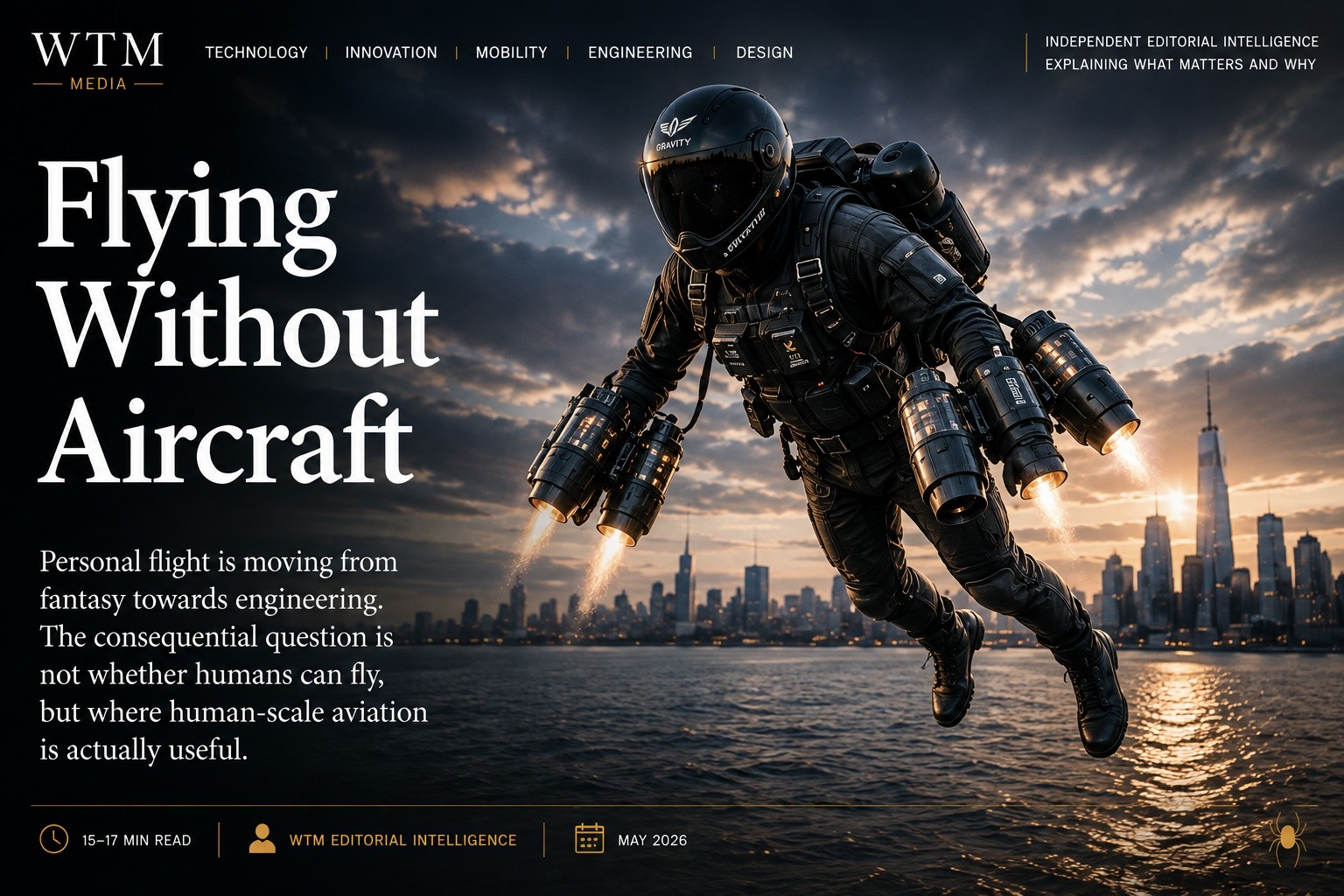
Human beings have spent centuries attempting to compress aviation until the machine becomes almost indistinguishable from the person operating it. Leonardo da Vinci imagined human-powered flying machines. Twentieth-century inventors experimented with rocket belts. Science fiction supplied jetpacks, powered armour, and personal aerial vehicles long before engineering could provide the propulsion, materials, sensing, and computation required to make them remotely practical. What has changed is not the ambition. Several enabling technologies have finally begun converging.
Modern jet suits represent one of the clearest demonstrations. Rather than placing a pilot inside a conventional fuselage, compact turbines generate thrust around the body, while the operator effectively becomes part of the flight-control architecture. Arms can influence thrust direction; body position affects movement; sophisticated engineering translates an extraordinarily unstable physical arrangement into controllable flight. The visual result looks almost primitive — person plus engines — but the technological system underneath it is anything but.
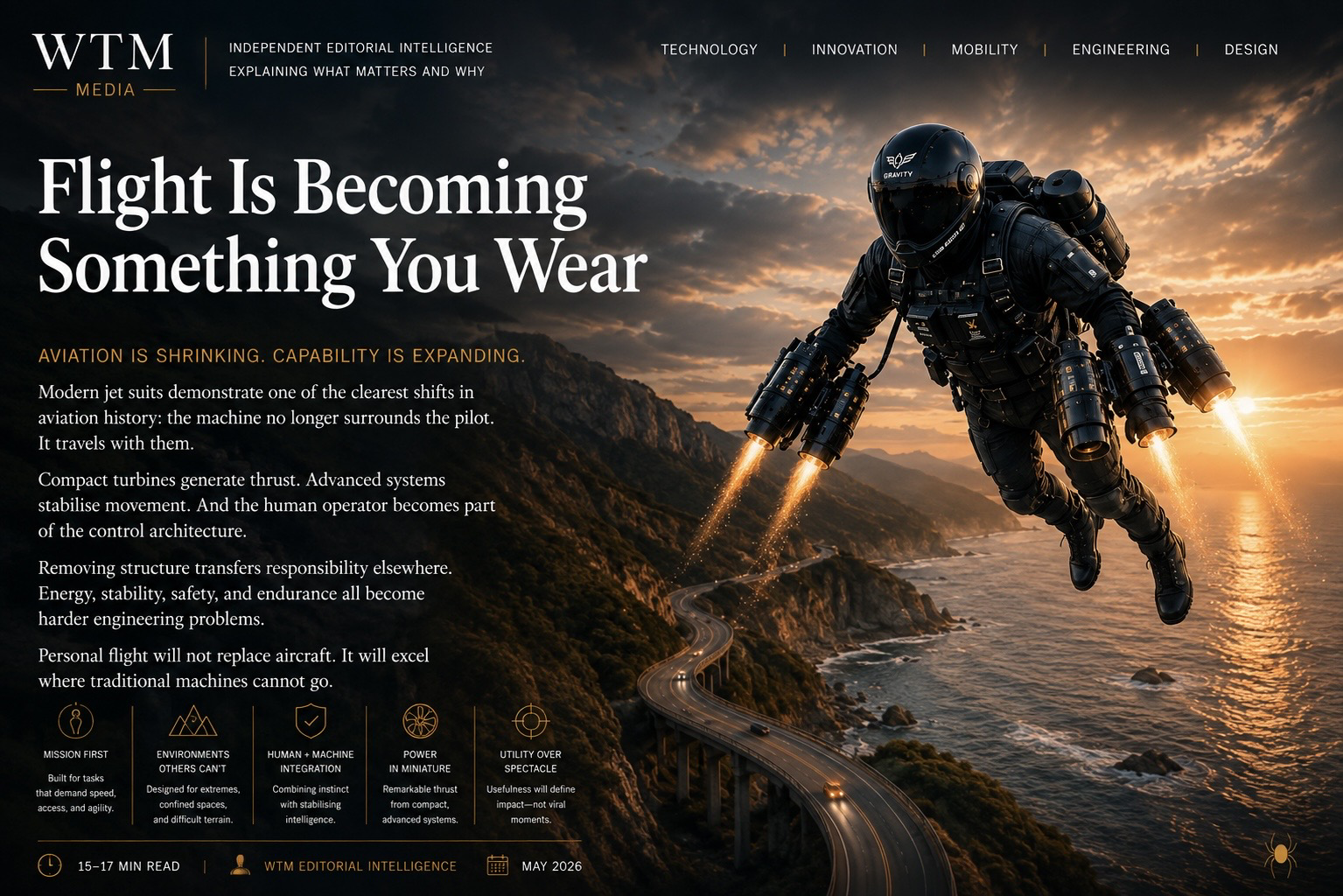
Yet this architecture exposes an important truth about innovation: removing structure transfers responsibility elsewhere. Eliminate wings, and propulsion must compensate. Eliminate a cockpit, and the human body becomes more exposed. Reduce vehicle mass, and fuel, payload, redundancy, and endurance become harder engineering compromises. Shrinking aviation does not shrink the laws of physics. It concentrates them.
That is why the impressive demonstrations circulating online should be interpreted carefully. Jet suits can achieve controlled powered flight, but demonstrations do not establish that a technology is ready for ordinary transportation. Endurance remains limited compared with conventional aircraft. Operation requires specialist training. Turbine systems introduce heat and noise. Weather matters enormously. Safe take-off and landing environments matter. And aviation regulation exists precisely because a failure in three dimensions is fundamentally different from a stalled automobile at the roadside.
Where these machines become interesting is where conventional mobility performs badly. A rescue worker attempting to reach somebody on mountainous terrain faces a different economic equation from an office worker travelling five miles to work. Offshore platforms, ships, disaster zones, military environments, cliffs, remote infrastructure, and difficult terrain can create situations where several minutes saved may carry extraordinary value. Personal flight does not have to replace the car or helicopter to become useful. It only has to outperform existing alternatives within specific missions.
The design principle is therefore more important than the particular machine: aviation is moving towards scale specificity. We once designed aircraft around the assumption that the machine carried humans. Emerging systems increasingly ask whether flight can instead be designed around a particular human task. That conceptual inversion — from vehicle first to mission first — could prove more consequential than the jet suit itself.
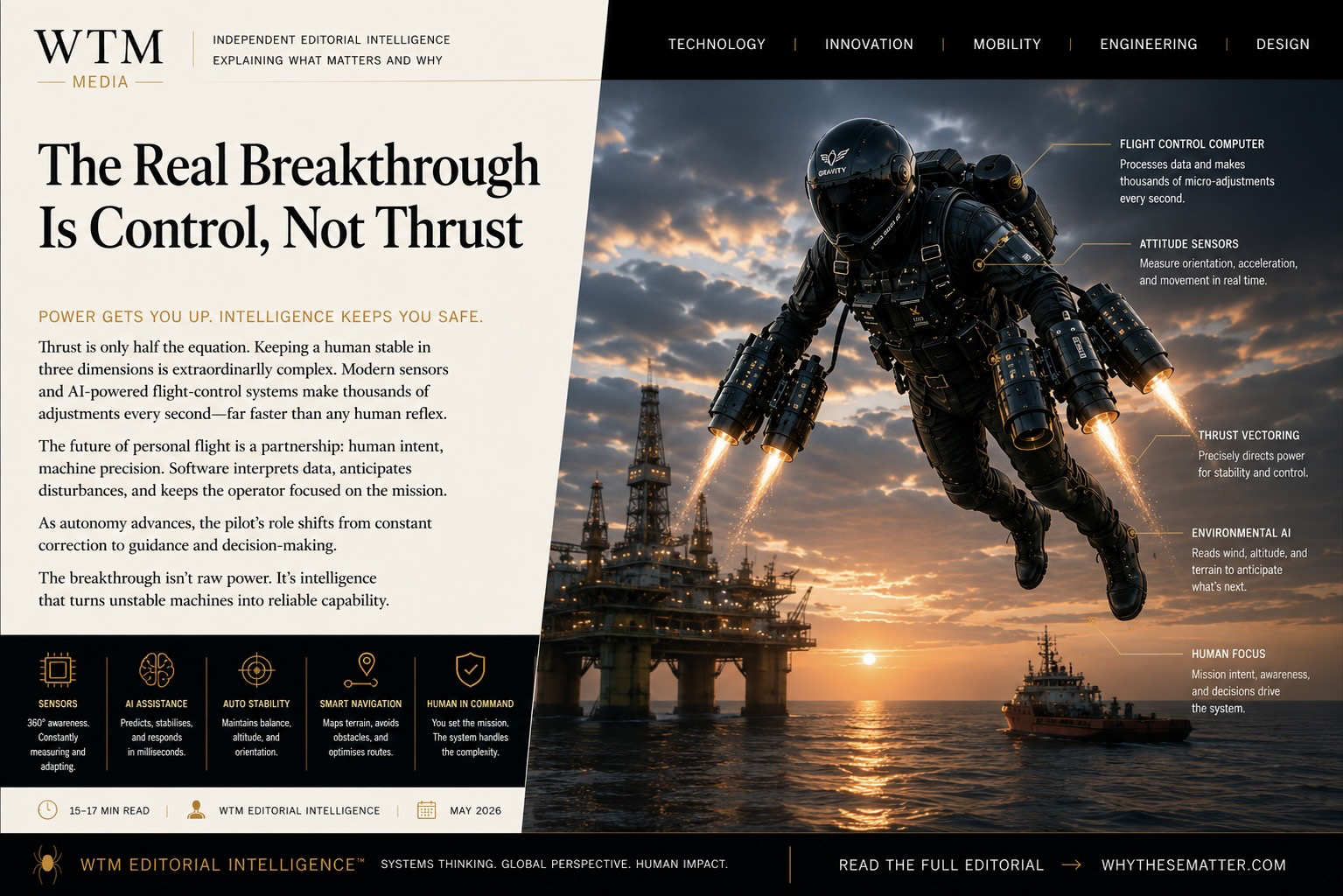
Powering something into the air is only the beginning of aviation. Keeping it stable, controllable, predictable, and survivable is the considerably harder problem. Personal flight intensifies that difficulty because human beings are irregular aerodynamic objects. We move unexpectedly, fatigue, misjudge distance, react differently under pressure, and were never anatomically designed to function as components inside high-performance propulsion systems.
The hidden revolution is therefore computational. Modern sensors can measure orientation, acceleration, altitude, movement, and position continuously. Flight-control computers can interpret those signals and make corrections at speeds no human pilot could reproduce manually. What appears visually to be a person mastering a machine is increasingly a collaboration between human judgement and machine stabilisation.
This development reaches far beyond jet suits. Consumer drones provide an instructive precedent. Flying a traditional radio-controlled helicopter required considerable skill because the operator was responsible for maintaining stability. Contemporary drones automate much of that work. Software holds position, manages orientation, compensates for disturbances, follows programmed routes, avoids some obstacles, and can return automatically when communication or battery conditions demand it. Computation converted specialist piloting into a substantially more accessible interaction.
Personal aviation could follow a related trajectory. The future system may require less continuous piloting and more destination selection, supervision, and exception management. Human beings would increasingly determine intent while software manages the thousands of micro-adjustments necessary to execute it safely. At that point, the distinction between aircraft, robot, wearable technology, and autonomous mobility system begins to blur.
Artificial intelligence adds another layer. Computer vision can identify terrain and obstacles. Predictive systems can evaluate weather and equipment conditions. Navigation software can optimise routes dynamically. Digital air-traffic systems could eventually coordinate large numbers of low-altitude autonomous vehicles. The future of flight therefore depends as much upon information architecture as propulsion architecture.
This reframes the entire personal-flight story. The spectacular component is the engine. The transformative component may be the intelligence surrounding it. Humanity’s ability to fly at smaller scales will ultimately depend not merely upon producing enough thrust, but upon making unstable machines sufficiently intelligent that ordinary human imperfection no longer makes them unmanageable.
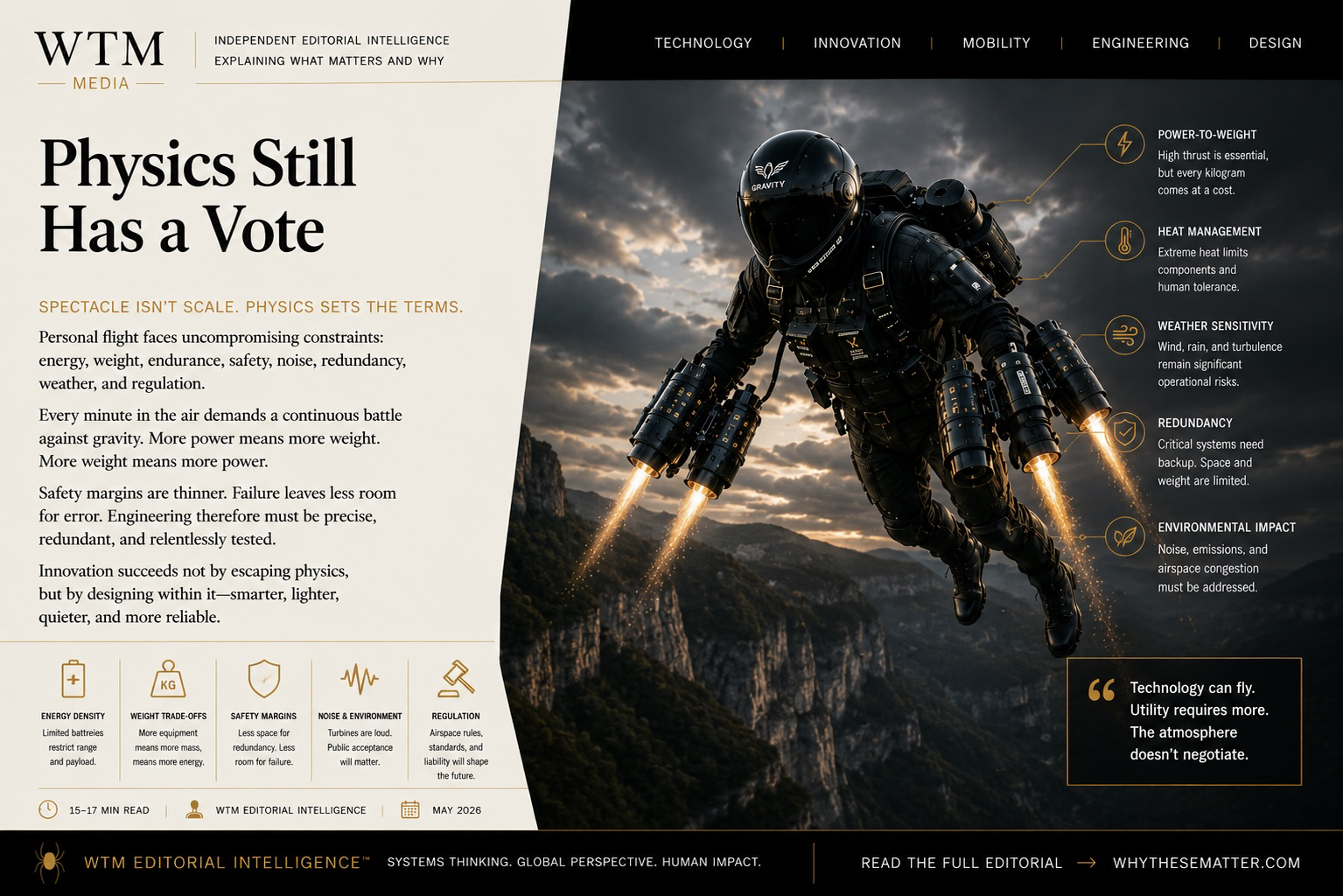
Technology culture has developed an unfortunate habit of treating successful prototypes as inevitable mass markets. Aviation is particularly unforgiving of this logic. A machine that works beautifully for eight minutes under controlled conditions has not necessarily solved transportation. The atmosphere remains indifferent to venture-capital enthusiasm, social-media engagement, and cinematic demonstrations.
Energy is the central constraint. Flight requires continuous work against gravity, and compact flying systems have limited capacity to carry the energy necessary to perform that work. Adding more fuel or batteries increases endurance but also increases weight, which requires additional energy to lift. Engineers consequently operate inside a relentless optimisation problem involving mass, power, range, payload, safety, and cost.
Electric propulsion solves some problems while exposing others. Electric motors can be efficient, responsive, mechanically simpler, and useful in distributed-propulsion configurations. Batteries, however, still impose significant weight relative to the energy they store. Turbine systems offer exceptional power-to-weight performance but bring fuel consumption, heat, noise, and operational complexity. There is no magical propulsion system waiting politely outside physics.
Safety presents the more serious barrier. Commercial aviation achieved extraordinary safety partly through redundancy, maintenance standards, professional training, regulated airspace, structured operations, and machines capable of tolerating certain failures. Miniaturised aviation has considerably less room — literally — for redundant systems. If a wearable propulsion unit fails close to the ground, the time available for recovery may be measured in seconds.
Noise and public space matter as well. A technology can be technically viable and socially intolerable. Thousands of personal turbines operating above residential neighbourhoods would introduce an entirely different environmental problem from the one their mobility benefits supposedly solve. Regulation will consequently have to address not simply whether personal aircraft can fly, but where, when, how loudly, at what altitude, under whose control, and with what liability when something goes wrong.
Personal flight therefore needs something futurism frequently resists: restraint. The engineering is remarkable precisely because the constraints are severe. Understanding those constraints does not diminish the achievement. It allows us to distinguish a genuine technological frontier from another round of flying-car mythology.
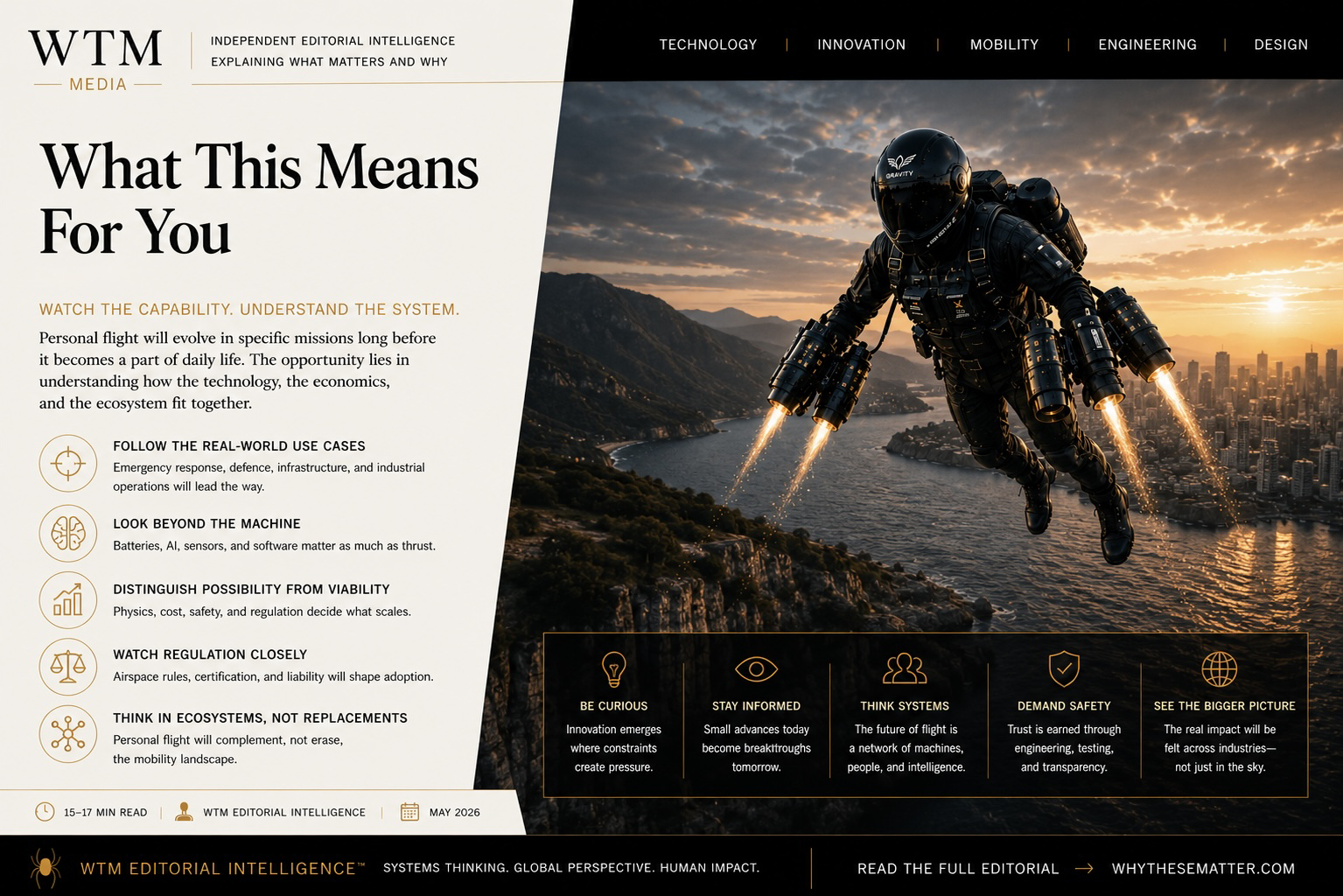
The immediate temptation is to ask when you will own a jet suit. That is probably the wrong investment of attention. Most transformative technologies first become valuable in places where their unusual capabilities solve expensive problems. Personal flight should be evaluated through the same lens. Watch emergency services, defence organisations, industrial operators, offshore infrastructure, logistics companies, and specialised aviation programmes before watching suburban driveways.
Second, pay attention to the technologies surrounding the vehicle. Improvements in batteries, lightweight composites, turbine efficiency, electric motors, sensors, computer vision, autonomous navigation, and flight-control software can migrate between industries. A breakthrough developed for drones may influence personal aircraft; an advance in electric aviation may improve robotics; better energy storage may transform ground transportation as much as flight. The system produces value beyond its most photogenic application.
Third, distinguish technological possibility from economic usefulness. Humans have demonstrated extraordinary machines that never became mainstream because another solution remained cheaper, safer, simpler, or more convenient. Concorde flew supersonically across the Atlantic for decades; most passengers still crossed oceans below the speed of sound. Technological superiority in one dimension does not guarantee systemic superiority.
Fourth, observe regulation as carefully as engineering. Airspace is shared infrastructure. Personal flight at meaningful scale would require rules governing certification, operator competence, routes, altitude, collision avoidance, privacy, insurance, emergency procedures, and interaction with conventional aviation. The technology that eventually succeeds may therefore be the one governments can safely integrate, rather than the one producing the most spectacular demonstration.
Fifth, rethink what “transportation” means. Mobility does not require one machine to solve every journey. Walking, bicycles, trains, cars, commercial aviation, helicopters, drones, and future aerial systems can coexist because each occupies a different performance envelope. Personal flight becomes plausible when treated as another layer within that network rather than as a universal replacement.
For the reader, the useful habit is simple: when confronted with a spectacular technological demonstration, ask what constraint has genuinely been removed? If the answer is merely that something previously impossible can now be demonstrated, remain curious. If the technology also becomes safer, cheaper, simpler, scalable, and meaningfully better than existing alternatives, pay considerably closer attention.
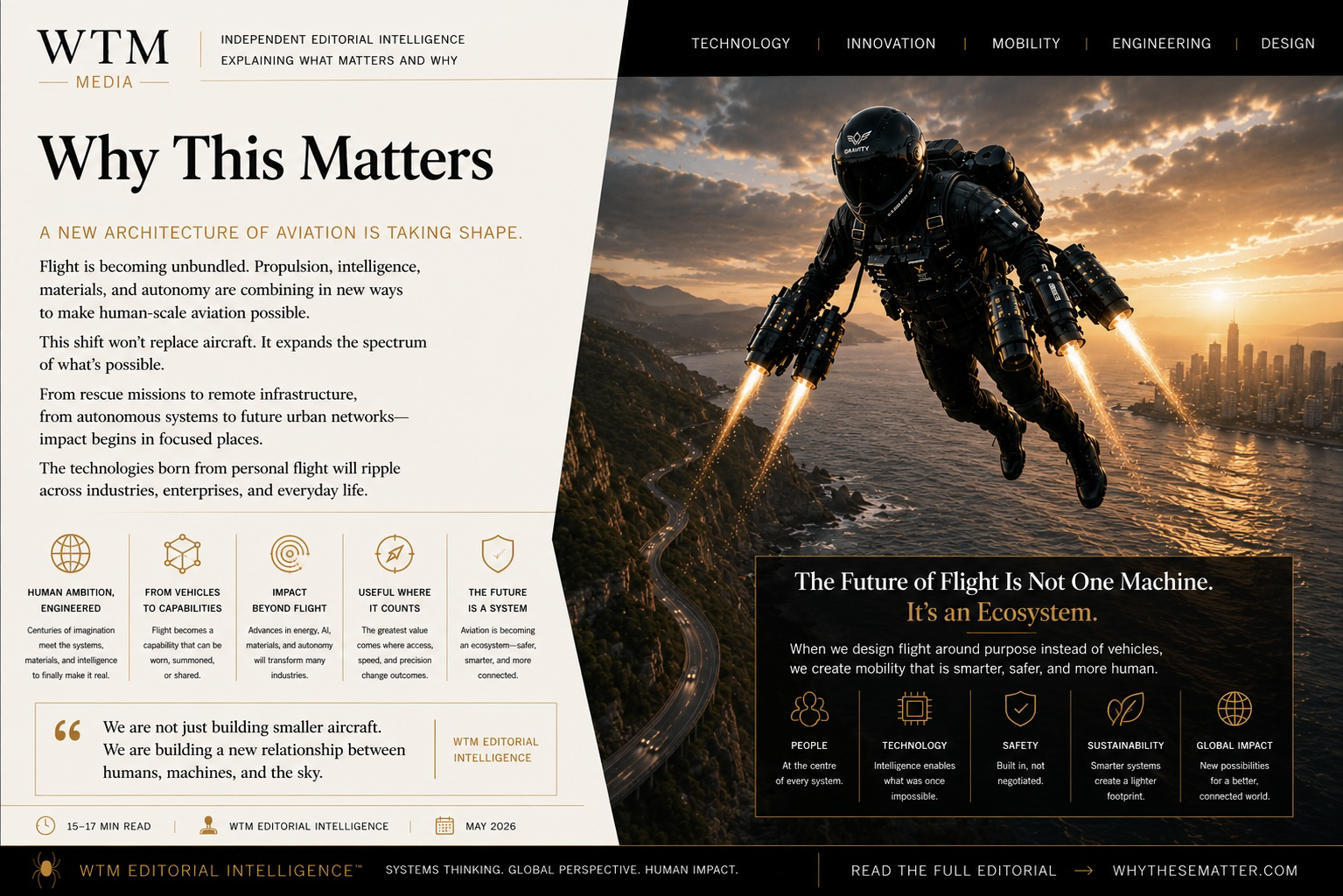
Flight has always been a story about human ambition negotiating with physical reality. We imagined flying long before we understood aerodynamics. We built gliders before jet engines, aircraft before computers, and global aviation networks before satellites could continuously locate every machine crossing the sky. Each era of aviation has emerged because multiple technologies matured together.
Personal flight may now be entering one of those convergence periods. Miniaturised propulsion, advanced materials, digital control systems, autonomous navigation, sensors, artificial intelligence, and improved manufacturing are allowing engineers to reconsider assumptions embedded in aviation for more than a century. The resulting machines may look strange because genuinely new categories usually do.
Their significance should nevertheless be measured by usefulness rather than spectacle. Jet suits may remain specialist machines. Powered wings may occupy recreational or military niches. Electric vertical-lift vehicles may find particular regional applications. Autonomous drones may ultimately transform aviation more profoundly than any machine carrying a person. Innovation rarely arrives in the exact configuration futurists predict.
What matters is that the boundary between the human and the aircraft is becoming negotiable. Flight can increasingly be distributed across propulsion systems, software, wearable hardware, autonomous intelligence, and infrastructure. The aircraft is no longer necessarily one discrete object containing all the intelligence required to fly.
That architectural shift mirrors developments elsewhere. Cars are becoming software platforms. Buildings are becoming energy systems. Medical devices are becoming continuous sensing networks. Phones became cameras, maps, wallets, libraries, and communication infrastructure. Mature technologies often evolve by dissolving the boundaries that originally defined them. Aviation may be beginning a similar transformation.
The deepest question is consequently not whether everybody will someday strap turbines to their arms. Most people probably will not, and civilisation will survive the disappointment. The meaningful question is whether the technologies emerging from personal aviation can make access to three-dimensional mobility safer, more precise, more autonomous, and useful in circumstances where existing machines are too large, expensive, or slow.
Flying without aircraft matters because it changes the unit of aviation itself. For a century, we designed machines capable of carrying humans through the sky. The next frontier may involve designing flight around the human, the mission, and the moment — using only as much aircraft as the problem actually requires.
Visual Intelligence: Noir Spider Atelier™ — A Division of WTM Media
Editorial Direction: Kelly Dowd, MBA, MA
Copyright: © 2026 WTM Media. All rights reserved.

Why These Matter - WTM MEDIA is an independent editorial platform exploring the forces shaping our world—through people, culture, commerce, design, systems, and governance. Connecting the dots between today’s headlines and tomorrow’s realities.