
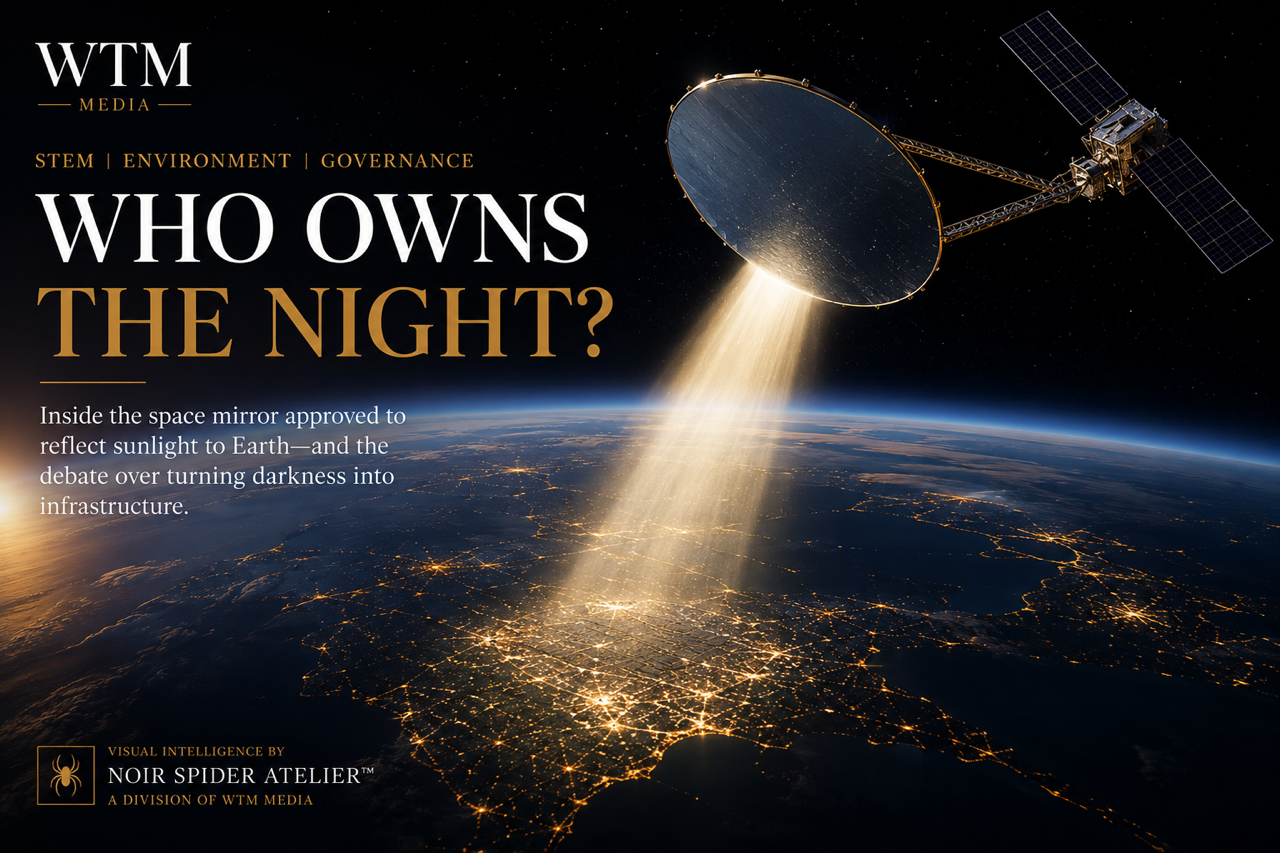
On 9 July 2026, the United States Federal Communications Commission granted Reflect Orbital conditional authority to deploy and operate Eärendil-1, a single experimental satellite designed to test whether a steerable, 18-metre reflector can redirect sunlight towards a targeted area on Earth after sunset. Supporters see a new form of infrastructure: controllable natural light that could extend solar-energy production, support emergency operations, and illuminate remote sites without installing poles, cables, or generators. Astronomers, dark-sky advocates, environmental organisations, and public-health specialists see a different possibility: a commercial precedent for altering a planetary condition that no company created, no nation owns, and countless species require. The immediate experiment is small. The question beneath it is not. Once darkness can be scheduled, directed, sold, and delivered from orbit, night ceases to be merely the absence of daylight. It becomes a governed resource. This is therefore not simply a story about an inventive satellite. It is a test of whether regulation can keep pace when commercial technology begins redesigning the natural environment itself.
The headline sounds like science fiction: the United States has approved a giant mirror in space to shine sunlight onto Earth at night. The reality is less spectacular, although no less consequential. The FCC has authorised one demonstration satellite, not a functioning global illumination service. Eärendil-1 may operate at an altitude of approximately 625 kilometres, using authorised radio frequencies for tracking, control, and transmission while testing a motorised, steerable reflector. The grant is conditional, limited to a single spacecraft, and issued for a two-year operating term beginning after successful deployment.

The planned reflector is approximately 18 metres by 18 metres. According to the American Astronomical Society, its reflected beam could cover an area roughly five kilometres wide on the ground. The satellite would remain in sunlight while passing above parts of Earth already in darkness, redirecting a portion of that light towards a designated location. This is not the creation of new energy. It is the relocation of existing sunlight across the boundary between day and night.
Reflect Orbital presents the technology as a controllable alternative to conventional illumination. The company says reflected sunlight could extend operating hours for solar farms, support industrial and emergency activity in remote areas, and provide temporary light without additional land, poles, wiring, or fuel. It also states that the beam can be redirected, switched away from Earth, restricted to selected areas, and scheduled only after approval from relevant local authorities. Those are company assurances rather than independently demonstrated outcomes; Eärendil-1 exists precisely because the system has not yet been proven at operational scale.
The distinction between one experiment and a future constellation matters. The FCC considered the immediate application before it: one satellite undertaking a limited technology test. It declined to treat concerns about a possible network of tens of thousands of reflectors as grounds to deny this particular licence. In regulatory terms, that is procedurally understandable. In systems terms, it creates a familiar problem: every large infrastructure system begins as a small proposal whose wider consequences are declared premature until the architecture is already taking shape.
Critics are not objecting merely because something bright may appear in the sky. Astronomers depend upon darkness as a working condition. Wildlife relies upon natural light-and-dark cycles for movement, feeding, migration, reproduction, and survival. Pilots, drivers, and telescope users may encounter a compact but intensely bright moving source. DarkSky International and the American Astronomical Society have therefore asked for deeper safety, environmental, and scientific review before orbital illumination expands beyond experimentation.
That leaves the public with two equally unhelpful temptations. The first is to dismiss the technology as an absurd billionaire fantasy. The second is to celebrate it as inevitable progress. Neither position requires much thought. The intelligent position is harder: allow serious experimentation, demand credible evidence, distinguish present authority from future ambition, and design governance before commercial success makes meaningful restraint politically expensive.

Human beings rarely notice a resource until someone finds a way to price it. Air became an economic concern when pollution imposed costs. Personal data acquired value when platforms learned to collect and predict behaviour. Orbital space became strategic when communications, surveillance, navigation, and commerce began depending upon it. Darkness may be entering the same transition. What has always appeared free, universal, and beyond ownership is becoming technically accessible enough to be packaged as a service.
Reflect Orbital’s proposition is economically seductive because it challenges one of solar energy’s oldest constraints: sunset. Electricity demand does not politely disappear when daylight does. Storage can shift energy across time, but batteries remain capital-intensive, geographically uneven, and dependent upon materials, supply chains, and grid architecture. Redirected sunlight offers a different proposition. Rather than storing daytime electricity for later, it attempts to extend the productive usefulness of solar infrastructure itself. The company describes this as making solar power more configurable and available beyond conventional daylight hours.
The commercial logic extends beyond energy. Mines, disaster zones, construction sites, agricultural operations, defence facilities, and isolated communities all incur costs when darkness restricts activity. Temporary illumination normally requires equipment, electricity, fuel, maintenance, and workers on the ground. Light delivered from orbit suggests an asset-light service model: customers purchase access without owning the physical infrastructure producing it. That resembles the wider economic movement from products towards platforms, subscriptions, and remotely controlled capacity.
Yet economic efficiency is not the same as public legitimacy. A light source can be valuable to the customer requesting it while creating costs for people, ecosystems, and scientific institutions outside the transaction. Economists call such effects externalities. The farmer receives additional operating time; the observatory absorbs interference. The construction company gains productivity; nearby residents inherit an altered night. The service provider earns revenue, while nocturnal species—unable to participate in a planning meeting—carry part of the environmental risk.
This is where the language of innovation can obscure the architecture of incentives. Reflect Orbital is rewarded for proving that its technology works, attracting customers, lowering operational costs, and scaling. Astronomers are rewarded for protecting observation. Regulators are rewarded for encouraging innovation while remaining within statutory authority. Communities want economic opportunity without surrendering control. Each participant is behaving rationally inside a different system. The danger does not lie in villainy. It lies in rational actors producing an irrational collective outcome.
Markets are effective at distributing goods whose ownership, boundaries, and costs can be defined. They are far less reliable when the commodity is embedded within a shared environment. The critical question is therefore not whether reflected sunlight has commercial value. It plainly may. The question is whether its price includes the value of what it changes—and whether anyone has the authority, evidence, or imagination to calculate that cost before the invoices begin.
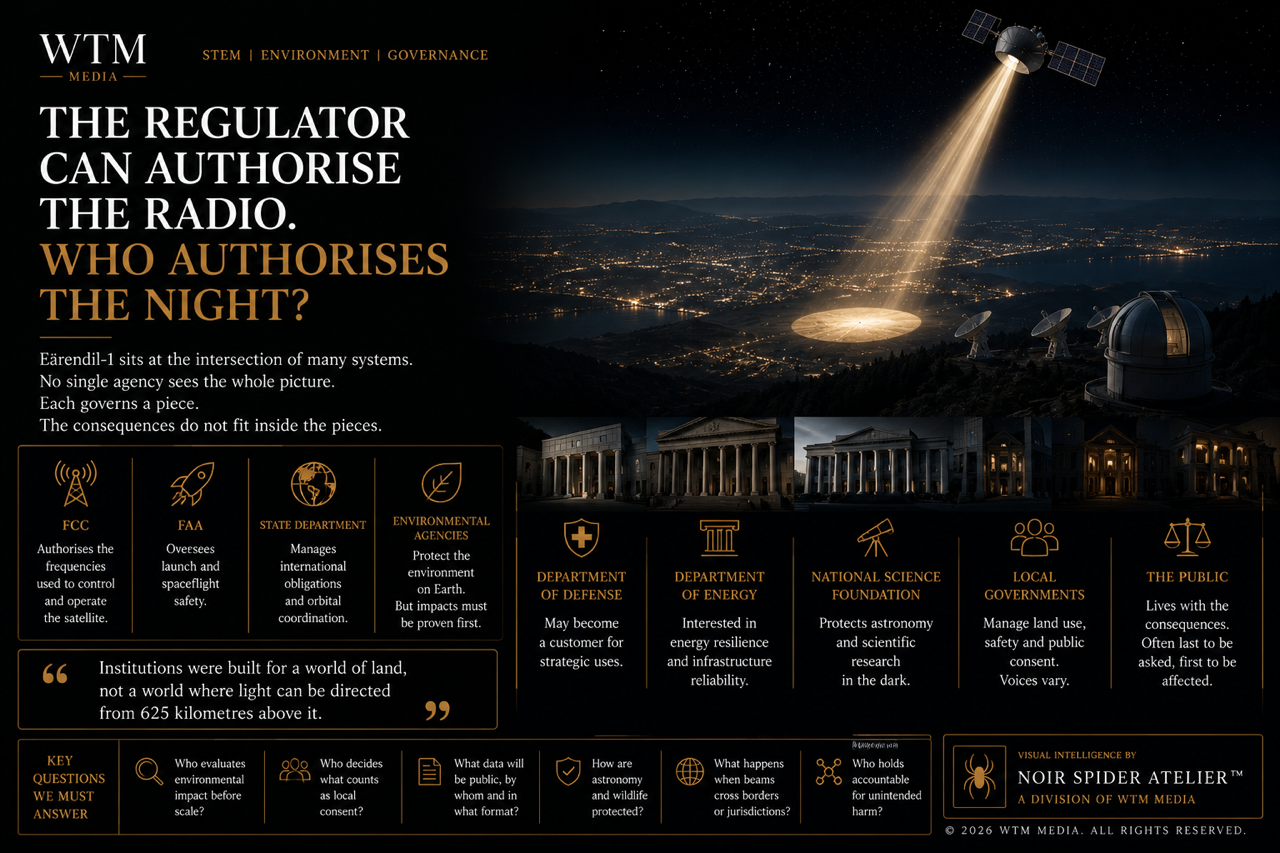
The FCC’s decision exposes a structural gap in modern government. The agency regulates communications by satellite, including the frequencies required to control and operate Eärendil-1. Its order found that a single demonstration could serve the public interest by testing an emerging technology and advancing American leadership in space. The Commission also concluded that objections had not established sufficiently specific environmental harm from this one satellite to justify denial or additional conditions.
At the same time, the FCC drew a boundary around its authority. Its formal action concerned the deployment and operation of a radio station using designated frequencies. The Commission declined to require further environmental review under the National Environmental Policy Act, reasoning that the approved communications activity was categorically excluded and that agencies need not analyse actions beyond their regulatory jurisdiction. Legally, that boundary may be defensible. Architecturally, it leaves the most important consequence—the deliberate redirection of sunlight—without an obvious institutional home.
The satellite is controlled through communications, launched under space and aviation rules, placed in an international orbital environment, directed towards terrestrial locations, and capable of affecting astronomy, ecology, transport, health, energy, and local communities. No single regulator sees the whole system because each agency governs one component. This is a recurring weakness in public administration: institutions are organised vertically, while technological consequences move horizontally.
The American Astronomical Society has argued that this fragmentation could become more serious if the FCC’s reasoning is applied to a future constellation. The Society objects not only to possible harm from Eärendil-1, but to the implication that the agency licensing satellite communications may consider the reflector’s broader use outside its remit. It also criticised the absence of a formal coordination agreement protecting major observatories. The FCC, by contrast, treated the single mission as a limited experiment and considered concerns about a far larger network too speculative for the application before it.
Both positions reveal a deeper governance dilemma. Regulation that anticipates every imaginable consequence can suffocate useful experimentation. Regulation that waits for conclusive harm may arrive only after investment, dependence, and political constituency make reversal difficult. The solution is not blanket prohibition or casual permission. It is staged legitimacy: limited testing, transparent data, independent measurement, enforceable operating boundaries, public consultation, and fresh approval before any material expansion.
The nineteenth century designed institutions around land, factories, railways, and national borders. The twentieth built agencies for broadcasting, aviation, medicine, finance, and nuclear risk. The twenty-first is producing technologies that cross all those categories at once. Orbital illumination is not uniquely ungovernable. It is simply an unusually visible example of the problem. The system does not fit neatly inside the state because the state was designed before the system existed.
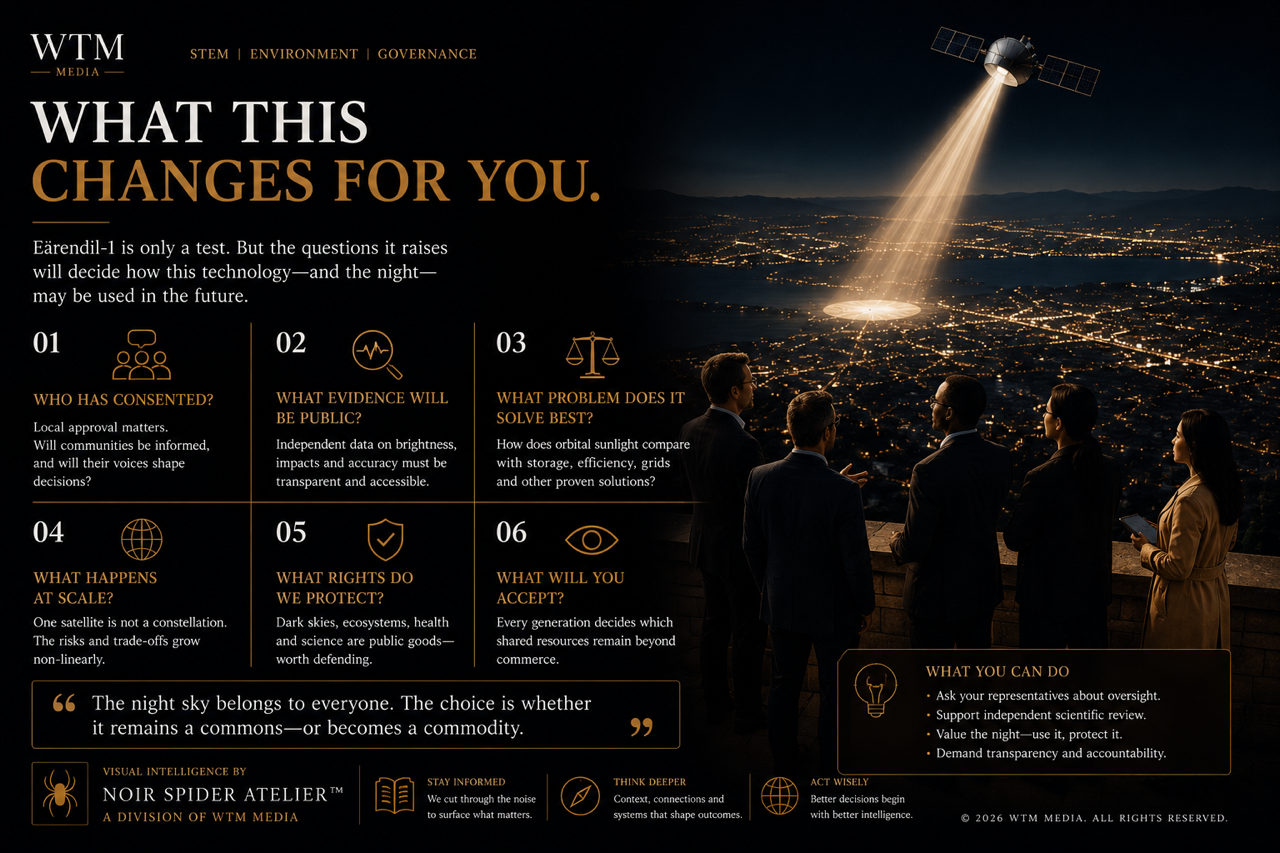
Most readers will never stand inside a beam from Eärendil-1. That does not make the issue remote. The experiment offers a practical way to understand how technological decisions increasingly enter ordinary life. A service may be approved at federal level, controlled from another jurisdiction, delivered through orbital infrastructure, purchased by a private organisation, and experienced by people who never joined the transaction. In such systems, proximity to the decision and exposure to its consequences are no longer the same thing.
The first question for any emerging technology should therefore be deceptively simple: who has consented? Reflect Orbital says illumination would occur only when requested and approved by appropriate local authorities, and that sensitive habitats and observatories could be avoided. Readers should watch whether those promises become binding operating conditions, how “local authority” is defined, whether residents receive notice, and what recourse exists when the beam crosses jurisdictions or creates effects beyond its intended target.
The second question is what evidence will be made public. A credible demonstration should measure more than whether sunlight reaches the designated site. It should record brightness, duration, atmospheric scattering, sky glow, flight-path interaction, effects on telescopes, animal behaviour, and the difference between predicted and observed performance. Reflect Orbital has said it is commissioning third-party studies and will make satellite-position information available to researchers. The value of those commitments will depend upon independence, transparency, and access to the underlying data.
The third question is whether the claimed benefit solves the right problem. Extending solar production sounds appealing, but readers should compare orbital reflection with storage, transmission upgrades, demand management, local generation, and efficiency. A technologically dramatic solution is not necessarily the most affordable, resilient, or environmentally responsible one. The intelligent comparison is not between space-based light and doing nothing. It is between every credible way of achieving the same social outcome.
The fourth question concerns scale. One experimental satellite may present manageable and measurable risks. Fifty thousand reflectors would create a different system, with different cumulative effects, failure modes, incentives, and geopolitical implications. Readers should resist arguments that move carelessly in either direction: one test does not prove a constellation safe, but a hypothetical constellation does not automatically prove one tightly controlled experiment intolerable.
The final question is personal and institutional: what do you consider part of the commons? Water, clean air, public roads, genetic information, data, orbital space, and the night sky all become difficult to protect once societies treat them solely as unused economic capacity. You do not need to oppose Reflect Orbital to recognise the pattern. You need only notice when language shifts from “shared condition” to “available resource”. That is usually the moment governance should begin—not the moment after ownership has effectively been established.

Modern civilisation is built upon light. Electric illumination extended working hours, improved safety, enabled night-time commerce, transformed cities, and weakened humanity’s dependence upon the sun’s schedule. Yet that triumph encouraged a peculiar assumption: more light is inherently more advanced. The ecological sciences now complicate that belief. Research increasingly shows that artificial light at night can alter animal behaviour, circadian rhythms, plant cycles, and ecosystem metabolism. Darkness is not empty. It performs work.
This changes the ethical calculation. If darkness supports sleep, navigation, reproduction, predation, pollination, astronomical observation, and cultural experience, then reducing it is not merely adding a convenience. It is modifying a functioning system. The appropriate comparison is not between light and nothingness, but between one form of infrastructure and another. A dark environment may be less visible than a power station, but invisibility does not make it valueless.
The question also extends beyond ecology. Night has spiritual, psychological, scientific, and cultural meaning. It has shaped navigation, calendars, religions, literature, agriculture, and humanity’s conception of its place in the universe. Most of the cosmos became knowable because someone could look into darkness without a commercial service passing through it. A civilisation that illuminates every shadow may gain productive hours while losing a source of humility.
There is also a geopolitical dimension. A company capable of directing light from orbit is developing more than an energy service. It is developing precise, remotely controlled environmental influence. Today’s stated uses include energy, industry, emergency response, and illumination. Tomorrow’s applications could involve defence, surveillance support, psychological signalling, border operations, or strategic infrastructure. The technology need not be weaponised to become an instrument of power. Control over timing, location, and access is already a form of power.
The mature response is neither fear nor worship. Civilisations advance by attempting difficult things, but they endure by learning which capabilities require restraint. The first aircraft did not invalidate aviation law; they made it necessary. The first nuclear reactor did not settle energy governance; it opened the question. Eärendil-1 should be treated in the same spirit: not as proof that humanity should commercialise the night, but as evidence that it now can—and must decide under what terms.
Perhaps the most important question is not who owns the night today. No one does, which may be precisely why it has survived as a shared inheritance. The larger question is what else we will learn to manipulate before we learn to govern manipulation itself. Once sunlight can be ordered after sunset, nature is no longer simply the environment surrounding the economy. It becomes part of the economy’s operating system—and every operating system eventually reveals whose values were written into its code.
Reader Reflection
When a technology can convert a shared natural condition into a private service, who should carry the burden of proving that the transformation serves more than the customer paying for it?
Sources & Further Reading
The principal sources for this editorial are the FCC’s 9 July 2026 Memorandum Opinion and Order, Reflect Orbital’s published technical and safety claims, the American Astronomical Society’s response to the authorisation, DarkSky International’s environmental-review request, and recent peer-reviewed research concerning artificial light at night and ecosystem function.
Editorial Intelligence: WTM STEM Editor
Visual Intelligence: Noir Spider Atelier™ — A Division of WTM Media
Editorial Direction: Kelly Dowd, MBA, MA
Copyright: © 2026 WTM Media. All rights reserved.
Why These Matter - WTM MEDIA is an independent editorial platform exploring the forces shaping our world—through people, culture, commerce, design, systems, and governance. Connecting the dots between today’s headlines and tomorrow’s realities.