
The discovery of a previously undocumented blue octopus near the Galápagos Islands offers more than biological intrigue. It provides a rare glimpse into one of evolution’s most extraordinary experiments in intelligence. Unlike mammals, birds, or primates, octopuses evolved sophisticated cognition along an entirely separate evolutionary pathway, demonstrating that intelligence is not a singular destination but a recurring solution to environmental complexity. Their ability to solve problems, manipulate objects, camouflage instantaneously, navigate uncertainty, and adapt to rapidly changing conditions challenges long-held assumptions about the nature of thought itself. At a moment when humanity is building artificial intelligence systems capable of increasingly sophisticated behaviour, the octopus serves as a reminder that intelligence emerges not from a single blueprint, but from the relentless pressures of adaptation. The discovery is not merely about a new species. It is about expanding humanity’s understanding of what intelligence can become.
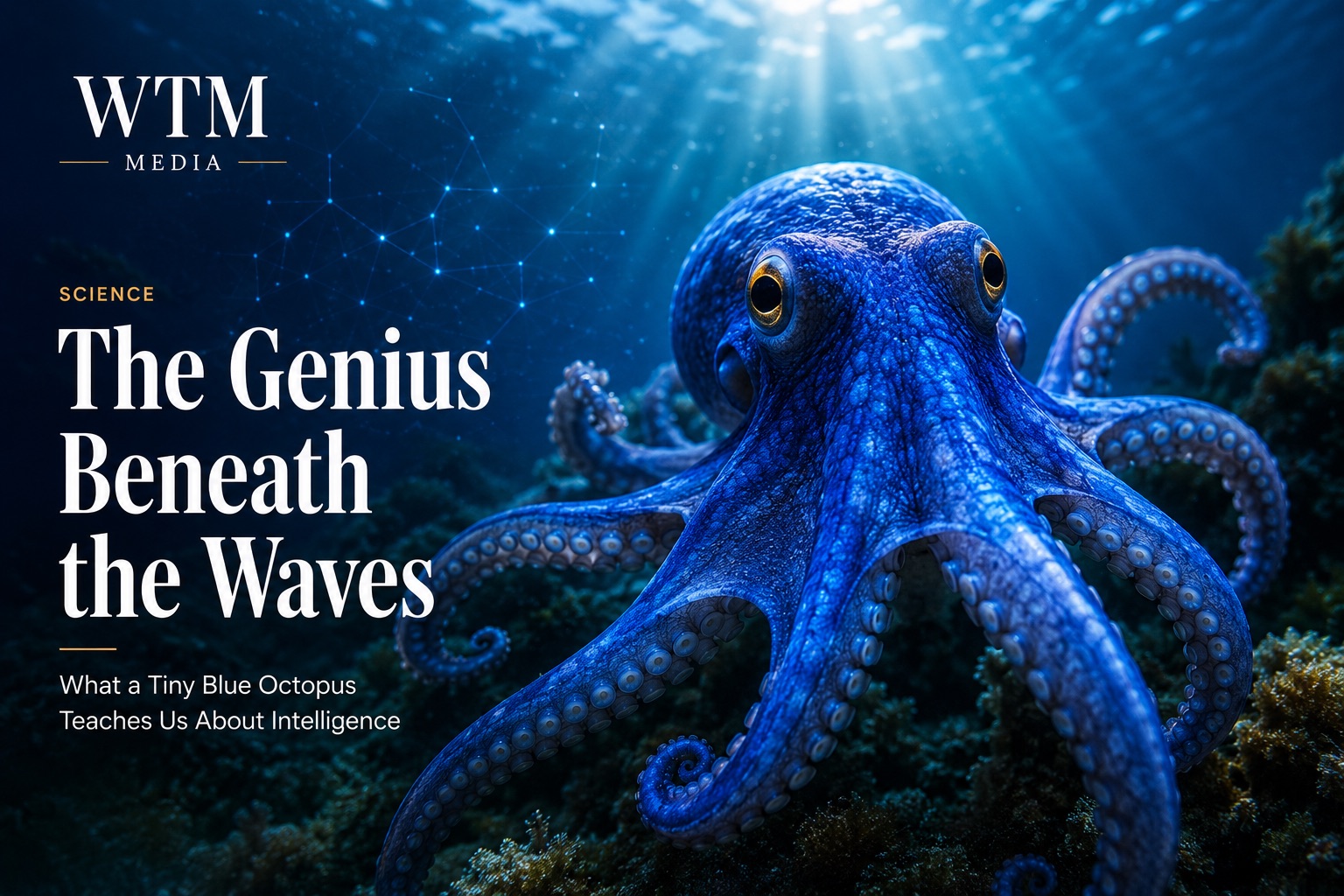
For much of modern scientific history, intelligence was viewed through a distinctly human lens. Researchers often measured cognition according to characteristics familiar to human experience: language, tool use, social organisation, memory, and abstract reasoning. This framework naturally positioned primates as the closest approximations to advanced intelligence. Yet the octopus presents a profound challenge to that assumption. Despite sharing a common ancestor with humans more than 500 million years ago, octopuses independently evolved remarkable cognitive capabilities, suggesting that intelligence is not an exclusive outcome of mammalian evolution but a recurring biological strategy.
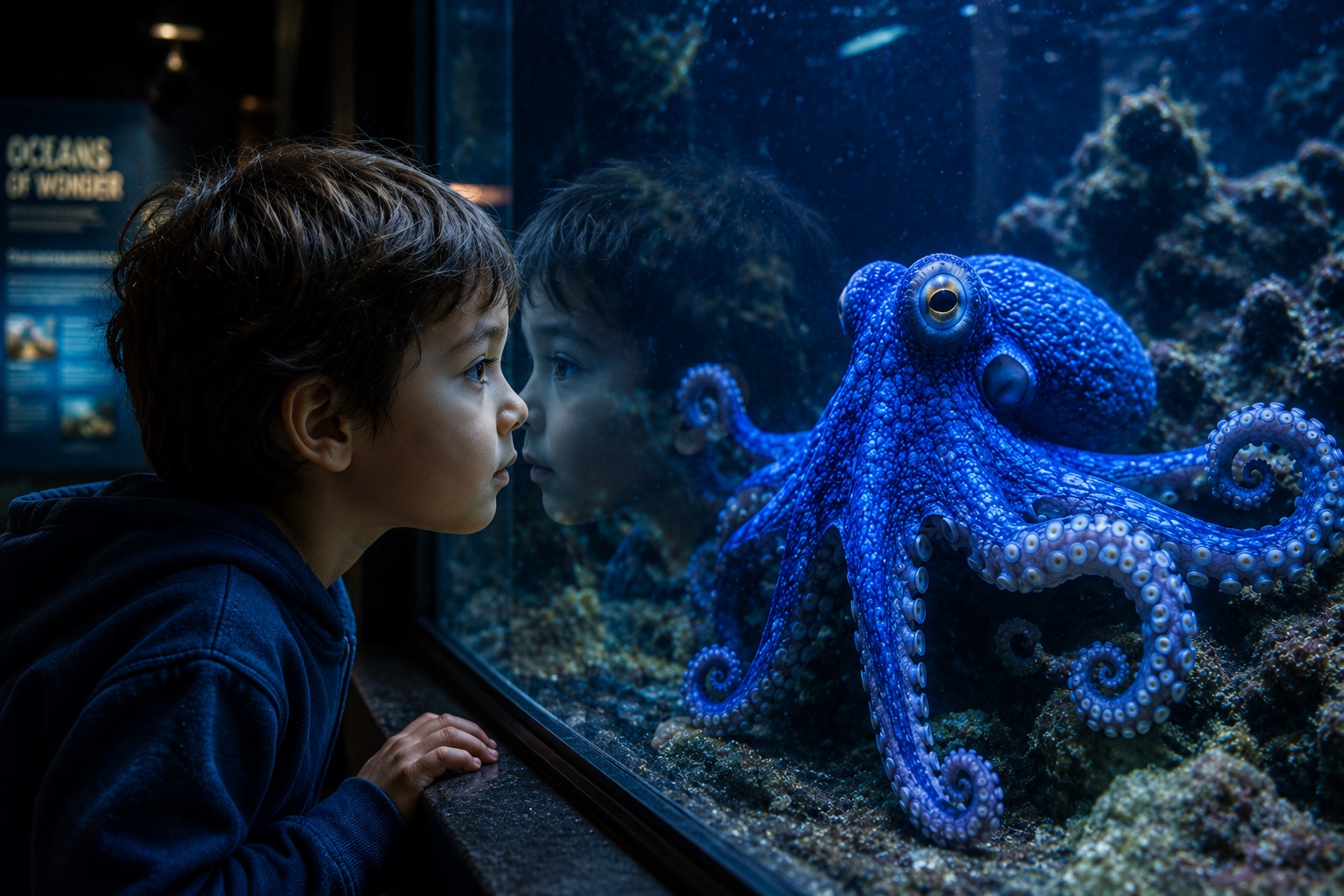
The newly identified blue octopus near the Galápagos archipelago joins a lineage already famous for behavioural sophistication. Octopuses have demonstrated problem-solving abilities comparable to some vertebrates, including navigating mazes, opening containers, recognising patterns, and adapting behaviour through experience. Unlike many intelligent animals, however, they achieve these feats without the social structures that often drive cognitive development in mammals. Their intelligence evolved largely in solitude, revealing that cooperation is not the only pathway to complex thought.
The marine environment itself helps explain this evolutionary trajectory. Unlike creatures protected by shells, speed, or large social groups, octopuses occupy an ecological position demanding constant adaptation. They are soft-bodied, vulnerable, and exposed to numerous predators. Survival depends upon perception, flexibility, and rapid decision-making. In evolutionary terms, intelligence became their primary defence mechanism. Where other species evolved armour, the octopus evolved cognition.
This distinction matters because it reframes intelligence as an adaptive technology rather than a biological luxury. Evolution does not pursue brilliance for its own sake. It rewards traits that improve survival. In the octopus, intelligence emerged because environmental conditions demanded extraordinary responsiveness. Cognition became a substitute for physical advantage. The lesson extends far beyond marine biology. Intelligence often flourishes not in conditions of comfort, but under conditions of persistent uncertainty.
The Galápagos Islands themselves carry symbolic significance within this story. The region has long served as a living laboratory of evolution, helping shape Charles Darwin’s understanding of natural selection. The discovery of a new octopus species within these waters reinforces a central evolutionary truth: nature remains far more inventive than human assumptions. Even after centuries of exploration, entirely new expressions of life continue to emerge from environments we thought we understood.
The existence of this blue octopus therefore challenges a subtle form of intellectual arrogance. Humanity frequently treats intelligence as a hierarchy culminating in itself. Evolution suggests something different. Intelligence is not a ladder. It is a landscape. Different environments produce different forms of brilliance, each adapted to the challenges they face. The octopus represents one of nature’s most compelling reminders that there are many ways to become intelligent.
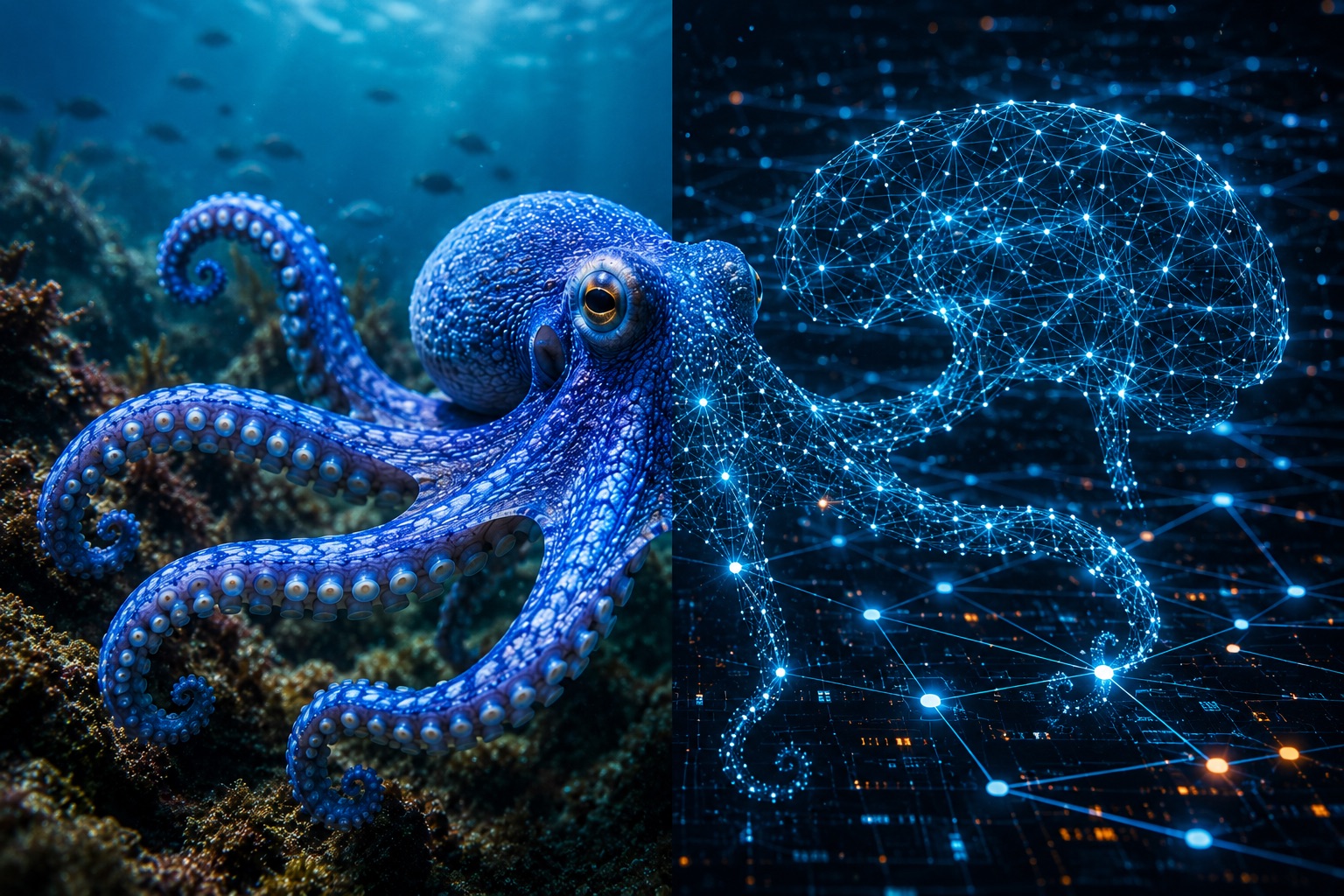
Perhaps the most astonishing aspect of octopus cognition is not its sophistication, but its architecture. Humans possess a highly centralised nervous system, with the brain functioning as the dominant command centre. Octopuses operate according to a radically different model. While they possess a large central brain, approximately two-thirds of their neurons reside within their arms. In practical terms, much of the animal’s intelligence exists outside its head.
This arrangement creates a form of distributed cognition rarely seen elsewhere in the animal kingdom. Each arm possesses substantial autonomy, capable of processing sensory information and coordinating movement with limited direct oversight from the central brain. Researchers have observed octopus arms continuing to perform complex exploratory behaviours independently, responding dynamically to environmental stimuli. The animal effectively operates as a network rather than a hierarchy.
The implications are profound. Human intelligence largely depends upon centralised coordination. The octopus demonstrates that intelligence can emerge through decentralisation. Rather than a single authority issuing commands, cognition is distributed across interconnected components capable of local decision-making. This mirrors many of the most resilient systems found elsewhere in nature, from fungal networks and ant colonies to immune systems and ecological webs.
Modern technology increasingly reflects similar principles. Cloud computing distributes processing across multiple servers. Blockchain systems eliminate central authorities. Swarm robotics explores collective intelligence through autonomous agents. Artificial intelligence architectures increasingly rely upon networks rather than singular computational pathways. The octopus appears less like an evolutionary curiosity and more like a biological prototype for many of humanity’s emerging technological systems.
This distributed model also offers extraordinary resilience. Centralised systems often fail catastrophically when critical nodes are compromised. Distributed systems continue functioning despite local disruptions. An octopus can lose an arm and survive. Ecosystems can absorb disturbances and recover. Decentralised networks reroute information around failures. Nature repeatedly demonstrates that resilience frequently emerges through distribution rather than concentration.
For civilisation, the lesson extends beyond biology and technology. Many institutions remain organised around hierarchical assumptions developed during industrial eras. Yet modern complexity increasingly rewards distributed decision-making, adaptive networks, and local autonomy. The octopus reveals that intelligence need not be concentrated to be effective. Sometimes the most sophisticated systems are those capable of thinking everywhere simultaneously.
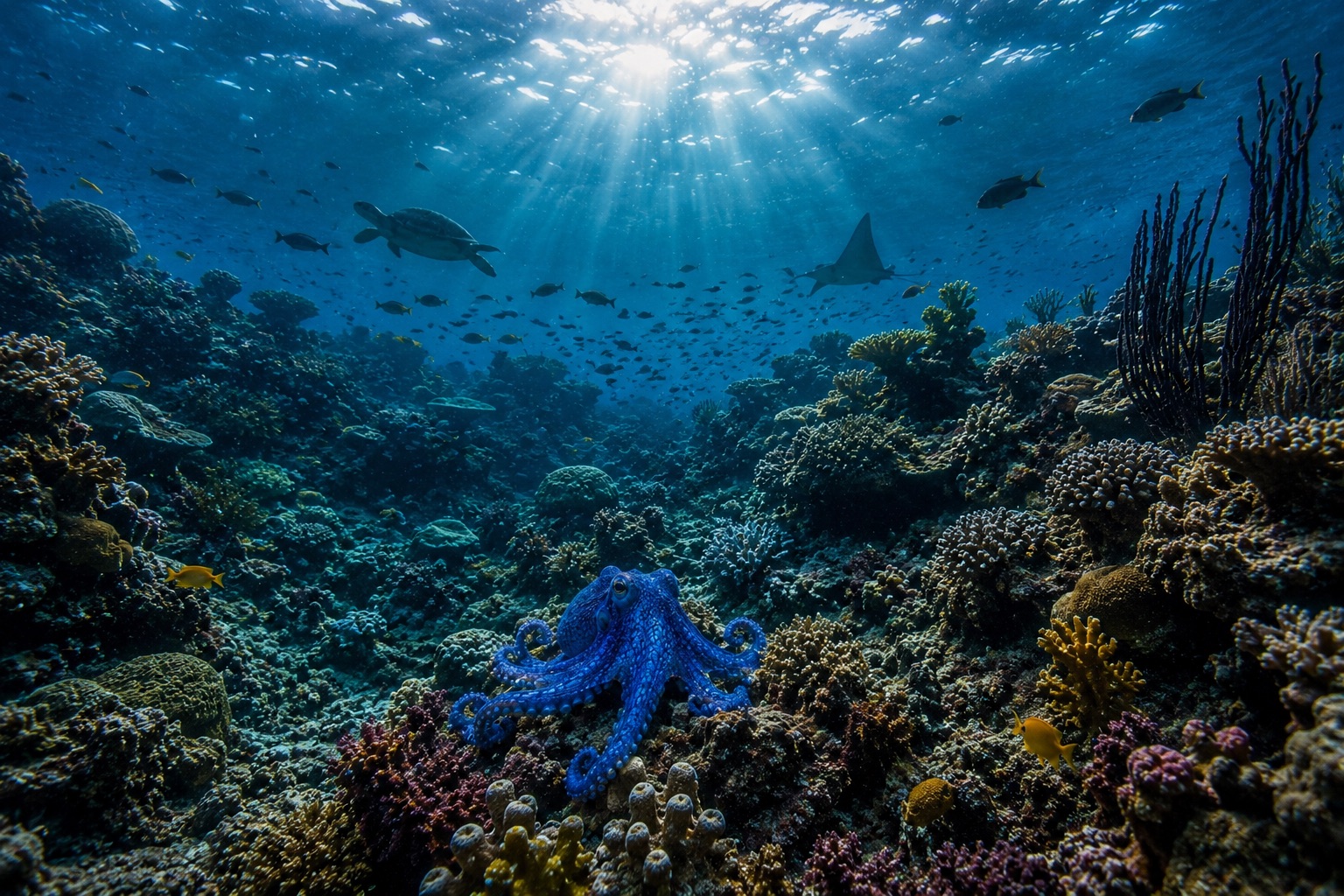
The discovery of a new octopus species arrives at a remarkable moment in human history. Humanity is simultaneously uncovering unfamiliar forms of biological intelligence while constructing entirely new forms of artificial intelligence. These parallel developments invite a deeper question: why does intelligence keep emerging across radically different systems? The answer may reveal more about the nature of adaptation than about intelligence itself.
Evolution repeatedly encounters environments characterised by uncertainty, complexity, and change. In such conditions, rigid systems struggle to survive. Adaptive systems thrive. Intelligence represents one solution to this challenge. Whether emerging through neural networks, biological evolution, or computational architectures, intelligence allows systems to model reality, anticipate outcomes, and adjust behaviour. It is less a destination than a strategy.
Artificial intelligence highlights this principle. Modern AI systems do not think like humans. They do not experience consciousness, emotion, or biological drives. Yet they increasingly demonstrate capabilities once considered uniquely human: pattern recognition, language generation, strategic reasoning, and creative synthesis. Like the octopus, AI reveals that intelligence can emerge from architectures fundamentally different from our own. The similarities lie not in structure but in function.
This observation challenges humanity’s tendency to define intelligence according to familiar characteristics. The future may contain forms of cognition that operate according to principles humans barely recognise. Biological evolution produced octopuses, whales, birds, insects, and humans—each expressing intelligence differently. Technological evolution may prove equally diverse. Machine intelligence, collective intelligence, synthetic intelligence, and hybrid human-machine systems may all emerge as distinct cognitive ecosystems.
The deeper lesson concerns emergence itself. Complex systems often generate properties that cannot be predicted solely by examining individual components. Consciousness emerges from neurons. Markets emerge from transactions. Ecosystems emerge from species interactions. Intelligence appears to follow the same pattern. It is not simply built. It emerges when relationships become sufficiently sophisticated. The octopus demonstrates that evolution discovered this principle long before humanity did.
Nature’s repeated reinvention of intelligence suggests that cognition may be less exceptional than humans imagine. Wherever complexity accumulates and adaptation becomes necessary, intelligence appears. The forms vary. The architectures differ. The outcomes diverge. Yet the underlying pattern remains remarkably consistent. Intelligence is not an anomaly within nature. It is one of nature’s preferred responses to uncertainty.
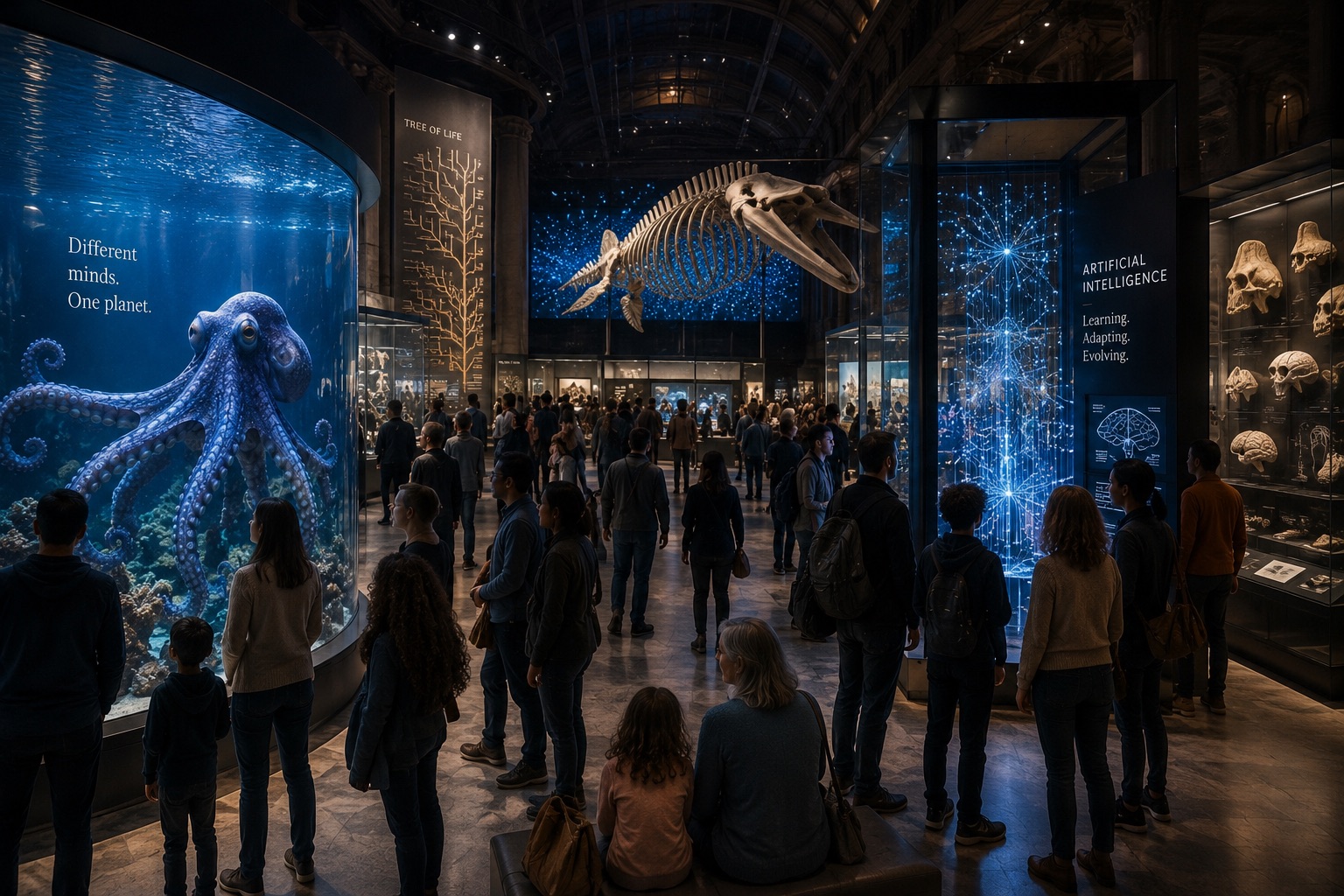
The discovery of a new species is often treated as a scientific footnote. In reality, every newly discovered organism expands humanity’s understanding of what is possible. The tiny blue octopus near the Galápagos Islands reminds us that intelligence is neither singular nor predictable. Evolution has already demonstrated multiple pathways to cognition, many of which challenge human assumptions about thought, awareness, and adaptation.
As humanity enters an era shaped by artificial intelligence, robotics, biotechnology, and increasingly complex systems, these lessons become more than biological curiosities. They become strategic insights. The future will likely be populated by forms of intelligence fundamentally different from our own. Understanding how nature repeatedly generates cognition may prove essential for navigating that future responsibly.
The octopus reveals a truth civilisation often forgets: brilliance does not emerge from conformity. It emerges from adaptation. There is no single blueprint for intelligence. Nature never needed one.

Why These Matter - WTM MEDIA is an independent editorial platform exploring the forces shaping our world—through people, culture, commerce, design, systems, and governance. Connecting the dots between today’s headlines and tomorrow’s realities.