
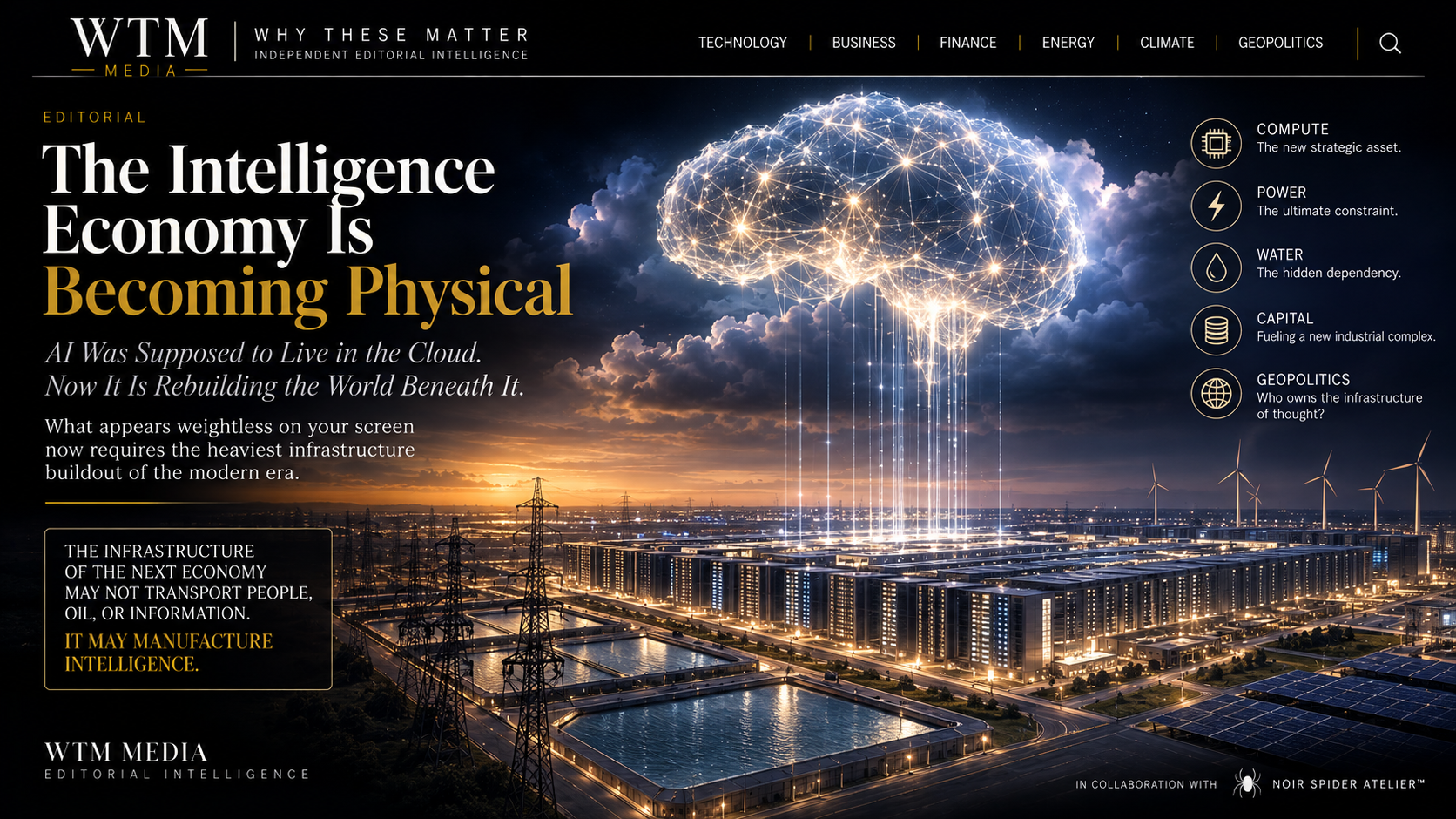
Artificial intelligence arrives on our screens almost without weight. A sentence materialises. An image appears. A model reasons through a problem in seconds. The interface encourages a seductive fiction: intelligence has escaped matter. It lives somewhere called the cloud. The economics now reveal the opposite. AI is becoming one of the most physically demanding capital projects of the modern era. In April, the International Energy Agency reported that capital expenditure among five large technology companies exceeded $400 billion in 2025 and was expected to increase by another 75 per cent in 2026. This month, Nvidia announced arrangements with major financial institutions intended to mobilise more than $500 billion of third-party capital for AI infrastructure. Alphabet, meanwhile, has returned repeatedly to debt markets as technology companies finance an AI investment cycle that Reuters says could push sector spending beyond $730 billion this year. Money is only the beginning. Intelligence at industrial scale requires semiconductors, servers, transformers, substations, transmission networks, cooling equipment, water, land, concrete, skilled labour and — above everything — electricity. Data-centre electricity demand rose 17 per cent in 2025, according to the IEA, while AI-focused facilities grew faster still. The agency now expects data-centre electricity consumption to double by 2030, with electricity use at AI-focused centres potentially tripling. Then comes the environmental contradiction. A Financial Times analysis of 60 large planned American data-centre projects estimates potential annual emissions of approximately 101.5 million tonnes of carbon dioxide if their projected electricity requirements are supplied under anticipated generation conditions. Utilities are adding gas capacity, and some coal retirements are being delayed as electricity demand accelerates. We called it artificial intelligence. The infrastructure required to produce it is brutally physical. The consequential AI story is therefore no longer merely which model can reason fastest, generate the best video or dominate the next benchmark. The deeper story is the emergence of an industrial system capable of reorganising capital, electricity, land, supply chains and geopolitical power around the production of machine intelligence. The cloud has touched the ground. And what it is building there may prove considerably more important than the chatbot.
The word cloud may be one of the most successful acts of abstraction in technological history. It transformed warehouses full of machinery into an atmospheric metaphor. Files floated into it. Software migrated towards it. Computing became something users experienced without confronting the physical systems producing it. Artificial intelligence inherited that illusion. Ask a model a question and the answer seems to emerge from nowhere. Yet somewhere, processors are switching, servers are consuming electricity, cooling systems are removing heat and transmission networks are carrying power towards machines executing billions of calculations. The cloud was never weightless. AI is simply making its weight impossible to ignore.
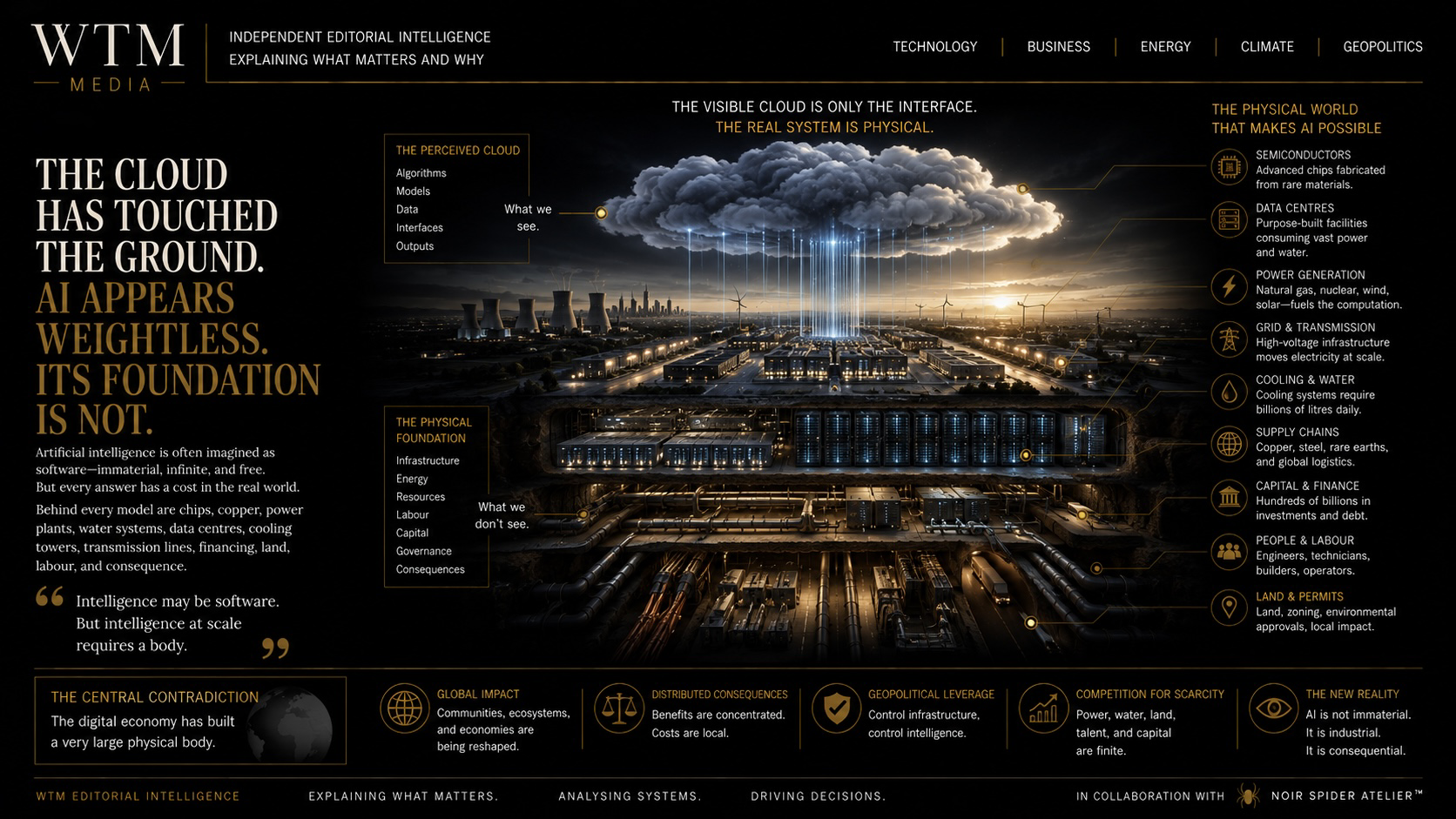
A modern AI data centre is less like an enlarged office server room than a new species of industrial facility. Its productive machinery is compute. Its raw inputs include electricity and data. Its supporting anatomy includes networking equipment, backup generation, cooling infrastructure, transformers, substations and increasingly specialised chips. The IEA notes that although a data centre itself can sometimes be operational within two or three years, the electricity infrastructure required to support one frequently demands longer planning horizons and substantial upfront investment. That mismatch — fast-moving technology meeting slow-moving infrastructure — is becoming one of the defining constraints of the AI economy.
The scale is already consequential. US data centres consumed approximately 176 terawatt-hours of electricity in 2023, around 4.4 per cent of national electricity consumption. Federal analysis has projected that they could consume between 6.7 and 12 per cent of US electricity by 2028, reaching roughly 325–580 TWh annually. The range is wide because technological efficiency, AI adoption and infrastructure development remain uncertain. The direction is not. Electricity systems built around decades of comparatively predictable demand are confronting enormous new loads that can arrive in concentrated geographic clusters.
And electricity is only one layer. High-performance computing generates heat, which must be removed continuously. Cooling can require substantial water or electricity depending upon system design and climate. Advanced chips depend upon globally distributed semiconductor supply chains. Data-centre campuses require land and planning permission. Grid connections require transformers and transmission capacity. Construction requires concrete, steel and specialised contractors. Operations require technicians, engineers and cybersecurity systems. Financing requires confidence that infrastructure built for today’s models will remain economically productive as architectures evolve. AI may be digital at the point of interaction, but virtually every layer beneath that interaction belongs to the physical economy.
This changes how we should understand technological scale. Software historically possessed an extraordinary economic property: once built, it could often be reproduced at negligible marginal cost. AI complicates that model. Digital intelligence can certainly be distributed globally, but producing more of it requires additional computational capacity. Greater model usage can translate into greater inference demand. More sophisticated systems may require increasingly capable hardware. Efficiency gains matter enormously, but the IEA reported in April that even exceptionally rapid improvements in energy efficiency were being overwhelmed by expanding AI adoption and increasingly energy-intensive uses.
The result is a conceptual inversion. For twenty years, technology companies persuaded markets that the future was increasingly asset-light. The next stage of technology may be extraordinarily asset-heavy. AI has not abolished industrial economics. It has created a new industrial system whose factories happen to manufacture computation. The digital economy has developed a very large physical body.
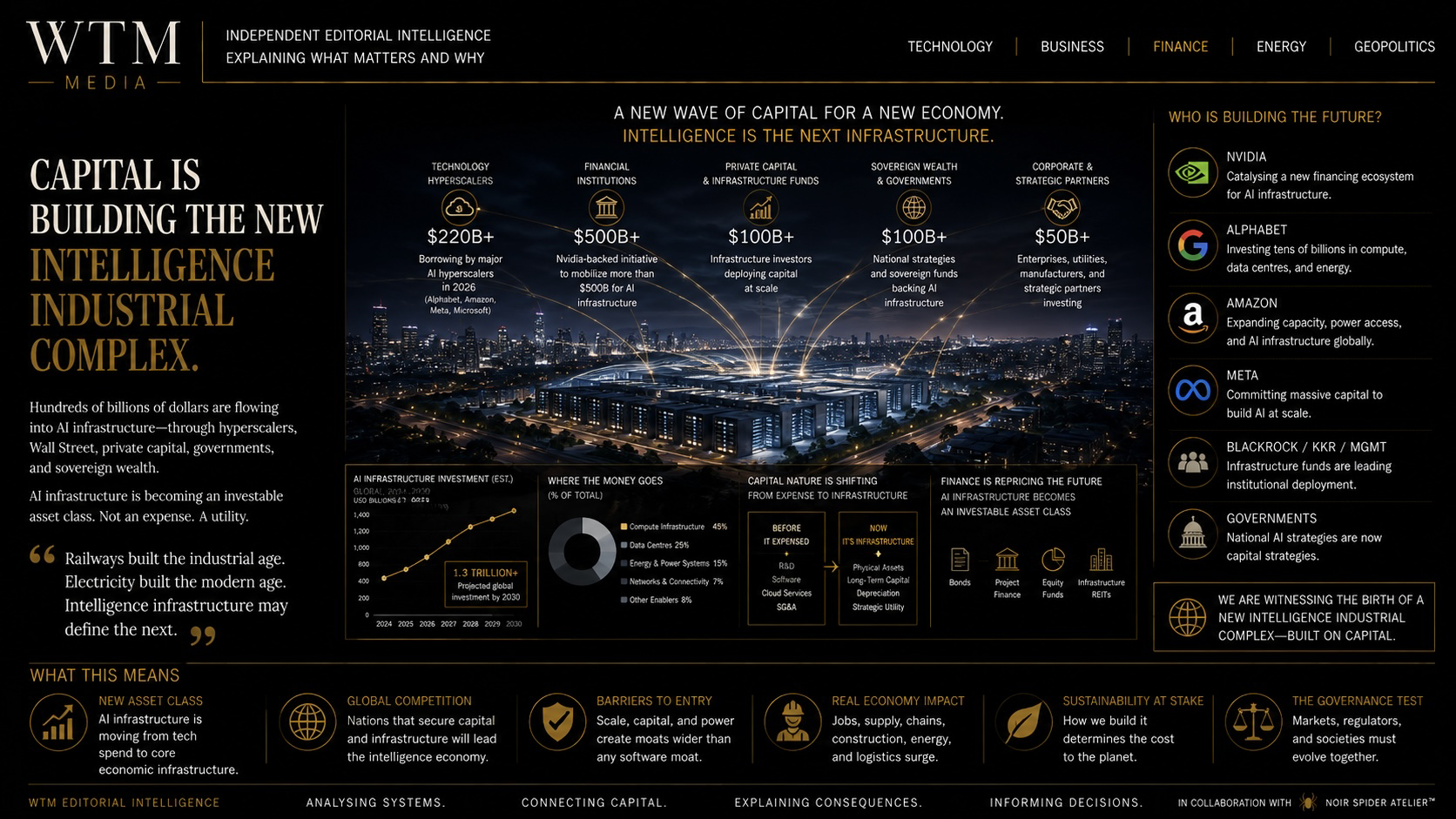
Follow the money and the transformation becomes clearer. Nvidia’s recently announced infrastructure initiative brings together major financial institutions including Goldman Sachs, Apollo, BlackRock, Blackstone, Brookfield and KKR around arrangements intended to mobilise more than $500 billion of third-party capital for AI infrastructure. The initiative is significant not because half a trillion dollars will necessarily appear tomorrow — financing arrangements are not the same thing as deployed capital — but because of what the structure implies. Compute is beginning to be financed not simply as corporate technology expenditure, but as infrastructure capable of attracting dedicated pools of institutional capital.
That distinction matters. Railways required financing structures capable of paying for enormous fixed assets before their economic networks fully existed. Electricity required generation plants, grids and long-lived capital. Telecommunications required towers, cables, satellites and spectrum. The internet eventually required hyperscale data centres and global fibre networks. Each technological revolution became economically transformative only after capital learned how to finance the physical systems underneath it. Artificial intelligence is entering that phase now.
The hyperscalers’ balance sheets make the transition visible. Alphabet’s move towards its first Australian-dollar bond follows a $25 billion US-dollar bond issuance in August and an $85 billion equity raise in June. Reuters reports that technology-sector AI spending is projected to exceed $730 billion this year and that escalating investment has begun putting pressure on cash flows; Alphabet recorded negative free cash flow in the second quarter of 2026. The strategic question is no longer whether wealthy technology companies can fund AI expansion. It is how long the industry can compound infrastructure spending before the economics of AI services must justify the capital underneath them.
This is why the financial architecture deserves as much scrutiny as the technical architecture. Debt converts expectations about future intelligence demand into obligations in the present. Infrastructure funds convert data centres into investable assets. Long-term power agreements convert anticipated computation into electricity demand years before a model processes its first prompt. Semiconductor orders propagate through manufacturing supply chains. Land purchases transform local property markets. Capital expenditure becomes construction revenue, utility investment, equipment orders and eventually depreciation sitting on corporate balance sheets. A chatbot may be the consumer-facing product. Beneath it sits an expanding financial machine.
There is opportunity here, but also risk. If AI adoption continues expanding rapidly and productive applications generate sufficient economic value, today’s infrastructure may resemble the early construction of other transformative networks: expensive before becoming indispensable. If utilisation, pricing power or productivity gains disappoint, some assets could prove considerably less valuable than their financing assumptions implied. Infrastructure has one unforgiving characteristic that software rhetoric sometimes obscures: once concrete is poured and debt is issued, optimism acquires a balance sheet.
That is why Nvidia’s proposition that compute could increasingly function as an asset class is so consequential. The idea shifts AI from technology procurement towards financial infrastructure. It invites pension funds, sovereign capital, private credit, infrastructure investors and banks into an ecosystem previously dominated by technology-company balance sheets.
When markets begin financing computation as they once financed railways, telecommunications and power generation, we should recognise what is happening. Intelligence is becoming investable infrastructure.
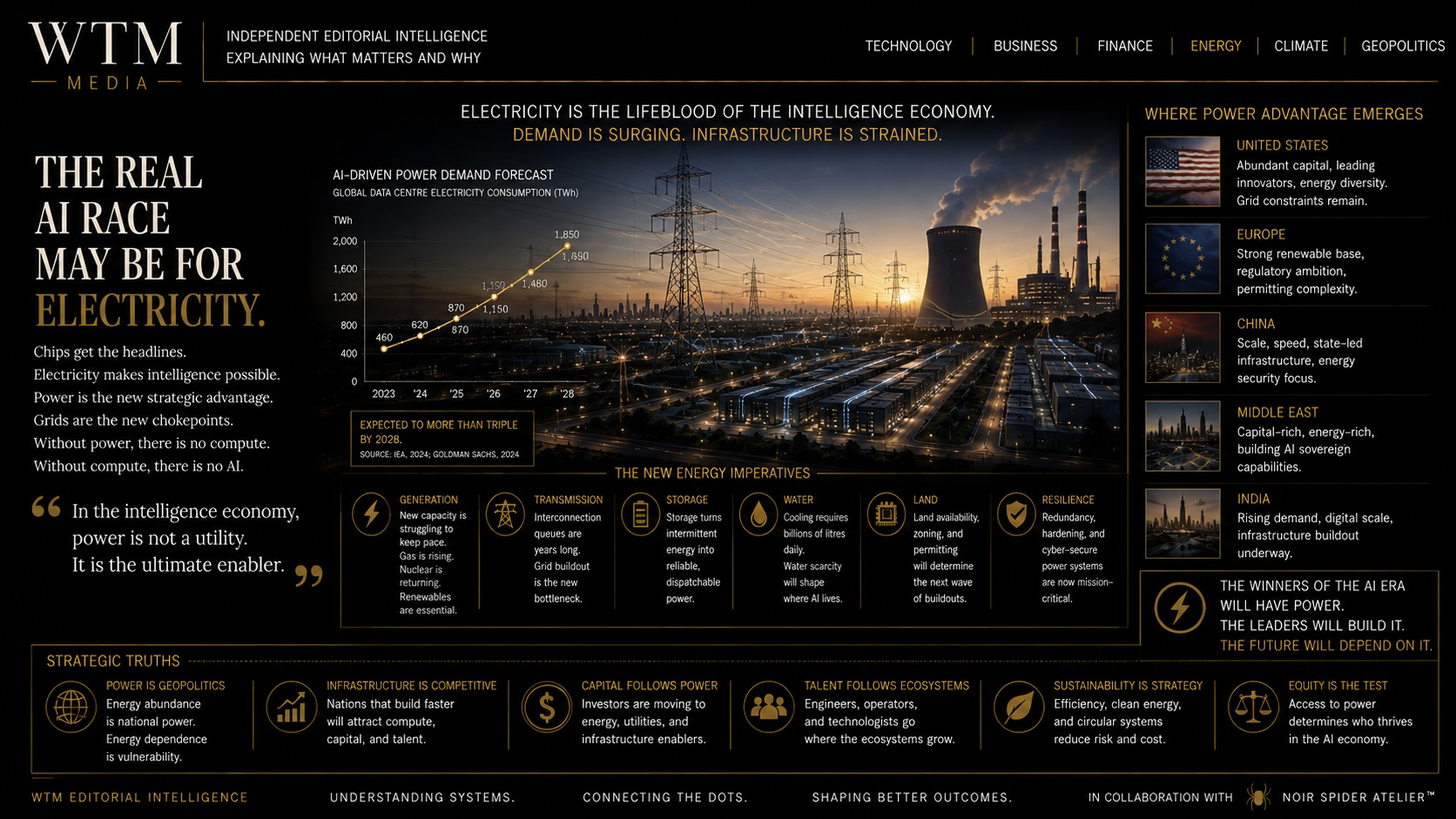
Semiconductors receive the headlines because chips are visible symbols of technological advantage. But a processor without reliable electricity is an expensive piece of silicon. The deeper AI competition may therefore be emerging not merely between model developers or semiconductor manufacturers, but between regions capable of producing enormous quantities of dependable, affordable power and delivering it where computation needs to exist.
The IEA projects global data-centre electricity consumption at approximately 945 TWh by 2030, more than twice current levels. In the United States, data centres are expected to account for nearly half of electricity-demand growth through the end of the decade. Yet the agency also provides an important corrective to apocalyptic narratives: globally, data centres still represent less than 10 per cent of projected electricity-demand growth to 2030. Electric vehicles, industrial activity, air conditioning and broader electrification also matter enormously. AI is not consuming the world’s electricity. Its significance comes partly from concentration: enormous new loads can appear in particular places faster than local grids can adapt.
This geographic concentration turns infrastructure availability into competitive advantage. A region may possess land and investment incentives but insufficient grid capacity. Another may possess abundant generation but lack transmission. A third may have electricity but face water constraints or community opposition. Some markets may have power but years-long interconnection queues. The IEA estimates that, without measures to address grid constraints, roughly 20 per cent of planned data-centre projects could face delays. Compute can travel through fibre. Power plants and transmission lines cannot be downloaded.
That reality is already changing energy strategy. Renewables are expected to meet roughly half of additional global electricity demand from data centres through 2035, supported by storage and grid expansion. But dispatchable power is also becoming strategically valuable. The IEA expects natural gas to supply a substantial portion of incremental demand, while nuclear and geothermal are receiving renewed attention from technology companies seeking reliable low-carbon generation. The emerging AI energy system will therefore be technologically plural rather than ideologically tidy.
The environmental tension follows directly. The Financial Times estimates that 60 large planned US data-centre projects could eventually produce 101.5 million tonnes of annual carbon emissions under its modelling assumptions. Utilities are developing new gas-fired generation, while some coal retirements have been delayed. At the same time, technology companies continue procuring renewable energy and investing in emerging clean-energy technologies. Both realities can coexist. AI can accelerate investment in clean generation while simultaneously increasing near-term fossil-fuel demand where grids cannot expand clean supply quickly enough.
This is precisely why treating AI, climate and energy as separate policy domains has become intellectually obsolete. A decision about where to construct a data centre is simultaneously a decision about electricity generation, transmission infrastructure, water, land, emissions, taxation, employment, industrial strategy and national technological capacity. Architecture matters. Planning matters. Utility regulation matters. Community consent matters. Climate policy matters. The server rack is merely where these systems meet.
The countries and regions that understand this integration earliest may acquire an advantage far more durable than temporary model leadership.
Because in the intelligence economy, power is no longer merely a utility; Power is now capability.

The AI conversation has trained audiences to watch the wrong scoreboard. Which model scored highest? Which company released the newest agent? Which application suddenly has a million users? Those questions matter, but they describe the visible layer of a much larger system. Models can change within months. Infrastructure operates across decades. Anyone trying to understand where durable economic value may accumulate should therefore examine what remains necessary even when today’s technological winner becomes tomorrow’s footnote.
Start with electricity. Who can provide reliable power, at what price, and on what timeline? Then examine transmission and interconnection. Generation capacity is irrelevant if electricity cannot reach the load. Examine cooling and water. Ask whether local environmental conditions constrain expansion. Examine permitting and land. Ask whether communities see data centres as economic development or resource competition. Examine hardware. Semiconductors receive attention, but transformers, switchgear, networking systems, backup power and cooling equipment can become equally consequential when supply chains tighten. The IEA reported this year that bottlenecks involving gas turbines, transformers, advanced chips and other equipment were already constraining development.
For executives, this means AI strategy cannot remain trapped inside the technology department. Procurement decisions increasingly intersect energy exposure, geographic resilience, data sovereignty, cybersecurity and capital allocation. A company choosing where its intelligence runs is indirectly choosing regulatory regimes, infrastructure dependencies and geopolitical relationships. Cloud strategy is becoming industrial strategy.
For investors, the lesson is not to indiscriminately purchase anything adjacent to a data centre. Infrastructure booms create both fortunes and spectacular overcapacity. The more useful discipline is to identify bottlenecks, pricing power, durable demand and replacement cycles. Which businesses benefit across multiple model architectures? Which assets remain useful if computing becomes more efficient? Which companies possess contractual protection against energy-price volatility? Which projects depend upon heroic assumptions about utilisation? Infrastructure rewards patience, but it punishes poor underwriting.
For designers, architects and planners, AI creates a different challenge. Data centres are not abstract boxes disconnected from human environments. They occupy land, consume resources, alter utility planning and shape regional development. Their architecture increasingly intersects heat reuse, water systems, renewable integration, modular construction, landscape impact and community relationships. Human-centred design must therefore expand beyond the interface. The most consequential AI design problem may not be the chatbot window. It may be designing the physical systems behind it so that intelligence infrastructure can coexist responsibly with the communities supplying its land, labour, water and electricity.
For citizens and policymakers, the questions become even more fundamental. Who pays for grid upgrades? Should households subsidise infrastructure built primarily for private computational demand? What obligations should data-centre developers carry for new generation or transmission? How should water consumption be governed in constrained regions? What happens when strategic national demand collides with local environmental limits? And how should countries balance the desire to attract AI investment against the risk of transferring infrastructure costs onto communities? The useful discipline is therefore simple: Do not merely ask what artificial intelligence can do. Ask what artificial intelligence requires. The second question reveals the system.
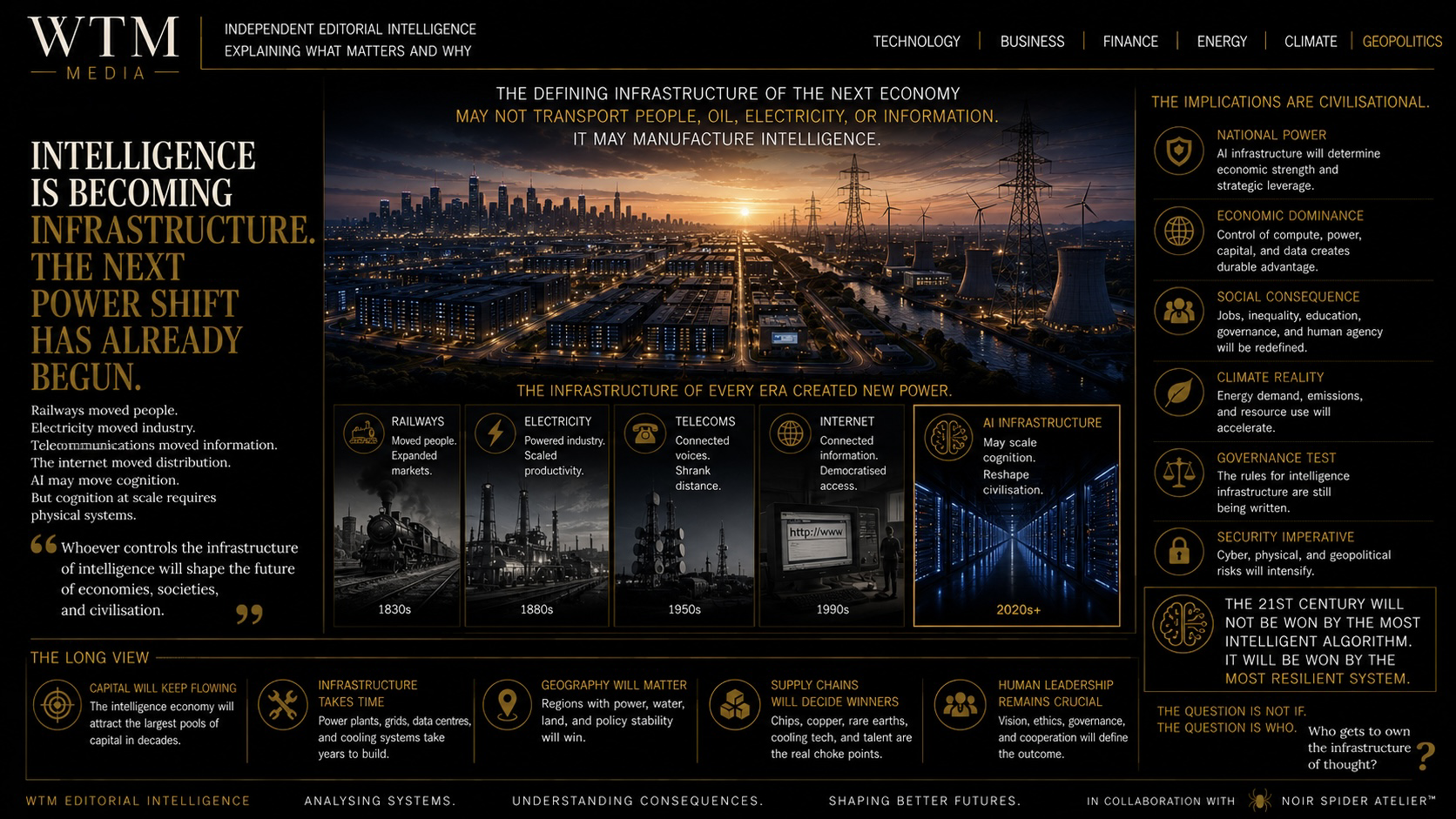
Civilisations are often reorganised by infrastructure before they fully understand what the infrastructure has changed. Railways compressed geographic distance and reorganised markets around stations, freight corridors and industrial cities. Electricity separated productive power from the location of rivers and steam engines. Telecommunications allowed voices and information to travel independently of bodies. The internet made distribution effectively instantaneous across much of the world.
Artificial intelligence may introduce another infrastructure layer: industrialised cognition.
That does not mean machines have become human minds, nor that intelligence is a commodity in any simple philosophical sense. It means certain cognitive functions — classification, prediction, generation, translation, coding, pattern recognition, simulation and increasingly forms of reasoning — can now be produced computationally and distributed through networks at enormous scale. Once those capabilities become embedded inside medicine, finance, manufacturing, defence, education, scientific research and government, access to computation begins to resemble access to productive infrastructure.
That changes geopolitics. Countries possessing abundant electricity, semiconductor access, capital, technical talent and regulatory capacity may acquire structural advantages. Those dependent upon foreign compute could discover that digital sovereignty is partly an energy and infrastructure question. The geography of intelligence may therefore follow resources differently from the geography of the consumer internet. Fibre made digital services global; power constraints could make advanced computation surprisingly local.
It changes economics as well. If intelligence becomes cheaper and more abundant, organisations may reorganise around what machines can perform and what humans remain uniquely responsible for. Yet the economic rents generated by that transition will not necessarily flow evenly. Owners of models, chips, data centres, energy infrastructure, proprietary data and distribution channels may capture different layers of value. The central economic struggle of the AI era may consequently concern not simply who invents intelligence, but who owns the systems required to produce and distribute it.
And it changes the climate equation. The same technology capable of optimising electricity grids, discovering materials, improving weather forecasting and accelerating scientific research also requires an expanding physical footprint. The IEA’s analysis captures the paradox: AI can potentially improve energy systems even while data-centre electricity demand grows rapidly. Technological progress does not eliminate resource constraints. It rearranges them.
Most importantly, it changes governance. Infrastructure eventually becomes too consequential to remain a purely technical matter. Railways produced regulation. Electricity produced utilities and public-service obligations. Telecommunications generated spectrum governance and universal-service debates. The internet created unresolved battles over privacy, competition, speech and sovereignty. Intelligence infrastructure will produce its own institutional questions: access, concentration, security, environmental responsibility, data rights, national control and accountability.
The mistake would be to believe that the future belongs automatically to whoever possesses the most intelligent algorithm. Algorithms will improve. Models will change. Today’s frontier system will become tomorrow’s commodity.
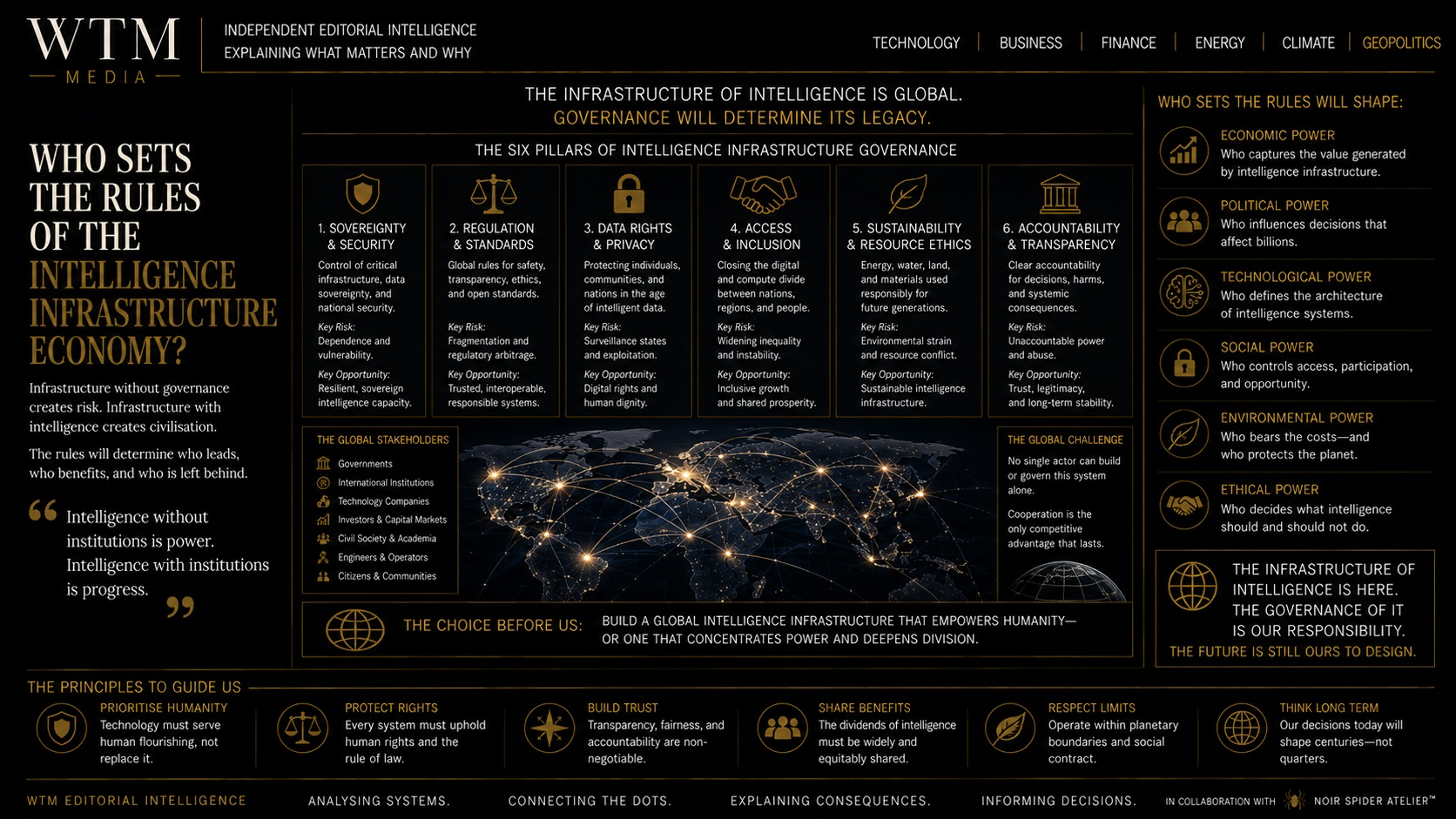
But power plants last decades. Transmission corridors reshape regions. Semiconductor fabrication requires extraordinary ecosystems. Data centres embed capital into geography. Institutions determine who may build, who may connect, who bears the cost and who receives the benefit.
The defining infrastructure of the next economy may therefore not primarily transport people, oil, electricity or information. It may manufacture intelligence. And once intelligence becomes infrastructure, the decisive question changes from What can AI do? to something considerably more consequential: Who gets to own the infrastructure of thought?
That question belongs not merely to Silicon Valley; It belongs to all of us.
Editorial note: Figures and projections in this editorial distinguish announced financing capacity, corporate expenditure, observed electricity consumption and forecast demand; they should not be read as interchangeable measures. Forecasts remain subject to changes in AI adoption, hardware efficiency, energy infrastructure and economic conditions.
Primary research and reporting: International Energy Agency — Energy and AI · US Department of Energy — Data Centre Electricity Demand · Financial Times — Big Tech's Data Centre Boom and Carbon Emissions · Reuters — Alphabet and the AI Financing Expansion.
Visual Intelligence: Noir Spider Atelier™ — A Division of WTM Media
Editorial Direction: Kelly Dowd, MBA, MA
Copyright: © 2026 WTM Media. All rights reserved.

Why These Matter - WTM MEDIA is an independent editorial platform exploring the forces shaping our world—through people, culture, commerce, design, systems, and governance. Connecting the dots between today’s headlines and tomorrow’s realities.