
Desk briefing
Who Gets to Use the Intelligence We Are Building?
NVIDIA’s science commitment makes access, infrastructure and public accountability a leadership decision. The next test is what institutions can actually do with it.
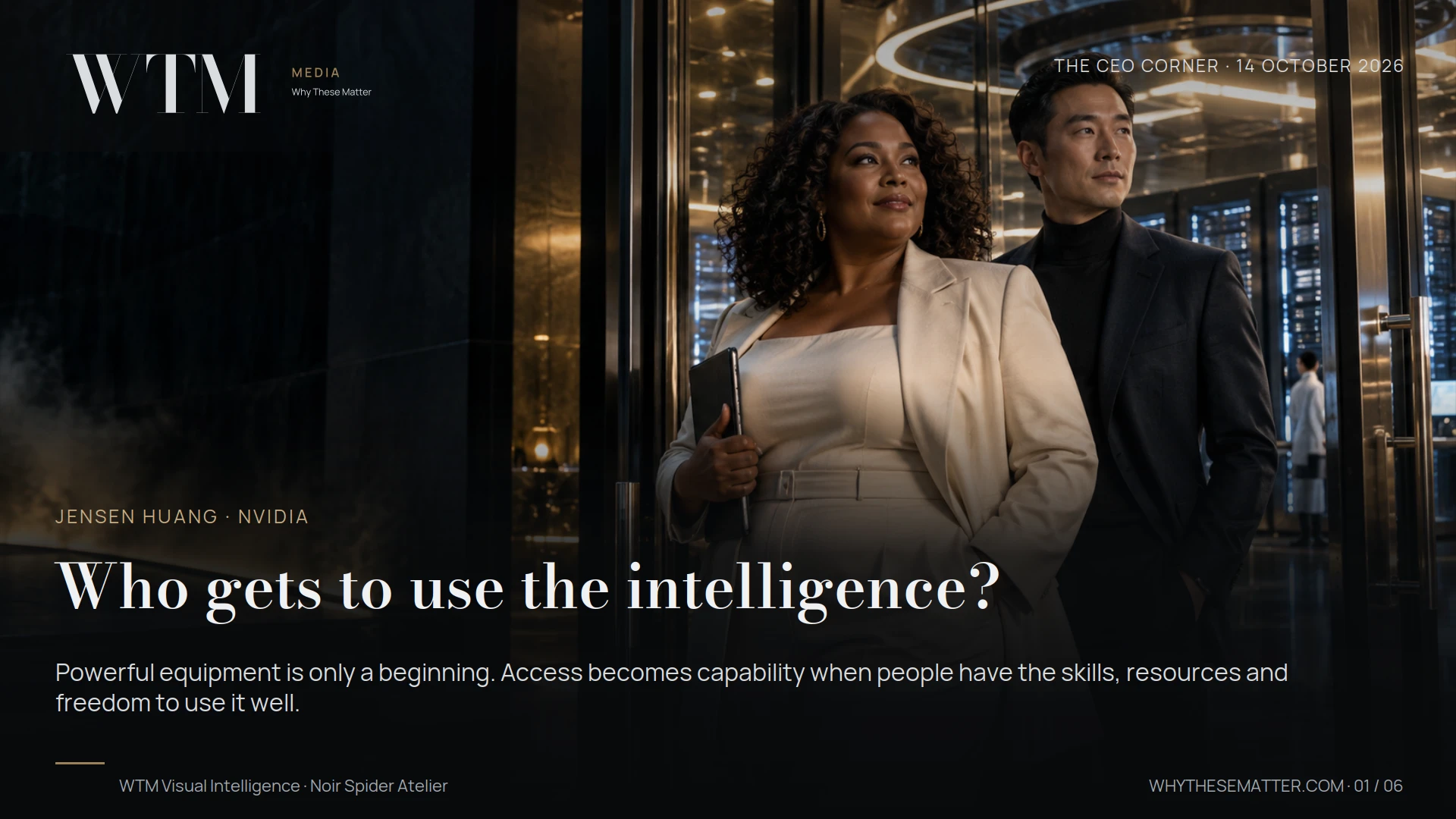
WTM Visual Intelligence · Noir Spider Atelier
The decision
Commit infrastructure and resources to scientific capability, while making the terms of access and the resulting dependence visible.
From the desk
WTM public-source analysis. This is not a WTM interview, a statement supplied to WTM, or an endorsement.
On 8 October, NVIDIA announced commitments valued at $1 billion over five years to support US science, including quantum computing, healthcare and energy security. Jensen Huang, the company’s founder and chief executive, presented the commitment as support for scientific and industrial progress. Those are stated intentions. The announcement does not demonstrate that the money or equivalent resources have already been delivered. [1]
The CEO decision signal is a commitment to influence the conditions under which research happens. Providing infrastructure can widen access to difficult experiments. It can also make a particular supplier’s tools central to an institution’s working habits. Both possibilities deserve examination without assuming that commercial benefit invalidates public value, or that public value removes the need for scrutiny.
NEWS CHECK · 14 OCTOBER 2026
On 13 October, NVIDIA announced a separate five-year compute-access donation to U.K. agentic safety and security research, valued by the company at $250 million, with $50 million of access planned annually through U.K.-based NVIDIA Cloud Partners. The announcement extends the access question beyond the United States, but provider selection, technical architecture and commercial terms remain to be agreed. This is a corporate commitment, not evidence of delivery or research impact. The Visual Intelligence PDF retains its 11 October research cut-off and does not include this dated update. [4]
WTM systems assessment
NVIDIA’s Vera Rubin announcement describes a platform integrating computing, networking and storage, alongside a reference design that addresses power and cooling. It is a useful design case because the object being optimised extends beyond a single processor. The company’s description is evidence of its design approach; it is not independent verification of every performance claim. [2]
Integration can make responsibility clearer when a supplier coordinates interacting components. It may reduce the work a customer must perform to make those components operate together. The counterargument is dependency: an institution can find itself adapting its data, skills and procedures to one commercial environment. Neither consequence should be assumed to dominate every deployment.
Double ROI™ asks two related questions. Return on Investment considers useful research capacity relative to the resources required. Return on Integrity considers fair access, honest reporting and responsible treatment of people and data. Keep the measures separate so an attractive productivity figure cannot conceal an unacceptable condition of participation.
Why These Matter
The teachers edition in this series asks how human capability develops. This edition follows that question into advanced infrastructure. The connection is deliberate: equipment becomes useful through people who can question, operate and improve it. Supporting those people is part of the infrastructure decision, even when the budget places them in another column.
NVIDIA’s announcement is consequential because it makes a substantial claim on the future of scientific capability. The public should be able to follow that claim from intention to delivery. Doing so would help distinguish a productive partnership from an impressive commitment whose practical terms remain difficult to assess.
Sources & publication notes
Research cut-off: 11 October 2026. Edition date: 14 October 2026. Statements attributed to companies are not independently tested outcomes. Human editorial responsibility: Kelly Dowd, MBA, MA.
[1] NVIDIA commitments for US science · 8 October 2026. Corporate announcement; no independent evidence of disbursement or realised research impact.
[2] NVIDIA Vera Rubin platform announcement · 16 March 2026. Vendor description. Availability and performance claims are conditional; no WTM benchmark testing.
[3] IEA Energy and AI executive summary · 10 April 2025. All data centres, not NVIDIA or AI alone. 2030 is a scenario projection, not observed consumption.
News check · 14 October 2026. On 13 October, NVIDIA announced a U.K. compute-access commitment valued by the company at $250 million over five years. Provider selection, technical architecture and commercial terms remained to be agreed. This is a corporate announcement, not evidence of delivery or research impact. The Visual Intelligence PDF retains its 11 October research cut-off.
[4] NVIDIA commitment for U.K. agentic safety and security research · 13 October 2026.