
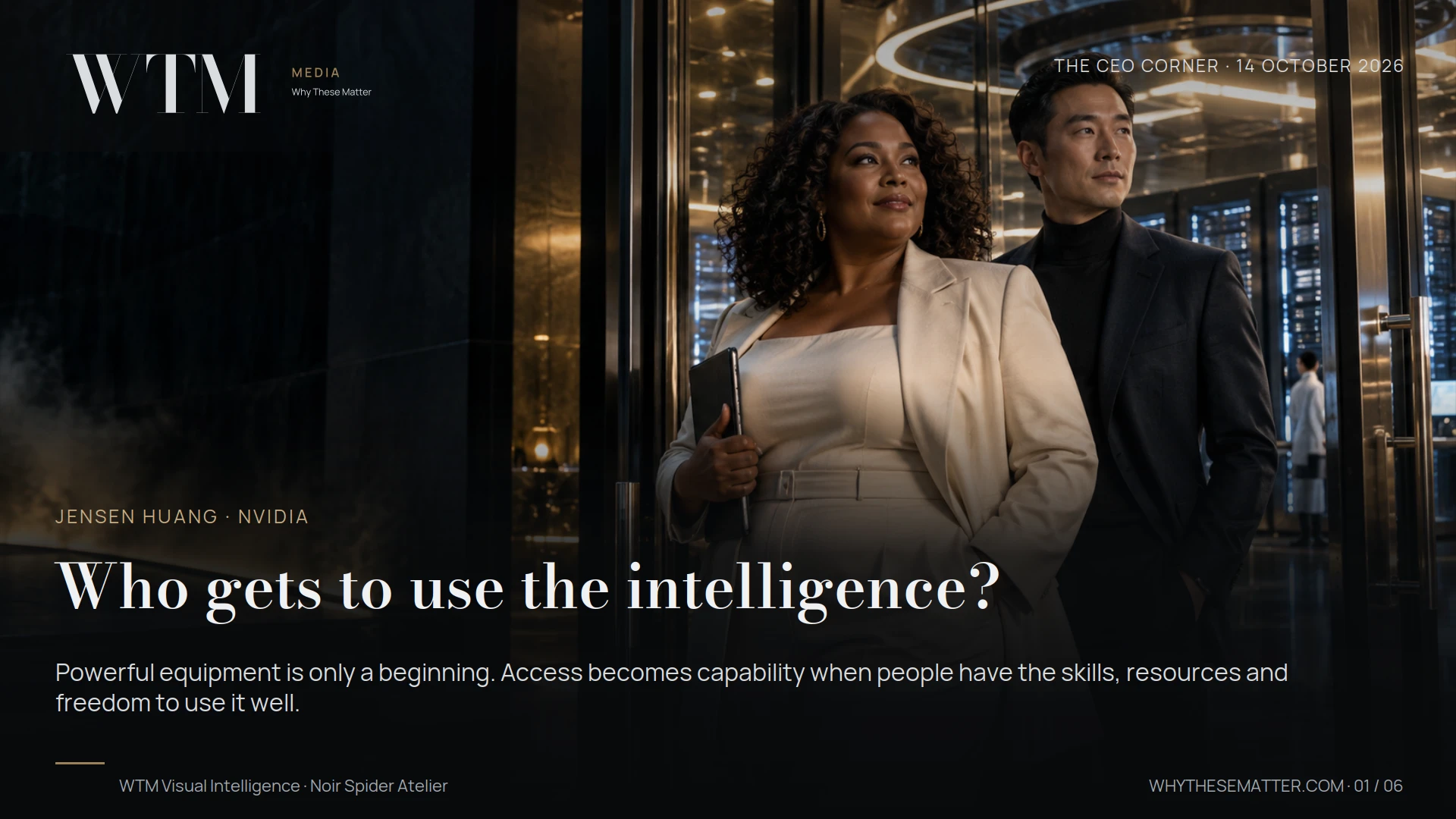
NVIDIA’s science commitments and integrated computing design expose a bigger question than processing speed: who gains usable capability? WTM examines access, electricity, institutional dependence and the evidence leaders should demand before calling infrastructure an achievement.
NVIDIA’s science commitment makes access, infrastructure and public accountability a leadership decision. The next test is what institutions can actually do with it.
Edition: 14 October 2026 · Kelly Dowd, MBA, MA · 9 MIN READ. Research checked 11 October 2026.
NEWS CHECK · 14 OCTOBER 2026
On 13 October, NVIDIA announced a separate five-year compute-access donation to U.K. agentic safety and security research, valued by the company at $250 million, with $50 million of access planned annually through U.K.-based NVIDIA Cloud Partners. The announcement extends the access question beyond the United States, but provider selection, technical architecture and commercial terms remain to be agreed. This is a corporate commitment, not evidence of delivery or research impact. The Visual Intelligence PDF retains its 11 October research cut-off and does not include this dated update. [4]

A research institution can own an impressive machine and still struggle to produce useful work. The missing element may be a trained engineer, a reliable electricity connection or permission to use the relevant data. Scientific capability depends on these relationships. A procurement photograph captures the equipment; it cannot show whether the institution can use it well.
On 8 October, NVIDIA announced commitments valued at $1 billion over five years to support US science, including quantum computing, healthcare and energy security. Jensen Huang, the company’s founder and chief executive, presented the commitment as support for scientific and industrial progress. Those are stated intentions. The announcement does not demonstrate that the money or equivalent resources have already been delivered. [1]
The CEO decision signal is a commitment to influence the conditions under which research happens. Providing infrastructure can widen access to difficult experiments. It can also make a particular supplier’s tools central to an institution’s working habits. Both possibilities deserve examination without assuming that commercial benefit invalidates public value, or that public value removes the need for scrutiny.
WTM’s assessment begins with a practical distinction: access to a resource and the ability to use it are separate achievements. An offer becomes usable when the recipient has the people, time, permissions and recurring budget to turn it into work. Leadership should account for these requirements before celebrating the scale of the offer.
For the scientists concerned, the terms matter. Who qualifies? Who chooses research priorities? Can a small laboratory participate without an established procurement team? Are training, storage and ongoing support covered? These are questions prompted by the commitment, not allegations about terms we have not seen. Their answers would help the public judge its substance.
The useful news is therefore the decision and its scale, accurately dated. The work still to be established is delivery. A responsible institution should publish an account of resources committed, resources made available, actual use and resulting outputs. Keeping those stages separate protects a promising initiative from becoming a story that outruns its evidence.

NVIDIA’s Vera Rubin announcement describes a platform integrating computing, networking and storage, alongside a reference design that addresses power and cooling. It is a useful design case because the object being optimised extends beyond a single processor. The company’s description is evidence of its design approach; it is not independent verification of every performance claim. [2]
The broader design lesson is that improving one component can expose another constraint. Faster computation is of limited use if data arrive too slowly, a workflow cannot be checked or a facility cannot remove the heat. Thinking in systems means identifying the limiting relationship before purchasing a more impressive part.
Integration can make responsibility clearer when a supplier coordinates interacting components. It may reduce the work a customer must perform to make those components operate together. The counterargument is dependency: an institution can find itself adapting its data, skills and procedures to one commercial environment. Neither consequence should be assumed to dominate every deployment.
A disciplined evaluation would run a representative workload from beginning to end. Measure useful completed work, the people needed to operate it and the total resources consumed. A demonstration selected by a vendor can be informative, but the institution’s own task is the relevant test. Workload choice belongs in the decision record.
This also changes the definition of affordability. An initial contribution can be generous while leaving substantial future costs. Planning should include maintenance, specialist staff, data movement, software changes and replacement. Those are proposed evaluation categories, not cost estimates for NVIDIA’s initiative. They help distinguish an attractive entrance from an affordable operating life.
The HANDS lens makes the question more complete. Humanity asks whose work improves; Adaptation asks whether people can learn and change tools; Nature asks what resources are consumed; Design asks whether the parts work together; Sustainability asks whether the arrangement can endure. The framework structures judgement. It does not certify the technology.

The IEA estimated that data centres used approximately 415 terawatt-hours of electricity in 2024. Its 2025 base case projects roughly 945 terawatt-hours in 2030. These figures concern data centres overall, with AI one driver of growth. They are not measurements of NVIDIA’s equipment or a prediction that every project will follow the same path. [3]
The figures give scale to a question that becomes local very quickly. A research programme has a location, a connection and an operating timetable. National enthusiasm cannot settle who funds the connection or how capacity is allocated among competing needs. The specific answer requires the local electricity system and project design.
Efficiency should be measured at more than one level. A system might use less energy for each completed task while total consumption rises because many more tasks are performed. That is a possible mechanism, not a measured outcome of the commitment discussed here. Leaders need both the unit measure and the total before describing an environmental benefit.
The human consequences also reach beyond researchers. Facilities staff must maintain equipment; public bodies may oversee investment; communities may experience construction and additional demand on services. An institution should identify affected groups early and give them a route to raise practical concerns. Consultation is most useful while choices can still change.
There is a credible positive case. Better research infrastructure could make difficult scientific work possible and reduce the time wasted assembling incompatible tools. But potential benefits require research quality, appropriate safeguards and subsequent application. Computing capacity cannot, by itself, establish the validity of a discovery or the fairness of its eventual use.
WTM’s conclusion is conditional: infrastructure creates an opportunity for public value when institutions can govern its use. The evidence needed includes access patterns, operating costs, reproducible outputs and an honest account of constraints. A count of installed machines belongs in that account, but it cannot stand in for the whole result.

An executive considering a comparable offer should begin by naming the capability the institution wants to retain. It might be a reliable research workflow, a trained team or the ability to test a class of hypotheses. This makes the purchase or partnership serve an institutional purpose rather than allowing the available technology to define one.
Next, assign responsibility for each dependency. The research lead owns scientific validity; operations owns reliability; procurement examines terms; the relevant governance body handles data and access. Actual roles will differ. The point is to prevent a cross-departmental programme from becoming everyone’s aspiration and nobody’s enforceable obligation.
Ask for a practical exit exercise. Can the institution export its data in usable form? Can another team reproduce the workflow? What would retraining or migration require? This is a recommendation for resilience, not a claim that the announced programme restricts either activity. The answer should be known before dependence becomes expensive.
A bounded pilot can make disagreement productive. Define one workload, its current baseline and the conditions under which the proposed system would be worth extending. Record staff time as well as technical performance. A disappointing pilot can still be valuable if it prevents a larger commitment based on an unsuitable assumption.
Double ROI™ asks two related questions. Return on Investment considers useful research capacity relative to the resources required. Return on Integrity considers fair access, honest reporting and responsible treatment of people and data. Keep the measures separate so an attractive productivity figure cannot conceal an unacceptable condition of participation.
The first decision need not be a large purchase. It could be a short feasibility review that identifies the dominant obstacle and who can resolve it. The owner should set a review date and report what remains unknown. An institution earns authority by understanding its commitments, not by borrowing the confidence of a launch presentation.

The teachers edition in this series asks how human capability develops. This edition follows that question into advanced infrastructure. The connection is deliberate: equipment becomes useful through people who can question, operate and improve it. Supporting those people is part of the infrastructure decision, even when the budget places them in another column.
NVIDIA’s announcement is consequential because it makes a substantial claim on the future of scientific capability. The public should be able to follow that claim from intention to delivery. Doing so would help distinguish a productive partnership from an impressive commitment whose practical terms remain difficult to assess.
For the company, rigorous evidence can make a stronger commercial case than unqualified celebration. For a recipient institution, it can protect bargaining power and mission. For the public, it can clarify whether access is broadening and which results justify continued support. Scrutiny is a condition of a credible relationship.
The 2027 question is not a forecast of who will win. It is a test leaders can use as commitments become operating arrangements: does greater technical capacity produce more independent institutional capability, or does it leave the institution less able to choose its next step? The answer will depend on implementation.
Start with a simple record: intended capability, access rules, full operating costs, responsible people, evidence and review date. Add the conditions under which the institution would revise or stop the arrangement. This original WTM decision tool is a practical prompt, not a validated performance model or a guarantee of return.
The most valuable intelligence infrastructure will be judged through the work people can do, the questions they can pursue and the choices they retain. That is a demanding standard. It is also more useful than confusing possession of powerful equipment with the power to act wisely.
[1] NVIDIA commitments for US science · 8 October 2026. Corporate announcement; no independent evidence of disbursement or realised research impact.
[2] NVIDIA Vera Rubin platform announcement · 16 March 2026. Vendor description. Availability and performance claims are conditional; no WTM benchmark testing.
[3] IEA Energy and AI executive summary · 10 April 2025. All data centres, not NVIDIA or AI alone. 2030 is a scenario projection, not observed consumption.
[4] NVIDIA commitment for U.K. agentic safety and security research · 13 October 2026. Corporate announcement. Provider selection, technical architecture and commercial terms remained to be agreed at publication; no independent evidence of delivery or realised research impact.
Public-source analysis, not a WTM interview or endorsement. WTM Visual Intelligence · Noir Spider Atelier. Illustrative figures; not portraits of the named executives or records of actual company events.
© 2026 WHY THESE MATTER MEDIA. ALL RIGHTS RESERVED.
Why These Matter - WTM MEDIA is an independent editorial platform exploring the forces shaping our world—through people, culture, commerce, design, systems, and governance. Connecting the dots between today’s headlines and tomorrow’s realities.