
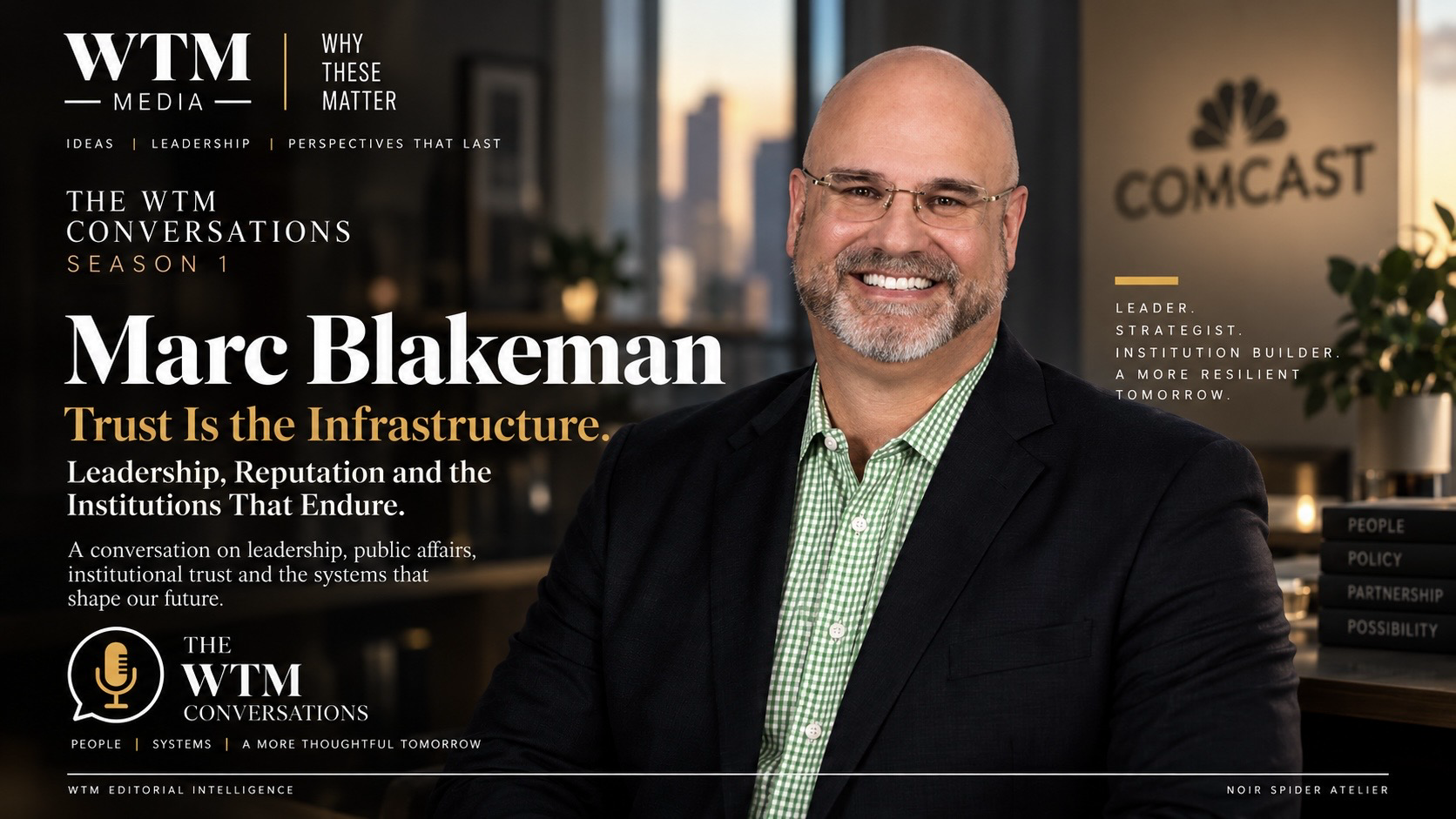
Trust is frequently treated as a sentiment: desirable, fragile and difficult to measure. Marc Blakeman Senior Vice President at Comcast, sees something more operational. Across decades in government affairs, public policy and institutional leadership — including his current role as Senior Vice President of Government and Community Affairs at Comcast — he has learnt that trust determines whether people will follow a leader, believe an institution, tolerate a mistake or remain in relationship when circumstances become difficult. In this WTM Conversation, Marc Blakeman and Kelly Dowd, MBA, MA, Editor-In-Chief, WTM Media | Why These Matter, and Host, The WTM Conversations, examine leadership beyond charisma, institutional credibility beyond communications strategy, reputation before crisis, the changing architecture of public communication and what artificial intelligence may make more — rather than less — valuable about human judgement. The central intelligence is deceptively simple: communication cannot manufacture institutional character. It can only make character visible. In an age capable of producing more information, faster, the institutions that endure may be those that understand that trust is not messaging. It is accumulated evidence.
The simplest proposition in this conversation may also be the most consequential: leadership begins with trust. Blakeman does not define trust merely as followers believing their leader. He makes it reciprocal. The leader must also trust the people being led — sufficiently to delegate responsibility, permit judgement and resist the instinct to micromanage. Once that reciprocity disappears, leadership can quietly become supervision.
That distinction matters because organisations often discuss trust as culture while managing as though distrust were policy. Employees are told they are empowered, then every decision requires approval. Innovation is celebrated, but failure is punished. Accountability is invoked, yet senior leaders distance themselves when something goes wrong. Blakeman’s model reverses this architecture. Trust becomes visible through what leaders permit other people to own.
His most useful formulation concerns failure. In a results-driven environment, he argues, people still require permission to experiment, discover that an approach is failing, understand why and move on. Failure is not the objective; intelligent learning is. The strategic requirement is recognising when something is not working before loyalty to the original idea becomes more expensive than abandoning it.
This leads to a more demanding definition of leading by example. Blakeman’s principle is that he should not ask his team to do something they know he would refuse to do himself.
Participation establishes credibility. The leader may eventually delegate the difficult task, but the team understands that delegation is an allocation of capacity rather than an evacuation of courage.
There is another layer: self-knowledge. Blakeman rejects the fantasy of the universally competent leader. He deliberately constructs teams around differentiated excellence, recognising where one person struggles and another thrives. His objective is not to produce a collection of people who are moderately capable at everything, but a system in which distinct strengths become collectively superior. That is an architectural view of leadership: the strength of the structure does not depend upon every component performing the same function.
Executive Briefing — Key Takeaways: Trust must operate in both directions. Delegation without trust becomes surveillance; experimentation without permission to fail becomes theatre. Leaders should absorb responsibility for collective defeats while visibly distributing credit for individual excellence. Teams should be designed around complementary strengths rather than manufactured sameness. And perhaps most importantly, leadership should be evaluated not simply by what a person can produce individually, but by what other people become capable of producing around them. Blakeman’s warning is explicit: outstanding individual contributors do not automatically become outstanding leaders.
WTM’s original editorial architecture for this conversation deliberately moved beyond
Blakeman’s career towards a larger systems question: how do societies build trustworthy institutions and effective leaders? His answer begins with reciprocity. Institutions endure because a relationship exists between what they require from people and what they provide in return. When that exchange ceases to make sense, legitimacy weakens.
This is an important distinction. Institutional trust cannot be repaired entirely by better public relations because communication is downstream from behaviour. An organisation may perfect its language, redesign its identity and optimise every channel through which it speaks; none of those interventions can permanently reconcile a contradiction between what the institution says it is and what people repeatedly experience it to be. Blakeman is unequivocal: communication cannot sustainably manufacture trust where the underlying conduct does not support it.
His metaphor of the suit makes the principle unusually clear. An institution may change the suit it wears — the outward expression required by a new audience, environment or era — while retaining the person inside it. The problem arises when adaptation becomes mutation: when the institution changes not merely its presentation but its core according to whichever constituency is presently watching. People eventually recognise the inconsistency. If yesterday’s identity can be abandoned today, tomorrow’s promise becomes difficult to believe.
This does not argue for institutional rigidity. Quite the opposite. Institutions must evolve because their environments evolve. What must remain coherent is the relationship between adaptation
and identity. A century-old institution communicating through a contemporary digital platform need not sound as it did in 1926. But the values governing what it says, what it does and whom it serves cannot become infinitely negotiable without eventually destroying the meaning of the institution itself.
Blakeman’s professional experience in public affairs adds a harder edge to the argument. Relationships, he observes, cannot simply be transferred from one executive to another as though they were files on a server. An introduction can be transferred. Institutional knowledge can be transferred. A contact list can certainly be transferred. Trust cannot. The incoming person must perform the human work required to establish it. In Blakeman’s field, one’s word becomes a form of professional currency; once counterparties cease believing it, access alone cannot restore its value.
That principle scales from individuals to institutions. A trusted organisation is therefore not one that has perfected the appearance of trustworthiness. It is one that has created sufficient behavioural continuity for stakeholders to predict how it will behave. The deeper WTM intelligence is that trust is accumulated predictability under conditions of uncertainty. People do not need institutions to be infallible. They need sufficient evidence that stated principles will survive inconvenience.
One of the most consequential ideas in the conversation concerns reputation. Blakeman describes it as something resembling a bank: credibility must be deposited before it is required. A crisis may expose reputation, damage it or occasionally strengthen it, but the organisation that begins constructing credibility only after something has gone wrong has misunderstood the chronology of crisis management.
His first principle in a crisis is ownership. Mistakes occur; institutional perfection is an impossible standard. What changes public interpretation is how an organisation appears once the failure becomes visible. Acknowledgement, genuine concern and willingness to participate in the solution signal that leadership understands the human consequences of what has happened. That does not mean recklessly accepting legal liability. It means refusing to confuse legal prudence with human absence.
The second principle is presence. Blakeman challenges the reflexive institutional instinct towards “no comment”. There are circumstances — particularly legal ones — in which silence may be necessary. But silence should not become a universal crisis strategy. His example from telecommunications is instructive: when an outage was already obvious to customers, concealing the obvious served little purpose. Showing crews working around the clock to restore service communicated something materially different: not that the failure had vanished, but that responsibility had arrived.
This creates a useful distinction between explanation and repair. During a crisis, institutions are frequently pressured to explain immediately why something happened. Yet establishing causation before stabilising the situation can consume the very capacity required to solve it. Blakeman’s sequence is pragmatic: resolve the immediate problem; communicate that resolution is the present priority; then conduct the post-mortem required to understand causation and prevent recurrence. Existing credibility gives an institution room to follow that sequence because stakeholders have some reason to believe the promised investigation will actually occur.
The insight extends beyond corporate reputation. Crisis compresses time. Decisions that might normally receive weeks of consideration are made in hours. Internal culture becomes externally observable. Authority becomes concentrated. Weak relationships are stressed. Previously invisible assumptions become operational choices. Crisis therefore functions as a form of institutional X-ray: it reveals whether values have been embedded deeply enough to survive pressure.
The strategic implication is substantial. Crisis preparedness should not sit solely inside a communications department or emergency manual. Reputation is produced continuously through customer experience, employee behaviour, executive conduct, stakeholder relationships, operational competence and the institutional memory of previous promises. The crisis plan begins on an ordinary Tuesday when nothing is wrong. By the time the cameras arrive, much of the public’s judgement has already been designed.
The information environment Blakeman describes is not suffering from an absence of communication. It is experiencing abundance. His distinction is therefore useful: communication has not necessarily become less meaningful; the architecture through which meaning travels has changed. Platform choice, format, audience behaviour and cultural fluency now influence whether an institution is heard at all.
This creates an uncomfortable reality for established organisations. Publishing a conventional corporate message on a contemporary platform does not make it contemporary communication. Blakeman uses TikTok as an example: transferring a traditional talking-head format onto a platform whose grammar, rhythm and audience expectations are entirely different is unlikely to produce relevance. Institutions must understand not only where people consume information, but how meaning behaves once it enters that environment.
That requires humility across generations. Blakeman notes that having once been twenty years old does not confer expertise in being twenty today. A teenager whose information environment is overwhelmingly mobile inhabits a different communications architecture from someone formed by newspapers, broadcast television or even early social media. Leadership therefore requires reverse intelligence: seniority may provide institutional knowledge, but younger people may possess forms of cultural and platform literacy that executive rank cannot substitute.
Artificial intelligence intensifies rather than eliminates this problem. Blakeman sees AI as a mechanism for moving certain forms of analytical labour away from humans. In government affairs, for example, machines can potentially examine large volumes of legislation, identify similarities across jurisdictions and rapidly produce preliminary assessments. That changes the economics of professional attention. Work previously consumed by information retrieval and comparison can move towards interpretation, strategy and relationship.
But this is where the conversation becomes more interesting than the familiar question of whether AI “replaces jobs”. Blakeman separates information processing from human consequence. A machine may identify what legislation does. A human still has to understand how to communicate its implications to policymakers, recognise competing interests, establish credibility and translate technical consequences into a human reality another person can meaningfully evaluate. His argument is not that machines will remain incapable forever; it is that the present strategic opportunity is to use machine capability to create greater space for distinctly human work.
That produces a paradox for the AI era. As synthetic communication becomes cheaper, faster and more convincing, verified human credibility may become more valuable rather than less. Trust, transparency, reputation and the ability to be regarded as an honest broker become differentiating assets precisely because information itself is increasingly abundant. Blakeman expects the enduring fundamentals of leadership to remain recognisable even as the speed at which society evaluates leaders accelerates. The technology changes. The burden of character does not disappear with it.
It is tempting to frame institutional decline as a communications crisis. That diagnosis is attractive because communication can be redesigned quickly: hire a new agency, change the message, replace the spokesperson, adopt a platform, launch a campaign. Character is considerably less convenient. It requires organisations to examine incentives, leadership behaviour, promises, decision rights, accountability and whether their relationship with stakeholders still produces genuine reciprocal value.
This conversation suggests that the trust problem sits deeper. Trust is a systems outcome. Leadership produces behaviour; behaviour produces experience; experience produces reputation; reputation influences interpretation; communication makes that system visible. Reverse the sequence and institutions begin trying to advertise their way towards credibility. That may produce attention. It does not necessarily produce authority.
Blakeman’s proposed starting point for an institution designed to endure for a century is therefore revealing: identify the genuine need it exists to meet, then build transparency, trust and effective communication around that purpose. Most importantly, be able to explain why another person should care. In public affairs, he argues, if the case for a proposal extends no further than the organisation benefiting from it, the proposal itself is deficient. Empathy, in this formulation, is not decoration around strategy. It is part of whether the strategy survives contact with society.
That principle also changes how opposition should be understood. Blakeman advocates examining an initiative from the perspective of those most likely to reject it: what will they see that its proponents have missed? What harm might they anticipate? What argument will they make? Organisations often devote extraordinary effort to proving themselves correct and insufficient effort to discovering how they might be wrong. Serious institutional intelligence requires both.
His optimism ultimately rests on adaptation rather than prediction. Humanity has crossed technological and social thresholds before. The appropriate response to AI and the next generation of institutional change is neither blind enthusiasm nor reflexive resistance, but the capacity to understand the emerging reality, preserve what remains valuable and redesign what no longer works. Blakeman’s view of change is fundamentally active: societies get through transformation partly according to how they choose to show up for it.
And this returns us to the deceptively modest idea with which the conversation began. Lead by example. Tell people the truth. Trust competent people to work. Admit what you do not know. Own failure. Share victory. Build reputation before needing to spend it. Adapt the medium without surrendering the core. Use machines where machines create leverage, and invest the resulting human capacity in judgement, relationships and meaning. None of these principles is technologically spectacular. That may be precisely why they matter. The future will not suffer from a shortage of intelligence. Its more consequential shortage may be institutions — and leaders — whose intelligence can be trusted.
Copyright
Author: Kelly Dowd, MBA, MA
Editorial Intelligence: Editor, WTM Media | Why These Matter.
Visual Intelligence: Noir Spider Atelier™ — A Division of WTM Media
Editorial Direction: Kelly Dowd, MBA, MA
© 2026 Kelly Dowd / WTM Media | Why These Matter. All rights reserved.
Third-party company names, research, publications and trademarks remain the property of their respective owners and are referenced for reporting, criticism, analysis and attribution.

Why These Matter - WTM MEDIA is an independent editorial platform exploring the forces shaping our world—through people, culture, commerce, design, systems, and governance. Connecting the dots between today’s headlines and tomorrow’s realities.