
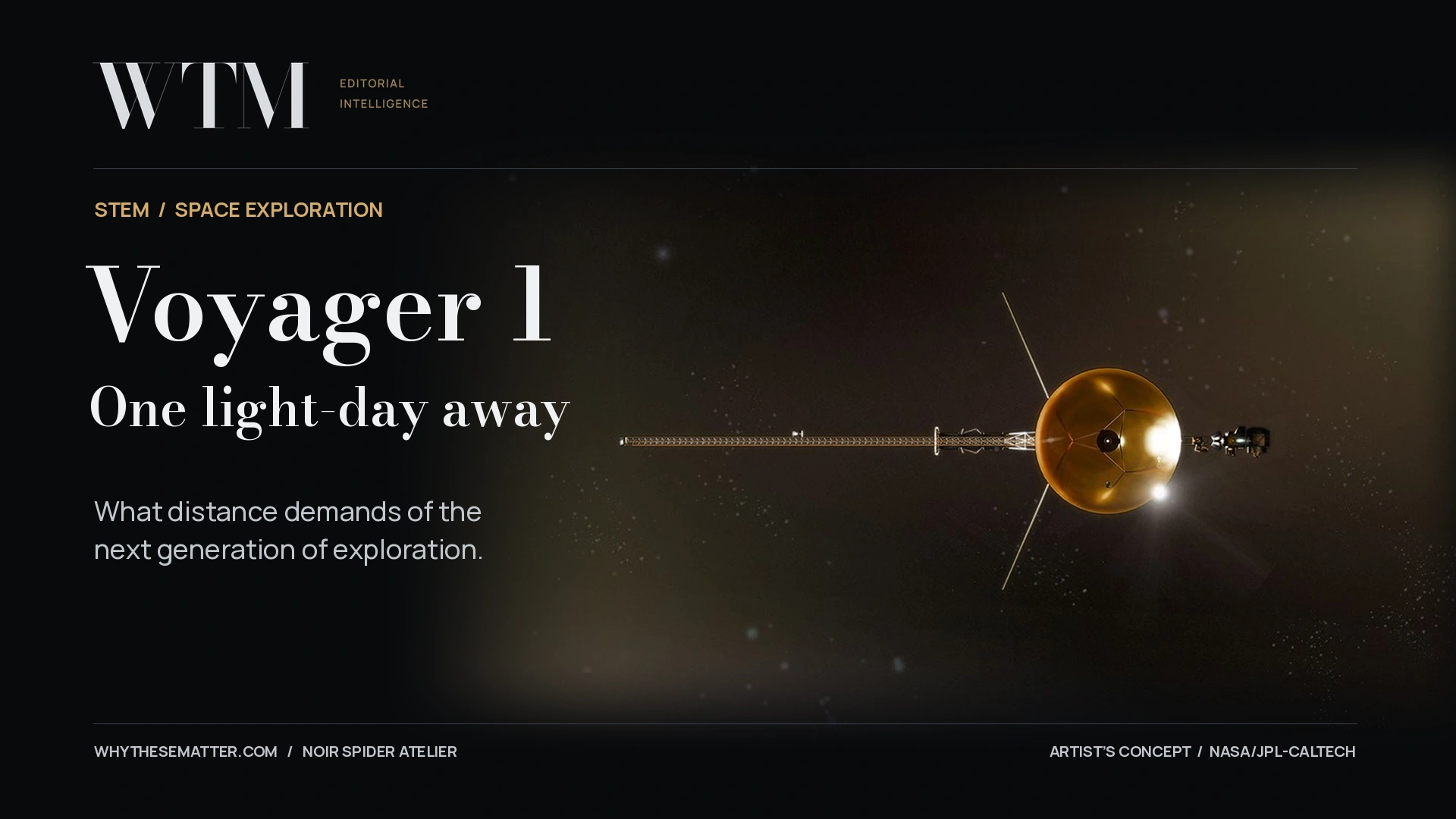
On 18 November, humanity’s farthest spacecraft crossed a boundary measured in the time it takes to hear back. The radio signal was there. Usable telemetry was not. The future of deep-space exploration depends on designing for both realities.
Edited by Kelly Dowd, MBA, MA and WTM Space Exploration Editor
Cover: NASA/JPL-Caltech artist’s concept of Voyager 1, not a photograph of the milestone. Editorial design: Noir Spider Atelier.
On 18 November 2026, at 10:16:07 UTC, Voyager 1 became the first human-made object to reach one light-day from Earth. It had spent more than 49 years travelling approximately 25.9 billion kilometres (16.1 billion miles). A radio signal can cover that distance in one day. To test a command and hear back takes roughly two days, even before the spacecraft or its operators have done any work. NASA’s distance explainer
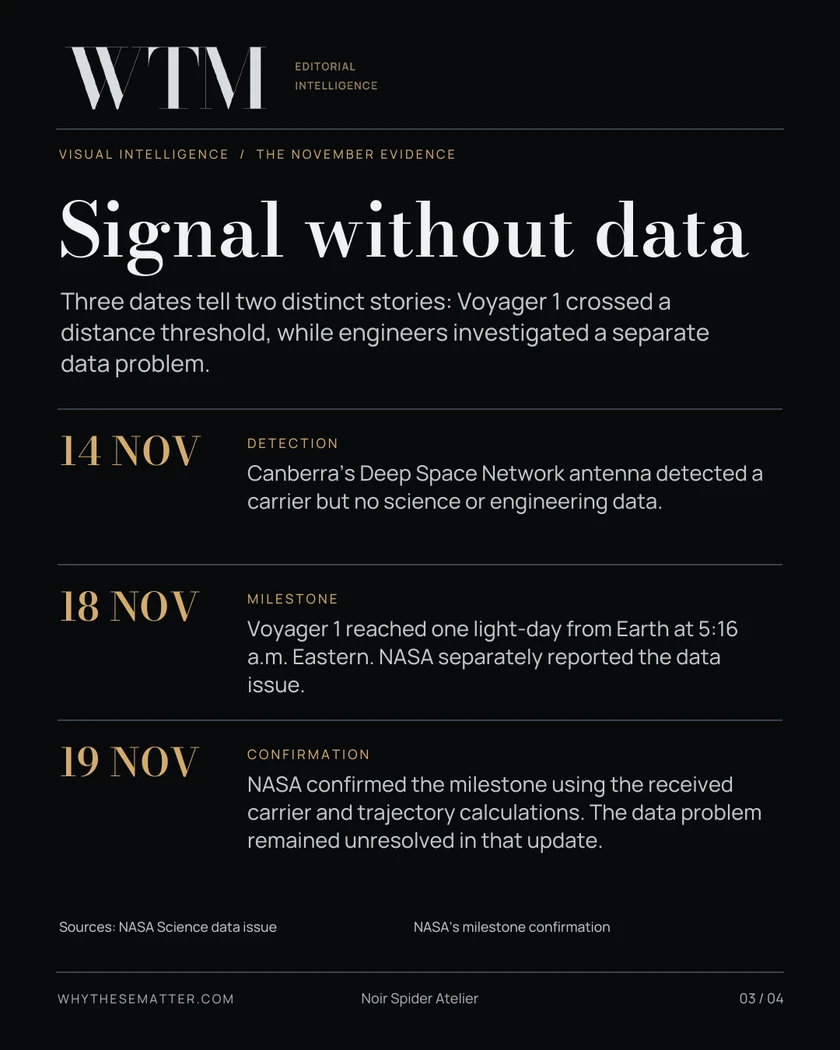
The milestone came with an awkward detail. On 14 November, an antenna in Canberra picked up Voyager 1’s radio carrier, but received no science or engineering data. On 19 November, NASA and JPL confirmed the distance milestone using the carrier and trajectory calculations. They had not established the cause of the data problem. The distinction is the story: we knew where our machine was, and that its radio was transmitting, without knowing enough about what was happening on board. NASA mission update, 18 November · NASA confirmation, 19 November
The light-day is a measure of distance, not a boundary Voyager could feel. The physical crossing came in 2012, when it passed beyond the heliosphere, the bubble shaped by the solar wind and the Sun’s magnetic field. Voyager 2 crossed in 2018. The two remain the only spacecraft to have sampled that region directly. A light-day does not mean Voyager has escaped every influence of the Sun or left the Solar System in every sense. NASA/JPL milestone and science
The November milestone nevertheless exposes a practical constraint. If Earth sends a command, waits for a reply and then sends a second command based on that reply, two simple exchanges consume roughly four days in signal travel alone. A real troubleshooting cycle also needs antenna time, interpretation and careful testing. Once delay is longer than the time a spacecraft has to respond to a hazard, the people on Earth cannot make that decision in time. The machine needs a bounded set of decisions it can make safely on its own.
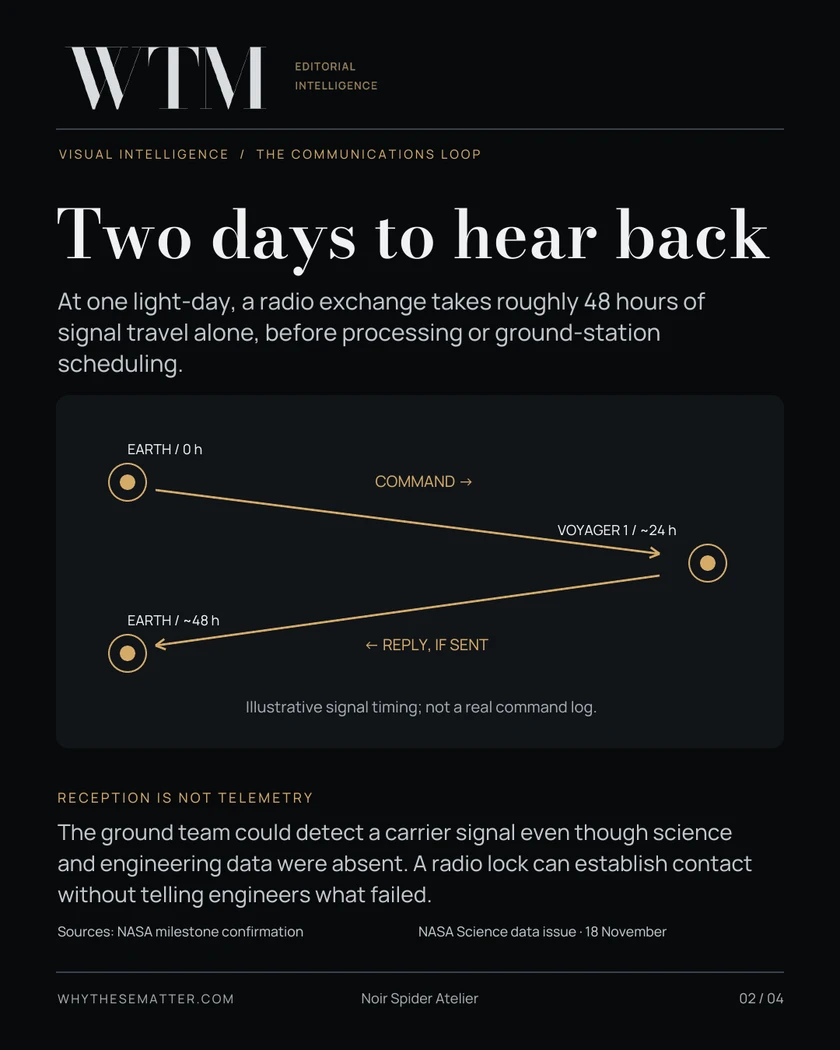
A carrier signal is evidence, not a medical chart. In its November update, NASA said the signal indicated that Voyager 1 was still pointed towards Earth and that its antenna and transmitting equipment were working. The loss of meaningful information pointed engineers towards the system that collects and formats data, but that was a lead, not a confirmed diagnosis. NASA was also examining whether the problem related to an October interruption; a connection had not been established. NASA mission update, 18 November
There is a precedent, not a prediction. In 2024, engineers found that Voyager 1 had lost the use of part of a computer’s memory. There was no room to move the affected code intact. The team split it into pieces, put those pieces in working memory and rewrote the references that held them together. Engineering data returned first, followed by usable science data from four instruments by June. When the engineering data arrived on 20 April, the ground team cheered in a JPL conference room. Their command had been sent two days earlier. That recovery tells us what was possible then. It does not tell us what caused the November 2026 fault, or how this one will end. JPL repair account · JPL science data update · JPL’s photograph of the April recovery
Voyager’s power supply illustrates an unglamorous discipline: decide which functions to preserve before something else decides for you. In October, JPL reported that each Voyager loses about four watts of electrical power a year. The team had exchanged three onboard devices for lower-power alternatives while keeping heat distributed where it was needed. On a spacecraft this old, switching something off can change temperature as well as electricity use. Efficiency is not simply doing more with less; it is knowing which system will pay for the saving. JPL’s October engineering update
Then there is the equipment we can still reach. NASA’s Deep Space Network receives and sends signals from three complexes around the world. Spacecraft, ground antennas, software, manuals and successive teams of engineers form one working system. Future programmes should budget for all of it. A 2023 NASA Inspector General audit found that network demand exceeded capacity by as much as 40% at times. That is a historical finding, not a measurement of today’s demand or an explanation for Voyager’s current fault. The trade-off is genuine: spare hardware costs mass and power, antenna time must be allocated, and maintaining engineering expertise for decades means paying for capability long after launch stops making headlines. Not every spacecraft should last fifty years. Every mission should know what it is prepared to lose, and what it must be able to recover. NASA’s Deep Space Network · NASA Inspector General’s 2023 audit
NASA’s Deep Space Optical Communications experiment, flown aboard Psyche, demonstrated that lasers could send more data than comparable radio systems under the tested conditions. JPL received an optical downlink from about 494 million kilometres in December 2024; the demonstration ended in September 2025. That is evidence of higher throughput in deep space, not of a laser link to Voyager, and not a shortcut around the speed of light. More information can fit into a transmission. The first bit still has to cross the distance. JPL’s optical communications experiment
NASA’s planned Dragonfly mission points to a complementary approach. In an October 2026 simulation, flight-like hardware used onboard navigation to assess potential landing areas for a rotorcraft intended for Titan. No such flight has taken place on Titan. The test nevertheless makes an important division of responsibility tangible: Earth decides what science is worth doing, while the vehicle must be able to make time-critical choices within safety limits. An autonomy system should make those choices legible afterwards, so scientists and engineers can tell what it did and why. NASA’s Dragonfly simulation update
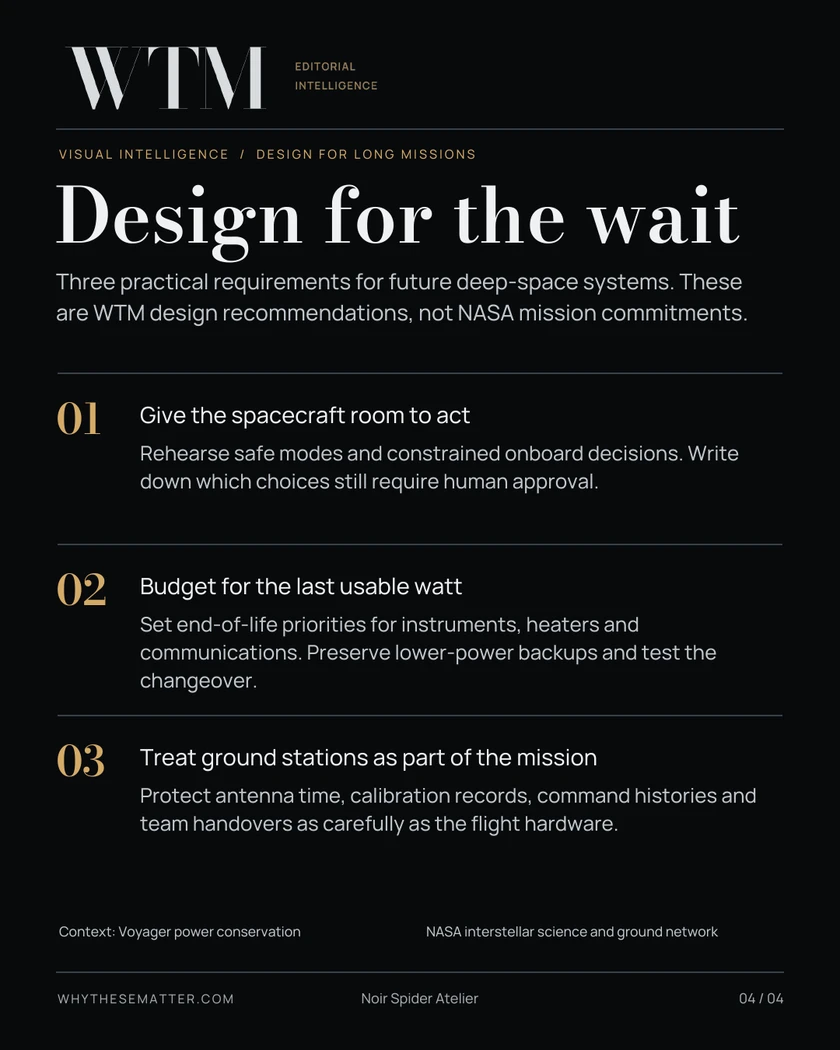
A future mission team should have to answer three questions before launch. If science data stops, can we still tell what is healthy? If Earth cannot respond in time, which decisions can the craft take, and how does it reach a safe state? If the original designers are gone, do the next operators have the records, working simulators and ground capacity to try a repair? These are questions of institutional design as much as engineering. They affect what a public investment can still teach us years after the people who approved it have left.
Voyager 1 does not need to recover this time for its lesson to hold. Its performance already demonstrates the value of engineerable margins and patient public stewardship. The harder test for the space programmes that follow is not only how far they can send something, but how much they can still learn when the link falters and the reply cannot arrive until tomorrow.
Research note, 20 November 2026: Claims about the current anomaly follow NASA’s 18–19 November reports and the mission updates checked on publication day. NASA confirmed a detectable carrier and the distance milestone; this editorial does not claim telemetry was restored, that a cause was confirmed, or that the antenna found a new science result at the threshold. Round-trip timings are approximate propagation times at the milestone; they exclude platform processing, contact schedules and ground analysis.
Editorial note: The topic arose in a recent conversation for The WTM Conversations. The reporting and analysis here rely on the public primary sources cited above; the unpublished interview is not used as evidence.
Why These Matter - WTM MEDIA is an independent editorial platform exploring the forces shaping our world—through people, culture, commerce, design, systems, and governance. Connecting the dots between today’s headlines and tomorrow’s realities.

article-support-3
Noir Spider Atelier

article-support-2
Noir Spider Atelier

article-support-1
Noir Spider Atelier

press-partnership
Noir Spider Atelier
press-reader-desk
Noir Spider Atelier

resource-access
Noir Spider Atelier
membership-example
Noir Spider Atelier

membership-tools
Noir Spider Atelier

membership-reader
Noir Spider Atelier
membership-public
Noir Spider Atelier
pathway-design
Noir Spider Atelier
pathway-institutions
Noir Spider Atelier
pathway-technology
Noir Spider Atelier