2025/26 is the 45th anniversary of the hit series "Hart to Hart.” Still working as an actress on stage as Anna in “The King and I,” and Norma Desmond in “Sunset Boulevard,” as well as “On Golden Pond,” Stefanie considers her greatest achievement the founding of the William Holden Wildlife Foundation, now approaching its 45th anniversary. Stefanie Powers was recently inducted into the prestigious list of "Agents Of Change" and honoured for her efforts with the William Holden Wildlife Foundation, at the United Nations for Inspiring Others: Sharing her wisdom and experiences to motivate and empower others to pursue their dreams and make a larger-scale impact on society through the William Holden Wildlife Foundation, Leaving a Legacy: Documentation of her journey and contributions as a lasting resource that ignites a passion for positive change. Reaching Wide Audience: Her delivering her message to a global audience.

LOS ANGELES, CA — In an era where celebrity is often measured in visibility, Stefanie Powers has built something far more enduring: impact that compounds across ecosystems, economies, and generations.
As the William Holden Wildlife Foundation (WHWF) approaches its 45th anniversary, Powers stands not merely as its founder, but as its chief architect—transforming star power into a long-term operational system for conservation, education, and regenerative land use across East Africa.
Recently honoured at the United Nations as an “Agent of Change,” her work signals a critical shift: influence is no longer defined by audience size, but by measurable outcomes.
Stefanie Powers began her career at age 15, dancing for famed Broadway choreographer, Jerome Robbins. She was put under contract to Columbia Pictures in the final years of the Hollywood star system. While under contract, she appeared in 15 of the 31 motion pictures she has made, co-starring with screen legends such as; John Wayne, Maureen O'Hara, Lana Turner, Ava Gardner, Cliff Robertson, Elliot Gould, Roger Moore, Donald Sutherland, Bing Crosby, Glenn Ford, Lee Remick, James Caan and Sammy Davis. She recently co-starred with Richard Chamberlin in the critically acclaimed independent film, THREE DAYS OF HAMLET.
Her first television series, “The Girl From U.N.C.L.E.,” marked a milestone in U.S. television's history as the first hour long series featuring a female in the leading role. Her television career includes over 25 mini-series, over 200 episodic guest starring appearances, 35 movies for television and two more television series, “Feather and Father” and the long running “Hart to Hart,” starring opposite Robert Wagner.
She became a member of the Screen Writers' Guild of America in the 1980s and has produced several of the screenplays she has written, one of which, “Family Secrets,” was not only a stepping stone for the careers of James Spader and Gary Sinise but it garnered her a nomination for the best screenplay of the year by her peers in the Writers' Guild. Her writing has extended itself to a memoir called, One From The Hart, published by The Robson Press.
Throughout her career she has never neglected her theatrical roots, appearing in productions of; How the other Half Loves, Under the Yum Yum Tree, Sabrina Faire, View from the Bridge, Oliver, Annie Get Your Gun, the West End debut of Matador, off-Broadway in The Vagina Monologues, back to the West End with Robert Wagner in Love Letters, which they also toured the United States with, becoming the cast most associated with the play after over 500 performances.
She once again appeared in the UK in the West End production of The King and I, which also toured the United States for ten months. As a result of the successful remounting of the musical Sunset Boulevard at the Ogunquit Theatre, a US revival is being planned. She appeared once again in the UK in 2012 co-starring opposite Richard Johnson of Royal Shakespeare Company fame, in the play, On Golden Pond. She has recorded a CD with the legendary jazz artist Page Cavanaugh called On the Same Page, available online at Jambomusic.com. Also in 2012 she performed her one woman show, Hart of my Heart, a tribute to the life and the lyrics of Lorenz Hart at the newly opened Matcham Room at the Hippodrome.
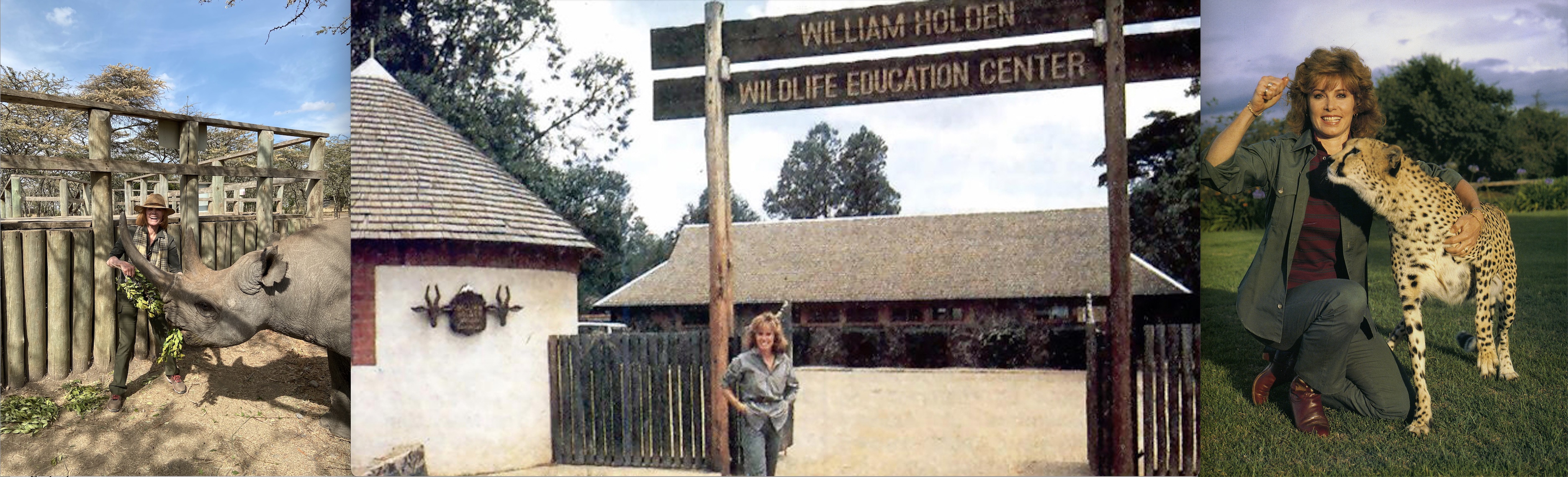
As much a part of her life as her career, is her devotion to animal preservation and protection, which at times becomes more of a vocation than an avocation. She is founder and president of the William Holden Wildlife Foundation, established in 1982 to continue and to further her long-time partner’s conservation work in East Africa after his death.

Throughout her life, Stefanie Powers has had a long-time enviable and successful career in theatre, television and films. However, foremost in her mind has always been the protection conservation and welfare of the natural world. This is exemplified in wildlife, biodiversity, the environment, and domesticated animals who have accompanied our evolution and served us in war and in peace.
Of the activities she has pursued to arrive at her current position are the following: In childhood, she was a member of 4H and at home we had a private sanctuary for anything that fell out of a tree, crawled into her backyard, or was hit by a car. She was raised partially on her stepfather’s stud farm where they were taught all of the hard lessons of animal husbandry and the commitment to the responsibility and welfare of animals both domestic and exotic. Those lessons lead her to rescue a baby Malaysian Sun Bear that had been sold to the pet trade, thus opening the door to the community of professionals and enthusiasts who look after wildlife in captivity. She has served on the board of 4 zoos in the United States and as conservation consultant for Jaguar North America where she created the Jaguar Conservation Trust which she operated in Belize, Guatemala and Costa Rica for 5 years. She was active in the movement to protect North American wild horses and was instrumental in obtaining a 6-month moratorium on wild horse roundups and sales from feed lots. In addition, she was able to affect the transfer of 40 wild horses whose DNA was traced to Spanish bloodlines. These horses were saved, collected, and transported to a private ranch in South Dakota where they survive and prosper thanks to Ford Motor Company and their negotiations with the BLM in Washington D.C.
Through her long-time relationship with William Holden, whose conservation work was never publicized, she became a shareholder in the Mount Kenya Game Ranch. The MKGR, now a conservancy, is a 2000-acre converted farm on the slopes of Mount Kenya where Bill established the first game ranch for the preservation of species in all of Sub-Saharan Africa in 1959. It was Bill’s hope to build a wildlife education center for the youth of Kenya to learn about the importance of preserving their world heritage wildlife. Thus, after his death in 1981, she founded a 501(c)3 public charity called the William Holden Wildlife Foundation in order to build and endow the education center Bill had imagined whose mission statement is ‘Wildlife conservation through education and alternatives to habitat destruction’.
At the time, she couldn’t envision that they would grow into the service of our mission statement as we have. It is the work all her staff and she do that brings their mission to the communities they serve, which number over 6000 in our outreach and 11000 at their main center annually.
After years of concentrating on the first half of our mission statement, they are now concentrating on their second half. In 2017, they began a program of habitat restoration including farmland in rural areas with an emphasis on carbon capture. They created 7 pilot projects attached to primary and secondary schools where we have over the years rebuilt their campus infrastructure. Our outreach to students, their teachers and parents, introduces a practice of regenerative soil and farming techniques which produce higher quality and quantity of food even in drier conditions. This program of Agro Ec teaches small farmers how they may become more productive and averts them from the need to further exploit and damage land through over-chemicalization and poor farming practices.
They are currently in the process of establishing a protocol with criteria to prove and qualify a given piece of land as having accomplished measurable soil regeneration. The have partnered with 2 laboratories in Kenya and 1 in the United States for soil analysis as well as a local Kenyan laboratory who specializes in carbon measurement in soil.
Their multiple achievements since 1982 are thanks to our donors and our careful husbandry of their donations. They keep their overheads to a bare minimum and, by the grace of one donor, all of our operational costs in Los Angeles are covered. In spite of this good news, it is still a constant challenge to raise funds for our ongoing projects as well as our ever-increasing new ones. Since Ms Powers is the chief fundraiser, it rests on her to seek grants and funding at great personal sacrifice. Whatever she has sacrificed in her personal and professional life, it is compensated by the impact they have made and the help they have given to the countless people who have benefited from the efforts of our work at WHWF.
The William Holden Wildlife Foundation
The William Holden Wildlife Foundation Education Center offers visiting students a unique opportunity to experience the outdoors in a rare communication with nature often unavailable to them in their own environment.It is essential to build respect and appreciation for both flora and fauna and the understanding of their delicate balance. Nature is a renewable resource, but only if we assume responsibility for its protection. For more information please visit: https://whwf.org/about/
Stefanie Powers is available for strategic media, partnerships, and global speaking engagements on:
About Stefanie Powers
Stefanie Powers is an internationally recognised actress, producer, author, and conservationist whose career spans film, television, and theatre. As founder and president of the William Holden Wildlife Foundation, she has spent over four decades advancing wildlife conservation, education, and regenerative land practices across East Africa, impacting thousands of communities annually.
Media Contact
BHBPR
Harlan Boll
+1 323-708-4172
www.bhbpr.com

Why These Matter - WTM MEDIA is an independent editorial platform exploring the forces shaping our world—through people, culture, commerce, design, systems, and governance. Connecting the dots between today’s headlines and tomorrow’s realities.