
Episode 4
Belonging Is More Than Being Let In: Edafe Okporo on Home and Trust
Edafe Okporo joins Kelly Dowd to explore home, visibility and trust. A practical WTM framework examines what belonging requires after an invitation: safety, voice and continuity.

The companion editorial
A door can open without a person feeling safe inside it. In Episode 4 of The WTM Conversations, Edafe Okporo speaks with Kelly Dowd about the distance between admission and belonging: being visible without becoming public property, surviving without being reduced to survival, and rebuilding trust without pretending that institutions did no harm. His account gives readers a practical question for workplaces, services and communities: what happens after someone is welcomed?
Okporo is an author and the executive director of Refuge America, whose stated work includes community connections, referrals, storytelling and advocacy for LGBTQIA+ asylum seekers and refugees. His memoir, Asylum: A Memoir and Manifesto, places personal experience alongside a wider argument about refuge. This editorial is not a judgement on an individual asylum claim. It examines the human and institutional choices illuminated by the conversation.
Key takeaways
- Belonging requires practical safety as well as recognition. A welcoming message cannot replace housing, reliable information or competent services.
- A survivor story is one part of a life, not a permanent job description for the person who lived it.
- Visibility does not grant permission to demand disclosure, unpaid representation or constant emotional availability.
- Trust can be rebuilt through repeated experiences of reliability. Personal agency matters, but does not excuse institutional failure.
- Test an invitation through Safety, Voice and Continuity: what protects the person, what can they influence, and what remains after the event ends?
Home Begins Where a Person Can Stop Performing

When Dowd asks what home means now, Okporo does not begin with an address. He describes a feeling that can exist in a place, in a relationship or in acceptance of himself. That formulation is intimate rather than administrative. It asks readers to consider the conditions under which they can stop anticipating rejection and be present without continually explaining why they deserve to be there. [Interview, 04:36–06:25.]
There is a useful distinction between having a place and feeling at home. A person can obtain accommodation while remaining isolated; another can feel understood by a friend while still facing serious housing insecurity. Neither condition cancels the other. The emotional and material dimensions of home have to be considered together, otherwise a moving account of inner acceptance can become an excuse to neglect external protection.
The World Health Organization's account of refugee and migrant mental health supports that wider view. It identifies post-arrival pressures including insecure housing and income, uncertain legal status, discrimination and barriers to services, alongside the importance of social support. These are population-level considerations, not a diagnosis of Okporo or a claim that all displaced people develop mental illness. They help explain why a humane response cannot end at the border or the reception desk. WHO, 2025.
Language matters here. In the United States, asylum and refugee resettlement are distinct routes to protection. An asylum seeker is seeking protection; an asylee has been granted asylum. International refugee status is also declaratory: someone may meet the refugee definition before an authority formally recognises it. These distinctions should clarify understanding, not become devices for ranking whose humanity counts. Readers facing an individual immigration question need qualified advice, not an editorial shorthand. UNHCR USA; UNHCR global guidance.
For a reader supporting someone through a transition, the first useful move is often small and specific. Ask what would make the next step manageable: a clear explanation, a reliable contact, help finding an appropriate service, or simply a meeting where nobody is required to perform gratitude. Do not assume that the help you would prefer is the help another person needs. Let the person define what is useful and what they would rather keep private.
For institutions, the same principle becomes a design question. Can someone understand the process without an insider? Can they ask for clarification without being treated as a problem? Is there a route to correct an error? A welcome is credible when these ordinary interactions support it. The aim is not to manufacture a feeling on demand, but to remove avoidable conditions that make a person feel perpetually provisional.
The Survivor Story Must Not Become Another Cage

Okporo recognises the hope people draw from stories of overcoming. He also resists being understood only through that frame. In the conversation, he describes the work, uncertainty and private recovery that an inspirational public narrative can leave out. The point is not that hope is dishonest. It is that a story can be uplifting and incomplete at the same time. [Interview, 08:57–12:26.]
The familiar narrative has an attractive shape: adversity, resolve, achievement. It offers an ending that audiences can recognise. Yet a person continues living after that ending. They may want ordinary pleasure, privacy, new ambitions and relationships unrelated to the difficulty for which they became known. To insist that every appearance return to the original wound is to give the audience more control over identity than the speaker should have to surrender.
This creates a responsibility for editors, interviewers and organisations commissioning testimony. Ask what the person wants to discuss now, not only what originally made their story compelling. Explain the purpose of the contribution and how it will be used. Offer a meaningful opportunity to decline a question. Participation in one interview is not blanket permission for every future campaign, derivative use or personal disclosure.
There is a counterargument worth taking seriously: difficult stories can make neglected conditions visible and help other people feel less alone. Okporo himself describes drawing strength from the lives of others. Removing suffering from public conversation would not necessarily protect the people experiencing it. The better distinction is between a person choosing to tell a story and an institution making access, credibility or support conditional on telling it.
A useful commissioning test is therefore not simply whether an account will move an audience. Ask what the contributor gains, what exposure costs them and what changes for the people the story concerns. Agree appropriate credit, compensation where applicable, boundaries and follow-through. An institution should not receive all the reputational benefit while leaving the speaker to absorb every consequence of being seen.
For readers, the lesson is equally practical. When someone shares a difficult history, do not mistake disclosure for a complete map of their life. Ask about their work, interests and present choices. Respect a change of subject. Recognition becomes more generous when it allows someone to be interesting beyond the experience that first attracted our attention.
Visibility Needs a Private Place to Land

In describing public recognition, Okporo makes an important distinction between being visible and being fully known. He speaks about a small community in which he can be a friend rather than a symbol. That is not a rejection of public responsibility. It is a boundary that makes responsibility more sustainable. A public identity need not occupy every room a person enters. [Interview, 15:51–18:06.]
He also describes the emotional weight of advocacy and the limits he places on reading commentary about himself. These are his practices and interpretations, not universal prescriptions. Another person may find feedback useful or need a different support structure. The editorial insight is that visibility creates demands, and those demands deserve deliberate management rather than being treated as the inevitable price of having a voice. [Interview, 40:57–43:42.]
An employer or civic organisation can make that insight concrete. Do not repeatedly ask the same person to explain an entire community. Make participation voluntary, distinguish a professional role from unpaid emotional labour and clarify whether someone is speaking for themselves or an organisation. A person can contribute valuable experience without being positioned as an authorised representative of everyone who shares an identity.
The UK's working definition of trauma-informed practice offers a useful operational lens: safety, trustworthiness, choice, collaboration, empowerment and cultural consideration. It also distinguishes this approach from treatment for trauma. A manager applying these principles is not becoming a therapist. They are examining whether their ordinary processes unnecessarily remove choice, create confusion or require people to relive painful experiences. Office for Health Improvement and Disparities, 2022.
This does not require abandoning scrutiny. Public claims should still be examined, professional standards should remain clear, and disagreement is not automatically a violation of safety. The relevant distinction is between accountable participation and compulsory exposure. People should know what is expected of the role, what information is genuinely necessary and how they can challenge a decision without having to reveal more of themselves than the task requires.
For the reader, a private place to land might be a relationship, a recurring activity or time that is not available for public performance. The conversation invites an audit of that boundary: who knows you outside your usefulness, and what protects that relationship from becoming another audience? No single practice guarantees wellbeing. But noticing where every interaction has become an obligation can reveal a choice worth reconsidering.
Trust Returns Through Evidence, Not Instructions to Be Resilient

Okporo recounts immigration detention and subsequent homelessness, then describes how more recent experiences of security have helped him rebuild trust. The chronology matters. His account is not simply that a better attitude produced a safer life. He speaks from a present in which stability provides evidence against the expectation that the past must repeat itself. [Interview, 26:02–27:08; 31:01–34:23.]
Personal agency is central to his interpretation. He describes learning to recognise the stories he tells himself and to make room for a different future. That agency should not be translated into blame. A person who remains frightened, distressed or insecure has not necessarily failed to think correctly. The material circumstances may still be unsafe, and recovery does not follow a uniform timetable or a formula supplied by someone else's success.
WHO's evidence review on the mental health of refugees and migrants reinforces the need to look beyond a single event. Basic needs, identity, community support, adversity and access to care interact across experiences. That is a reason to build coordinated services, not to infer a clinical explanation for every individual. It also cautions against presenting a personal practice from an interview as a substitute for appropriate professional care. WHO, 2023.
Institutional trust can be approached through similarly concrete evidence. Did the promised call happen? Was the decision explained? Was a referral received by the next service, or did responsibility disappear at the handover? These questions are less dramatic than a statement of values, but they reveal whether a person has grounds to expect reliability. One good encounter is valuable; repeated reliability makes it more credible.
Resource constraints are real. No organisation can meet every need, and promising more than it can deliver can deepen distrust. The responsible response is to define the scope honestly, explain limits early and create a safe route to another provider when possible. A transparent limitation is not the same as abandonment. The distinction lies partly in whether someone remains accountable for what was actually promised.
For leaders, the practical task is to choose one point where people repeatedly become uncertain and improve it. Record the baseline, the owner, the promised response and the review date. Ask the affected people whether the change helped, without making their gratitude the success measure. Trust is not something an institution can order people to feel. It is something its behaviour can give them reason to consider.
Being in the Room Is Only the Beginning
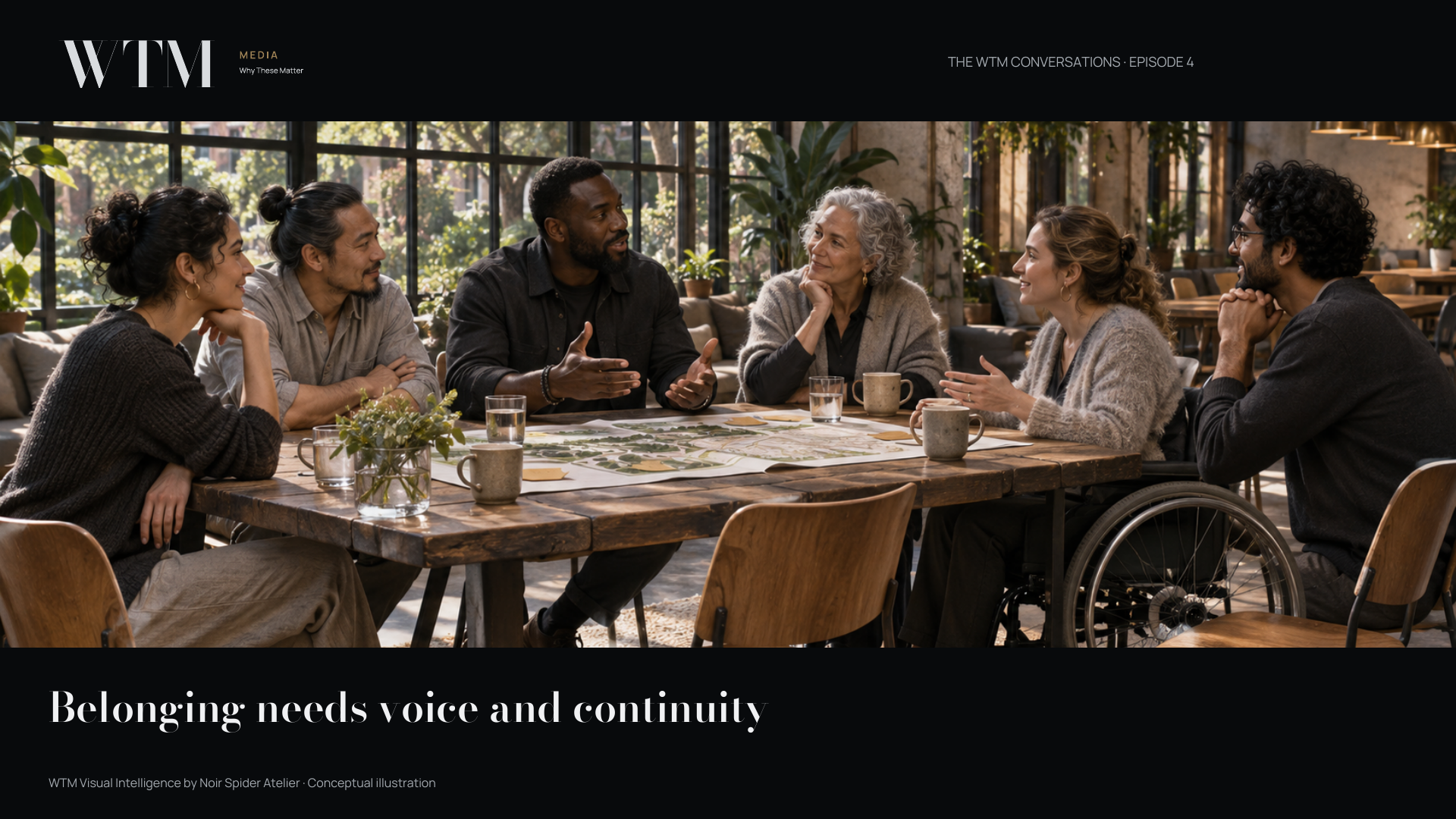
Okporo describes lived experience as a legitimate contribution in institutional settings. His account challenges the assumption that authority comes only from an established title. Someone who has navigated a system can identify consequences that remain invisible to those who administer it. That insight does not mean experience is the only form of expertise. It means a decision can be poorer when that knowledge is excluded. [Interview, 44:31–46:26.]
There is an important tension in the conversation. Feeling worthy of a place at the table can be personally sustaining; being invited to the table does not, by itself, establish equal power. WTM's institutional question is what follows the invitation. Can the person change the agenda? Is their contribution recorded accurately? Can they disagree? Do they have access to the information and resources needed to participate meaningfully?
The series has approached this problem from different directions. Marc Blakeman's conversation examined trust through institutional behaviour. Michael Steiner's editorial explored the human capacities needed to direct change. Liris Crosse's account connected representation to access and creative authority. Okporo brings the question home: a system should not merely recognise a person's presence, but make room for their continuing agency. These are editorial connections, not claims that the guests endorse one another's conclusions.
WTM's proposed decision aid is Safety, Voice and Continuity. Safety asks what practical protection and clear information are available. Voice asks what the person can influence without compulsory disclosure. Continuity asks what support, accountability and opportunity remain after the public moment ends. This is an unscored editorial framework, not a validated clinical assessment or a measure of someone's worth.
Apply it to one real invitation. If a workplace asks a colleague to contribute to an inclusion event, check the brief, consent, time and compensation arrangements; identify the decision their contribution could affect; then set a date to report back on what changed. If a community service welcomes a newcomer, check the immediate need, the person's preferences and the next accountable contact. The framework should sharpen a decision, not become another form for the person to complete.
Double ROI, in this context, means pursuing a useful immediate result while strengthening the capacity to provide value again. A clearer handover may reduce avoidable repetition today and build a more reliable service tomorrow. Those are aims to test, not guaranteed savings. Integrity must remain a condition of the work, not merely a tactic for increasing revenue or producing a persuasive story.
Why This Matters
Belonging is easy to praise because the word asks little of the speaker. The work begins when a person arrives with needs, preferences, disagreement and a life that cannot be compressed into a campaign. Okporo's conversation invites a more demanding response: respect agency without denying vulnerability, offer hope without requiring a heroic performance, and examine the conditions that make a promise believable.
For individuals, the value is a vocabulary for asking for what is needed and recognising what should not have to be surrendered. For organisations, it is a test of whether recognition is connected to action. For storytellers, it is a reminder that the person who makes an audience feel something remains a person after the audience moves on.
The most useful question is not whether we have said that someone belongs. It is whether our next decision makes that statement easier to live inside.
Put the Intelligence to Work
- Choose one welcome, invitation or handover that you influence.
- Ask the person what would make it useful, and what they prefer not to share.
- Identify one gap in safety, voice or continuity. Record evidence rather than assigning a flattering score.
- Name the responsible person, realistic action and review date.
- Return to the person affected and explain what changed, what did not, and why.
Sources and editorial notes
Primary source: the final-composition transcript of Episode 4, compared on 15 November 2026, with timestamps on the 54:35 edited timeline. This editorial uses attributed paraphrases, not direct quotations. The comparison is transcript-based, not an independent listening review. Personal accounts remain attributed; general claims are supported by the sources below. Uncertain book titles, music references, official names and election figures have been excluded. The organisation name is Refuge America, as confirmed by its official record.
- Edafe Okporo: official biography
- Refuge America: team and roles
- Refuge America: stated work
- Asylum: publisher record
- UNHCR USA: What is asylum?
- UNHCR: asylum and refugee status
- WHO: Refugee and migrant mental health, 2025
- WHO: Mental health of refugees and migrants: risk and protective factors and access to care, 2023
- OHID: Working definition of trauma-informed practice, 2022
Series continuity: Marc Blakeman; Michael Steiner; Liris Crosse.
Editorial analysis: WTM Media | Why These Matter. Host and editorial direction: Kelly Dowd, MBA, MA. Featured guest: Edafe Okporo. Visual Intelligence: Noir Spider Atelier. Conceptual scenes depict fictional adults, not the guest or documented events. Source review: 15 November 2026. General editorial information, not individual medical or legal advice.
© 2026 WTM Media | Why These Matter. All rights reserved. Third-party works remain their owners' property.
WTM Visual Intelligence
Download the visual companion: Safety, Voice and Continuity (PDF).
Sources & publication notes
Supporting index record for the Articles draft. Guest role independently verified; interview paraphrases only. No publication date until approved release.