Fees are racing toward zero, fintech disruptors are nipping at the edges, and wealth clients demand more bespoke, human-meets-digital experiences. Schwab is at a crossroads: evolve into the platform of the future or risk being seen as a relic of the discount-brokerage past.
Charles Schwab has built itself into an empire of trust and trillions. With the absorption of TD Ameritrade’s nearly 17 million accounts and $1.9 trillion in assets, it became the undeniable scale player — a fortress of retail investing. But scale is no longer enough. Fees are racing toward zero, fintech disruptors are nipping at the edges, and wealth clients demand more bespoke, human-meets-digital experiences. Schwab is at a crossroads: evolve into the platform of the future or risk being seen as a relic of the discount-brokerage past.
1. Efficiency Through Integration: The TD Ameritrade merger was about scale and cost synergy. Schwab is pushing hard to unify systems, reduce duplications, and leverage volume economics.
2. Low-Cost Leadership: Expense ratios, trading fees, and advisory costs are kept razor thin to win the mass market.
3. Client-Centric Philosophy: Schwab’s “Through Clients’ Eyes” mantra seeks to simplify investing journeys, bundle services, and offer advisory layers tuned to net worth.
4. Diversification of Revenue: The pivot away from commission trading toward fee-based advice, lending, cash management, and ETFs reflects a smarter, more sustainable monetisation model.

But challenges remain:
• Fee Compression is relentless. Schwab’s low-cost model can erode margins as competitors slash fees further.
• Integration Fatigue could haunt the Ameritrade deal, especially if platform migrations frustrate long-time traders.
• Tech Competition is fierce — from Robinhood’s design simplicity to Vanguard’s cult of low-cost investing, Schwab risks being neither the coolest app nor the cheapest alternative.
• Segmentation Tensions arise when mass retail clients are satisfied but high-net-worth individuals feel underserved.
1. Invest in Intelligent Personalisation
AI is not just a buzzword here — Schwab must make each client’s experience uniquely relevant. Predictive nudges, tailored portfolios, tax optimisation, and cash-flow insights should feel “designed for me” rather than “one size fits most.”
2. Balance Digital and Human Touch
The next generation of wealth clients doesn’t want only robo-advisors or only human advisors. They want both. Schwab must make the blend seamless: chat-first AI with quick escalation to empathetic advisors who can navigate complex life events.
3. Re-imagine Trust as Transparency
Trust today isn’t built by glossy ads. It’s built through radical transparency: clear disclosures, visible fee structures, ESG impact breakdowns, and open data tools. Schwab could lead by being the most “see-through” institution in finance.
4. Expand the Value Universe
Schwab can’t just be “where you trade.” It must be “where you grow.” That means more sustainable investment vehicles, impact-driven funds, cross-border opportunities, and lifestyle-aligned financial products.
5. Global Ambition Without Overreach
The U.S. is saturated. Selective international expansion — whether through partnerships, digital-only platforms, or cross-border wealth services — could open Schwab to growth while avoiding bloated overhead.
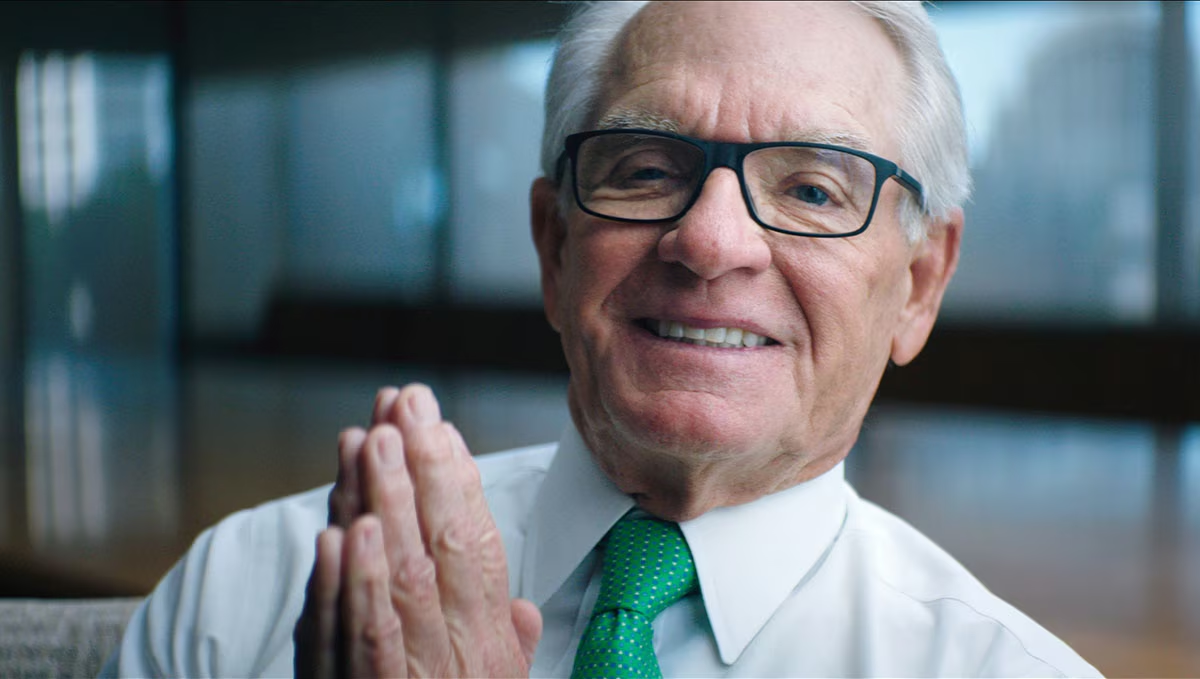
Schwab represents more than a brokerage firm. It is a barometer of how legacy financial institutions adapt — or fail to adapt — in an era of democratised investing. Its choices will ripple across millions of American households who see Schwab not just as a custodian of money, but as a custodian of trust.
If Schwab can re-invent itself as an empathetic, transparent, tech-infused wealth partner, it will remain a leader for the next generation. If it rests too long on the laurels of scale and low cost, the market will pass it by.
The future of Schwab is not about being big. It’s about being indispensable.
Why These Matter - WTM MEDIA is an independent editorial platform exploring the forces shaping our world—through people, culture, commerce, design, systems, and governance. Connecting the dots between today’s headlines and tomorrow’s realities.