
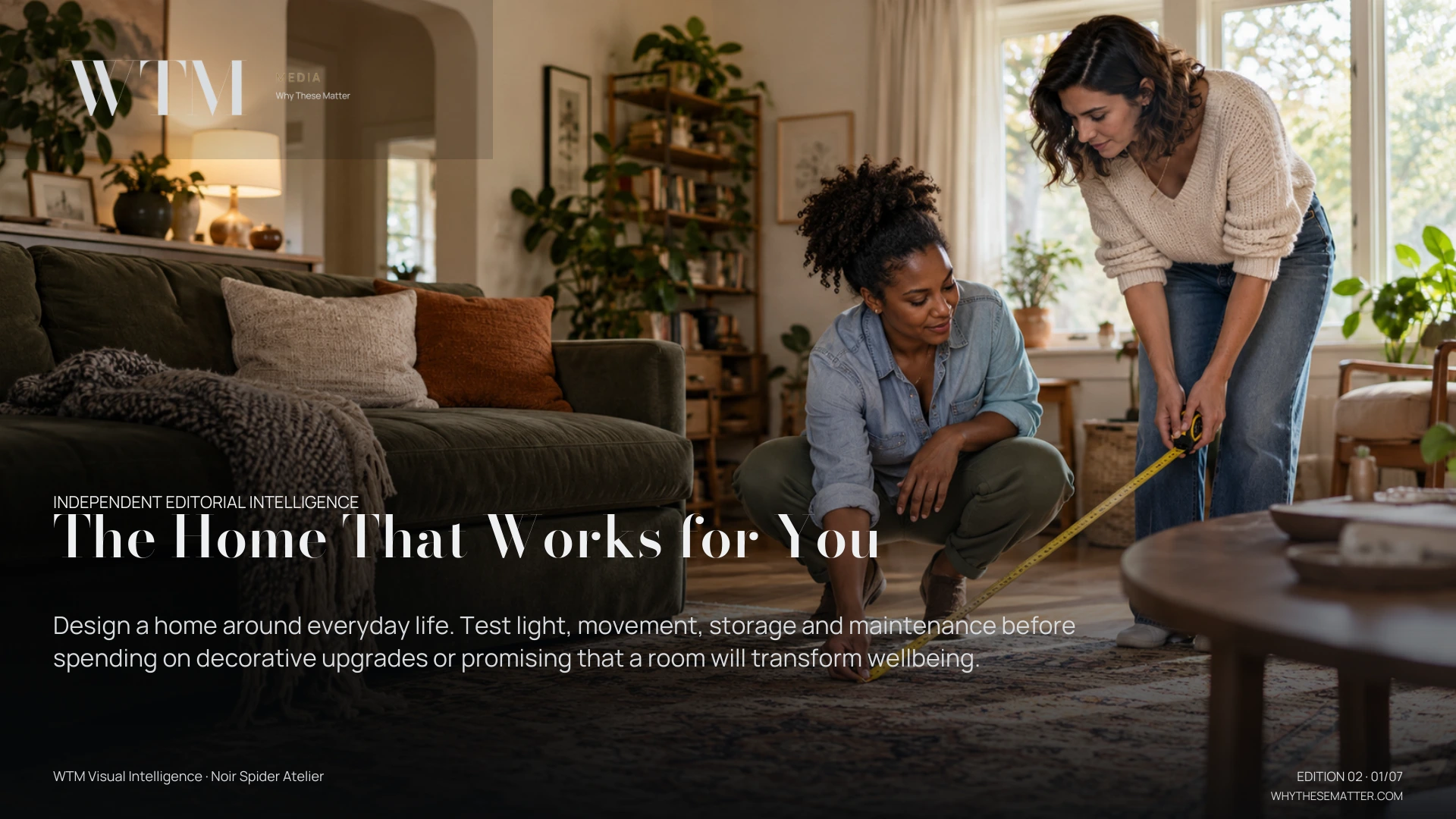
Design a home around everyday life. Test light, movement, storage and maintenance before spending on decorative upgrades or promising that a room will transform wellbeing.
The most useful home is not the most furnished. It is the environment that reduces avoidable effort, supports healthy routines and leaves people room to live. Beautiful rooms can still fail their occupants when lighting, circulation, storage or maintenance is poorly resolved.
Reader value: Design a home around everyday life. Test light, movement, storage and maintenance before spending on decorative upgrades or promising that a room will transform wellbeing.

Observe where household members put keys, charge devices, prepare food, work and rest. Map repeated searches, awkward movements and points of congestion. An attractive entry table is not useful if it sits far from the door where bags actually land. For seven days, record the three most irritating repeated tasks. Rearrange objects before buying organisers or renovating. Prioritise high-frequency problems with inexpensive, reversible interventions.
Walk through a normal morning with the household. Where do bags land, where does a person wait, and which objects must be moved twice? Include the person who cleans, the person who works at home and anyone whose reach or mobility differs from yours. The household's actual sequence is more useful than a photograph of an ideal room.
Try a temporary landing place or move one frequently used object closer to its task. Agree how success will be judged: fewer searches, a clearer doorway or less lifting. These are small design experiments, not clinical claims about happiness. A rented home, shared room or limited budget can still support useful adjustments without pretending that every constraint is within the occupant's control.
Describe a problem in observable terms before naming the solution. 'The room is wrong' gives little direction; 'the doorway is blocked whenever two people arrive' identifies a sequence that can be tested. This makes it easier to compare an inexpensive rearrangement with a purchase and to notice whether either has improved everyday use.
A household includes visitors, care responsibilities and changing capacity. Ask whose routine the current arrangement assumes. A place that works for one tall, mobile adult may be awkward for someone carrying a child or using an aid. The useful response begins with those actual circumstances, rather than a universal ideal of efficient living.
Keep a change reversible while uncertainty is high. Move a chair or trial a temporary surface before commissioning fixed joinery. Observe the same activity again and invite disagreement from other occupants. A room is not successful merely because its designer prefers the photograph; the people living with the arrangement need to recognise the benefit.
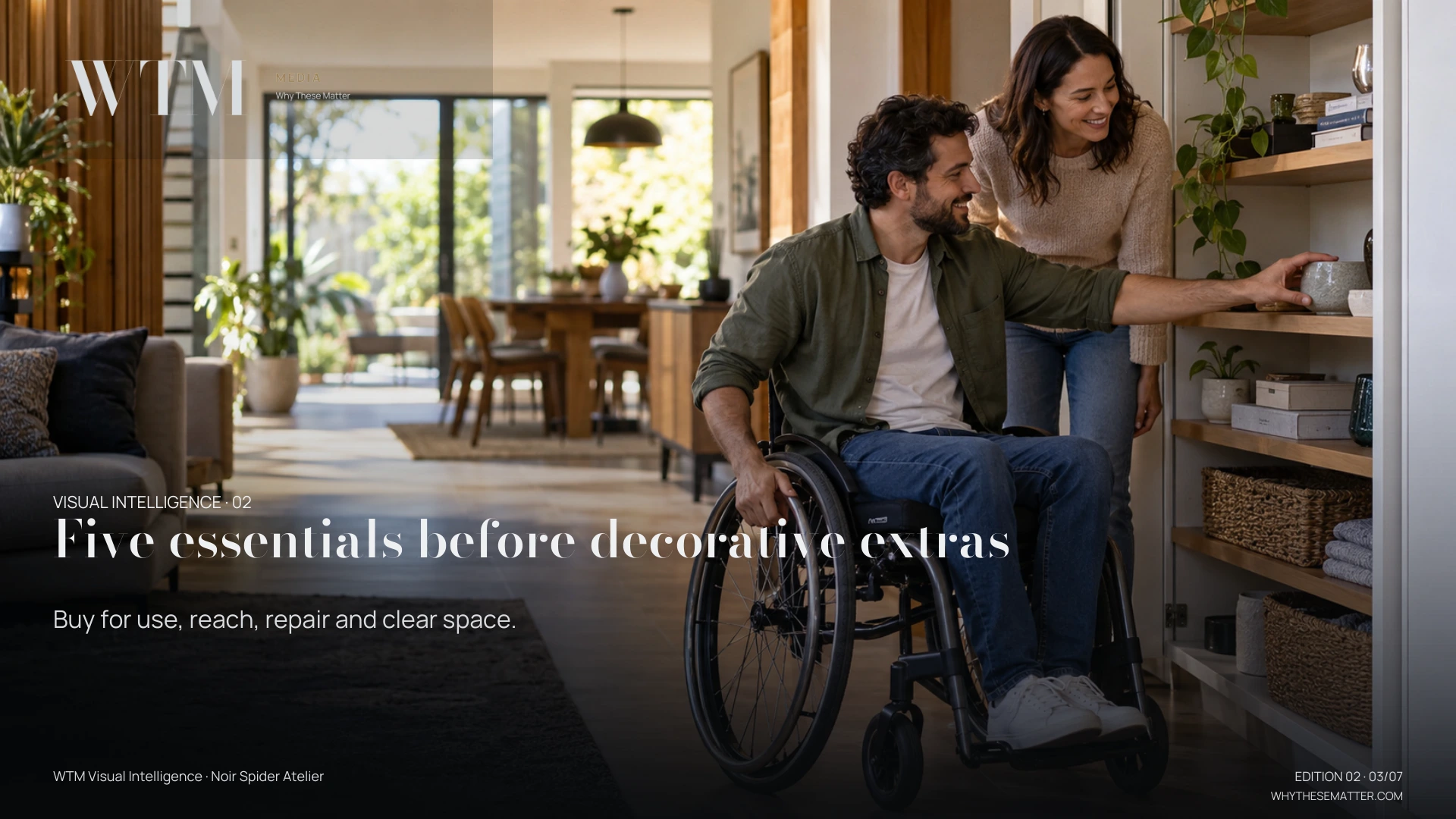
A supportive sleep arrangement, task lighting, safe food-preparation area, comfortable seating and practical storage often have greater everyday value than statement pieces. These are functional categories, not universal shopping prescriptions; accessibility and household circumstances may change the order. Measure rooms, door clearances and reach heights. Ask whether an item supports several activities, whether it can be maintained and whether it replaces something already owned.
Before ordering, mark an item's footprint on the floor and test the remaining route with the people who use it. Consider a door opening, a chair pulling back and the space required for an assistive device. A compact item is not automatically accessible, and an attractive multifunctional item can fail if converting it each day is burdensome.
Evaluate maintenance as part of the purchase. Can the fabric be cleaned, the bulb replaced and the mechanism repaired? Ask which existing object the purchase replaces. A useful priority list is specific to this household: a quiet sleep arrangement may matter more than extra seating; accessible food preparation may outrank both. Comfort should not become an instruction to buy a prescribed set of expensive things.
Cost includes what an object asks from its owner after delivery. Assembly, cleaning, replacement parts and the effort of moving it can change its practical value. Compare those obligations alongside appearance and price. An item that seems economical at checkout may still be difficult to keep useful in this particular home.
Treat a product's advertised versatility as a proposition to test. A table that converts between several functions can save space, but only if the change is manageable for the person who must perform it. Consider where displaced objects go during conversion and whether the mechanism will still be used on an ordinary busy evening.
Make room in the decision for pleasure as well as function. A familiar chair or meaningful object may deserve space even when it is not multifunctional. The purpose of prioritisation is to spend deliberately, not to strip the home of identity. Ask what supports daily life and what brings welcome enjoyment within the household's constraints.
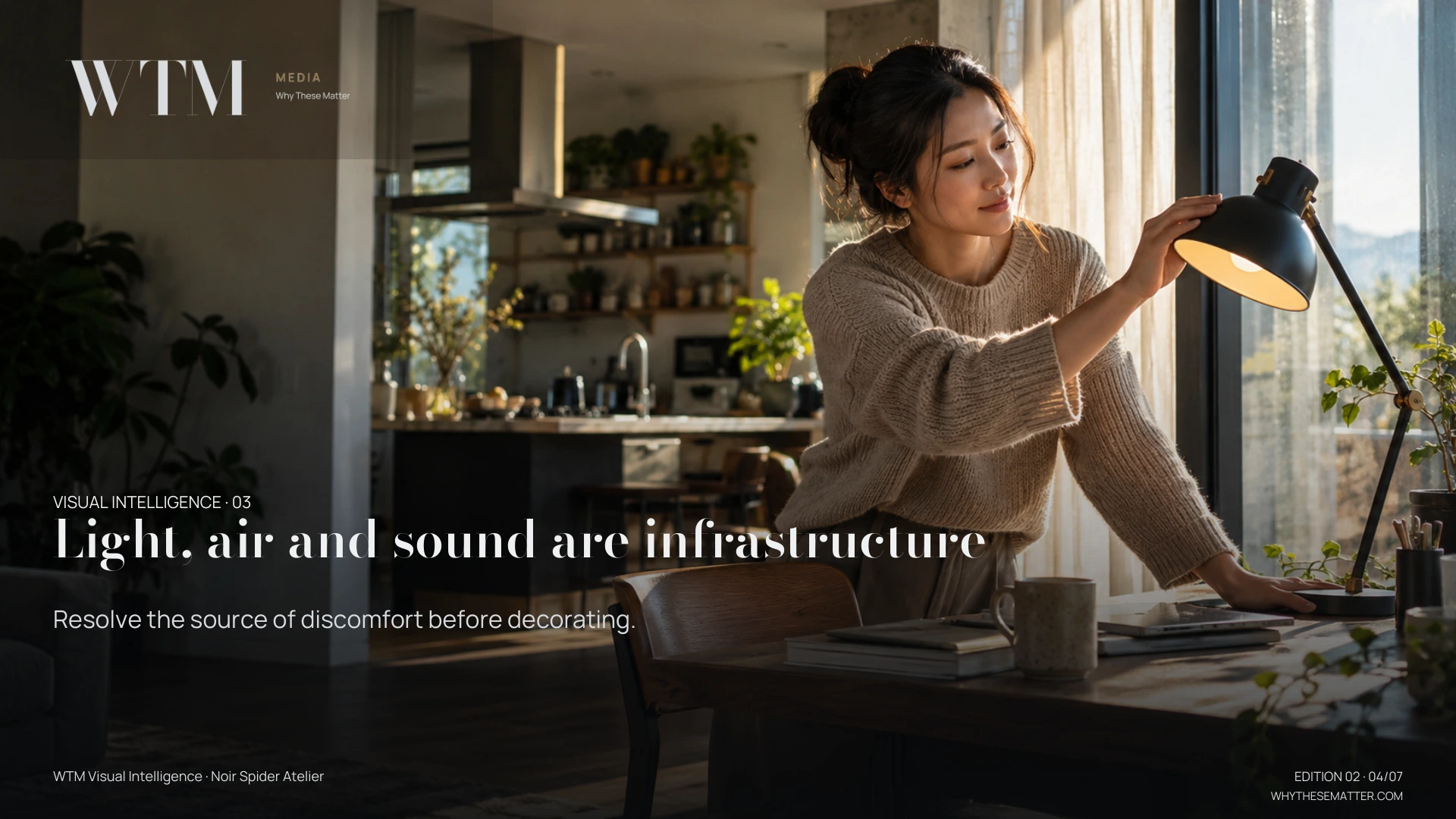
Glare, insufficient task light, excessive noise and dampness can make a room tiring even when it looks immaculate. Use daylight thoughtfully and provide controllable light for reading, cooking and work. Investigate moisture and ventilation issues rather than masking them with fragrance. Try moving a desk, adding an appropriate task light or changing window coverings. Persistent mould, unsafe wiring or ventilation defects require competent assessment; decorative upgrades are not remedies.
The EPA identifies source control, ventilation and filtration as three strategies for indoor air quality; it does not promise that an air cleaner solves every problem. Outdoor conditions matter when bringing air inside. Persistent moisture, smoke or a suspected hazardous material deserves appropriate assessment. Plants and fragrance should not be presented as substitutes for resolving a source. [1]
For light and sound, start with the task and the person's preference. Test screen glare at the time the desk is used, or move a noisy appliance away from a rest area where practicable. Separate a comfort experiment from a repair that needs a competent professional. A warmer-looking photograph cannot establish that a room is safe, adequately ventilated or suitable for every occupant.
Separate the visual mood of a room from the conditions of a task. A dim setting may feel restful while being unsuitable for reading small print. Test the light where the work happens, at the time it happens, and with the person doing it. Adjustability can be more useful than a single prescribed lighting atmosphere.
Sound also has sources and routes. Notice whether disruption comes from an appliance, an adjacent activity or outside the building before buying a decorative treatment. A small relocation may help one problem and do little for another. Where building performance is involved, obtain competent advice rather than treating soft furnishings as a guaranteed remedy.
Keep a record when a condition persists. The time, location and circumstances of dampness, noise or discomfort can make a discussion with an owner or professional more specific. A comfort preference and a suspected hazard need different responses. Both deserve attention, but an attractive interior should never conceal an unresolved material concern.
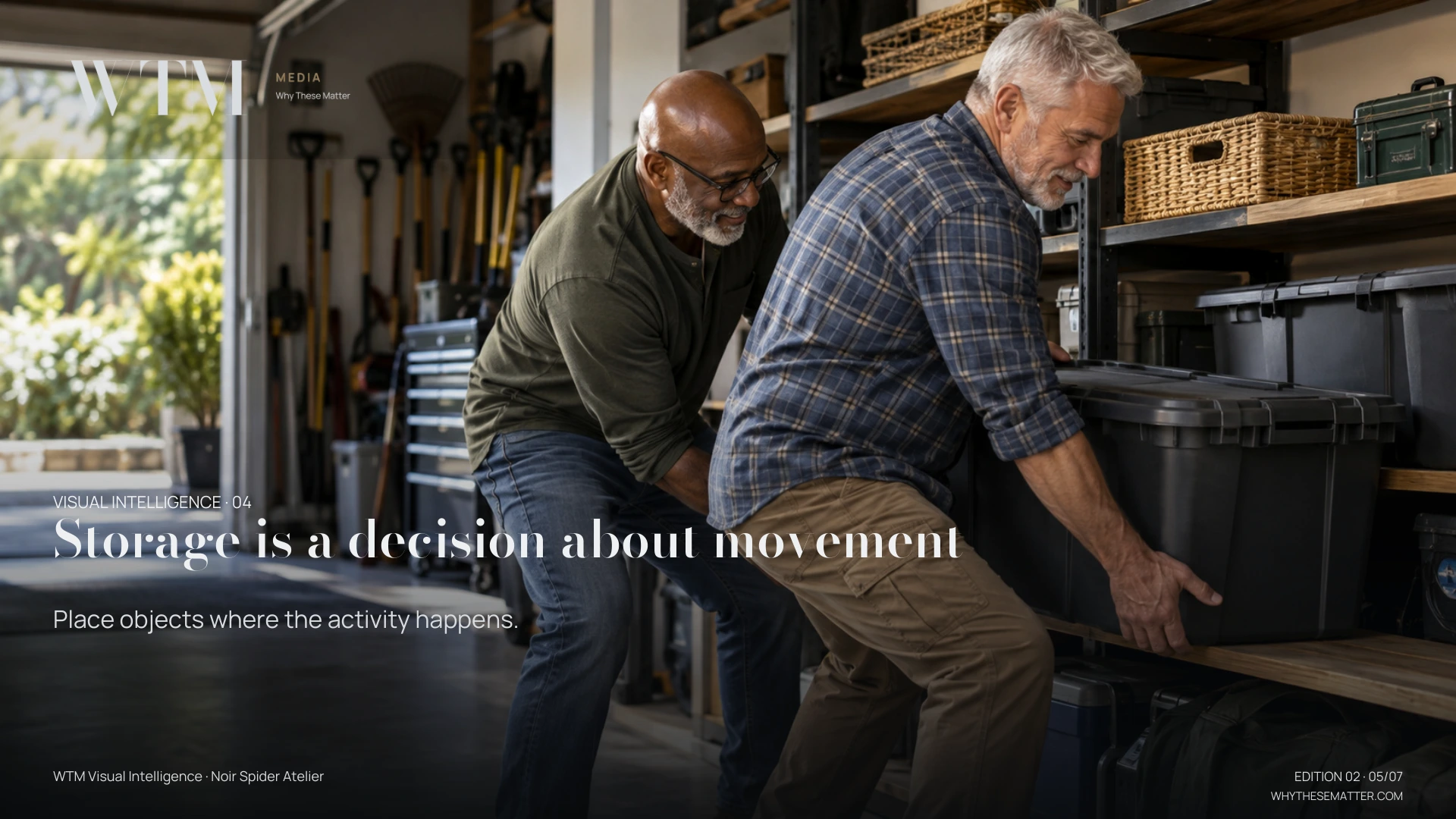
Put frequent-use objects at their point of use. Keep heavy objects on stable lower shelves and protect clear routes. Shared households benefit from simple predictable locations. Excess storage can merely hide excess possessions. Remove redundant objects first. Create an entry landing zone, a clearly organised cleaning station and a charging area, then test whether search time falls.
Use storage to shorten a journey, not merely to hide its evidence. An accessible cleaning kit near the area it serves may be more useful than a beautifully organised cupboard on another floor. Keep heavy items in a stable position that suits the actual user; avoid a universal rule about shelf height without considering ability, weight and lifting conditions.
Agree a small number of predictable locations in shared spaces. Labels or tactile cues may help some households; others will prefer an uncluttered visible arrangement. Test the system with the people expected to maintain it. If returning an object requires several awkward steps, the storage design is asking daily discipline to compensate for poor placement.
Storage creates a return journey as well as a retrieval journey. An object needs a place that can be reached when the user is tired or carrying something else. Test putting it away, not only taking it out. This often reveals whether a tidy-looking arrangement depends on effort that the household cannot reasonably repeat.
Ownership of shared space deserves discussion. A system imposed by the person who enjoys organising may be confusing to everyone else. Agree which locations must remain predictable and where individual preferences can differ. The best arrangement is one that can survive normal use without requiring one resident to continually correct the others.
Review what should remain visible. Some people benefit from seeing a frequently used item; others need fewer visual demands. Neither preference justifies a universal rule about clutter. A useful storage decision balances access, safety, memory and the activity of the particular space, rather than measuring success only by an empty surface.
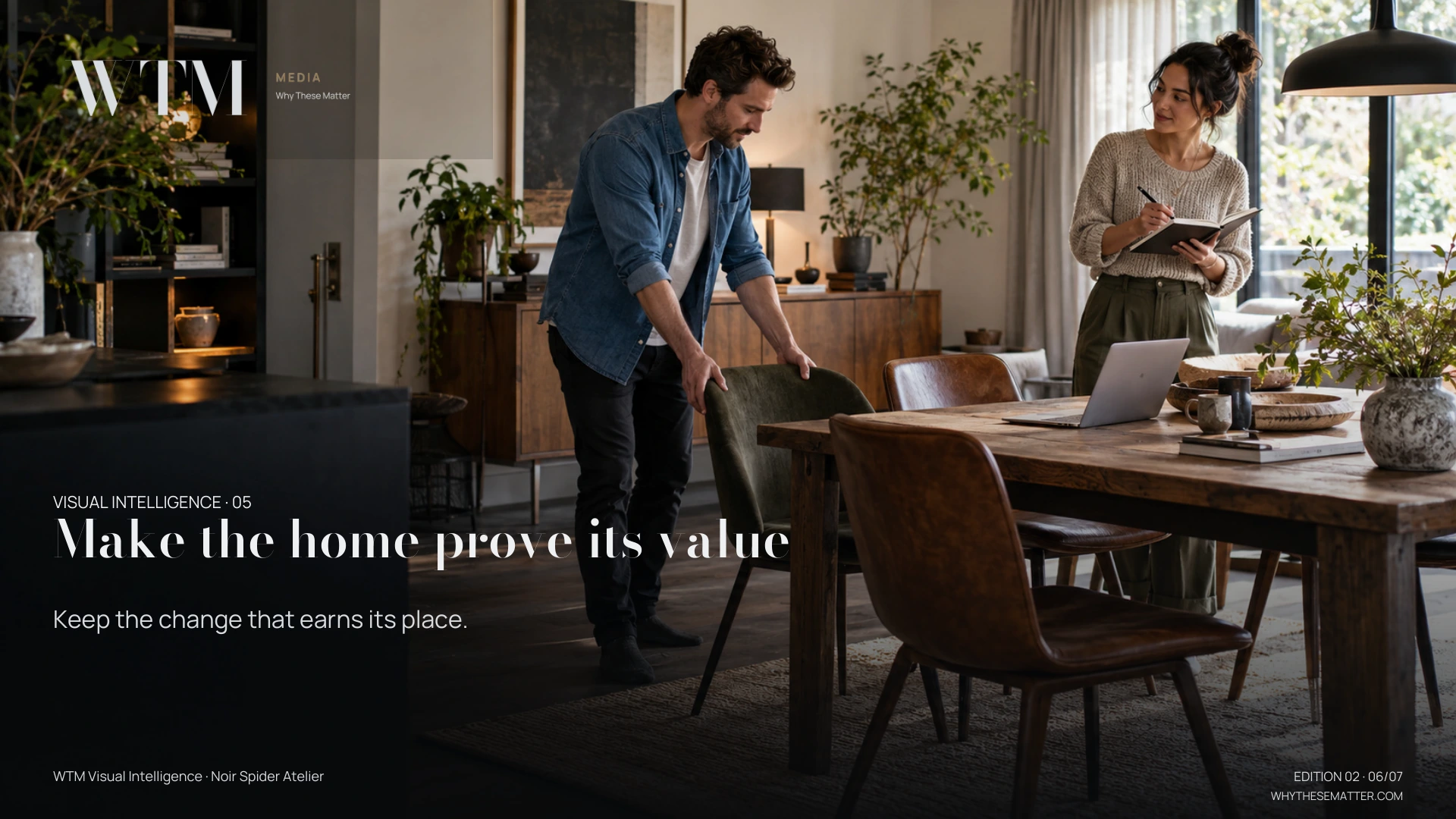
Treat home improvements as small experiments. Record a baseline such as minutes spent searching for items, interrupted sleep from light or repeated clutter accumulation. Make three reversible changes and assess the result after a week. Spend more only when the observed benefit justifies it. Consider repairability, energy costs and accessibility over time. Design can support comfort and happiness but cannot guarantee either.
Choose a short trial with a clear before-and-after question. For example, does placing work materials in one portable tray make it easier to restore the dining table each evening? Record the result without assigning every good or bad day to the room. A useful change should remain practical when the household is busy.
Review running costs before a larger alteration. A home energy assessment can identify building-specific opportunities, whereas a product label alone cannot predict the household's saving. [2] Consider whether the improvement will still work as occupants' needs change. The final test is not whether the room resembles a design trend, but whether it makes valued activities easier without creating new obligations.
Define the observation period and the activity before beginning a home experiment. If the purpose is an easier morning, note the searches, obstacles or repeated movements that made it difficult. A photograph taken after tidying cannot establish that the routine improved. Look for a difference during ordinary use, including the less orderly days.
Agree what would justify keeping, modifying or reversing the change. A new arrangement may help one occupant and inconvenience another. That is information for the next version, not evidence that someone used the room incorrectly. Include maintenance and affordability in the judgement so that an initial improvement does not become an ongoing burden.
Build improvements in a sequence that preserves options. Resolve the most consequential practical problem, observe what remains and only then decide whether larger work is warranted. This avoids committing an entire room to an untested assumption. The result can be modest in appearance while substantially better suited to the household's life.
Design becomes valuable when it helps a person live more comfortably within the conditions of their actual home. That may involve a clearer route, a well-placed light or less effort retrieving something used every day. These outcomes deserve attention even when they do not produce a dramatic renovation photograph.
The person using the space remains the most important participant in the review. An arrangement that looks coherent to a visitor may require unnecessary reaching, lifting or remembering from its occupant. Ask what becomes easier and what remains difficult, and take an inconvenient answer seriously before committing to a permanent solution.
Return on Investment includes money, maintenance and the time a home asks from its residents. Return on Integrity means explaining what a design change can reasonably do without promising happiness, health or a transformed identity. Beauty can be an important value without being presented as a cure.
A useful improvement leaves evidence in ordinary use. Observe the same task before and after the change, including a busy day when nobody has prepared the room for inspection. If the intervention fails, revise it. An inexpensive reversal can be a better result than defending a visually persuasive but impractical decision.
Start with the repeated problem that matters most to the household. Test a reversible change, obtain appropriate help for material hazards and leave more expensive commitments until the need is understood. The process should make the home more responsive to its residents, rather than ask residents to perform the lifestyle suggested by its furnishings.
A home earns its value in use: a clear route, a task that takes less effort, a room that welcomes the people who live there. Improvement need not begin with a purchase. Make one considered change, observe who benefits and ask what remains difficult. Beauty becomes more meaningful when it supports an ordinary day.
Evidence reviewed 18 October 2026. This is public-source educational editorial analysis. Numerical scenarios and WTM exercises are illustrations, not measured outcomes or personalised professional advice. Recheck changing guidance before release.
Visual provenance: AI-generated illustrative scenes of fictional adults. These visuals support the analysis; they do not document reported events, identify actual research participants or imply endorsement. WTM Visual Intelligence · Noir Spider Atelier.
Download the WTM Visual Intelligence PDF · Support independent WTM journalism
Why These Matter - WTM MEDIA is an independent editorial platform exploring the forces shaping our world—through people, culture, commerce, design, systems, and governance. Connecting the dots between today’s headlines and tomorrow’s realities.