
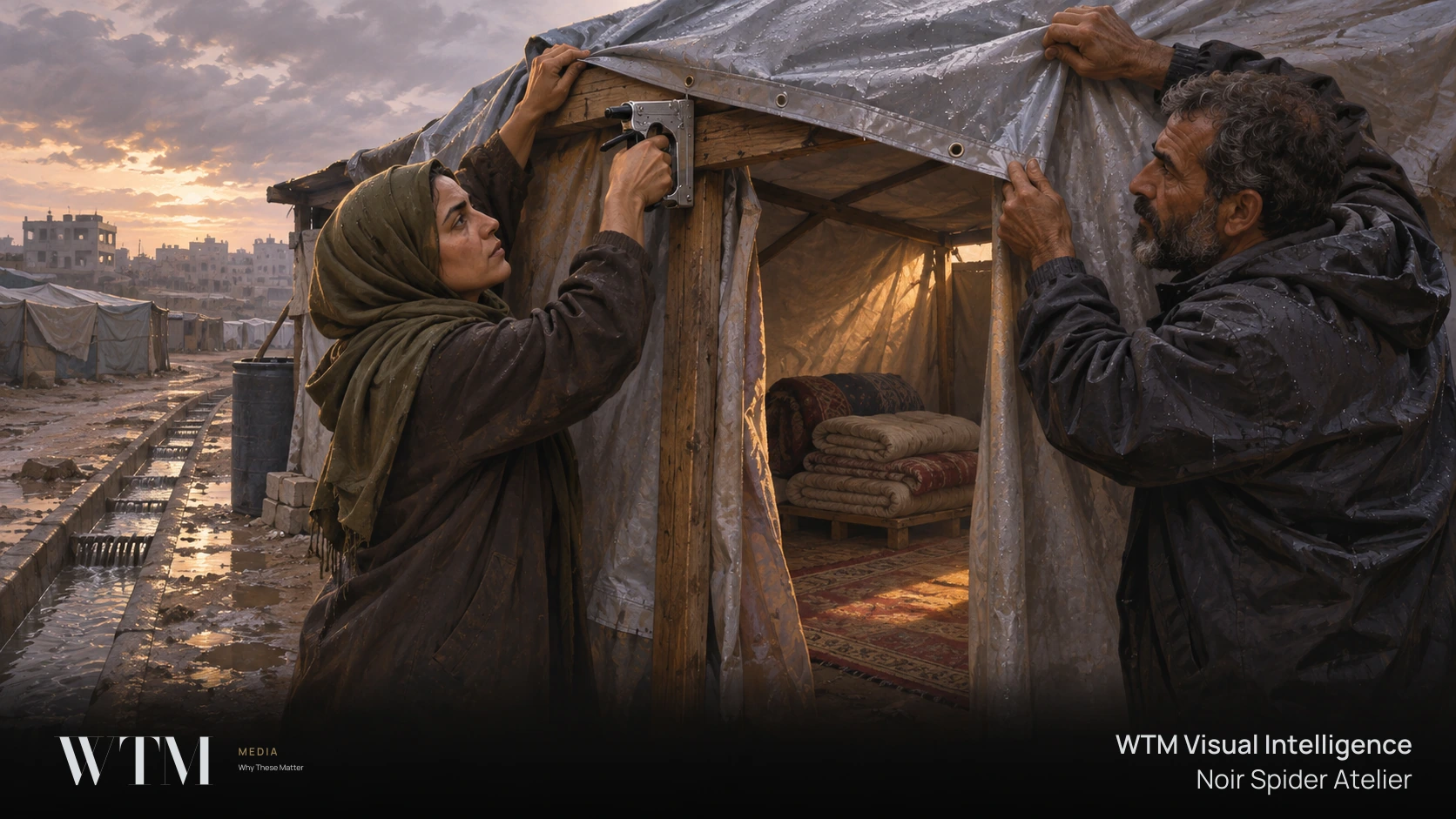
Gaza’s winter emergency exposes the distance between a diplomatic agreement and a liveable home. Closing it requires access, funding, safe construction and Palestinian agency, measured by what families can actually use.
George’s editorial narration · 21:28
Recorded synthetic narration of the editorial. Open the MP3.
Standfirst: Gaza’s winter emergency exposes the distance between a diplomatic agreement and a liveable home. Closing it requires access, funding, safe construction and Palestinian agency, measured by what families can actually use.
The one-minute read
Evidence reviewed on 11 November 2026; underlying reporting dates are shown. This is an editorial based on attributed reporting and published assessments, not original field reporting. Recommendations are WTM’s analysis. Conditions and access arrangements can change rapidly.
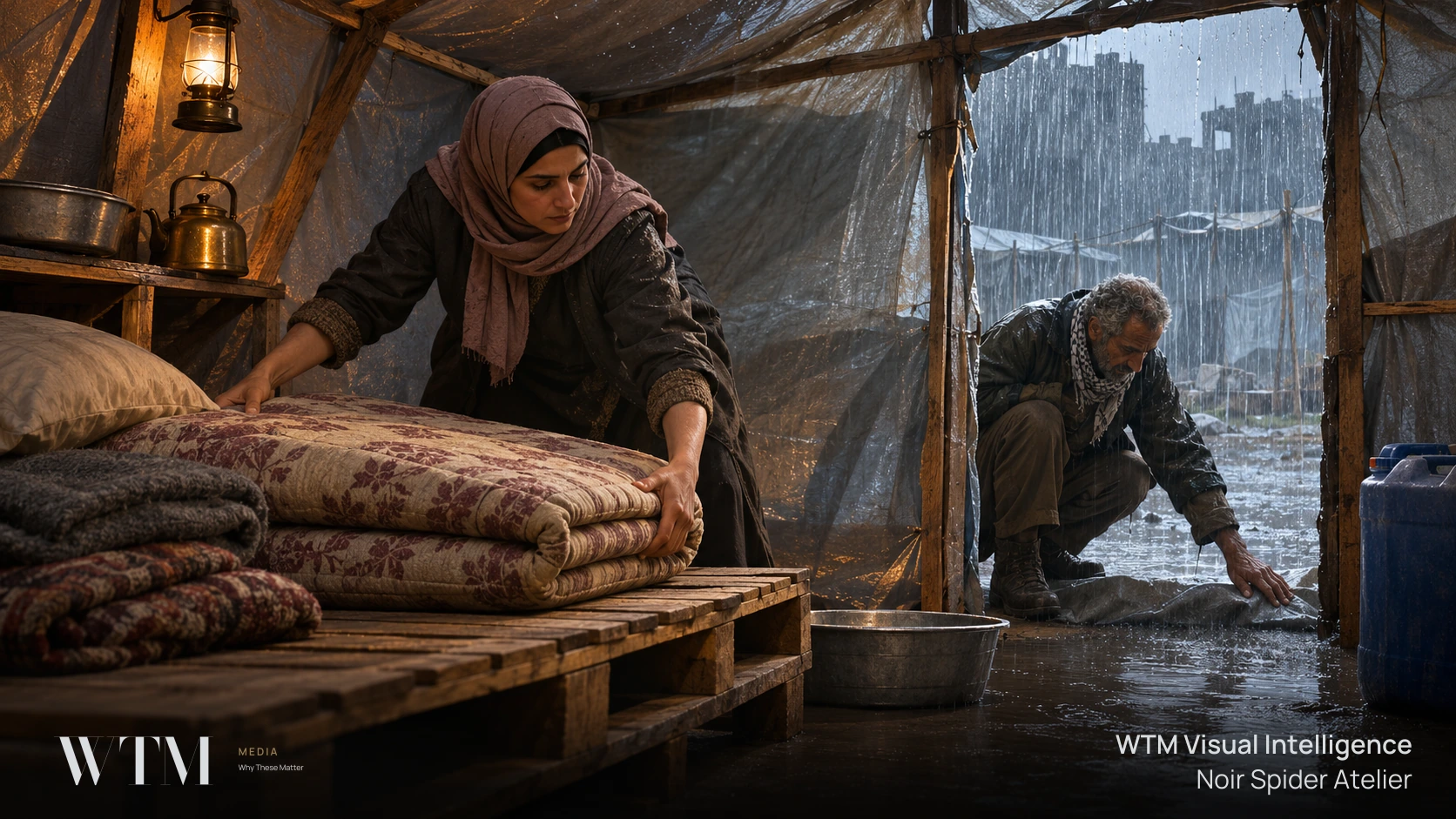
On 7 November, Reuters reported flooding across Gaza’s tent encampments. Its journalists described residents repairing shelters, reinforcing them with sand and moving children away from flooded tents. Municipal and civil defence officials said shortages of fuel and damaged equipment were limiting their response. The precise scale remained dependent on local authorities’ accounts; the flooded shelters themselves were part of the reporting. Reuters, 7 November, republished by GV Wire A subsequent OCHA report, dated 8 November and published on 9 November, described appeals from more than 26,000 households whose shelters or belongings were damaged. It reported that stocks of tents, tarpaulins, blankets and clothing inside Gaza were nearly exhausted. These are attributed, dated operational reports, not an independently reconciled measure of every household affected. OCHA, heavy-rain update
This is where the meaning of a ceasefire has to be examined carefully. The agreement that took effect on 10 October 2025 brought a reduction in fighting and hostage and prisoner releases. A year later, Reuters reported that Israeli strikes continued and major questions about Hamas’s disarmament, Israeli withdrawal and reconstruction remained unresolved. It would be wrong to call that a completed peace. It would also be wrong to dismiss the lives protected when large-scale fighting subsides. Reuters, 6 October
The distinction matters because public attention can move faster than recovery. An agreement supplies a date that fits a headline. Rebuilding requires repeated decisions about access, land, money, engineering and safety. Those decisions receive less attention, although their consequences enter every room that no longer has a wall.
At a UN briefing on 9 October, the International Organization for Migration said nearly all of Gaza’s approximately two million people still needed shelter assistance. It reported that half of existing tents and makeshift shelters were in poor or very poor condition. Tents are temporary products, the agency explained, typically intended to last six to twelve months. UN Geneva briefing, 9 October
A replacement tent can be essential. Replacing one repeatedly without a route to something safer is a warning about the wider response. Success should therefore be judged at the household: can people sleep dry, use a toilet safely and remain in one place without another foreseeable emergency forcing them out?
Protecting the ceasefire and demanding adequate shelter belong to the same recovery agenda. The agreement and the shelter response should be assessed together without confusing their functions. Reduced fighting can make repairs possible; adequate materials, safe access and maintained services determine whether families can use that opportunity. A diplomatic milestone deserves credit without becoming an excuse to stop asking about those conditions.

The word “shelter” can make a complex problem sound like a missing object. Deliver the object, and the problem appears solved. Humanitarian practice takes a broader view. Catholic Relief Services’ emergency guidance connects shelter to health, security, family and community life, livelihoods and secure tenure. It also treats living space and household essentials as part of a response, rather than optional extras. CRS, shelter and settlement guidance
That changes what a serious winter plan must contain. The covering needs to resist rain and wind. The ground needs to drain. People need bedding, safe cooking arrangements, drinking water, washing facilities and a way to reach healthcare. A person using a wheelchair needs an accessible route, not merely an allocation on a distribution list. Privacy and a safe route to a toilet matter to the quality of the shelter itself.
These are design requirements, not claims that every household has identical needs. Families should be able to describe what is failing and what would make a practical difference. An aid package designed around a standard household can miss people living alone, those caring for injured relatives, and families sharing space after repeated displacement.
The Norwegian Refugee Council warned on 5 October that shortages of heavy machinery, engine oil and fuel were slowing flood prevention. It also described overcrowding and restricted available space as obstacles to moving families voluntarily away from exposed sites. These are different problems from a shortage of fabric, and a consignment of tents cannot resolve them all. NRC, winter shelter warning, 5 October
The implication for donors is straightforward: fund the less visible work. Drainage maintenance, site assessment, repairs and skilled local labour deserve the same seriousness as an easily photographed delivery. For agencies, it means evaluating shelter after installation and after bad weather, with residents involved. A distribution total records activity. Whether the shelter remains usable records the result.
A shelter programme should protect daily life, not merely distribute a roof covering. That requires attention to the space around a home, the route to essential services and the people responsible for maintenance. Residents should be able to report a failure after a delivery has been counted. Otherwise a successful distribution record can conceal a shelter that no longer protects its occupants.
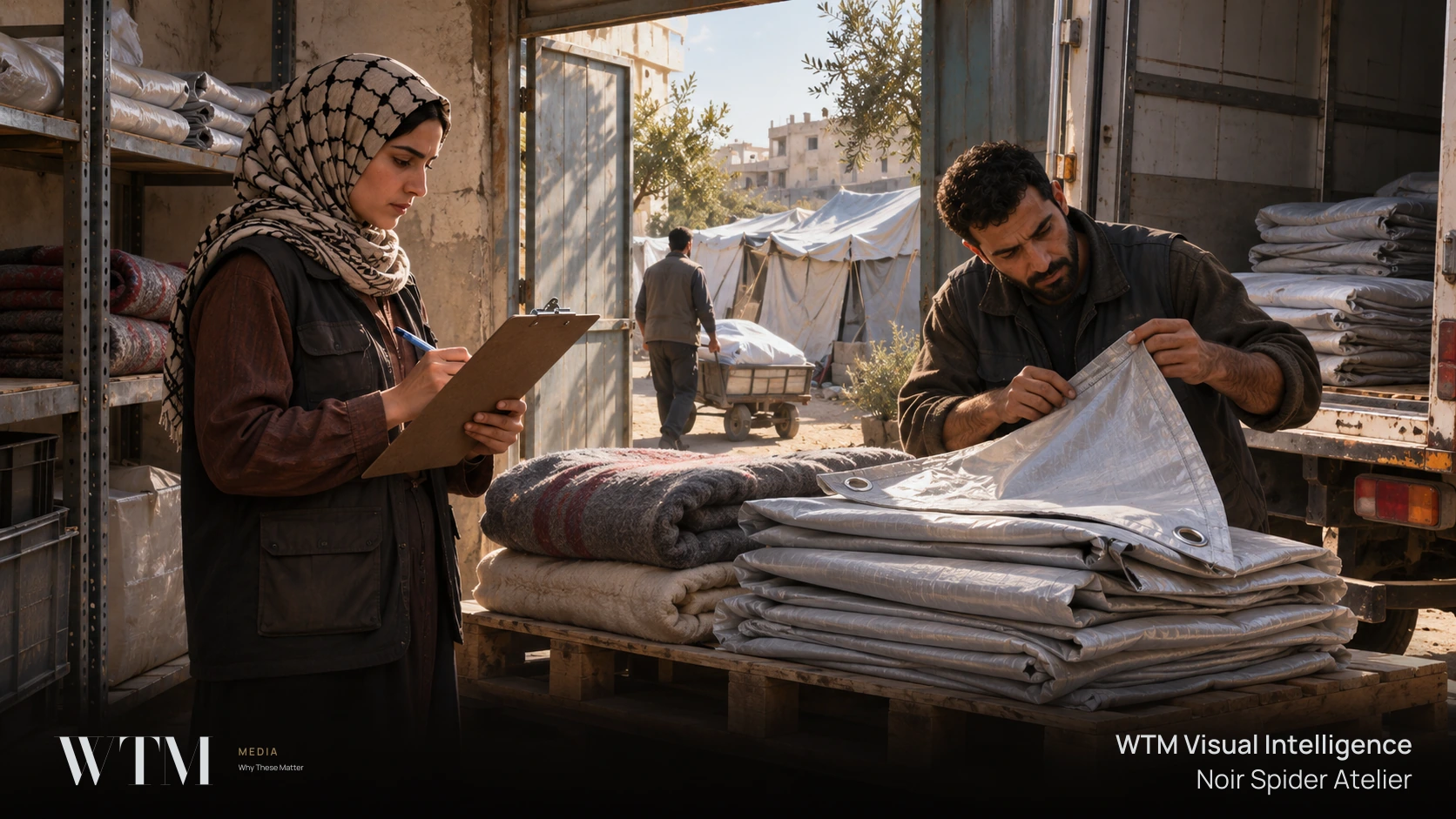
A dated operational snapshot shows why the stages matter. In its report dated 5 November, OCHA relayed Shelter Cluster estimates that, as of 1 November, Gaza still needed approximately 121,000 tents and 57,000 emergency shelter kits. The cluster reported approximately 2,800 tents in its stocks inside Gaza and no emergency shelter kits, with timber entry continuing to be rejected by Israeli authorities. Its winterisation requirements stood at US$267.9 million, with a US$186.5 million funding gap. OCHA, report dated 5 November Those are dated operational estimates, not a complete census of everything available through every channel. Nor should tents in stock be divided by people in need to produce a theatrical “coverage rate”: different units, household sizes and forms of assistance would make that misleading.
Israel gives a different account of the response. In a statement dated 6 November, the Israel Defense Forces said its winterisation effort had facilitated the entry of more than 85,000 tents and more than 8,000 trucks carrying winter and other supplies since implementation began. It said roughly half of approved requests had not yet resulted in entry, partly because of logistical and budget difficulties unrelated to Israel. It also alleged that Hamas’s conduct was the principal obstacle to progress. These are the military’s claims, not independently reconciled findings. IDF winterisation statement, 6 November
The figures cannot simply be placed on opposite sides of a graphic as though they measure the same thing. A cumulative entry total and a current stock count have different denominators and time periods. Distributed tents may already be occupied, worn out or unsuitable. An approval can exist before funding, transport or delivery has been secured.
The useful demand is a transparent chain of evidence. Start with what was pledged and the money actually received, then identify what was purchased and made ready for shipment. Record which items were approved, refused or left pending, with the reason. Next establish what entered, through which crossing and on what date. Finally, ask what reached households, was safely installed and remained usable. Keeping those stages separate reveals where a promise is still awaiting an action.
No single organisation necessarily holds every answer. That makes reconciliation more necessary, not less. Authorities, donors and relief agencies should publish compatible reporting while protecting recipients’ identities and sensitive operational details. The public should be able to see where responsibility sits when a promised shelter never becomes a place to sleep.
Count assistance at every stage, but judge success by safe, sustained use. A public tally should retain its date, unit and reporting organisation so readers can follow it without turning tents into people or approvals into completed homes. This is a proposal for accountable reporting, not a claim that one reconciled dataset already exists. Useful comparison begins by showing what each number actually counts.

The strongest argument for restrictions is security. Materials with civilian uses can also have military applications. Preventing diversion and protecting people from renewed attacks are legitimate concerns. After Hamas-led attacks, hostage-taking and a devastating war, treating security as an invented issue would undermine any serious argument for recovery.
But recognising a concern does not establish that every restriction is necessary or that its humanitarian consequences are acceptable. The ICRC explains that parties may exercise controls over humanitarian consignments, while those measures must be applied in good faith and must not unduly delay or make relief impossible. Civilian protection obligations apply to the parties on both sides of a siege. ICRC explanation of humanitarian law
A workable policy should therefore answer practical questions. Can a disputed item be inspected, tracked or supplied through a monitored project? Can officials give a specific reason for refusal and a prompt review route? If a material cannot enter, who is responsible for identifying a genuinely usable alternative? “Security” must lead to a process that can be assessed, rather than end the discussion.
The second objection is that access alone will not produce recovery. That is correct. Money, procurement capacity, transport and competent delivery also matter. OCHA’s November report attributes delays to a combination of funding shortfalls, lengthy procurement, entry restrictions and delayed approvals. Some supplies may arrive only in the second half of winter. OCHA, 5 November
This should sharpen accountability. A donor cannot blame a crossing for money never released. A controlling authority cannot treat an unfunded item as an explanation for refusing a funded one. An agency should acknowledge procurement or delivery failures within its control. Each bottleneck needs its own evidence and remedy.
The third objection is that temporary shelter risks becoming permanent displacement. That danger deserves attention. It is a reason to attach emergency provision to rights, meaningful choice and a reconstruction pathway. It is not a reason to leave families exposed while a final political settlement remains out of reach. Security, effective delivery and civilian protection must be designed together. None makes the others optional.

Gaza’s reconstruction is much larger than a winter appeal. The joint EU, UN and World Bank assessment published in April estimated recovery and reconstruction needs at US$71.4 billion over a decade, including US$26.3 billion in the first eighteen months. It reported more than 371,000 housing units destroyed or damaged. These are assessment-period estimates, not a fresh November count. Final Gaza Rapid Damage and Needs Assessment, 20 April
The scale can encourage two opposite mistakes. One is to promise a frictionless rebuilding programme, as though finance and a master plan could settle questions of security and governance. The other is to regard the task as so large that modest, immediate improvements no longer matter. Families need an approach that avoids both.
WTM’s proposal is to plan across three overlapping horizons. Protection now: fund and permit appropriate weather protection, bedding, drainage work and urgent repair. Prioritise people facing the greatest exposure and barriers to access, using transparent criteria rather than visibility or political connections.
Safer living during recovery: expand repairs and transitional accommodation where qualified assessment establishes that they are appropriate. Provide maintenance, water, sanitation and access to services. Do not pressure families to enter damaged structures because a nominal housing target must be met.
Durable homes and neighbourhoods: support Palestinian-led decisions about housing, services, livelihoods and public space. Make room for residents, municipal professionals, women, people with disabilities, tenants and displaced households in decisions that will shape their lives. The sequence is a policy recommendation, not a claim that a fully funded programme already exists. Safety assessments, debris management and land and property questions must be resolved within it. Rebuilding on an apparently empty plot can still affect someone’s rights. Losing documents in a war should not automatically erase a claim to a home or exclude a tenant from assistance.
Local participation also means allowing disagreement. Communities may have different priorities about return, repairs, temporary accommodation and the location of services. Consultation should change decisions, with a credible route to challenge errors. A finished building is an inadequate measure of recovery if its intended residents cannot afford to live there, cannot reach work or school, or had no meaningful say in its creation. Reconstruction should restore people’s ability to decide where and how they live.
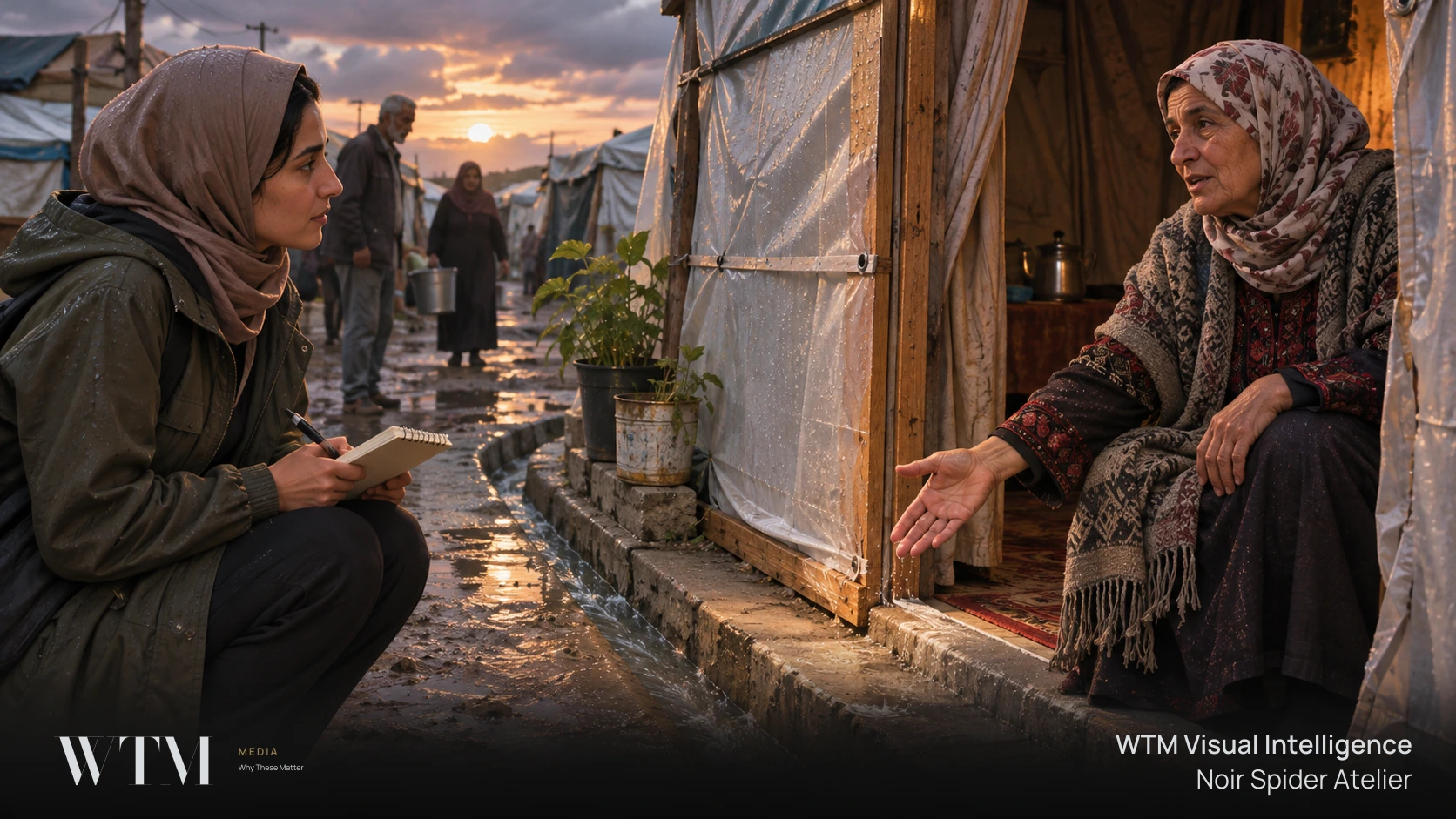
No individual donation can settle the conflict. No social-media post can substitute for access or government responsibility. There are still useful actions available to readers, and they become more effective when attached to specific demands. If you can give, check the delivery model. Read an organisation’s latest operational update and its donation terms. Look for current work, local partnerships, financial reporting and a clear account of access constraints. Ask whether an appeal is restricted to Gaza or may support a wider emergency response. Avoid assuming a price beside a photograph guarantees that a particular family will receive that exact item. The NRC shelter update is one starting point for understanding operational needs, not a guarantee of delivery or an endorsement of every fundraising claim.
If you contact an elected representative, make the request answerable. Ask what your government is doing to secure predictable humanitarian access, fund winter protection, support repairs and defend displaced people’s rights. Ask for delivery dates and public reporting. A response that repeats sympathy without naming an action should invite a follow-up question.
If you share reporting, carry the qualifications with it. Preserve dates and attribution. Distinguish an organisation’s assessment from an independently verified total and a government’s statement from a reconciled operational record. Do not turn “supplies approved” into “families housed”. Do not circulate an image of uncertain origin as evidence of this week’s conditions.
If you commission or produce coverage, follow the outcome. Return to the same questions after the announcement: what arrived, what worked, what failed and what residents want changed. Pay and credit Palestinian reporting and technical expertise fairly. Protect identities where publication could create risk. Never fabricate a witness, quotation or image of an identifiable event to make the story more affecting.
For anyone judging the next announcement, keep five questions close: How many households are safer? Who is still excluded? What is blocking the next improvement? Who can remove that obstacle? When will the result be checked? The purpose of a ceasefire is to make life possible again. That purpose is served by fewer attacks, credible security arrangements and sustained humanitarian access. It is also served by unglamorous work: repairing a drain, replacing unsafe materials, restoring a water connection and protecting a family’s claim to its home.
Gaza’s recovery should be measured by whether those improvements last. The next rain will test the shelters. Public scrutiny should test the decisions that determine whether they hold. Choose an action with a named objective, a responsible institution and a way to check the result.
Source statements rechecked on 11 November 2026 against the linked publications, with their stated reporting periods retained. This is editorial analysis, not original field reporting or interviews. Recommendations and hypothetical examples are identified in the text. Images are conceptual illustrations of fictional people and settings, not documentary evidence. Production uses AI-assisted research, writing and visual tools. WTM Visual Intelligence · Noir Spider Atelier.
Why These Matter - WTM MEDIA is an independent editorial platform exploring the forces shaping our world—through people, culture, commerce, design, systems, and governance. Connecting the dots between today’s headlines and tomorrow’s realities.

article-support-3
Noir Spider Atelier

article-support-2
Noir Spider Atelier

article-support-1
Noir Spider Atelier

press-partnership
Noir Spider Atelier
press-reader-desk
Noir Spider Atelier

resource-access
Noir Spider Atelier
membership-example
Noir Spider Atelier

membership-tools
Noir Spider Atelier

membership-reader
Noir Spider Atelier
membership-public
Noir Spider Atelier
pathway-design
Noir Spider Atelier
pathway-institutions
Noir Spider Atelier
pathway-technology
Noir Spider Atelier


