Artificial intelligence is being sold through two futures at once. In one, it becomes the great productivity engine of the twenty-first century: making workers more capable, companies more profitable, science faster and economies richer. In the other, it displaces workers, concentrates power, destabilises industries and leaves millions economically exposed. Investors are often encouraged to choose between these narratives. They should resist. Both can occur simultaneously. The more consequential question is whether household wealth has been designed to survive either outcome. The AI boom is no longer confined to technology shares. It is moving through data centres, electricity systems, corporate debt, private credit, retirement portfolios, labour markets and government policy. The IMF says equity-market concentration around AI has continued to intensify. The BIS describes one of the largest technology-driven investment booms in American history, increasingly financed through debt. Reuters calculates that five major technology companies have accumulated approximately $1.09 trillion in future lease commitments, predominantly connected to data-centre expansion. Yet the ILO finds that the productivity gains from generative AI are real but uneven, while mass employment displacement has not yet occurred. These facts do not describe either a certain bubble or a guaranteed revolution. They describe something more difficult: a system undergoing simultaneous technological, financial and labour-market repricing. For households, that requires a different conception of diversification. Your wealth is not merely what sits inside your brokerage account. It includes your earnings capacity, liquidity, debt obligations, property, pension, professional skills and ability to absorb disruption. Someone can therefore become wealthier on paper because AI-related equities are appreciating while simultaneously becoming more economically vulnerable because AI threatens the income financing their life. The objective is not to predict AI perfectly. It is to construct sufficient financial resilience that several plausible futures remain survivable
The easiest way to misunderstand the AI boom is to imagine that participation requires deliberately buying an artificial-intelligence company. Millions of investors have done nothing of the sort. They own broad-market index funds, workplace retirement plans, pensions, target-date funds, insurance products and professionally managed portfolios. Yet as the largest technology companies have become more valuable, market-capitalisation-weighted portfolios have naturally allocated more capital towards them. The IMF reported in July 2026 that concentration in AI-related equities had continued to intensify and that markets with substantial AI exposure — including the United States, Japan, Korea and Taiwan — were outperforming. The ordinary investor can therefore participate materially in the AI trade without ever deciding to make an AI investment.
This does not make index investing defective. Diversification through broad, low-cost funds remains one of modern finance’s most powerful innovations. But diversification has layers. An investor may own hundreds of securities and still have a meaningful portion of portfolio performance determined by a comparatively small collection of companies, sectors or economic assumptions. The distinction is between the number of securities owned and the number of independent risks actually owned. A portfolio containing an S&P 500 fund, a growth ETF, a technology fund, a target-date portfolio and several individual technology companies may look diversified when viewed through product names. Look through the products to their underlying economic exposures, however, and considerable duplication can appear.

That matters because today’s concentration is attached not merely to companies but to expectations. The market is assigning enormous present value to a future in which artificial intelligence generates sufficient productivity, revenues and profits to justify enormous investment. Nvidia’s latest results provide genuine evidence for the optimistic case: the company reported fiscal second-quarter revenue of $96.22 billion, more than twice the prior-year level, and projected exceptionally strong continued growth as demand spreads across hyperscalers, enterprises and sovereign buyers. The AI economy is not simply an imaginary valuation phenomenon. Companies are selling real products into extraordinary demand.
But real technology and rational investment are not synonymous concepts. The railway transformed civilisation while railway speculation destroyed fortunes. The internet changed virtually every modern industry while many dot-com investors lost enormous amounts of capital. A technology can be revolutionary, economically indispensable and ultimately profitable while particular assets associated with it remain overpriced. This distinction is essential because investment markets do not price whether a technology matters. They price expectations about how much it will matter, how quickly, who will capture the economics and what those future cash flows are worth today.
That is why the relevant question is not whether someone believes in AI. Belief is a poor substitute for portfolio analysis. Investors should understand how much of their equity exposure ultimately depends upon the same companies; whether their retirement and taxable portfolios duplicate one another; whether their employment income comes from the same sector dominating their investments; and whether a decline in one economic theme could simultaneously weaken their securities, bonuses, stock compensation and employment prospects. None of this requires abandoning growth. It requires seeing the architecture beneath it.
Awareness changes the question from “Do I own AI?” to “How much of my economic life already depends upon AI succeeding?” That is a considerably more difficult calculation. It also reveals why the AI boom cannot be treated merely as a technology story. Once a technological thesis becomes embedded across retirement accounts, corporate investment, employment expectations and national growth, its success or failure begins travelling through systems most people do not consciously associate with artificial intelligence.

Artificial intelligence is frequently described through software: models, prompts, agents and applications. Its economic architecture is considerably more physical. AI requires semiconductors, servers, cooling systems, transmission infrastructure, power generation, substations, fibre networks, land, construction, water and enormous buildings filled with expensive equipment. This physicalisation changes the nature of the boom. Software can scale quickly at the margin; infrastructure demands capital before the full economic return is known. The AI economy is therefore creating not merely technological optimism but one of the largest capital-allocation experiments of the modern era.
The BIS estimates that the five largest hyperscalers are set to spend more than $1 trillion on AI-related capital expenditure across 2025 and 2026. It says those commitments are outpacing earnings and free cash flow, encouraging some companies to raise additional debt. In a separate July assessment, the BIS characterised the AI boom as a large and increasingly debt-financed investment surge supporting trade and equity markets, while cautioning that its ultimate productivity payoff remains uncertain and uneven. These are not predictions of collapse. They are descriptions of a financial system becoming progressively more committed to a particular technological future.
The financing architecture is also becoming less visible. The BIS describes growing use of special-purpose vehicles, private credit and long-term capacity agreements that can move economically debt-like obligations outside conventional corporate balance sheets. Banks can provide funding lines to those vehicles; insurers and private-credit funds can hold the debt; technology companies can guarantee capacity or lease payments. What begins as a data-centre project can therefore create financial connections among technology companies, developers, banks, institutional investors, utilities and private-credit markets. Innovation acquires a balance sheet, and the balance sheet acquires counterparties.
Reuters’ examination of future lease commitments makes the scale tangible. Microsoft, Meta, Oracle, Amazon and Alphabet together disclosed approximately $1.09 trillion of future lease commitments, largely associated with the data-centre race. Because many of the leases have not commenced, they are not yet recorded as conventional lease liabilities. Reuters found that this future commitment pool was nearly four times the companies’ reported lease liabilities. The number does not mean $1.09 trillion is suddenly due, nor does it establish that the investment is unsustainable. It reveals something more useful: enormous quantities of tomorrow’s capital are already being promised against expectations about tomorrow’s demand.
This is where comparisons with 2008 require discipline. The global financial crisis was fundamentally a housing-credit, securitisation, leverage and banking crisis. AI infrastructure is not subprime housing, and invoking 2008 as though history were repeating would obscure more than it explains. The transferable lesson is structural rather than literal: when optimistic assumptions become embedded across interconnected financing arrangements, understanding who owes what to whom becomes increasingly important. The BIS currently judges macroeconomic and financial-stability risks from AI financing as moderate, but explicitly says sustainability depends upon firms meeting high earnings expectations. Its research on the investment race also examines how debt and circular financial relationships could amplify stress if expectations disappoint.
The deeper issue is therefore not whether the AI infrastructure boom becomes another 2008. It is whether households recognise that financial markets are converting technological expectations into long-duration commitments before society knows the ultimate distribution of AI’s productivity gains. If the returns justify the expenditure, enormous new productive capacity may have been constructed. If returns arrive more slowly, capital will be repriced. If some infrastructure becomes redundant, specialised assets may lose value. And if competition causes today’s dominant companies to overspend merely to prevent rivals from winning, extraordinary technological progress could coexist with disappointing investment returns. The technology can work while the capital structure surrounding parts of it does not.

The public conversation around artificial intelligence has developed a peculiar duality. Workers are told that AI is a tool: a collaborator that can eliminate drudgery, accelerate research, expand creativity and allow individuals to accomplish what previously required teams. They are also told that AI may eliminate occupations, compress white-collar employment and radically alter the relationship between labour and capital. These messages are often treated as mutually contradictory — optimism when selling the technology, apocalypse when describing its power. Sometimes rhetoric undoubtedly serves commercial incentives. Economically, however, the two propositions can coexist.
Productivity is not synonymous with employment. A company can produce more value per worker because AI makes each employee more capable. It can use that additional capacity to expand production, reduce prices, create new services and hire more people. Or it can discover that the same output now requires fewer workers. Different industries can experience both processes simultaneously. The ILO’s June 2026 review of empirical evidence finds genuine but uneven productivity improvements from generative AI, while large-scale employment displacement remains limited so far. Worker-reported time savings have not yet consistently translated into corresponding increases in measured output, earnings or employment. The transition is real; its eventual labour-market equilibrium is not.
The distribution matters as much as the aggregate. The ILO identifies emerging concerns around inequality, younger workers’ employment opportunities, worker autonomy and job quality. The BIS similarly notes that US sectors with greater AI exposure have experienced stronger productivity growth alongside weaker employment growth relative to less-exposed sectors. Neither finding establishes an inevitable jobless future. Together, they suggest that society should stop asking only whether AI creates or destroys jobs and begin asking whose productivity increases, who captures its value, which tasks disappear, which new tasks emerge and how quickly workers can move between them.
For wealth security, this introduces a neglected concept: households possess both financial capital and human capital. Financial capital includes equities, bonds, property, pensions, cash and other assets. Human capital includes the future earning capacity generated by skills, knowledge, health, professional relationships, reputation and adaptability. Traditional investment conversations concentrate overwhelmingly on the first. Yet for most working-age households, the present value of future labour income can be one of their largest economic assets. AI can therefore increase the value of a household’s investment portfolio while simultaneously threatening part of the income stream required to finance that portfolio.
Consider the professional whose retirement account rises because technology shares are appreciating while the company employing them begins using AI to reduce headcount. Their brokerage statement says wealth has increased. Their labour-market position says economic security has weakened. Or consider a technology employee whose salary, bonus, restricted stock and personal investments are all connected to the same industry. What appears to be extraordinary wealth creation can contain extraordinary concentration. Conversely, someone who holds excessive cash because they fear AI could miss years of compounding if the productivity revolution succeeds. Fear can create concentration too — concentration in one imagined future.
This is why the correct response to AI uncertainty is neither panic nor worship. Acceptance means allowing contradictory evidence to coexist long enough to understand the system. AI can raise productivity and increase inequality. It can create industries and eliminate tasks. It can make today’s leading companies more valuable while eventually commoditising technologies that currently generate their margins. It can reward investors and destabilise workers. The central wealth question is therefore no longer simply “How should I invest in AI?” It is “How exposed are my financial capital and human capital to the same technological outcome?”

Financial markets reward conviction, but household security requires something conviction alone cannot provide: survivability. Nobody knows the final productivity contribution of artificial intelligence, which companies will dominate its mature economy, how quickly labour markets will adapt, where regulation will intervene or whether today’s infrastructure expenditure will prove excessive. Strategic imagination is useful precisely because forecasting is imperfect. Instead of constructing one heroic prediction and betting the household upon it, wealth architecture can be tested against several plausible futures.
Future One is the Productivity Boom. AI performs extraordinarily well. Adoption spreads beyond technology companies into medicine, logistics, science, professional services, manufacturing and government. Productivity accelerates, new products emerge, corporate profits expand and today’s infrastructure expenditure increasingly looks prescient. In this future, the danger is excessive defensiveness. Someone who responded to uncertainty by abandoning productive assets, hoarding cash or waiting indefinitely for a market collapse could protect themselves against a crisis that never arrives while sacrificing years of compounding. Wealth security therefore cannot mean permanent retreat from risk.
Future Two is the Great Rotation. AI succeeds, but value migrates. Competition reduces the cost of models and computing. The economic advantage shifts from the companies building foundational infrastructure towards businesses applying intelligence to healthcare, robotics, energy, industrial production, financial services or categories that do not yet exist. History repeatedly demonstrates that predicting a technological revolution correctly does not guarantee predicting its ultimate profit pools correctly. In this future, concentration in today’s winners becomes dangerous not because AI failed, but because AI succeeded so widely that the economics moved elsewhere.
Future Three is the Expectations Reset. AI remains transformative, but financial markets priced the transformation faster than revenues and productivity could justify. Valuations contract. Infrastructure projects are cancelled or repriced. Some specialised assets lose value. Highly leveraged participants suffer more severely. Strong businesses survive; weaker financing structures do not. The internet provides the useful precedent: the dot-com crash did not invalidate the internet. It separated the civilisation-changing technological thesis from many investment theses built around it. BIS researchers now model a similar possibility in AI, estimating substantial potential over-investment under winner-take-most competitive dynamics, while emphasising the role that debt and interconnected financing could play in making a reversal more disruptive.
Future Four is the Labour Shock. AI delivers the productivity its investors expect, but labour-market adaptation is slower than technological adoption. Some companies become more profitable precisely because fewer people are required for particular categories of work. Markets can therefore remain strong while sections of the workforce experience wage compression, unemployment or reduced entry-level opportunity. That possibility breaks one of the most dangerous assumptions in personal finance: that a healthy stock market necessarily implies a healthy household. A worker can own shares in the companies benefiting from automation while simultaneously losing the income that allowed those shares to accumulate.
The purpose of these futures is not to choose the most dramatic one. It is to ask what breaks in each. What happens if equities fall sharply while employment remains secure? What happens if equities rise while employment becomes insecure? Could the household meet twelve months of obligations without selling long-term assets into a falling market? Is expensive debt consuming flexibility? Are multiple funds actually duplicating the same exposures? Does insurance protect catastrophic risks? Are skills becoming more or less valuable in an AI-mediated economy? Could someone retrain, relocate, negotiate or start something if necessary? Scenario planning converts uncertainty from something to fear into something that can be designed around. The objective is not to eliminate risk. It is to prevent one future from possessing the power to destroy all the others.

Modern investment culture frequently reduces wealth to a scoreboard. Return is measured against an index; success becomes the portfolio that appreciated most; intelligence becomes the ability to identify the next winner before everyone else. But human beings do not live inside brokerage statements. They live through mortgages and rent, ageing parents, children, illnesses, redundancies, businesses, divorces, relocations, ambitions and years in which markets refuse to cooperate. The highest-returning theoretical portfolio is not necessarily the portfolio that allows a person to withstand their actual life. Wealth has another purpose beyond maximisation: it creates optionality.
Optionality is the ability to make consequential decisions without immediate financial coercion. It allows someone to survive unemployment without liquidating investments at precisely the wrong moment; retrain when an occupation changes; move when opportunity moves; care for someone; start a company; leave an unhealthy institution; absorb an emergency; negotiate from strength rather than desperation; or simply wait when markets are irrational. Seen this way, liquidity is not lazy money, productive investment is not gambling, insurance is not wasted expenditure and diversification is not mediocrity. Each performs a different function within an architecture designed to preserve agency.
That architecture must now incorporate technological exposure. A person whose occupation faces meaningful AI disruption may rationally require different liquidity, debt and investment decisions from someone whose income is relatively insulated. Someone whose compensation already depends heavily upon technology equities may need to think differently about additional portfolio concentration. A retiree drawing income from investments faces a different problem from a thirty-year-old with decades available to recover from volatility. There is no universal AI portfolio because there is no universal household. Alignment means connecting investments to liabilities, earning power, time horizon and the risks already embedded elsewhere in one’s life.
The WTM AI Wealth Stress Test therefore begins with questions rather than securities. What percentage of your economic life depends upon your employment continuing uninterrupted? How much portfolio exposure ultimately traces back to the same companies or economic theme? How long could your household operate if income stopped? Which debts remove optionality? Which assets could be sold without permanently impairing long-term plans? How adaptable are the skills producing your income? What happens if AI succeeds faster than expected? What happens if markets discover they expected too much?These questions do not predict prices. They reveal fragility.
Responsible authority begins there. Not with abandoning equities because a crash is possible. Not with buying every AI-related security because technological transformation is possible. Not with assuming cash is safety regardless of inflation, or assuming diversification automatically exists because several fund names appear on a statement. It begins by knowing what one owns, what one owes, what produces one’s income, what risks overlap and which assets exist specifically to preserve freedom when conditions deteriorate. Where complexity or tax consequences are substantial, that diagnosis belongs alongside qualified fiduciary, tax and legal advice. Intelligence should improve decisions, not impersonate certainty.
Artificial intelligence may become one of civilisation’s greatest productivity technologies. It may also generate one of the largest reallocations of economic power since industrialisation. Those outcomes are not opposites. The wealth created by a technological revolution and the insecurity created during its transition can exist in the same economy, the same city and even the same household. The task, therefore, is not to defeat uncertainty. It is to design around it: awareness sufficient to see exposure, acceptance sufficient to confront uncomfortable possibilities, alignment sufficient to connect capital with reality and authority sufficient to act without surrendering judgement to either euphoria or fear.

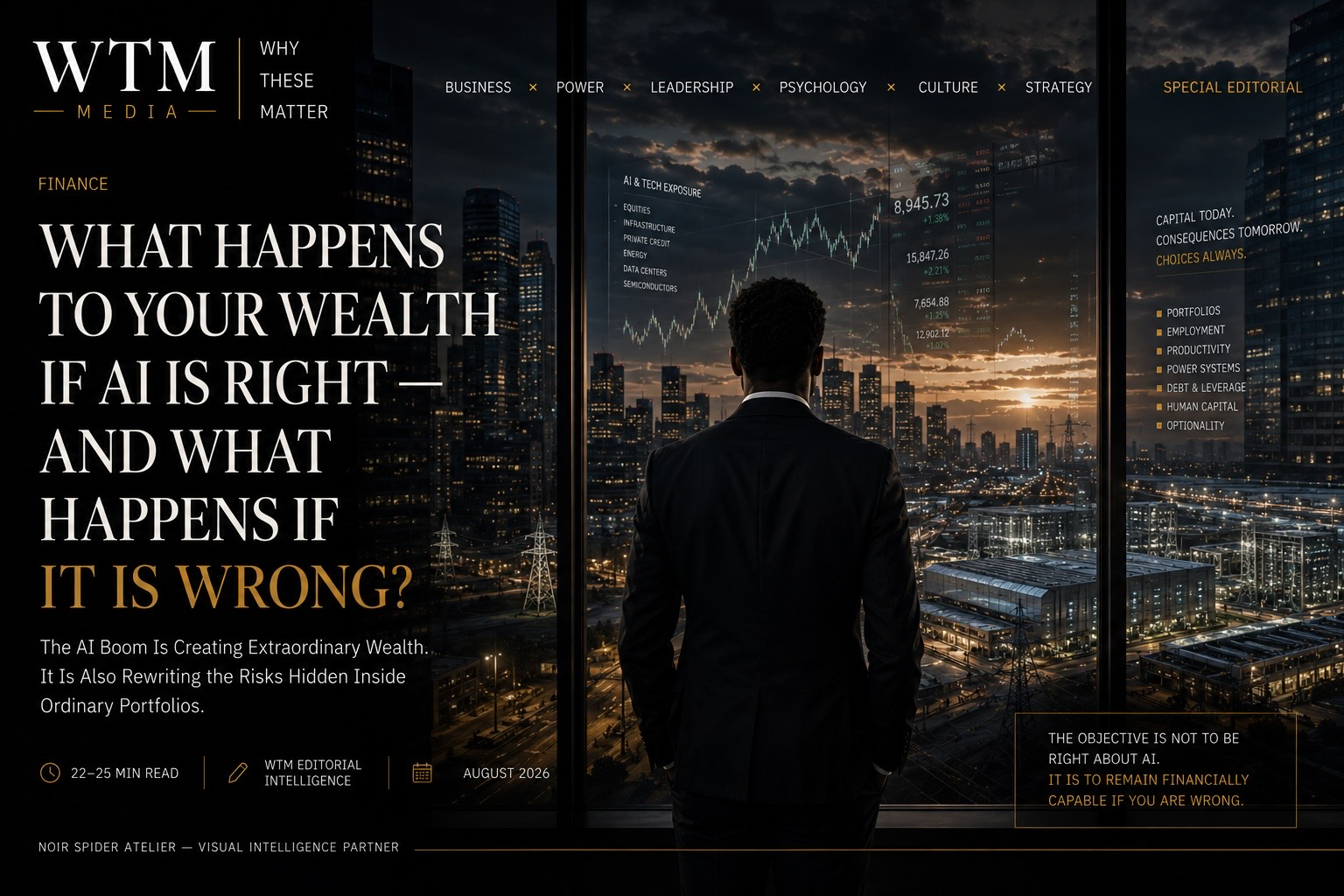
The objective is not to be right about AI. It is to remain financially capable if you are wrong.
Reader Reflection: If your job, investments and future income are all exposed to the same technological revolution, how diversified are you really?
WTM AI Wealth Stress Test
Before making any investment decision in response to the AI boom, a household should be able to answer six questions:
That is the actionable purpose of the investigation: not investment prediction, but wealth resilience.
Editorial Evidence Note: This editorial distinguishes established evidence from scenario analysis. Current evidence supports a rapidly expanding and increasingly debt-financed AI investment cycle, intensified AI-related equity concentration, substantial infrastructure commitments, genuine but uneven productivity improvements and limited evidence so far of economy-wide mass employment displacement. The four futures described above are strategic scenarios, not forecasts.
The BIS cautions that the productivity payoff remains uncertain and uneven, while its January analysis says sustainability depends upon high earnings expectations being realised. Its July working paper goes further by modelling the possibility of over-investment and financial contagion in a competitive AI investment race. These findings justify stress-testing the boom; they do not establish that a crash is imminent.
Principal research: BIS — AI and the global economy: implications for central banks. BIS — Financing the AI boom: from cash flows to debt. BIS — The AI investment race. International Labour Organization — The impact of GenAI on jobs, productivity and work organisation. IMF — July 2026 World Economic Outlook Update. Reuters — AI data-centre race builds $1 trillion lease burden for Big Tech
Visual Intelligence: Noir Spider Atelier™ — A Division of WTM Media
Editorial Direction: Kelly Dowd, MBA, MA
Copyright: © 2026 WTM Media. All rights reserved
Why These Matter - WTM MEDIA is an independent editorial platform exploring the forces shaping our world—through people, culture, commerce, design, systems, and governance. Connecting the dots between today’s headlines and tomorrow’s realities.