
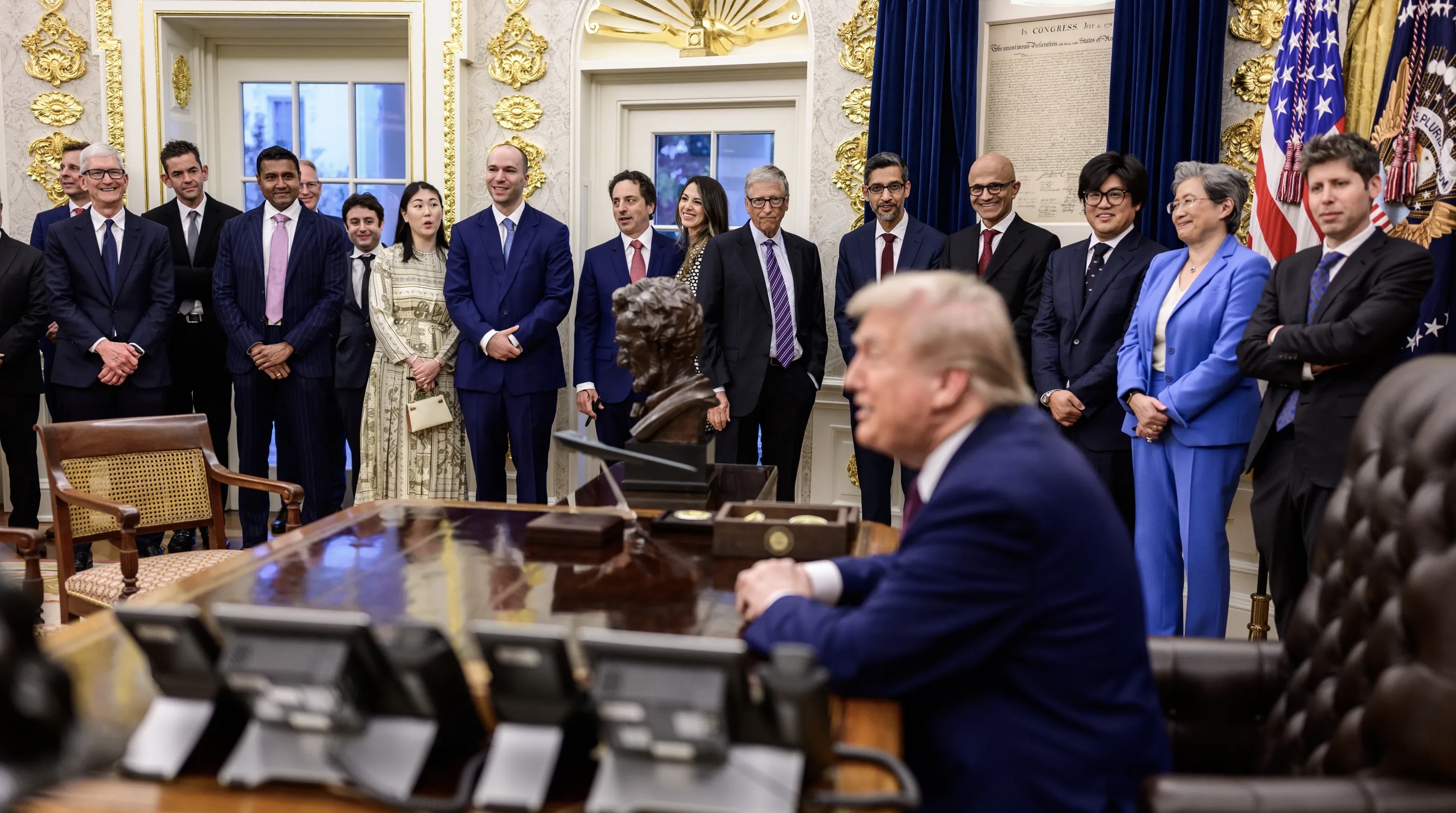
The presence of major American executives alongside President Donald Trump during high-level China engagements reveals a critical transformation in global power: multinational corporations are no longer merely economic actors. They are geopolitical participants. Executives from companies including Apple, Tesla, BlackRock, Qualcomm, and Boeing understand that the future global economy will be shaped not simply by markets, but by strategic negotiations between states, supply chains, artificial intelligence, semiconductors, and industrial dependency.
Historically, diplomacy belonged primarily to nation-states. Today, corporations often possess resources, data infrastructures, technological influence, and supply-chain leverage exceeding those of many governments. Technology companies control communication systems. Financial institutions shape capital flows. Semiconductor firms influence national security capabilities.
China understands this reality deeply. American corporations continue depending heavily on Chinese manufacturing capacity, consumer markets, rare earth processing, battery infrastructure, and industrial ecosystems. Simultaneously, the United States increasingly views Chinese technological advancement as a national security challenge.
Executives accompanying political delegations therefore serve dual purposes: commercial negotiation and strategic signalling. Their presence demonstrates that despite political tensions, economic interdependence remains extraordinarily deep.
For years, political rhetoric in Washington promoted the idea of economic “decoupling” from China. Yet global supply chains remain deeply integrated. Apple’s manufacturing dependencies, Tesla’s Shanghai operations, semiconductor production chains, and rare-earth mineral processing networks reveal how difficult true separation would be.
The modern economy was built around efficiency, not geopolitical resilience. Corporations optimised for cost reduction, just-in-time logistics, and global integration. The result is a system where geopolitical rivalry coexists alongside profound economic dependence.
This contradiction creates structural instability. Governments seek strategic autonomy while corporations seek market continuity. CEOs increasingly find themselves balancing shareholder expectations against national security concerns.

Unlike the ideological Cold War between the United States and Soviet Union, the emerging U.S.-China rivalry is economically intertwined. The battlefield is no longer solely military positioning. It includes semiconductors, AI leadership, cloud computing, electric vehicles, shipping corridors, pharmaceuticals, quantum research, and energy infrastructure.
Executives participating in diplomatic visits are therefore not merely business leaders. They are intermediaries inside a larger contest over technological and economic supremacy.
This convergence of politics and commerce also raises uncomfortable questions about democratic accountability. As corporations accumulate geopolitical influence, who ultimately shapes national priorities — elected governments or multinational capital systems?

The future global order will not be determined solely in parliaments or military headquarters. It will increasingly be negotiated inside boardrooms, semiconductor facilities, cloud infrastructures, logistics networks, and AI laboratories. The CEOs travelling to China are not tourists. They are participants in the redesign of the 21st-century power structure. The deeper issue is no longer whether business and politics intersect. It is whether modern democracies still possess the capacity to separate them at all.

Why These Matter - WTM MEDIA is an independent editorial platform exploring the forces shaping our world—through people, culture, commerce, design, systems, and governance. Connecting the dots between today’s headlines and tomorrow’s realities.