
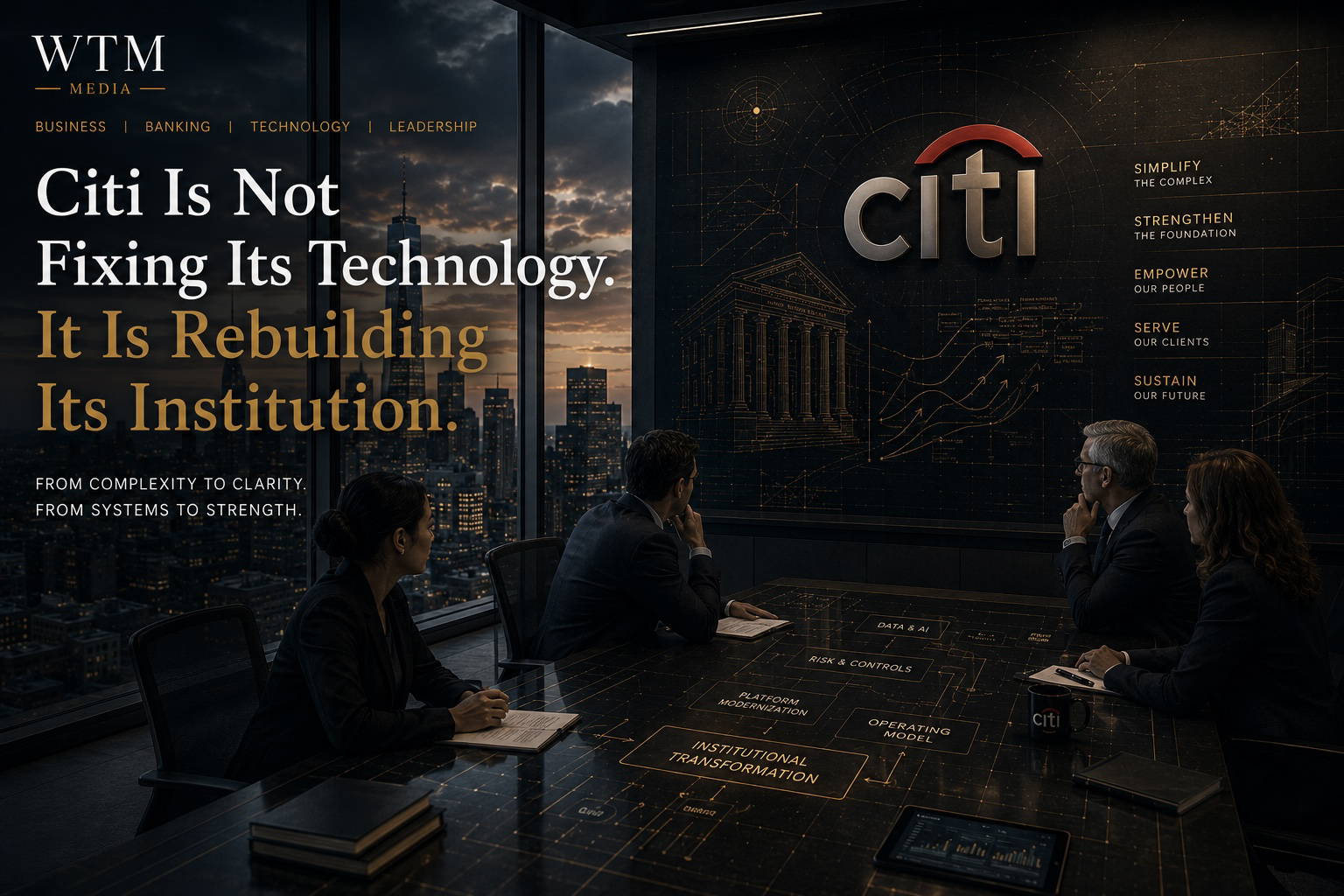
Most headlines describe Citigroup’s technology transformation as another expensive digital modernisation programme. That framing misses the larger story; the real transformation is institutional. Technology has become the visible expression of something much deeper: organisational redesign. Under CEO Jane Fraser, Citi is attempting one of the most complex reinventions in modern banking—not merely replacing ageing software, but rebuilding governance, simplifying decision-making, redesigning accountability, reducing organisational complexity, and restoring confidence after years of regulatory scrutiny.Tim Ryan’s arrival from PwC represents more than a technology appointment. It reflects a growing recognition that technology leaders increasingly function as institutional architects. Their responsibility is no longer confined to servers, software, or cybersecurity. They now redesign how information moves, how decisions are made, how risks are managed, and ultimately, how organisations earn trust. The future of banking will not be determined by whichever institution deploys the most artificial intelligence. It will belong to those capable of redesigning themselves whilst continuing to operate at global scale.
Large organisations rarely collapse because of a single failed technology platform. They become vulnerable because years of acquisitions, regulatory responses, departmental autonomy, and incremental decisions gradually produce systems that no longer communicate with one another. Over time, complexity itself becomes the greatest operational risk. Citi’s challenge reflects decades of accumulated institutional weight rather than a sudden technological failure.
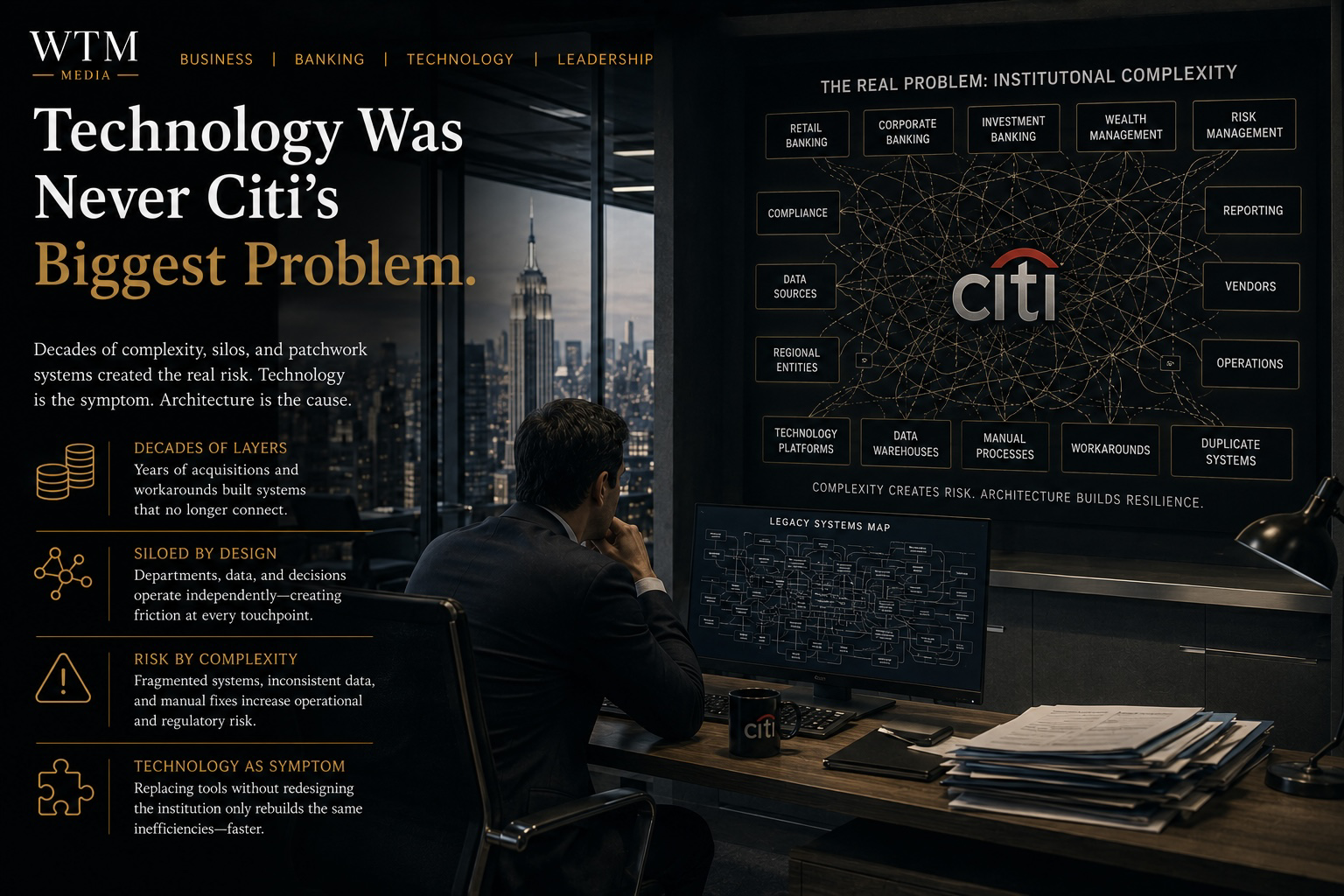
Technology often becomes the most visible symptom because employees encounter it every day. Delayed processes, fragmented customer information, duplicated databases, inconsistent reporting, and incompatible platforms create frustration throughout an organisation. Yet replacing software alone cannot solve problems rooted in governance. Without changing how decisions are made, organisations merely install newer versions of yesterday’s inefficiencies.
Global banks operate among the most complicated institutions on Earth. Every payment, loan, compliance review, cybersecurity protocol, customer interaction, and regulatory report depends upon thousands of interconnected processes operating continuously across jurisdictions. Small failures in one system frequently expose weaknesses embedded elsewhere. Complexity compounds exponentially rather than linearly.
Jane Fraser inherited not simply a technology challenge, but an organisational architecture requiring simplification. Regulators had already highlighted weaknesses surrounding risk management, data governance, and operational resilience. These observations were less about software than about institutional coherence. Restoring confidence demanded structural redesign rather than isolated digital upgrades.
Tim Ryan’s appointment therefore represents a different philosophy of leadership. His experience managing transformation at both PwC and Citigroup suggests that successful technology leaders increasingly operate as enterprise integrators. They connect business strategy, operational execution, regulation, finance, cybersecurity, and organisational culture into a coherent operating model.
The broader lesson extends well beyond banking. Every mature institution eventually confronts the same reality: technology cannot compensate indefinitely for organisational complexity. Sustainable competitiveness depends upon simplifying the institution itself before attempting to modernise the tools supporting it.
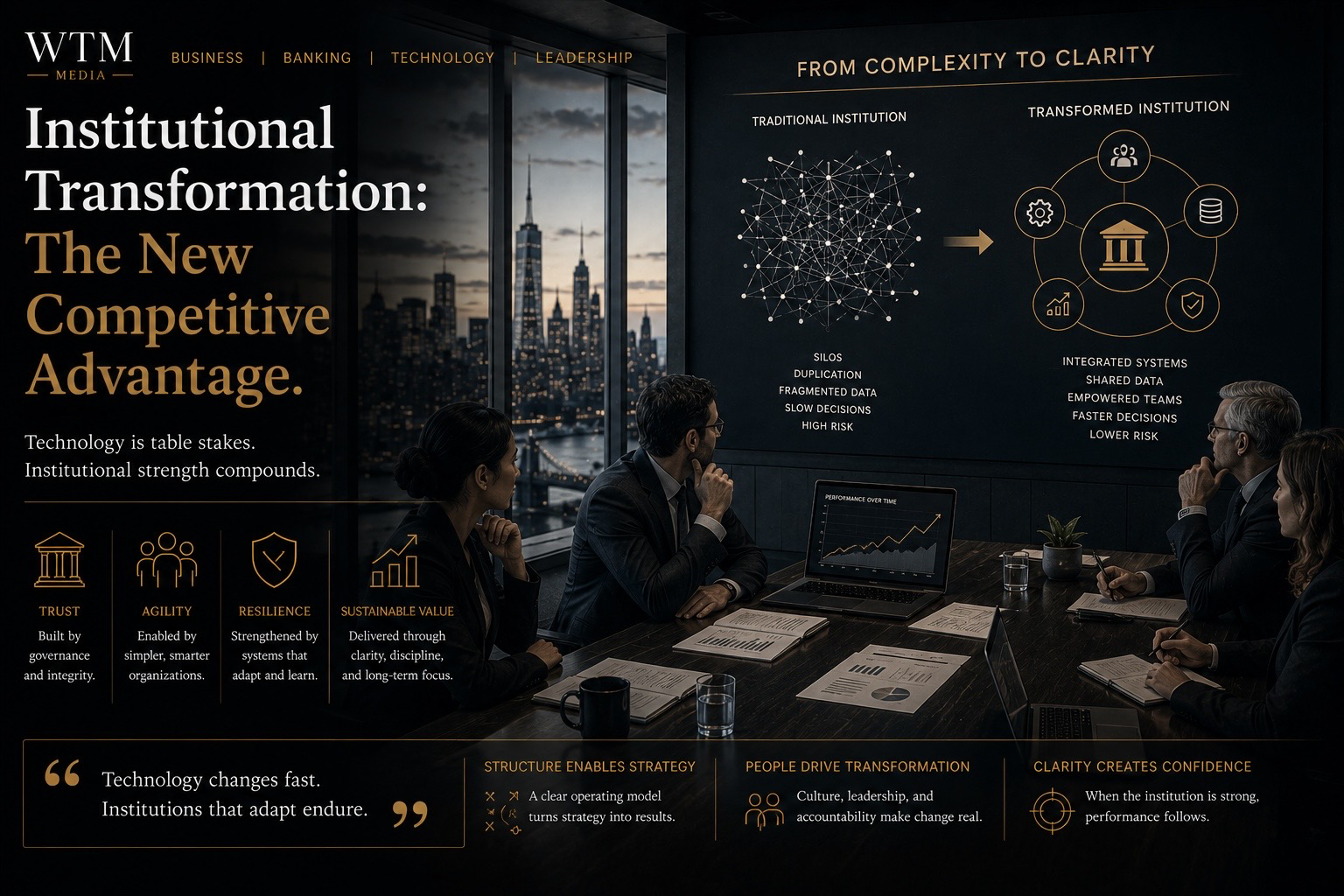
Artificial intelligence has accelerated an important misconception. Many executives believe competitive advantage comes from adopting newer technologies faster than competitors. History suggests otherwise. Organisations rarely fail because they lacked access to technology. They fail because they lacked the institutional capacity to integrate technology intelligently.
The strongest institutions develop architectures that allow continuous adaptation. Rather than rebuilding every decade, they evolve continuously. Governance structures, operating models, leadership accountability, and information flows become sufficiently flexible that new technologies strengthen existing capabilities rather than disrupt them. Adaptability becomes embedded within the institution itself.
Financial services illustrate this transition particularly well. Digital banking, cloud computing, AI-assisted fraud detection, algorithmic trading, personalised financial advice, and cybersecurity all depend upon trusted institutional foundations. Sophisticated algorithms become liabilities if underlying data quality remains inconsistent or governance remains fragmented.
Institutional transformation therefore requires unusual patience. Software may be deployed within months. Cultural redesign often requires years. Employees must learn new behaviours. Managers must relinquish outdated authority structures. Incentives must reinforce collaboration rather than departmental optimisation. Transformation succeeds only when people begin making different decisions before anyone notices different technologies.
Increasingly, investors recognise this distinction. Markets reward institutions capable of demonstrating operational resilience, disciplined governance, and strategic clarity alongside technological capability. Long-term value emerges from institutional credibility rather than digital novelty. Technology amplifies trust; it rarely creates it independently.
For every organisation observing Citi’s transformation, the underlying question becomes increasingly relevant: are you digitising existing bureaucracy, or redesigning the institution that bureaucracy created? Those represent fundamentally different strategic ambitions, and only one compounds over decades.
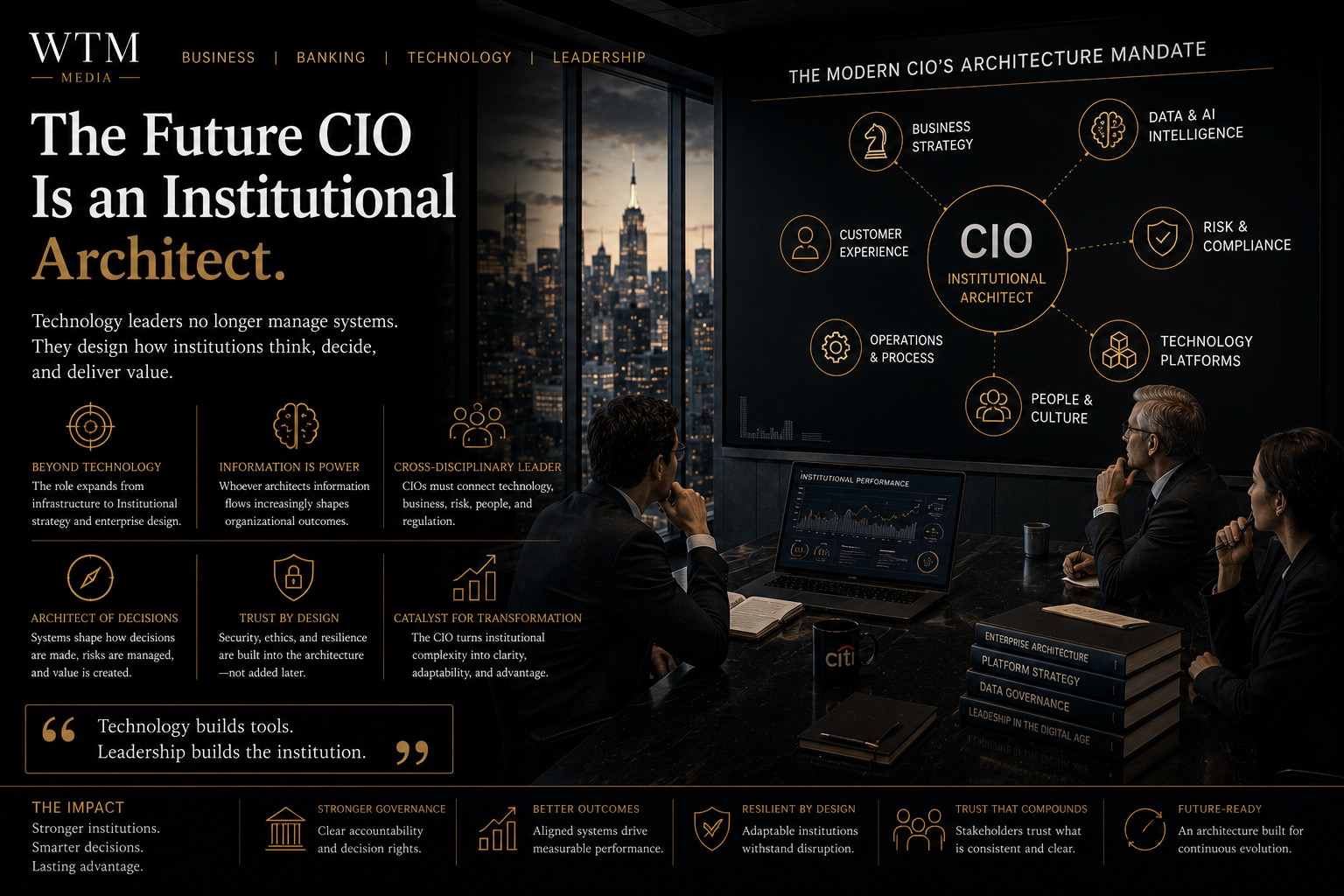
The traditional Chief Information Officer managed infrastructure, procurement, software implementation, cybersecurity, and technology budgets. Whilst these responsibilities remain important, they no longer define the position’s strategic influence. Modern CIOs increasingly shape organisational design itself. Their decisions determine how information becomes intelligence across the enterprise.
Information has become every institution’s central operating resource. Finance, healthcare, government, manufacturing, education, media, logistics, and defence all depend upon accurate, secure, accessible, and actionable information. Whoever governs information increasingly governs institutional performance. Technology leadership therefore becomes organisational leadership.
This shift demands broader capabilities. Technical expertise alone is insufficient. Future technology executives require understanding of economics, behavioural science, regulation, systems thinking, organisational psychology, communication, risk management, and executive leadership. They must translate complexity across disciplines rather than optimise isolated systems.
Tim Ryan’s background reflects this evolution. Consulting experience develops an understanding of enterprise complexity extending beyond technology itself. Large-scale transformation requires negotiating competing incentives, balancing stakeholder expectations, managing institutional resistance, and maintaining strategic momentum despite inevitable setbacks. These skills increasingly distinguish successful technology leaders.
Artificial intelligence will reinforce this transition. As routine technology management becomes increasingly automated, executive value shifts towards judgement. Determining where intelligence should be deployed, how governance should evolve, and which risks remain uniquely human becomes the defining leadership challenge. Institutions require architects rather than administrators.
The organisations attracting exceptional technology leaders over the next decade will therefore offer more than attractive salaries. They will offer opportunities to shape institutional futures. Technology leadership is quietly becoming one of the most influential executive disciplines in modern business because it increasingly governs how institutions themselves evolve.
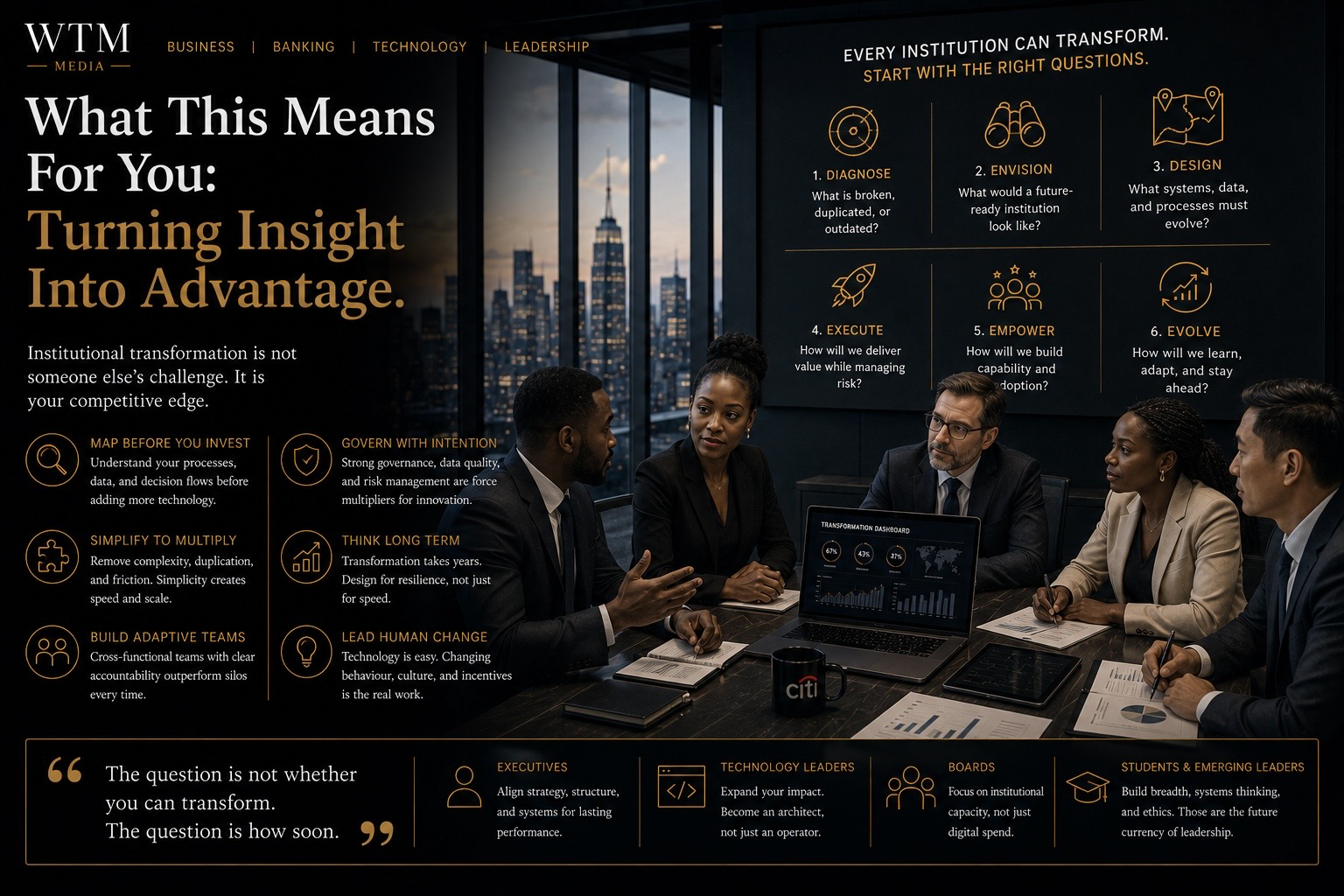
Whether you lead a multinational corporation or manage a small organisation, Citi’s transformation offers an important reminder: technology strategy cannot exist independently from organisational strategy. Before investing in new platforms, ask whether existing structures support the outcomes you expect technology to deliver. Often, they do not.
For executives, institutional mapping becomes increasingly valuable. Identify duplicated processes, fragmented reporting structures, competing data sources, and unnecessary organisational complexity. Simplification frequently produces greater returns than additional technology investment. Complexity silently taxes productivity long before it appears on financial statements.
Technology professionals should expand beyond technical expertise. Study governance, organisational behaviour, finance, leadership, regulation, and communication. Careers increasingly reward those capable of connecting disciplines rather than mastering only one. The future belongs to translators who bridge technical depth with executive judgement.
Boards should evaluate transformation programmes differently. Instead of measuring success solely through project completion or budget adherence, examine whether institutional capability has genuinely improved. Faster decision-making, stronger accountability, improved resilience, clearer governance, and better information quality often indicate greater progress than software implementation milestones.
Students entering technology careers should recognise that coding represents only one component of future leadership. Systems thinking, ethics, communication, adaptability, and institutional understanding will increasingly differentiate exceptional professionals from technically competent ones. Technology expertise opens doors; institutional intelligence shapes careers.
Ultimately, every organisation should periodically ask a difficult question: if we rebuilt this institution today, would we organise it the same way? Honest answers often reveal that transformation begins not with technology procurement, but with organisational imagination.
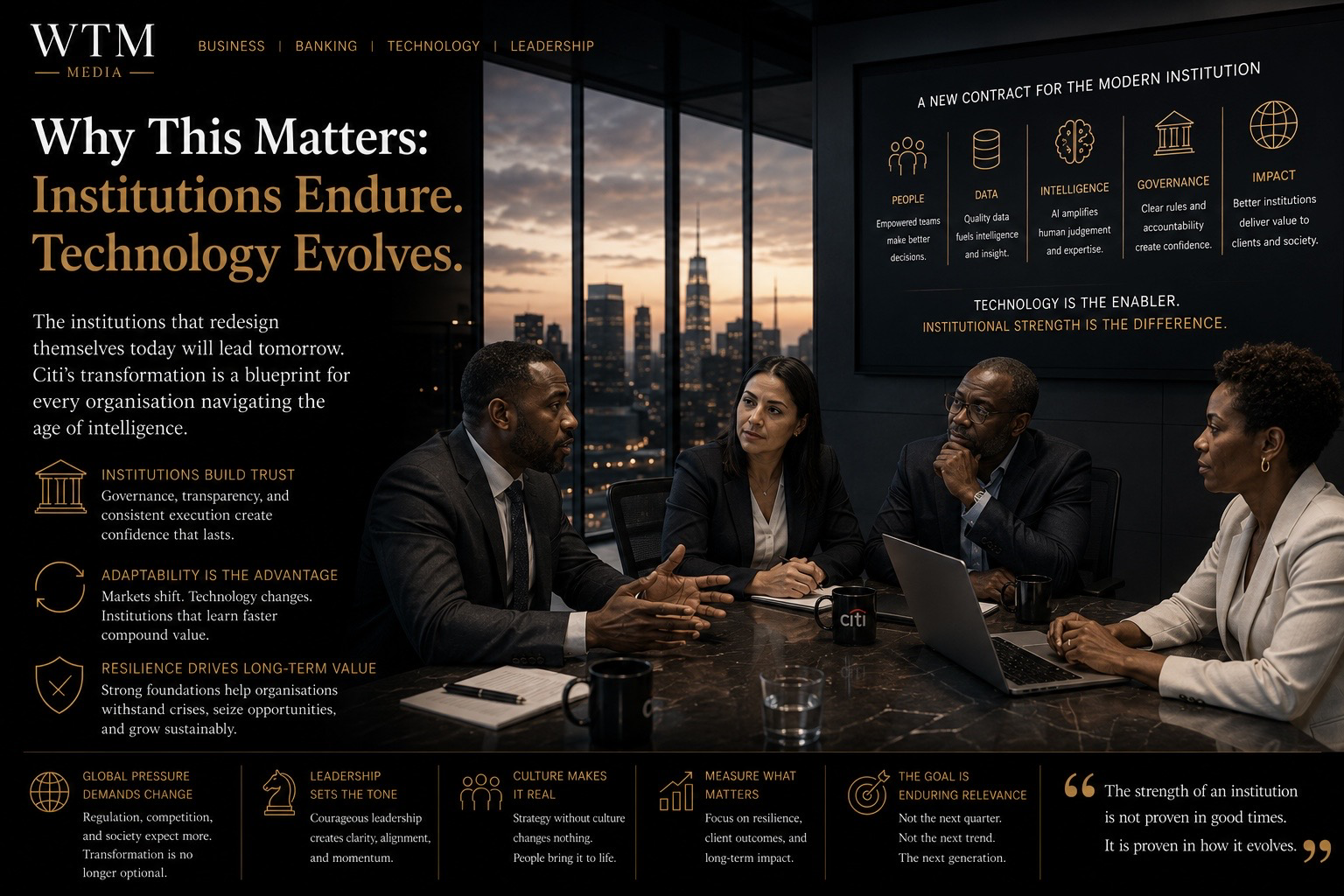
History rarely remembers institutions for the software they purchased. It remembers whether they adapted successfully when conditions fundamentally changed. Technology eventually becomes obsolete. Institutional capability compounds across generations. The organisations that endure redesign themselves before external pressures force them to do so.
Citi’s transformation illustrates a broader global pattern. Banking, healthcare, governments, universities, manufacturers, media organisations, and professional services firms increasingly recognise that their greatest strategic challenge is organisational adaptability. Digital transformation has matured into institutional transformation.
Artificial intelligence accelerates this reality. As technological capability becomes more widely available, competitive advantage shifts towards governance, trust, organisational coherence, leadership quality, and cultural resilience. These remain profoundly human capabilities. Technology amplifies them, but it cannot substitute for them.
The future economy will increasingly reward institutions capable of continuous learning. Adaptability itself becomes infrastructure. Organisations that learn faster than their environments change will outperform larger competitors burdened by accumulated complexity. Institutional agility becomes an enduring economic asset.
For readers, this story offers a valuable lens through which to interpret future business headlines. Whenever organisations announce digital transformation programmes, ask a deeper question: are they upgrading technology, or redesigning the institution? The answer usually determines whether transformation becomes evolutionary theatre or lasting strategic advantage.
Citi is not merely modernising its technology estate. It is attempting something considerably more ambitious: rebuilding institutional confidence for the age of artificial intelligence. That distinction may ultimately determine not only its future, but the future of leadership across every complex organisation.
Editorial Intelligence: WTM Business Editor
Visual Intelligence: Noir Spider Atelier™ – A Division of WTM Media
Editorial Direction: Kelly Dowd, MBA, MA – Editor-in-chief
Copyright: © 2026 WTM Media. All rights reserved.
Why These Matter - WTM MEDIA is an independent editorial platform exploring the forces shaping our world—through people, culture, commerce, design, systems, and governance. Connecting the dots between today’s headlines and tomorrow’s realities.

article-support-3
Noir Spider Atelier

article-support-2
Noir Spider Atelier

article-support-1
Noir Spider Atelier

press-partnership
Noir Spider Atelier
press-reader-desk
Noir Spider Atelier

resource-access
Noir Spider Atelier
membership-example
Noir Spider Atelier

membership-tools
Noir Spider Atelier

membership-reader
Noir Spider Atelier
membership-public
Noir Spider Atelier
pathway-design
Noir Spider Atelier
pathway-institutions
Noir Spider Atelier
pathway-technology
Noir Spider Atelier