
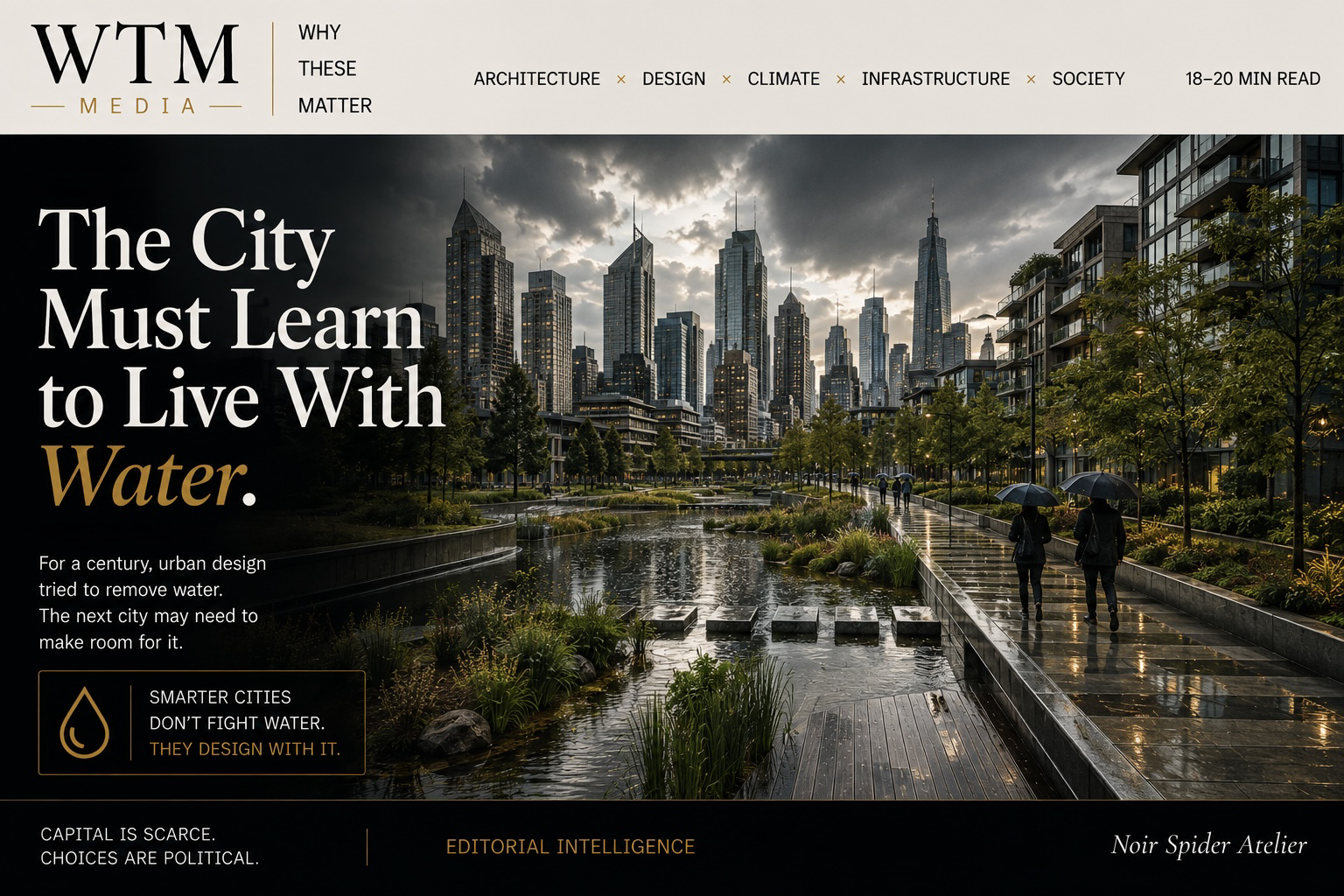
The modern city has spent more than a century attempting to make water disappear. Rain falls onto roofs, roads and pavements. Gutters collect it. Drains capture it. Pipes bury it. Pumps move it. Rivers are channelled. Wetlands are filled. Coastlines are defended. The engineering objective has largely been straightforward: separate water from urban life as efficiently as possible. That model is reaching its limits. Around 600 million urban residents already live with significant annual flood hazard, according to the World Bank. Globally, 1.81 billion people live in flood-prone areas, while annual urban flood losses could approach $50 billion by 2050. Rapid urbanisation, ageing drainage infrastructure, land subsidence and changing rainfall patterns are interacting with the basic physical reality that cities have covered enormous portions of naturally absorbent ground with concrete and asphalt. Yet the consequential story is not simply that cities need bigger drains. A different philosophy of urban resilience is emerging: parks designed to flood temporarily; streets shaped to carry cloudbursts; wetlands restored as infrastructure; plazas capable of storing stormwater; permeable landscapes that absorb rainfall; buildings elevated or adapted to tolerate inundation; sensors that reveal water movement in real time; and neighbourhoods organised around the understanding that some water cannot — and perhaps should not — be engineered away. The World Bank increasingly describes effective urban flood management as an integration of grey infrastructure, green infrastructure, nature-based systems, planning, warning systems and institutional reform, rather than reliance on any single engineering intervention. The conceptual reversal is enormous. For generations, successful urbanisation meant controlling nature sufficiently to construct the city. The next generation of urbanism may require something more intelligent: designing the city so nature can still function inside it.
Walk through almost any modern city during ordinary weather and one of its most sophisticated systems is largely invisible.
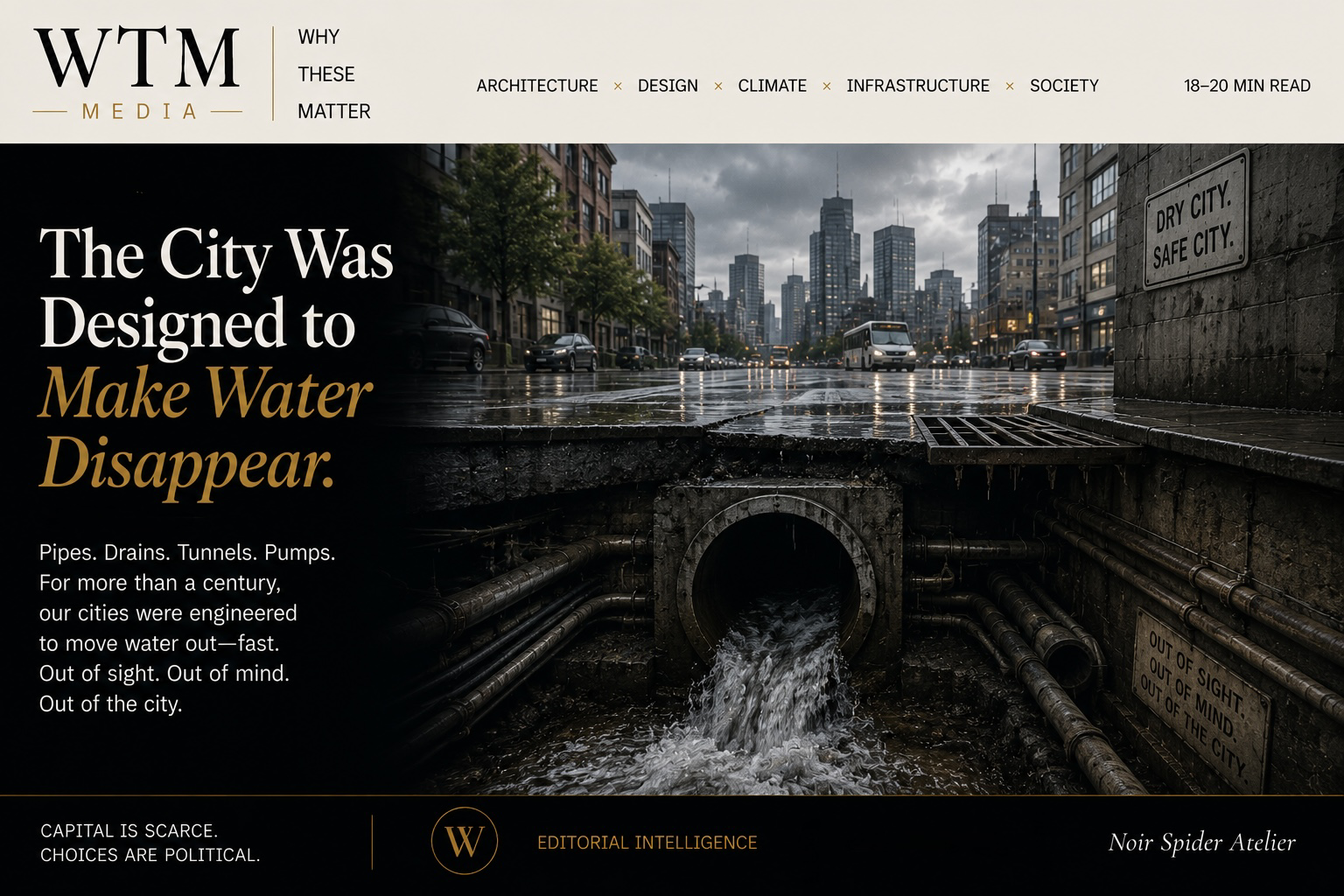
Beneath streets sits an enormous hydraulic architecture: drains, culverts, pipes, reservoirs, pumps, sewers and tunnels engineered to remove water from the surface. This system helped make dense urbanisation possible. Streets could remain passable. Buildings could occupy land once considered wet. Wastewater could be separated from daily life. Property became developable because water became manageable. But urbanisation changed the surface through which rainfall once travelled.
Soil absorbs water. Wetlands store it. Vegetation slows it. Rivers expand into floodplains. By contrast, roofs, roads, pavements and car parks accelerate runoff. Water that might once have infiltrated gradually into the landscape can arrive rapidly at drainage infrastructure already operating near capacity.
Climate pressure intensifies the mismatch. Warmer atmospheric conditions can contribute to heavier precipitation, while coastal cities face additional exposure from sea-level rise and storm surge. But climate change is not the only variable. Poor land-use decisions, rapid construction, inadequate drainage, disappearing wetlands and development in flood-prone areas can transform intense rainfall into catastrophe.
The engineering response has traditionally been to increase capacity: larger pipes, stronger barriers, deeper tunnels, more pumps. Those interventions remain essential. But there is a physical and financial limit to how large underground infrastructure can become. Extreme rainfall can exceed design assumptions. Pumps can lose power. Drainage systems can become overwhelmed. Higher seas can make gravity drainage more difficult. And continuously enlarging subterranean systems can become extraordinarily expensive.
The design problem therefore changes entirely.
Instead of asking only: How quickly can we remove water?
Cities increasingly need to ask: Where can water safely go?
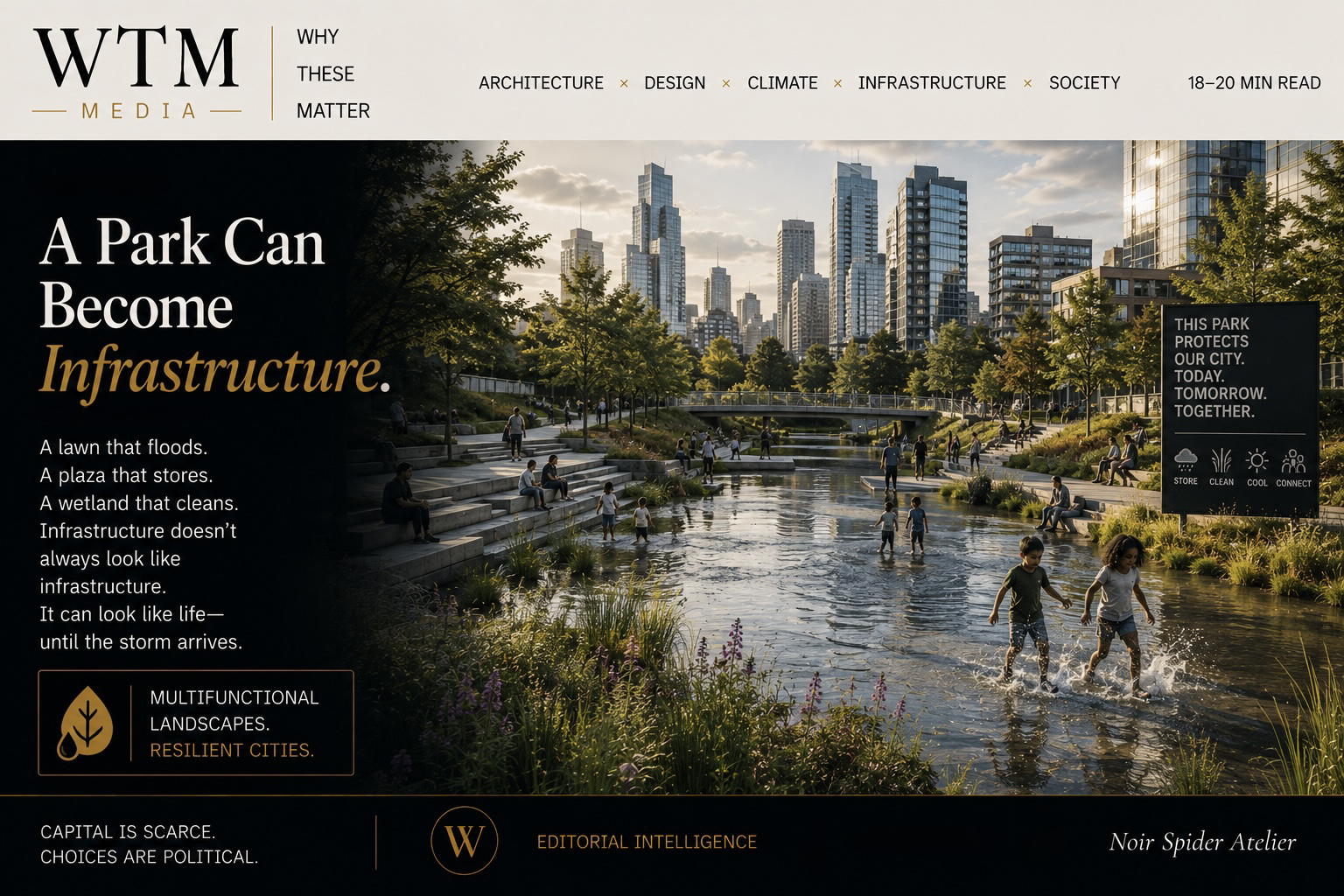
This is where urban resilience becomes architecturally interesting. A conventional park is categorised as amenity. A drainage tunnel is categorised as infrastructure, but what if the park is both?
Across cities experimenting with water-sensitive design, public landscapes are being engineered to perform multiple functions. Depressed lawns can temporarily hold stormwater. Sports fields can become retention basins during exceptional rainfall. Planted corridors can slow runoff. Wetlands can store and filter water. Streets can be graded to direct cloudbursts towards places designed to receive them.
Copenhagen became an influential example after a catastrophic cloudburst in July 2011 caused billions of Danish kroner in damage. Its subsequent Cloudburst Management Plan explicitly recognised that surface-level adaptation could sometimes be easier and cheaper than relying exclusively on underground systems, while simultaneously creating new blue and green recreational spaces. The plan envisaged protection against rainfall events statistically expected roughly once a century.
The important innovation is not the rain garden. It is multifunctionality.
Land in cities is expensive precisely because many competing systems require it: housing, mobility, commerce, recreation, ecology and infrastructure. Climate adaptation becomes economically more compelling when one investment performs several functions simultaneously.
A park that only stores floodwater may be difficult to justify on valuable urban land. A park that provides recreation 360 days a year, reduces heat, supports biodiversity, improves neighbourhood quality and safely stores stormwater during the remaining five begins to represent a different kind of public asset.
This is design intelligence applied to infrastructure: the best climate infrastructure may not look like infrastructure at all.
There is a temptation in climate adaptation to search for the heroic engineering solution. Build the seawall. Enlarge the sewer. Install the pump. Raise the barrier.
Sometimes that is precisely what is required. Rotterdam cannot abandon flood defences. Tokyo cannot replace its extraordinary subterranean flood infrastructure with flower beds. Dense urban districts cannot absorb every cloudburst through permeable paving.
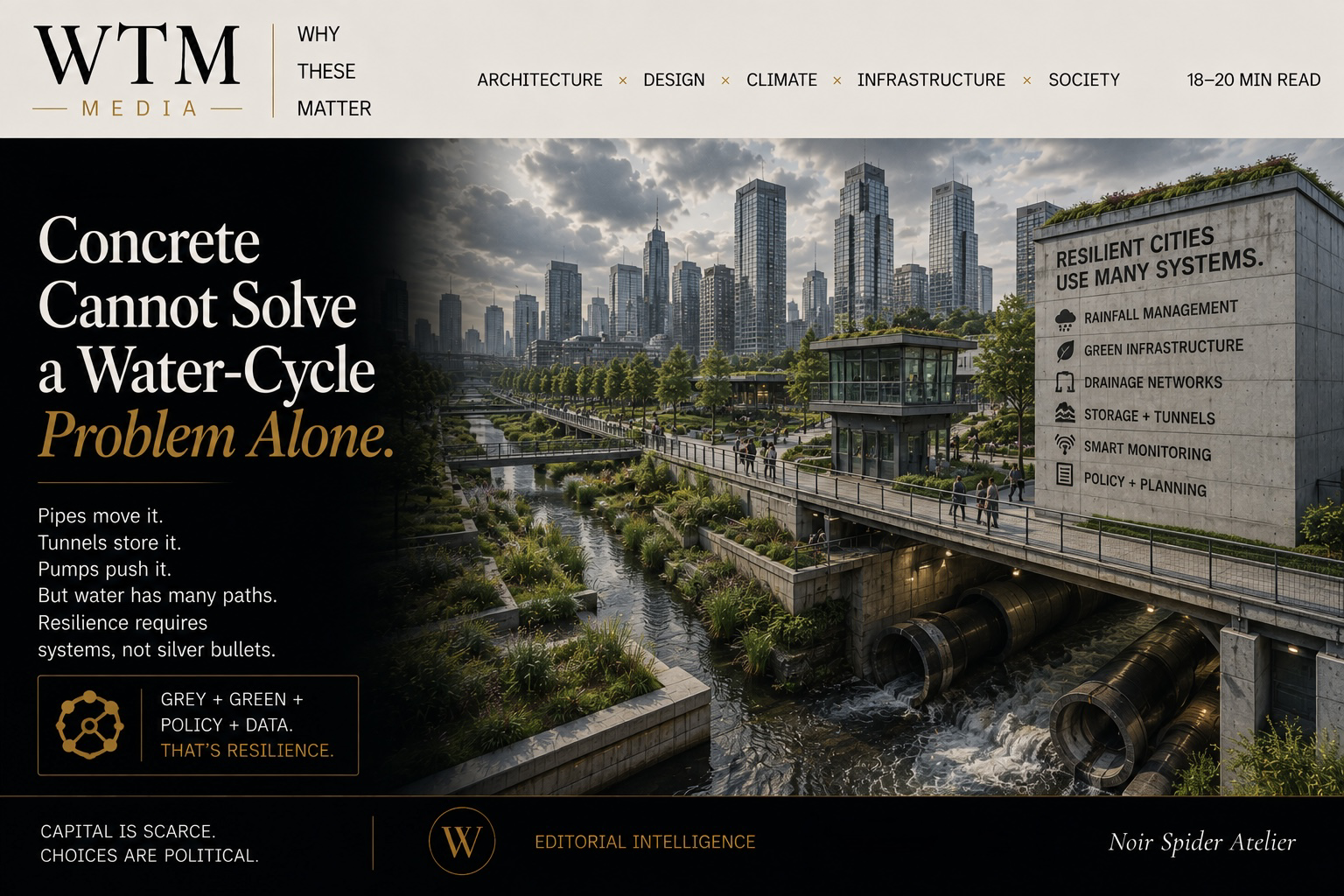
The mistake is not using grey infrastructure. The mistake is imagining that one infrastructure system can solve a systems problem.
The World Bank’s contemporary urban flood-resilience work increasingly combines engineered — or grey — infrastructure with green and nature-based systems and non-structural interventions such as planning, early-warning systems and policy reform. Since 2019, it says its urban flood-resilience support has reached more than 58 countries through 69 projects involving $4.4 billion in commitments.
The logic is therefore architectural. A resilient building does not depend upon one structural member. Loads are distributed through systems. Redundancy matters. Failure paths matter. Materials respond differently to different stresses.
Cities require the same intelligence. A wetland may absorb ordinary rainfall. A park may store an exceptional downpour. A drainage tunnel may carry extreme flows. A forecasting system may provide warning. Building codes may reduce damage. Land-use regulation may prevent construction where protection becomes economically irrational.
The city becomes resilient not because water has been defeated. It becomes resilient because failure is no longer concentrated in one system.
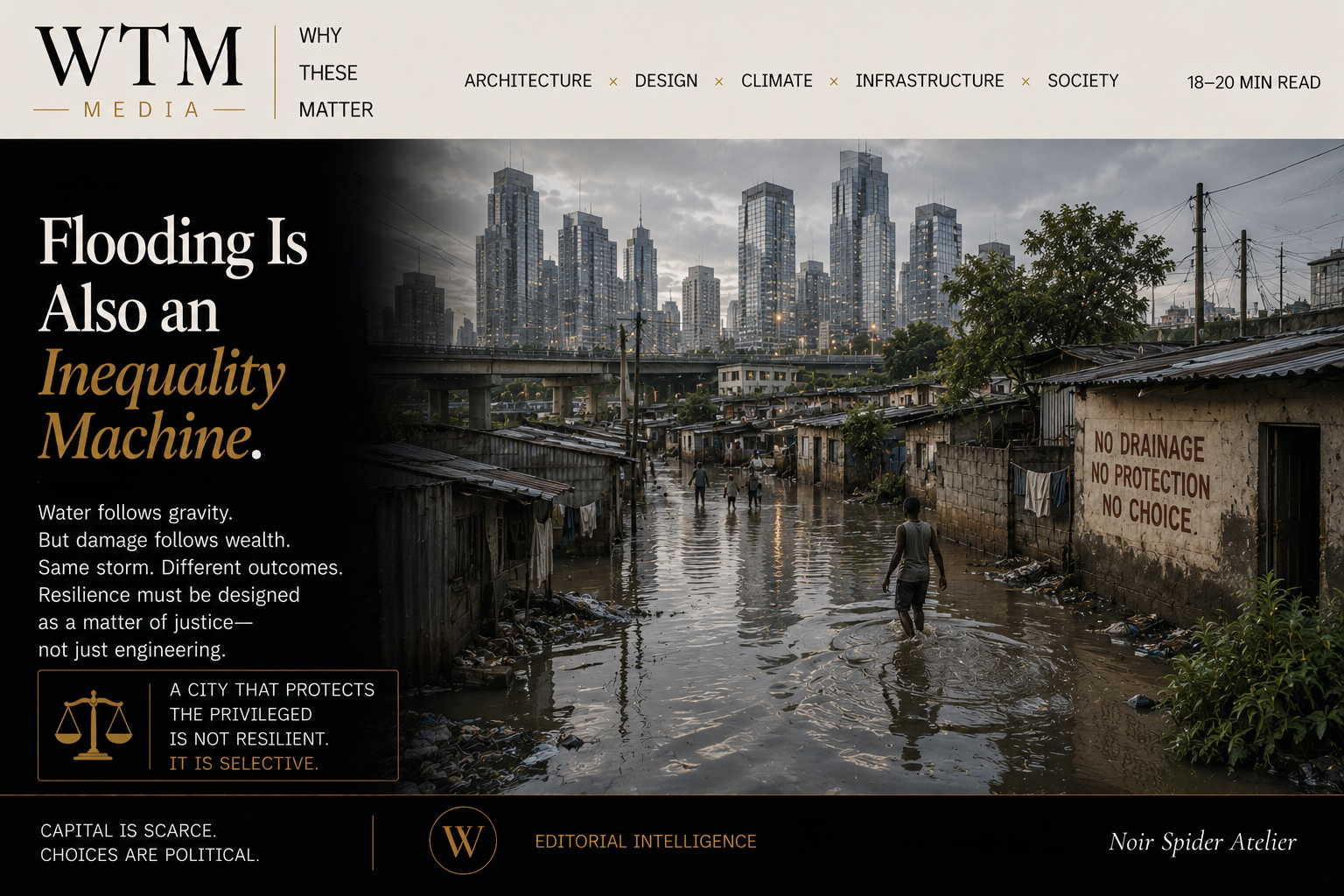
Water follows gravity. Damage follows wealth differently. Two households may experience the same storm and inhabit entirely different recovery systems.
One family has insurance, savings, a structurally resilient home, a vehicle, flexible employment and somewhere else to stay. Another loses a week’s income, a car, furniture, medication, school access and perhaps the home itself. This is why flood resilience cannot be reduced to hydrology.
Infrastructure investment determines which neighbourhood receives drainage upgrades first. Land-use policy determines where affordable housing is permitted. Insurance determines who can recover. Property values influence municipal revenue. Political power affects which communities can successfully demand protection.
The resulting feedback loop can be brutal. Repeated flooding depresses property values. Insurance becomes expensive or unavailable. Households with sufficient capital relocate. Those without it remain. Municipalities face declining tax bases precisely as infrastructure requirements increase.
The World Bank estimates that as much as 10 per cent of urban employment can be directly affected by flooding. In rapidly urbanising economies, the problem extends beyond property damage: disrupted transport, closed businesses and damaged infrastructure can interrupt the systems through which households earn income.
Resilience therefore cannot mean protecting valuable real estate while allowing vulnerable populations to absorb residual risk. A city that successfully redirects water but merely redirects suffering has not solved the problem. It has redesigned its geography.
Climate adaptation is ultimately a question about whose continuity the city considers worth financing.

The most consequential shift may happen at the scale people barely notice – the street. For most of modern urbanism, streets have been optimised principally for movement: vehicles, pedestrians, bicycles, utilities and commerce.
Water was something the street was supposed to shed.
But imagine the street as part of a watershed. Kerbs can direct stormwater. Tree pits can capture it. Permeable surfaces can absorb it. Planted medians can slow it. Underground storage can temporarily hold it. Street gradients can deliberately channel exceptional flows towards parks, canals or retention areas.
Suddenly the street has another job. The same applies across the city.
A school playground can become temporary water storage.
A public square can become a retention basin.
A roof can become a landscape.
A canal can become recreational infrastructure.
A wetland can become a flood defence.
A waterfront can become habitat rather than simply a hard boundary between land and water.
This is not aesthetic environmentalism. It is systems efficiency.
Every square metre of urban land becomes capable of performing multiple forms of work.
And that changes the economics of resilience. Instead of treating climate adaptation as a separate category of expenditure competing with parks, mobility, housing and public realm, cities can increasingly ask whether those investments themselves can perform adaptation.
The question for architects and urban designers therefore becomes considerably more ambitious than:
What should this place look like?
It becomes: What else can this place do when the weather changes?
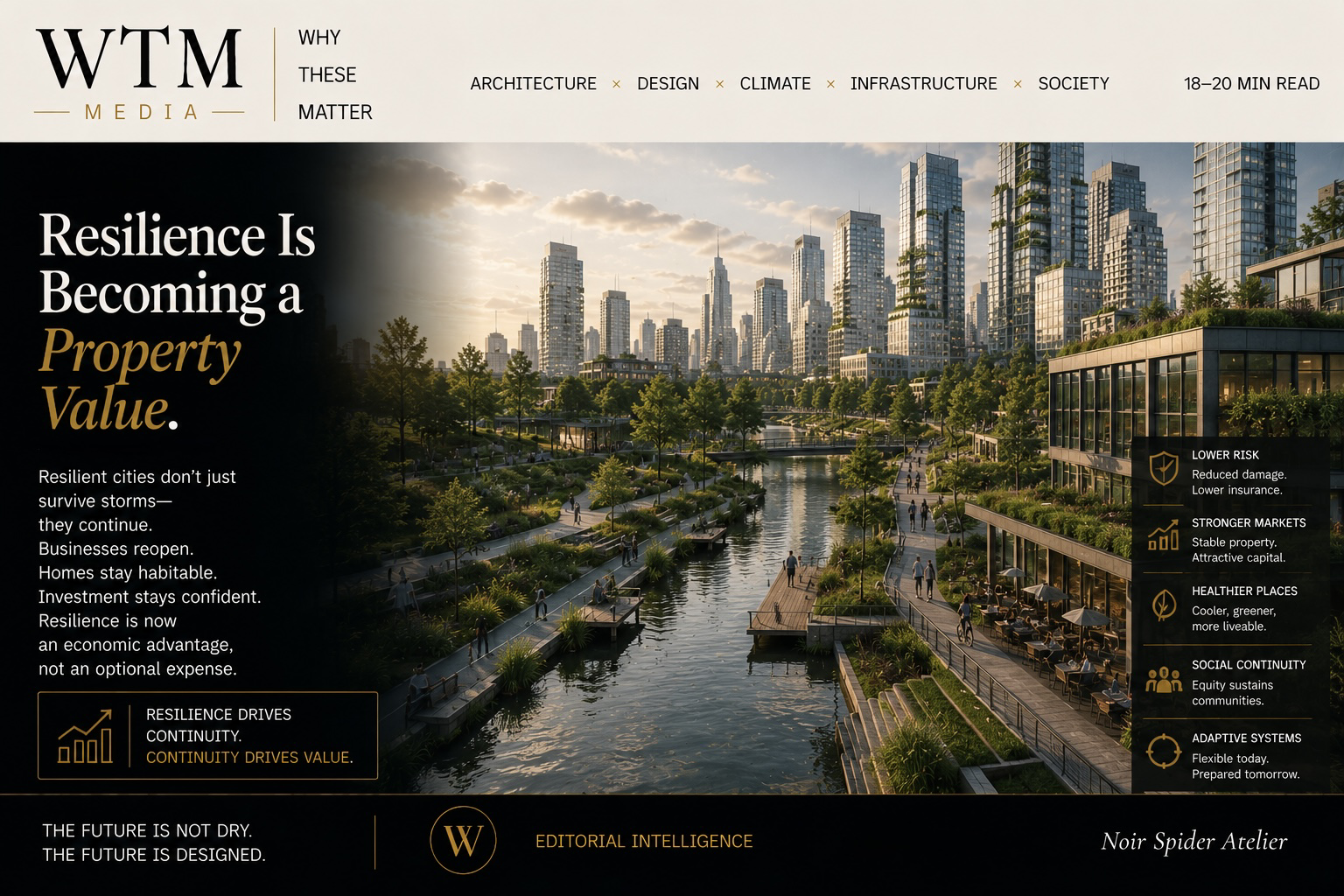
Climate risk is moving from environmental abstraction into financial calculation: Insurers price it. Mortgage lenders examine it. Infrastructure investors model it. Municipalities finance it. Developers increasingly encounter it through regulation, construction requirements and insurance availability. Homeowners encounter it when premiums arrive. That means resilience is gradually becoming an economic attribute of place.
A neighbourhood with reliable drainage, elevated infrastructure, accessible evacuation routes, resilient utilities and intelligently designed public landscapes possesses something economically valuable: continuity. Businesses can reopen. Homes remain habitable. Transport functions. Electricity stays available. Property retains confidence. Investment continues.
This is why climate adaptation should not be understood merely as money spent preventing disaster. Well-designed adaptation can simultaneously produce public space, biodiversity, cooler neighbourhoods, improved water quality and more attractive urban environments.
The World Bank’s experience in Can Tho illustrates the financial logic. A combined system of flood defences, green corridors and monitoring infrastructure now protects more than 422,000 people and is estimated to avoid approximately $10.7 million in flood damage annually.
The deeper lesson is that urban resilience is not primarily about predicting exactly which storm arrives next. It is about designing cities whose essential systems remain useful across a wider range of futures.
For the twentieth-century city, water management largely meant drainage. For the twenty-first-century city, it increasingly means accommodation, absorption, storage, movement, protection and recovery. That demands architecture. Landscape architecture. Engineering. Ecology. Finance. Insurance. Governance. Behaviour. And political judgement.
The city is not separate from the watershed beneath it. It never was. We simply built as though it were.
The next generation of cities may therefore be distinguished not by how completely they conquer water, but by how intelligently they negotiate with it. Because the most resilient city may not be the city that keeps every drop outside. It may be the city that knows: what to resist, what to absorb, what to redirect — and what to let in.
And that leaves the defining design question: What if the city itself became part of the water cycle again?
Editorial Evidence Note: The numerical claims above distinguish observed exposure and current programmes from projections. The World Bank reports 1.81 billion people living in flood-prone areas, approximately 600 million urban residents exposed to significant annual flood hazard, and urban annual losses projected around $50–52 billion by 2050 under specified socioeconomic assumptions. Such projections are scenarios, not predictions of a fixed outcome.
Visual Intelligence: Noir Spider Atelier™ — A Division of WTM Media
Editorial Direction: Kelly Dowd, MBA, MA
Copyright: © 2026 WTM Media. All rights reserved.
WTM Editorial Intelligence
Systems thinking. Global perspective. Human impact.
Why These Matter - WTM MEDIA is an independent editorial platform exploring the forces shaping our world—through people, culture, commerce, design, systems, and governance. Connecting the dots between today’s headlines and tomorrow’s realities.