

Fairphone’s US expansion places modular repair and long support at the centre of its proposition. WTM examines the design, the maintenance obligations and the commercial discipline needed to turn promised longevity into something customers can use.
Fairphone’s repairable design asks a harder commercial question: can a technology company prosper by helping customers keep what they own?
Edition: 16 October 2026 · Kelly Dowd, MBA, MA · 8 MIN READ. Research rechecked 16 October 2026 (Eastern Time).
NEWS CHECK · 16 OCTOBER 2026 (EASTERN TIME). Fairphone’s latest material development verified before publication was its 14 October Fairbuds 2 announcement. The company says the audio product has up to seven replaceable parts, including both earbud batteries and the charging-case battery, with US availability planned for November 2026. This extends Fairphone’s repairability proposition beyond phones, but it is a company product claim—not independent evidence that customers complete more repairs, keep devices longer, or produce a measured environmental or commercial outcome. The Visual Intelligence PDF records its separate 15 October research recheck and does not include this dated web update. [7]
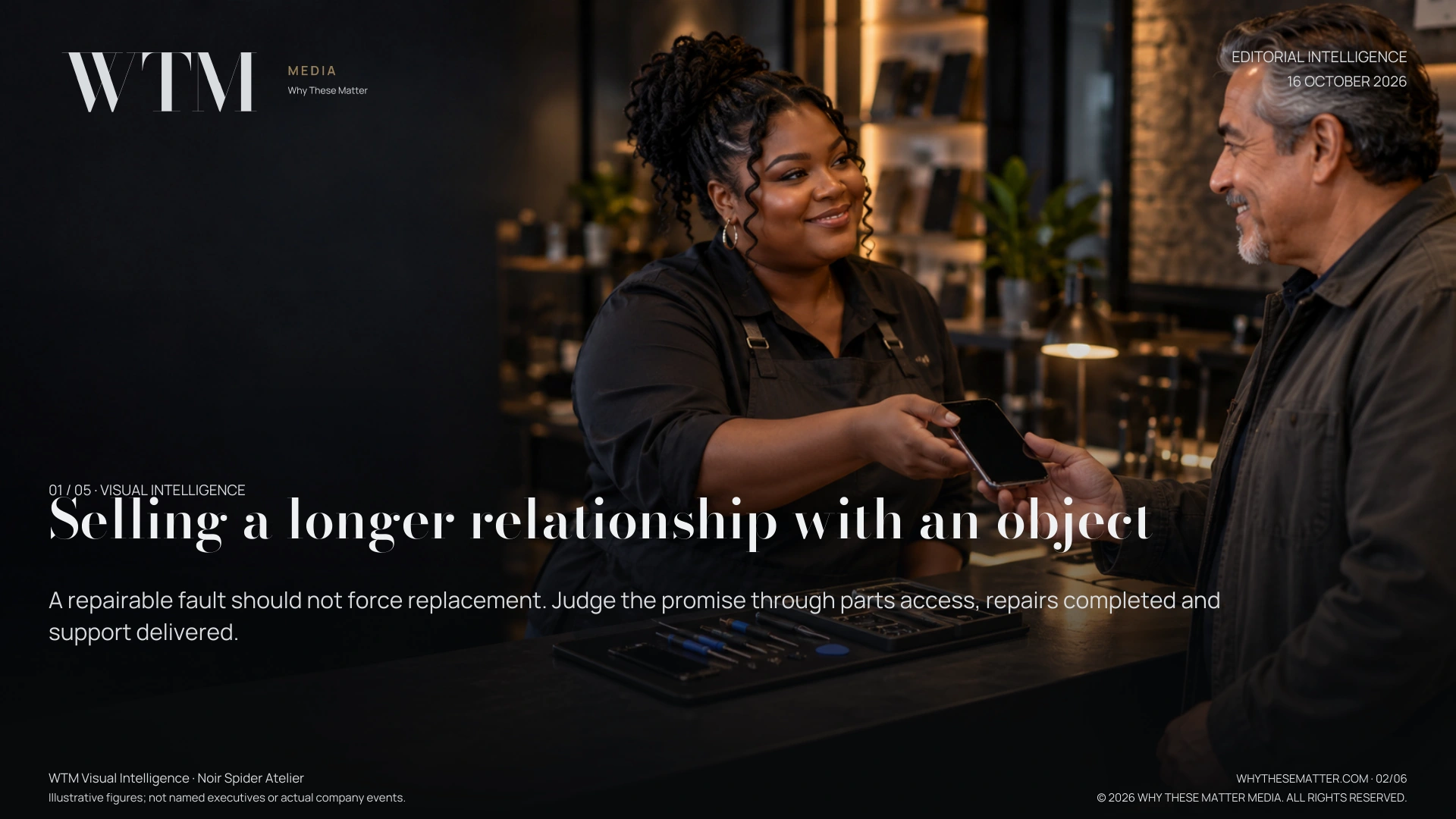
A broken charging port can make an otherwise useful phone feel finished. The practical problem is small, but the available response may be replacement of the entire device. A repairable product changes that decision only when the owner can obtain the part, understand the process and complete the repair at a sensible cost.
Fairphone’s 18 August 2026 Gen. 6+ launch release describes its entry into direct US smartphone sales and identifies Raymond van Eck as chief executive. The company describes twelve replaceable parts and software updates through 2033. It advertises warranty coverage of up to five years, subject to the applicable terms; this is not a promise that every component receives identical coverage or that every customer will obtain the same useful life. [1] Buyers should check the warranty terms for their market, including registration requirements and component exclusions. Fairphone’s US warranty summary lists a shorter period for the Gen. 6+ battery than for the rest of the phone. The binding legal documentation, not a launch headline, governs a particular purchase. [6]
The CEO decision signal is to make continued ownership part of the commercial proposition. A company making that choice must care about the customer after the purchase for reasons that reach beyond the next upgrade. Maintenance quality, spare parts and usable information become elements of the product’s value.
This does not make replacement inherently irresponsible. A device may no longer suit a person’s accessibility needs, work requirements or essential applications. The better question is whether replacement is a considered choice or the only practical response to a repairable fault. Good design should expand useful options without moralising about circumstances it cannot see.
WTM’s assessment is that longevity should be judged as a service obligation. A promise extending into the next decade creates work for future engineering, support and supply teams. The physical design can make that work possible, but an operating business must keep performing it. The product is therefore partly a continuing institutional commitment.
The commercial challenge is real. A customer keeping a device longer may make fewer replacement purchases. The manufacturer needs sufficient value from its wider relationship with customers to fund support and innovation. We have not established Fairphone’s unit economics here. The strategic question is how maintenance can remain economically credible as adoption grows.
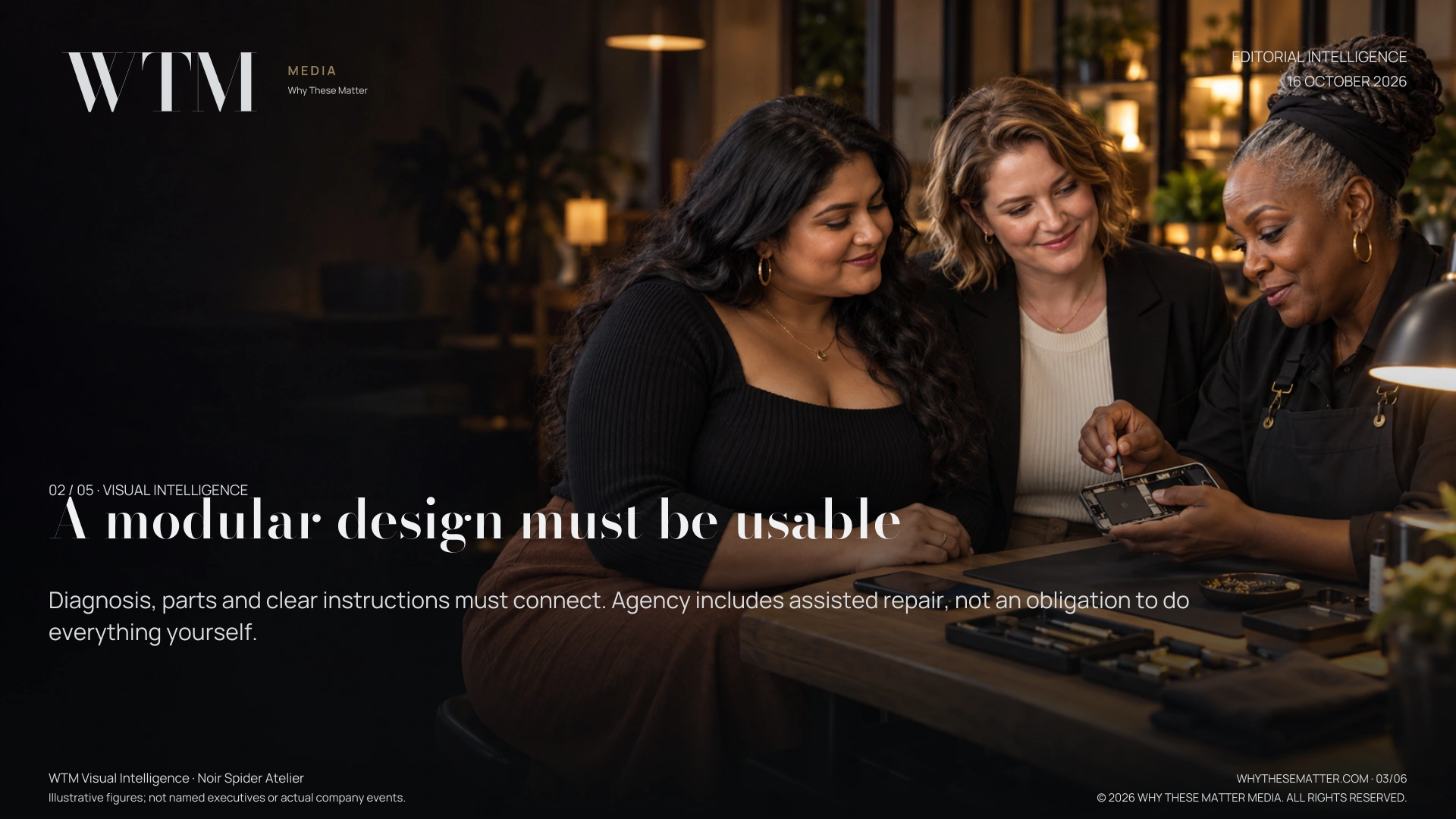
Fairphone publishes repair guides for its devices, including pathways for replacing components such as batteries, displays and charging-related modules. Those instructions make the repair proposition more concrete. A guide is evidence that a process is documented; it does not establish that a particular part is available locally or that every user can undertake the work. [4]
The innovative design is the connection between a replaceable component and an accessible repair process. Merely dividing an object into modules is insufficient. The owner needs to identify the fault, obtain the correct replacement and know when specialist help is appropriate. Each hand-off can determine whether the product remains useful.
Designing for repair also means designing for people with different capacities. Small screws, visual instructions and fine hand movements will not work equally well for everyone. Assisted repair and clear service options should sit alongside self-repair. Agency includes being able to delegate a task safely, not being required to perform it personally.
A useful procurement test would follow a realistic fault from beginning to end. How long does diagnosis take? Is the part in stock? What is the total cost, including labour and downtime? Can a repaired device return to its intended use? These are proposed evaluation questions, not results from a WTM teardown or hands-on test.
There are design trade-offs to investigate. Modularity may interact with dimensions, sealing, materials and assembly. Buyers should compare the exact product’s performance and durability evidence against their needs. A repairable device should earn consideration through a complete proposition, rather than receiving a permanent exemption from ordinary expectations of reliability.
The Four P’s help keep that proposition balanced. People need usable repair options; Planet requires credible environmental evidence; Pragmatism requires available parts and working support; Profit must fund the arrangement. A design that satisfies only the launch presentation will struggle when the first customer needs an ordinary problem solved.
On 28 September 2026, Fairphone’s team announced a staged software update for Gen. 6 and Gen. 6+. The notice listed corrections involving Wi-Fi application loading, camera behaviour and device interaction. This is a dated company report of intended fixes. It should not be mistaken for independent evidence that the update resolved every affected user’s problem. [2]
That apparently modest development matters to the broader story. A repairable shell cannot compensate for software that makes essential tasks unreliable. The useful life of a connected product depends on physical condition and continuing digital support. Neither can be reduced to the number of years printed beside a promise.
Maintenance is also an accountability practice. Clear release notes tell customers what changed and provide a basis for reporting what still fails. A company should make persistent problems visible enough to investigate. Honest specificity can build more durable trust than presenting every revision as a flawless leap forward.
The environmental context is substantial but must be described accurately. The Global E-waste Monitor 2024 reports that the world generated 62 million tonnes of electronic waste in 2022, of which 22.3 per cent was documented as formally collected and recycled. This covers electronic waste broadly; it is not a measure of smartphones alone or Fairphone’s impact. [3]
Repair could reduce the need for replacement under appropriate conditions. Establishing the actual benefit would require knowing how long a device is used, what repairs consume and what would otherwise have been purchased. A repairability feature is therefore a mechanism worth examining, not a complete environmental outcome in itself.
The lesson for leaders is to examine maintenance as an ongoing result. A long support promise becomes credible through repeated, usable delivery and a route for unresolved problems. That work is consequential precisely because it continues after attention moves elsewhere. A launch starts the relationship; dependable service gives the customer a reason to retain it.

Executives can begin with a simple change in measurement: track useful years of service alongside initial sales. This proposed measure would need a clear definition and a practical collection method. It could help reveal whether the organisation creates durable customer value, while avoiding the assumption that every longer-held device remains suitable or safe.
Customer support should then be assessed as part of product performance. Repeated faults, unresolved tickets and unavailable parts can indicate where the ownership experience breaks down. These are diagnostic categories, not claims about Fairphone’s current service record. Measuring them would help any manufacturer turn a longevity strategy into operational work.
The financial test should include the cost of promises already made. A warranty, a parts programme and future software support create obligations whose delivery must be resourced. Management needs a credible method for funding them as products age. That is a governance question even when the customer-facing language is beautifully simple.
For a business buying a fleet, a small pilot can test whether repair reduces disruption and total cost. Compare a defined group of devices on equivalent tasks. Record repair time, replacement needs, support effort and user experience. Avoid selecting only enthusiastic volunteers if the intended deployment will include people with very different needs.
Double ROI™ keeps the review honest. Return on Investment asks whether the organisation receives dependable service for the full cost of ownership. Return on Integrity asks whether customers can understand the promise, access support and make a meaningful choice. Lower spending alone cannot prove good design if it transfers unreasonable effort onto users.
A sensible next step is to audit one existing product’s repair journey before launching a new sustainability campaign. Name the owner, the common failure, the available remedy and the evidence of completion. This is a manageable test of institutional seriousness. A company learns more from one completed repair than from another abstract declaration of care.
Fairphone provides a concrete case for examining whether technological progress can include keeping something useful. Its proposition deserves scrutiny because it connects product form with continuing responsibilities. The strongest version of that model would make repair ordinary enough that a customer need not become a specialist to benefit from it.
The question extends beyond phones. Organisations designing equipment, appliances or services can ask which forms of dependence they create and whether users retain practical alternatives. This is an analytical extension, not evidence that one modular design can be copied successfully into every industry. Different products impose different safety and performance constraints.
There is also a question of dignity. People should be able to understand why an object has stopped working and what can realistically be done. An unexplained failure can remove choice as effectively as an unavailable component. Good information and proportionate support are therefore part of a humane ownership experience.
For 2027, WTM will watch delivery rather than the rhetoric of disruption. Are promised updates arriving? Can customers obtain appropriate repairs? Does the company report enough evidence to assess durability? These are future tests. This editorial makes no claim to have observed results that have not yet occurred.
The decision record is straightforward: intended service life, support obligation, parts access, repair cost, customer effort and review date. Use it to compare actual options in context. It is an original WTM editorial tool, not a certification, a product recommendation for every reader or a forecast of commercial success.
The more interesting future is one in which innovation gives people greater command of what they own. Fairphone’s design makes that future tangible enough to test. Its lasting value will depend on whether the business can keep the ordinary promises that allow an ordinary object to remain useful.
[1] Fairphone Gen. 6+ launch press release · 18 August 2026 launch release; date confirmed in the source. Company promises; not proof of future delivery or a universal suitability recommendation.
[2] Fairphone official software update announcement · 28 September 2026. Use only the official Fairphone team post; no generalisation from forum replies.
[3] ITU Global E-waste Monitor 2024 · 2024; underlying statistics for 2022. All electronic waste globally, not Fairphone waste or smartphone-only statistics.
[4] Fairphone repair guides · Current service page rechecked 16 October 2026 (Eastern Time). Guides alone do not establish local parts availability, repair cost or user ability.
[5] Raymond van Eck’s company-published account · 8 October 2026. First-person corporate perspective on supplier relationships and modular-platform reuse, not independently established causation or a WTM interview.
[6] Fairphone US warranty summary · Rechecked 16 October 2026 (Eastern Time). Coverage varies by component; consult binding terms. Registration requirements and market-specific conditions require checking for the purchase in question.
[7] Fairphone: The new Fairbuds 2 · 14 October 2026. Company announcement of up to seven replaceable parts and planned US availability in November 2026; not independent evidence of realised repair rates, device longevity, environmental benefit or commercial performance. This source was checked for the 16 October web release and is not included in the separately dated Visual Intelligence PDF.
Public-source analysis, not a WTM interview or endorsement. WTM Visual Intelligence · Noir Spider Atelier. Illustrative figures; not portraits of the named executives or records of actual company events.
© 2026 WHY THESE MATTER MEDIA. ALL RIGHTS RESERVED.
Why These Matter - WTM MEDIA is an independent editorial platform exploring the forces shaping our world—through people, culture, commerce, design, systems, and governance. Connecting the dots between today’s headlines and tomorrow’s realities.

article-support-3
Noir Spider Atelier

article-support-2
Noir Spider Atelier

article-support-1
Noir Spider Atelier

press-partnership
Noir Spider Atelier
press-reader-desk
Noir Spider Atelier

resource-access
Noir Spider Atelier
membership-example
Noir Spider Atelier

membership-tools
Noir Spider Atelier

membership-reader
Noir Spider Atelier
membership-public
Noir Spider Atelier
pathway-design
Noir Spider Atelier
pathway-institutions
Noir Spider Atelier
pathway-technology
Noir Spider Atelier