
Corporate life operates through two architectures simultaneously: the organisation formally described through titles, reporting lines, performance systems and policies, and the organisation actually experienced through trust, reputation, sponsorship, visibility, relationships, timing and power. Excellence matters. But excellence that cannot travel through an institution can remain professionally stranded. Drawing upon an anonymised real-world corporate experience — stripped of employer, industry, geography, chronology and personally identifiable circumstances — this editorial examines what happens when a high-performing professional discovers that doing the work and understanding the system governing the work are different capabilities. The sustainable lesson is neither cynicism nor manipulation. It is institutional intelligence: learning how power works without surrendering one’s principles to obtain it.
Every corporation has an organisation chart. It tells employees who reports to whom, where authority ostensibly resides and how responsibilities are distributed. It is useful, sometimes essential, and never quite sufficient. Beside that formal architecture exists another structure built from relationships, confidence, institutional memory, access, reputation and the capacity to influence decisions before they become decisions. One hierarchy can be printed. The other must be observed.
A high-performing professional can spend years mastering the first system because that is the system the organisation explicitly teaches. Meet expectations. Deliver excellent work. develop expertise. Take responsibility. Collaborate. Solve difficult problems. Become dependable. The logic appears beautifully meritocratic: increasing competence should produce increasing responsibility, and increasing responsibility should eventually produce increasing authority. Sometimes it does. But corporations are human institutions, not mathematical equations.
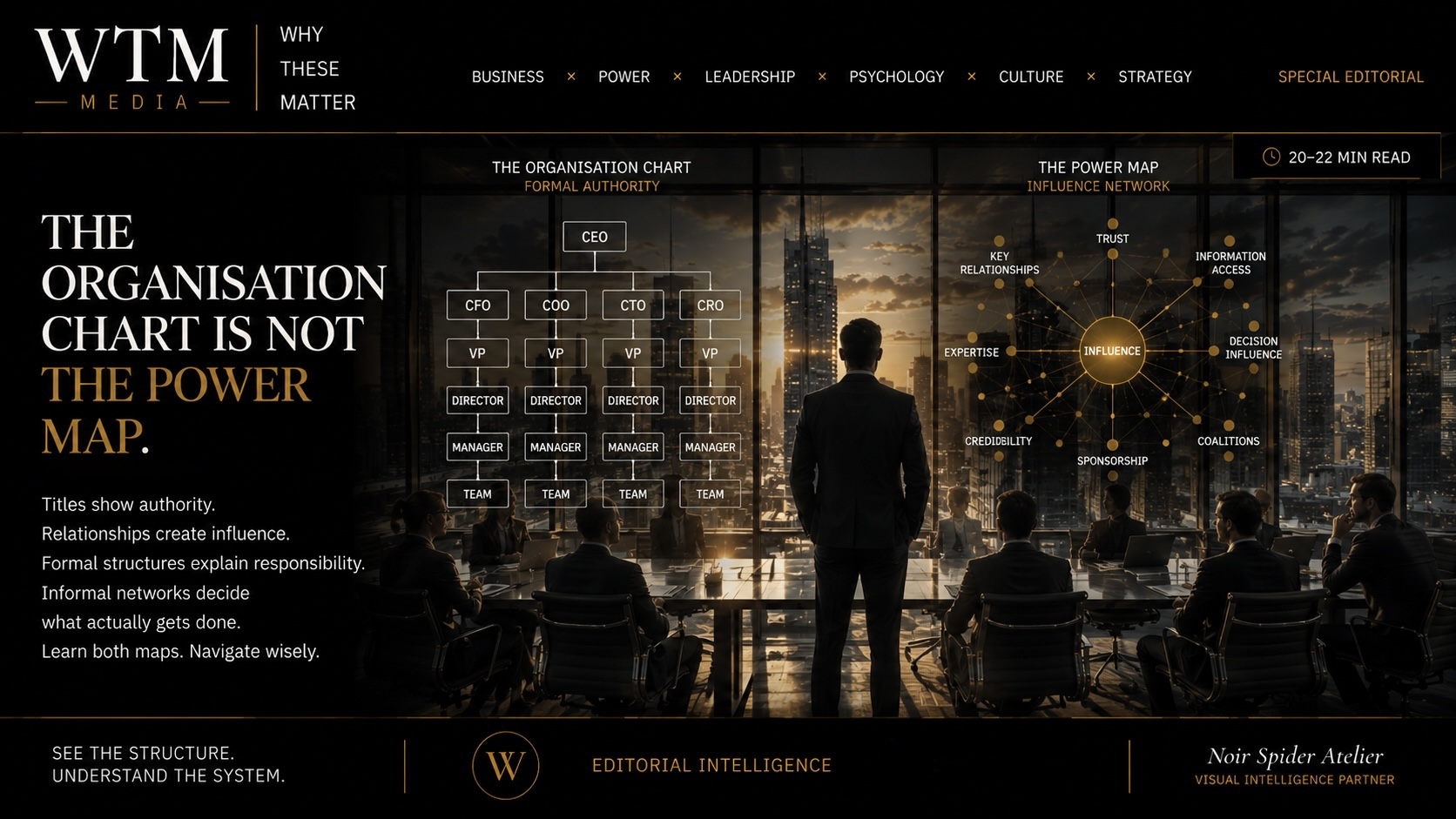
The second architecture becomes visible through anomalies. Someone without the largest title seems able to move an initiative across departments. Another person knows about a strategic change before the official announcement. An executive asks one particular colleague for judgement even when somebody else technically owns the subject. A proposal that struggled for months suddenly moves after the right person supports it. None of these observations necessarily implies corruption. They reveal that organisations depend upon informal networks because formal structures cannot process every decision efficiently.
This distinction explains why some extraordinarily capable employees become bewildered by corporate outcomes. They are evaluating decisions according to competence, hierarchy and documented performance while the institution may simultaneously be evaluating confidence, political risk, relationships, leadership perception, strategic usefulness and future potential. The employee concludes that the organisation is irrational. The organisation may indeed be behaving badly — but sometimes the employee is simply reading one map while decisions are occurring on another.
Institutional intelligence begins by observing both without becoming paranoid about either. Who possesses formal authority? Who possesses trusted expertise? Who controls information? Who can convene people? Who can stop something quietly? Who can accelerate it? Who translates between technical specialists and executives? Who has accumulated sufficient credibility that their recommendation reduces uncertainty for everybody else? These are questions about organisational architecture, not gossip.
The sustainable lesson is therefore neither play politics nor ignore politics. It is more precise: understand where power actually resides before deciding how to engage it. The professional who understands only hierarchy can become institutionally naïve. The professional who sees conspiracy in every relationship becomes institutionally corrosive. Mature corporate intelligence occupies the space between them: clear-eyed enough to recognise power, disciplined enough not to become consumed by it.

Corporate culture loves the mythology of indispensable people. Become the person everybody calls. Solve the impossible problem. Know the client, process, technology or institutional history better than anyone else. Reliability appears to create security because the organisation increasingly depends upon you. But dependence and advancement are not synonyms. Sometimes the employee who becomes indispensable to a particular function becomes extraordinarily difficult to remove from that function.
This is the paradox of competence. Strong performance attracts work. More work creates more evidence of competence. Competence creates dependence. Dependence produces still more responsibility. Yet unless authority, compensation, visibility and strategic opportunity compound alongside responsibility, the professional may be creating enormous institutional value without accumulating proportional professional capital. The organisation compounds from their capability faster than they compound from the organisation.
That distinction matters because work does not automatically preserve the identity of the person who created it. Organisations compress thousands of hours of activity into executive presentations, performance discussions, succession plans and reputational shorthand. Complex professionals become sentences: strategic thinker; excellent operator; difficult personality; safe pair of hands; technically brilliant; leadership material; not quite ready. Those sentences can influence careers long after the circumstances that produced them have disappeared.
Visibility therefore deserves a more intelligent definition. It is not standing in every meeting, announcing every accomplishment or turning colleagues into an audience for personal branding. Healthy visibility is information integrity. It ensures that the relationship between contribution, consequence and contributor remains legible enough for the institution to understand where value originated. Invisible excellence may remain morally admirable, but organisations cannot reliably reward information they do not possess.
This requires professionals to communicate outcomes rather than merely activity. What changed because the work happened? What risk disappeared? What revenue became possible? What decision became clearer? What client remained? What system improved? What capability now exists that did not exist previously? Translating work into institutional consequence is not boasting. It is making the economics of contribution understandable to people who cannot observe every hour of its production.
The sustainable diagnostic is uncomfortable but valuable: Am I accumulating responsibility faster than I am accumulating authority, compensation, reputation, optionality or opportunity? If the answer remains yes for long enough, diligence can become self-exploitation. The solution is not to work less intelligently. It is to understand whether the institution is converting your contribution into a career asset for you as effectively as it converts that contribution into an organisational asset for itself.
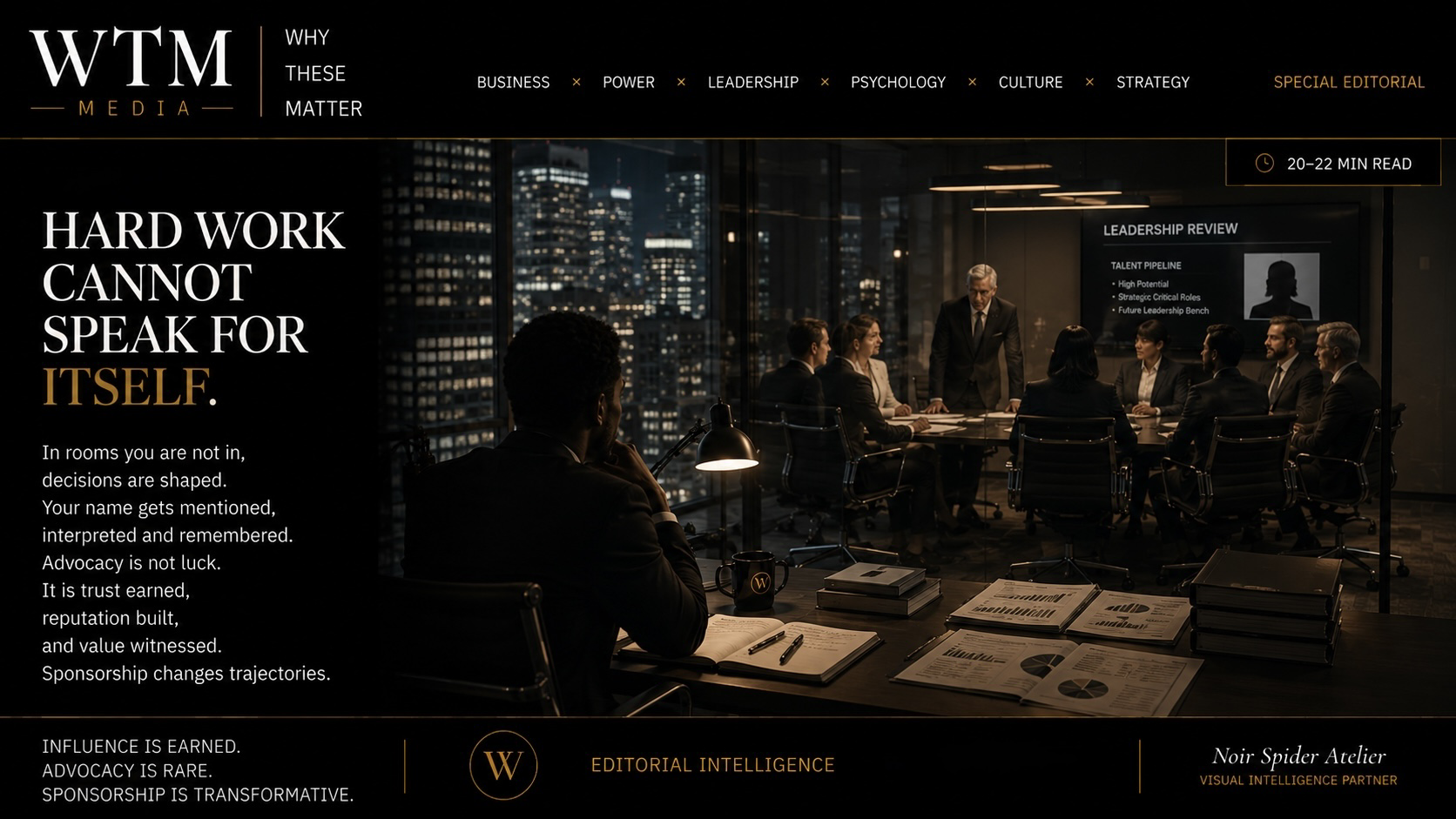
We tell young professionals that hard work speaks for itself because the alternative sounds politically impure. Unfortunately, work has no vocal cords. People speak about work. People interpret it, attribute it, remember it, forget it and decide what it means. Most consequentially, people speak about other people when those people are not present. Careers are therefore partly constructed in rooms the person whose career is being discussed cannot enter.
This is where mentorship and sponsorship separate. A mentor can provide extraordinary wisdom. A manager can evaluate performance. A coach can improve capability. A network can expose someone to information and opportunity. But a sponsor does something fundamentally different: they place some portion of their own credibility behind another person’s future. Give them the assignment. Put them in the room. Consider them for the role. I believe they can do it. Advocacy converts reputation into opportunity.
For the high-performing professional who assumes excellence will independently generate advancement, this can be a painful discovery. The mistake is not failing to flatter powerful people. That would confuse sponsorship with patronage. The mistake is assuming institutional relationships will automatically emerge from technical performance. They frequently do not. People must experience how someone thinks, responds under pressure, handles ambiguity, treats colleagues and exercises judgement before they can credibly advocate for greater responsibility.
Relationships therefore need to be built before they are needed. Not as transactions disguised as friendships, but as accumulated evidence of professional character. Help other people succeed. Understand what senior stakeholders are trying to accomplish. Become capable of translating expertise into decisions. Let colleagues experience your judgement outside the narrow boundary of assigned tasks. Credibility compounds through repeated encounters long before somebody spends political capital on your behalf.
This also exposes one of the inequities hidden inside apparently meritocratic systems. Not everybody enters the organisation with equal access to influential networks, cultural familiarity, social confidence or people who instinctively recognise themselves in them. The advice to “get a sponsor” becomes almost insulting if the institution ignores who receives natural sponsorship and who must repeatedly prove their legitimacy before advocacy appears. Individual intelligence matters, but institutional design determines whether opportunity depends excessively upon proximity.
The sustainable answer operates at both levels. Professionals should understand sponsorship because ignorance does not protect them from its effects. Leaders should examine who receives advocacy and why. Organisations should build systems that make high-quality work more discoverable beyond existing networks. And individuals should remember the essential distinction: being known by powerful people is not the objective; becoming sufficiently trusted that credible people will advocate for your capability when you are absent is.

Corporate intelligence becomes most valuable when something goes wrong. Expectations diverge. Credit becomes disputed. A decision appears inconsistent. A relationship deteriorates. Performance is characterised differently from how it was experienced. An employee encounters behaviour that feels unfair, inaccurate or incompatible with the organisation’s stated values. At precisely the moment judgement matters most, the nervous system wants immediacy.
Explain. Defend. Correct. Confront. Escalate. Send the message. Copy the additional person. Produce the evidence. Win the argument. Human beings are exquisitely capable of transforming a legitimate concern into a strategically disastrous response because emotional urgency feels like strategic necessity. Corporate history contains an impressive number of career wounds inflicted through communications that felt magnificent for approximately eleven minutes.
The more sustainable response begins by separating four questions: What happened? What can be demonstrated? What interpretation am I making? What outcome do I actually need? Those questions appear elementary until pressure arrives. Then they become architecture. Facts can be documented without exaggeration. Patterns can be distinguished from isolated incidents. Relevant processes can be understood. Interpretations can remain interpretations rather than being inflated into indisputable facts.
The fourth question — the desired outcome — changes everything. Being right is an intellectual condition. Producing a sustainable resolution is a strategic objective. They sometimes coincide; sometimes they do not. A professional may be completely justified in an argument yet pursue it in a manner that destroys the possibility of obtaining the outcome they actually require. Conversely, restraint should never be confused with surrender. There are circumstances in which documentation, formal escalation, independent advice or departure becomes entirely appropriate.
Strategic response therefore means choosing the intervention proportionate to the objective. Sometimes the correct move is a conversation. Sometimes it is written documentation. Sometimes it is asking a question rather than making an accusation. Sometimes it is allowing a provocation to expire from lack of oxygen. Sometimes it is drawing a boundary. Sometimes it is negotiating an exit rather than spending another year attempting to win recognition from a system that has already revealed what it intends to value.
This produces one of the most durable lessons in professional life: do not allow another person’s behaviour to design your response for you. Once provocation determines strategy, the other party effectively controls both sides of the interaction. Agency begins when the professional can acknowledge anger, disappointment or injustice without surrendering the architecture of the next move to those emotions. The objective is not emotional suppression. It is maintaining authorship.

Modern corporate language celebrates authenticity. Bring your whole self to work. Speak your truth. Be unapologetically yourself. These ideas emerged partly as necessary corrections to cultures that demanded conformity. Yet taken literally, they produce questionable professional advice. Human beings contextualise constantly. We communicate differently with a board, a client, a close friend and a child without concluding that three of those four selves are fraudulent.
Adaptation is therefore not automatically inauthenticity. It can be intelligence. The professional who learns to communicate an intricate idea in the language an executive can use has not betrayed the idea. Someone who understands when to challenge privately rather than publicly has not necessarily surrendered courage. Reading an audience, choosing timing, adjusting presentation, understanding incentives and managing conflict are interfaces through which substance becomes effective.
The danger appears when adaptation migrates from interface to identity. There is a difference between changing how an argument is presented and changing what one believes because power prefers something else. There is a difference between professional discretion and silence purchased through fear. There is a difference between learning institutional language and gradually becoming incapable of speaking independently of it. A career can advance while the person inside it quietly disappears.
The opposite extreme is equally destructive. Some professionals convert rigidity into a moral virtue. This is simply who I am. I tell people exactly what I think. I refuse to play politics. What sounds like authenticity can occasionally be an unwillingness to develop social intelligence. Integrity does not require poor timing. Courage does not require unnecessary humiliation of another person. Intellectual independence does not require making every disagreement a referendum on personal principle.
The more sustainable framework is simple enough to remember under pressure: adapt the interface; protect the operating system. Interface includes communication, presentation, timing, negotiation, stakeholder management and contextual behaviour. Operating system includes dignity, ethical boundaries, intellectual independence, truthfulness and the principles whose surrender would make advancement increasingly meaningless.
Political intelligence without an operating system becomes manipulation. Principles without an effective interface can become impotence. Corporate maturity requires both: sufficient adaptability to influence institutions and sufficient sovereignty to remain recognisable to oneself while doing so. The objective is not merely to survive power. It is to become capable of exercising influence without reproducing the behaviours that made power dangerous in the first place.

Eventually the most important corporate question stops being How far can I rise here? and becomes What am I accumulating that survives here? A job is temporary even when it lasts thirty years. Titles belong partly to institutions. Organisational authority disappears astonishingly quickly after departure. The office, team, expense account, corporate platform and proximity to powerful people can vanish in an afternoon. What remains reveals what the career actually built.
The durable assets are different: judgement, expertise, relationships, reputation, pattern recognition, financial capital, negotiation ability, intellectual confidence, transferable skills and the capacity to understand institutions without being psychologically dependent upon them. These assets convert employment from an identity into a compounding environment. The organisation receives labour and capability; the professional should also be accumulating forms of capital that remain useful beyond the organisation.
This reframes winning. Sometimes winning means promotion. Sometimes it means greater compensation or responsibility. Sometimes it means successfully changing an institution from within. But sometimes winning means recognising that the game available is too small, too expensive or too misaligned to deserve further participation. Departure is not automatically defeat, just as remaining is not automatically resilience. The correct measurement is what each choice makes possible next.
That distinction is particularly important after difficult corporate experiences. The sustainable question is not whether every injury can be transformed into a motivational slogan. Some organisational failures are simply failures, and some losses should not be cosmetically renamed victories. The more serious question is whether experience can subsequently become usable intelligence. What patterns are now visible? What boundaries became clearer? What assumptions failed? What capabilities became stronger? What will never again be outsourced to somebody else’s judgement?
For leaders, the argument carries an equally demanding consequence. An organisation that requires employees to become master politicians merely to have excellent work recognised has not built a meritocracy; it has built an information failure. When access determines opportunity more reliably than contribution, talent eventually learns the wrong lesson. Some leave. Some disengage. Others become extremely proficient at the politics and reproduce the system. Leadership therefore has an obligation not merely to understand informal power but to prevent it from overwhelming legitimate institutional process.
The mature response is neither to reject the game nor worship it. Play the game when it deserves playing. Change the game when its rules produce poor institutions. Leave the game when continued participation costs more than winning is worth. But never let the game play you. Because power does not disappear when principled people refuse to understand it. It merely becomes easier for somebody else to exercise. The sustainable professional learns the board, preserves the self and keeps accumulating assets that no employer can revoke.
What are you building from your career that your employer can never take back?
Visual Intelligence: Noir Spider Atelier™ — A Division of WTM Media
Editorial Direction: Kelly Dowd, MBA, MA
Copyright: © 2026 WTM Media. All rights reserved.
Why These Matter - WTM MEDIA is an independent editorial platform exploring the forces shaping our world—through people, culture, commerce, design, systems, and governance. Connecting the dots between today’s headlines and tomorrow’s realities.