
For much of the post-financial-crisis era, wealthy economies became accustomed to an extraordinary condition: money was cheap. Governments could borrow heavily, companies could finance expansion at modest rates, asset prices could rise on abundant liquidity, and households learned to treat low-cost mortgages as something approaching economic normality. That world is disappearing fast. Across major economies, long-term government borrowing costs have climbed towards levels not seen for years or decades. On 17 August, the US 30-year Treasury yield reached roughly 5.31 per cent, its highest level since 2007. Japan’s 10-year government bond yield subsequently approached 2.95 per cent, a three-decade high, while German borrowing costs have risen to 15-year highs. The OECD describes the present combination of elevated financing requirements and elevated yields as exceptional compared with the previous two decades. Behind those numbers is a larger structural contest. Governments need capital for debt refinancing, defence, infrastructure, pensions, healthcare and climate resilience. Technology companies require extraordinary sums for artificial-intelligence infrastructure. Energy systems require grids, generation and storage. Businesses require investment. Families require mortgages and credit. These demands do not occupy separate universes. They ultimately encounter the same fundamental economic resource: capital. And when many powerful institutions want more of it simultaneously, the price of money stops being an obscure financial-market variable. It becomes a question of who gets financed, at what price, and at whose expense.
An entire economic generation grew accustomed to historically unusual financing conditions. Following the global financial crisis, central banks suppressed policy rates, purchased enormous quantities of bonds and flooded financial systems with liquidity. Inflation remained subdued for much of the period. Government bond yields fell. In parts of Europe and Japan, sovereign debt even traded at negative yields — investors effectively accepting a guaranteed nominal loss in exchange for safety and liquidity. Cheap capital changed behaviour.

Governments discovered that larger debt burdens could coexist with surprisingly manageable interest bills. Companies borrowed cheaply to expand, acquire competitors and repurchase shares. Venture capital funded businesses years away from profitability. Property prices benefited from low mortgage rates. Investors moved further along the risk spectrum searching for returns unavailable in government bonds.
Then inflation returned. Central banks raised interest rates aggressively after 2022. But today’s problem is no longer simply what central banks are doing with short-term rates. Long-term borrowing costs increasingly reflect something more structural: the amount of debt markets must absorb uncertainty about inflation, fiscal deficits, geopolitical risk and investors demanding greater compensation for committing money for decades.
The OECD’s 2026 assessment is unusually important here. Governments now face high borrowing needs and high yields simultaneously, a combination that stands apart from much of the previous twenty years. That changes the mathematics. A government can carry enormous debt surprisingly comfortably when refinancing costs 1 or 2 per cent. The same debt becomes a different political object at 4, 5 or 6 per cent. The debt did not suddenly become larger, its price did.

The United States crossed a symbolic threshold this month: federal debt exceeded $40 trillion for the first time. Approximately $32.3 trillion was held in Treasury securities by the public, with another $7.8 trillion representing intragovernmental holdings. Interest expense has risen sufficiently to become the federal government’s second-largest budget category, behind Social Security and ahead of Medicare.
The financing machine continues because it must. The US Treasury expects to borrow $739 billion in privately held net marketable debt during July–September 2026, followed by another $628 billion during October–December. Those are financing requirements measured not in political rhetoric but in securities that investors must actually purchase.
Guess what? America is not alone. Germany is undertaking an enormous fiscal transition involving defence and infrastructure. Its finance ministry expects borrowing of roughly €838 billion between 2027 and 2030, while federal interest costs are projected to rise from €41.9 billion in 2027 towards €80.7 billion by 2030. Japan, after decades associated with extraordinarily low interest rates, is considering using a 3.8 per cent assumed rate when calculating debt-service costs for its next budget request — the highest assumption in 29 years.
These numbers expose something politics often obscures—Interest payments purchase no hospital bed, railway, university laboratory or military aircraft. They are the price of decisions already financed. As that price rises, yesterday begins consuming a larger share of tomorrow’s budget.
Governments then confront choices that are inherently political: raise taxes, reduce spending, tolerate larger deficits, issue still more debt, accept inflation risk or attempt to generate enough economic growth to outrun the burden. Bond markets cannot choose among those priorities. But they can change the price at which governments must confront them. Fiscal policy eventually meets a creditor.

At almost precisely the moment governments need enormous amounts of financing, another borrower has arrived with industrial-scale ambitions. That gentle stranger is Technology. Artificial intelligence is transforming the largest technology companies into infrastructure developers. Data centres require land, chips, electricity, cooling systems, transmission infrastructure and enormous upfront capital expenditure. The investment plans increasingly resemble those of industrial and utility companies rather than conventional software businesses.
Reuters reported this week that rising corporate debt associated with AI investment has become one factor weighing on long-duration bond markets. Separately, Alibaba announced a roughly US$10.2 billion equity placement on 23 August to finance chips, infrastructure, models and AI deployment, amid expectations that major US technology companies alone could spend approximately $725 billion on AI-related infrastructure in 2026.
This creates a connection conventional coverage often separates; a government issuing thirty-year bonds and a technology company financing a data centre are not selling identical securities. Their risks differ enormously. Their investors differ. Their financing structures differ, but capital has opportunity cost.
An institutional investor allocating another billion dollars to attractive government bonds cannot simultaneously allocate that same billion to corporate credit, infrastructure, property or private markets. Rising risk-free yields also change the return investors demand from almost everything else. This is why government borrowing matters beyond government.
Sovereign bonds establish reference prices throughout financial systems. Corporate bonds price relative to them. Mortgages respond to longer-term market rates. Infrastructure projects are judged against them. Equity valuations incorporate discount rates derived partly from them.
When governments pay investors more for relatively safe assets, riskier projects must become correspondingly more attractive. The economic competition therefore does not require governments and technology companies to literally bid against each other in the same auction. It happens through the price of capital across the system.

Bond markets appear abstract until they arrive at the kitchen table. A family does not ordinarily discuss term premiums when deciding whether it can afford a home. A small business owner does not build strategy around sovereign debt duration. A university graduate financing a company may never examine a Treasury auction. Yet all live downstream from the price of money.
When long-term government yields rise, mortgage rates can remain elevated even if central banks eventually reduce short-term policy rates. Corporate borrowing becomes more expensive. Property projects become harder to finance. Private-equity transactions require different return assumptions. Municipalities face higher infrastructure costs. Companies may invest less or demand greater returns before proceeding.
The consequence is not uniformly negative. Savers can earn meaningful returns on cash and high-quality bonds again. Pension funds and insurers can match long-term liabilities against higher-yielding assets. Capital becomes more discriminating. Businesses that survived only because money was almost free may no longer absorb resources indefinitely. Price is information. Cheap money tells an economy that waiting is inexpensive and distant profits are valuable. Expensive money says something different: prove the return.
The problem emerges when higher financing costs collide with investments society cannot simply abandon. Housing still needs to be built. Electricity grids still require modernisation. Climate adaptation still requires financing. Defence commitments still require resources. Ageing societies still require healthcare and pensions. Capital discipline can eliminate waste. Capital scarcity can also postpone necessity. That distinction will increasingly shape everyday economic life.

Modern economic debates frequently organise scarcity around physical resources. Oil can become scarce. Housing can become scarce. Labour can become scarce. Electricity can become scarce. Semiconductors can become scarce. Capital feels different because modern financial systems can create enormous quantities of nominal money. But money and affordable long-term capital are not the same thing.
Investors must be persuaded to exchange present purchasing power for uncertain future repayment. The interest rate is part of that persuasion. When inflation uncertainty rises, government borrowing expands and geopolitical risk increases, investors can demand more compensation. That compensation reverberates everywhere.
The current US yield structure makes the shift visible. Treasury data showed the 30-year nominal yield at approximately 5.31 per cent on 17 August. Inflation-protected Treasury yields simultaneously showed real long-term yields above 3 per cent. Investors were therefore receiving substantial returns even before compensation for inflation.
For an infrastructure developer, entrepreneur or government, that establishes a formidable hurdle. Projects must generate enough economic or social value to justify capital costing materially more than it did during the previous decade. This may become one of the defining allocation problems of the late 2020s.
AI infrastructure wants capital - Energy transition wants capital - Defence wants capital - Housing wants capital - Climate adaptation wants capital - Governments refinancing accumulated debt want capital. And demographic ageing means pensions and healthcare increasingly claim resources before many new investments even begin. The constraint may therefore become less about whether humanity possesses ideas worth building. It may become whether we can finance all of them at the same time.
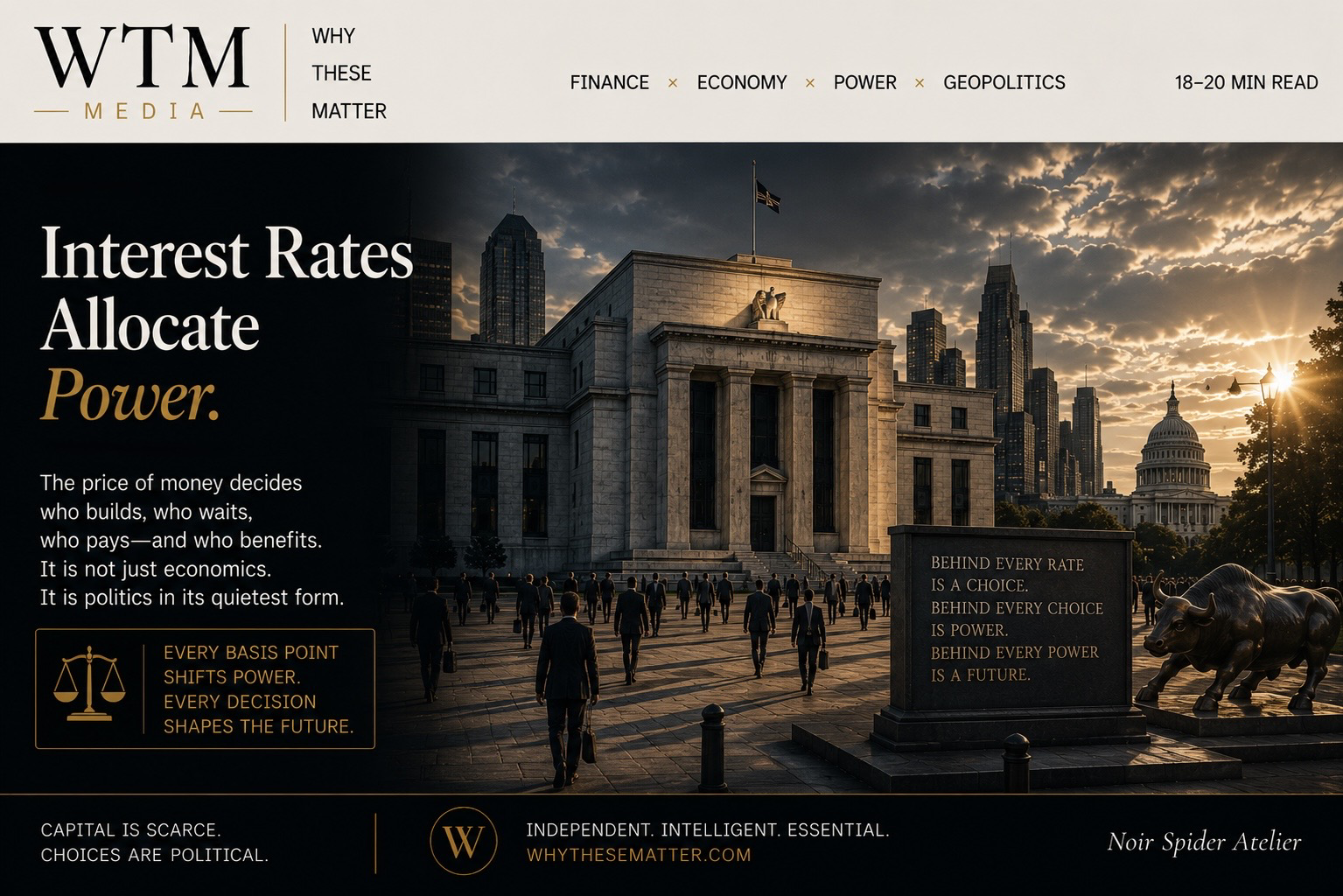
Interest rates are often discussed as though they were meteorological conditions. Rates rose, rates fell, and markets expect rates to remain higher for longer. But beneath those phrases sits a distribution mechanism.
The price of capital determines which projects survive, which governments retain fiscal flexibility, which companies can expand, which families can purchase homes and which generations inherit obligations created before them. It also determines power between debtors and creditors.
The low-rate era favoured borrowers and owners of long-duration assets. Cheap financing supported property values, technology valuations and leveraged investment. Higher yields restore income to savers and creditors but simultaneously increase the burden carried by borrowers. Neither condition is morally pure. Both redistribute opportunity.
That is why the emerging bond-market story should not be reduced to whether yields reach 5.2 or 5.4 per cent next Tuesday. The consequential issue is structural: governments are carrying larger debts precisely as societies confront enormous new investment requirements.
Artificial intelligence needs infrastructure - climate adaptation needs infrastructure - energy security needs infrastructure - defence needs infrastructure - housing needs infrastructure, and governments must finance the promises already made before financing many of the promises now being proposed.
The political argument of the next decade may therefore increasingly become an argument about priority.
Which investment receives capital first?
Which expenditure can wait?
Which generation pays?
Which borrower receives favourable financing?
Which national economy can still attract global savings without paying prohibitively for them?
And which public ambitions disappear quietly because their financing no longer works?
Markets will participate in answering those questions whether electorates realise it or not. Because when capital was abundant and extraordinarily cheap, societies could postpone difficult choices. When capital becomes expensive, priorities become visible. That is why the price of money is becoming political again. And it leaves a question that extends well beyond Wall Street, Frankfurt, Tokyo or the City of London:
When everyone needs capital, who gets to decide what the future can afford?
Editorial Evidence Note: Market yields change continuously. Figures above reflect the latest authoritative or high-quality reporting available during 17–23 August 2026 and should be date-labelled in publication graphics rather than presented as permanent levels. The broader argument — that higher sovereign financing requirements and higher yields are occurring simultaneously — is independently supported by the OECD’s August 2026 analysis.
Visual Intelligence: Noir Spider Atelier™ — A Division of WTM Media
Editorial Direction: Kelly Dowd, MBA, MA
Copyright: © 2026 WTM Media. All rights reserved
Why These Matter - WTM MEDIA is an independent editorial platform exploring the forces shaping our world—through people, culture, commerce, design, systems, and governance. Connecting the dots between today’s headlines and tomorrow’s realities.