

We have never possessed more ways to know people. We collect followers, contacts, colleagues, neighbours, group chats, professional networks and digital communities until connectivity itself begins to resemble security. Yet when life becomes consequential — illness, grief, unemployment, opportunity, conflict, reinvention, ageing, ambition — the enormous network often contracts remarkably quickly. The important question stops being how many people we know and becomes: who actually shows up?. Charlie’s Angels offers an unexpectedly useful doorway into that question. Its three protagonists are not powerful because they become alike. They remain distinctive personalities with different temperaments, capabilities and ways of seeing, yet learn to operate as a coordinated unit. That fictional architecture points towards something real in social science: adding a third person changes the structure of human interaction. Network research has long studied triadic relationships and the tendency of social networks to form triangles, while the Convoy Model of Social Relations describes how people move through life surrounded by changing layers of meaningful relationships that provide different forms of support. None of this proves that every human being requires exactly three people. Three is not a scientific prescription. It is a systems-thinking device. The more useful proposition is that resilient lives require more than reach. They require reciprocal relationships capable of performing different functions: someone who steadies us, someone who challenges us and someone who expands what we can see or become. WTM calls this the Personal Resilience Triad — not a psychological diagnosis or universal law, but a framework for interrogating the architecture of our closest relationships. And it contains a reciprocal obligation. The question is not merely Who are your three? It is also: Whose three are you?
The mathematics begins innocently. Place two people together and one relationship exists between them: A and B. Introduce C and the architecture changes. There can now be A–B, A–C and B–C, while the three people can simultaneously operate as a collective. The third person does not merely increase the population by one; the third person increases the possible relationships and introduces dynamics that a pair cannot generate in quite the same way. One person can mediate between two. Two can validate or challenge the perception of one. Information can travel indirectly. Coalitions can form. Exclusion becomes possible. The group can acquire an identity distinct from any individual member. This is why the triad has occupied such an important place in sociological thinking and why triangles recur throughout real social networks.
Popular culture understands this almost instinctively. Three witches. Three musketeers. Three siblings. Three founders. Three friends. Three antagonists. Three wishes. Three acts. And, in the 2000 film Charlie’s Angels, three highly differentiated women whose individual capabilities become considerably more consequential when coordinated. Natalie, Dylan and Alex do not dissolve into a single personality. Their differences remain visible. What changes is their capacity to move between independence and interdependence. The fictional pleasure comes partly from watching three autonomous people behave, when necessary, as though the boundaries between them have temporarily become permeable.
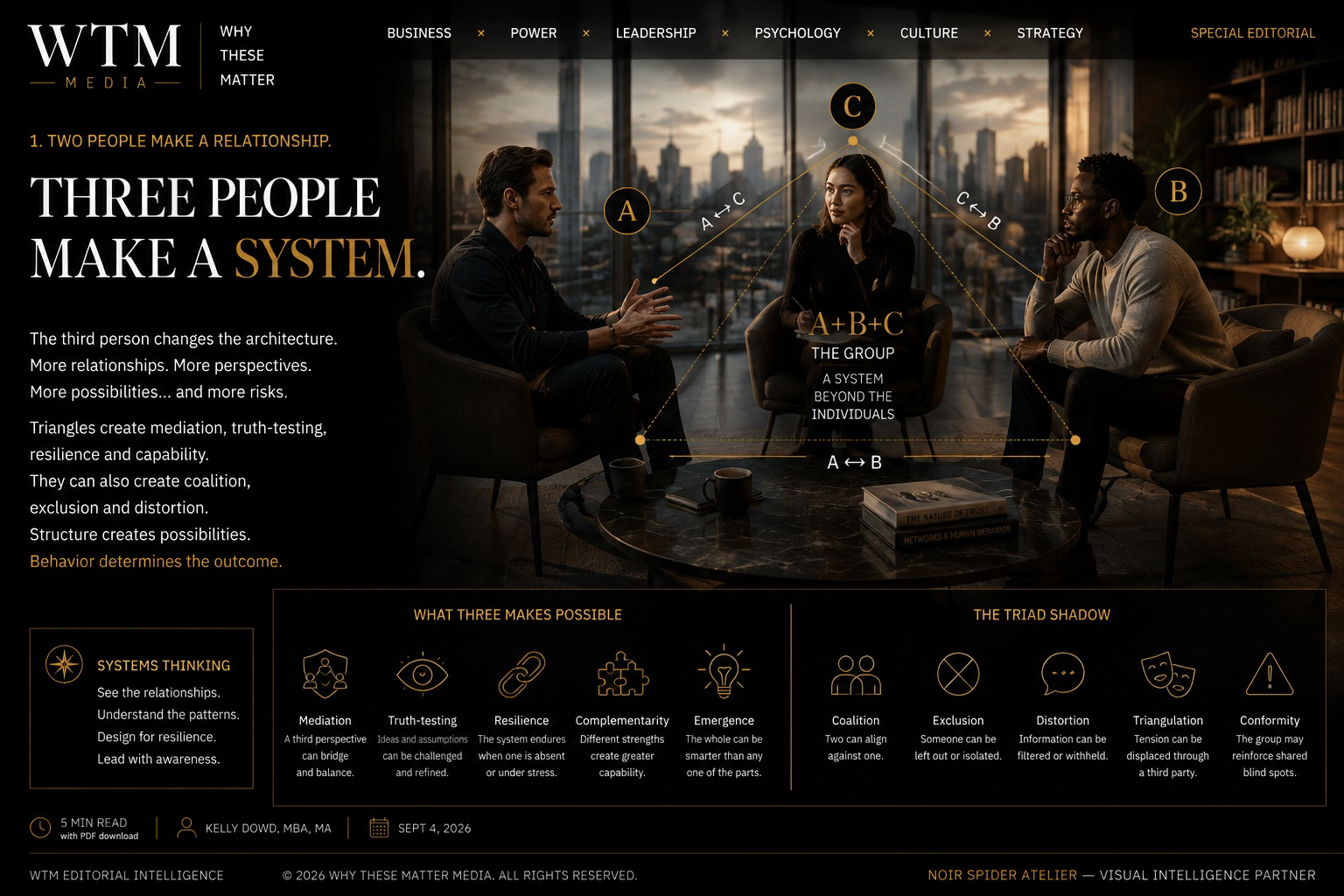
That is what makes the Angels more interesting as a systems metaphor than as an argument for a mystical rule of three. A functioning triad can create redundancy without uniformity. If one member becomes temporarily unavailable, two relationships remain. If one person’s interpretation becomes distorted, two other perspectives exist against which it can be tested. If one possesses a capability the others lack, the system gains that capability without requiring every member to acquire it. Systems engineers understand the value of avoiding unnecessary single points of failure. Human relationships are not machines, but the principle prompts a useful question: how much of a life has been designed around one person, one institution or one relationship carrying everything?
Modern intimacy frequently asks extraordinary things of remarkably few people. A spouse can gradually become lover, closest friend, therapist, financial partner, social organiser, emergency contact, career counsellor, travel companion and principal witness to an entire life. A workplace can become income, status, health insurance, friendship network, identity and future. A parent can become emotional infrastructure long after childhood. None of these arrangements is inherently unhealthy. The fragility appears when one relationship becomes the only architecture through which too many essential human needs can be met. Loss then becomes more than loss; it becomes systems failure.
But the triangle has a shadow. The same architecture that permits mediation permits coalition. Two can turn against one. Information can be withheld. One person can communicate through a third rather than confront another directly. Psychology describes forms of triangulation in which tension between two people becomes displaced through a third. Social networks can stabilise through triangles, but triangles can also intensify conformity and exclusion. The mere existence of three people therefore guarantees nothing. Structure creates possibilities. Behaviour determines whether those possibilities become resilience or dysfunction.
The first lesson is consequently not “find three people”. It is more demanding: see your relationships as a system. Who carries what? Which relationships are independent of one another? Who knows whom? Where does truth travel? Where does it stop? What happens when one person disappears? Who mediates? Who dominates? Who receives support but rarely provides it? Awareness changes relationships because it moves attention away from labels — spouse, best friend, brother, colleague — and towards function. A person can occupy an honoured title in our life while performing remarkably little of the function we imagine the title guarantees.
The three Angels are visually, temperamentally and behaviourally differentiated. That is part of the film’s entertainment architecture, but it also offers a more interesting systems proposition: a resilient team does not necessarily become stronger by replicating the same person three times. If every member sees the same signals, possesses the same knowledge, shares the same blind spots and responds to uncertainty identically, adding members may increase capacity without increasing perspective. Redundancy has value, but redundancy alone does not produce intelligence. The stronger architecture combines sufficient similarity to coordinate with sufficient difference to notice what others miss.
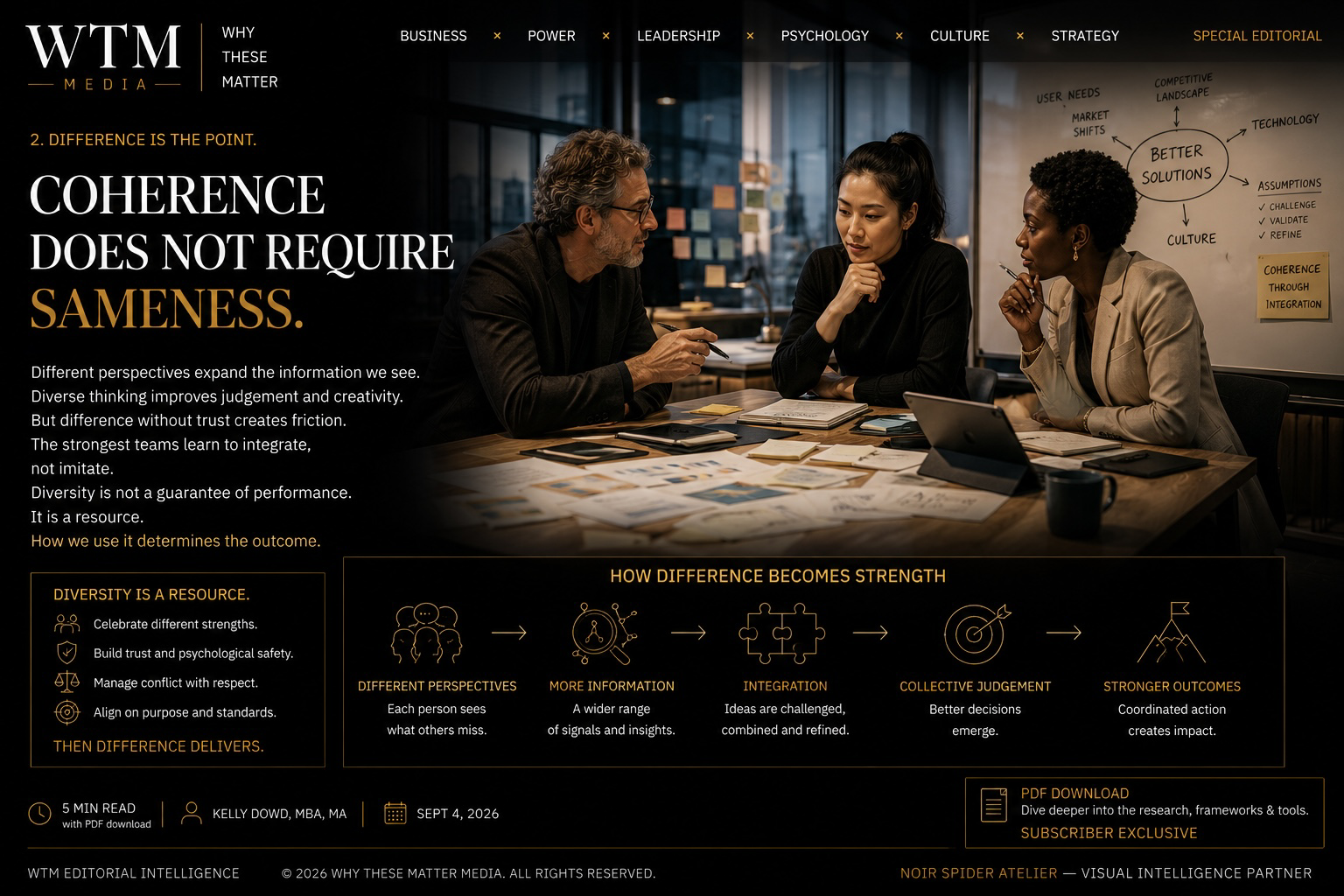
Research on cognitive diversity makes the point more carefully than popular corporate rhetoric sometimes does. Different cognitive styles and perspectives can broaden the information available to a team and improve the possibilities for creativity and problem-solving. But diversity does not automatically improve performance. It can also weaken cohesion, increase misunderstanding and create coordination difficulties when teams lack effective conflict management and information integration. A 2024 review describes precisely these competing paths: diversity can produce synergy through the exchange of different perspectives, while social categorisation and bias can disrupt collaboration. Difference is therefore a resource, not a guarantee.
That distinction matters beyond organisations. Consider three close friends who all share the same profession, politics, social circle, economic circumstances and assumptions about success. Their similarity may create extraordinary emotional ease. They understand one another’s shorthand. They can validate experiences quickly. Yet when one encounters a problem created partly by the assumptions the group shares, the network can become an echo chamber with excellent hospitality. Everyone loves one another. Nobody can see the wall approaching. A person outside the shared worldview may initially feel less comfortable precisely because they can see something the group has normalised.
The opposite extreme is equally dangerous. Difference without sufficient trust can produce fragmentation. Three brilliant people who cannot interpret one another, resolve conflict or subordinate ego to shared purpose do not constitute collective intelligence. They constitute three competing intelligences occupying the same room. Research on high-performing teams suggests that productive groups often need to tolerate multiple interpretations during exploration and then create enough shared understanding to coordinate action. The system needs both divergence and convergence: difference when seeing the problem, coherence when deciding what to do.
This is where Charlie’s Angels offers its better metaphor. The Angels do not surrender identity to achieve coordination. They develop an interface between identities. One person’s strength does not have to become everyone else’s strength because the system knows how to access it. One person’s vulnerability does not automatically become systemic vulnerability because capability exists elsewhere. Their fictional competence is exaggerated, but the underlying principle is useful for friendships, families, executive teams and partnerships: integration is not assimilation. Healthy systems can create coherence without demanding sameness.
That should alter how we select and maintain our closest alliances. Comfort matters. Shared history matters. Affection matters. But perhaps we should also ask whether the people closest to us expand our field of vision. Who understands money when we do not? Who understands our emotional patterns? Who knows the industry we are entering? Who can detect our arrogance? Who recognises our fear before we rename it prudence? Who belongs to a world sufficiently different from ours that they can reveal assumptions we have mistaken for reality? The point is not to engineer friendships like a corporate board. It is to recognise that difference becomes valuable when trust allows it to remain different.
Imagine drawing three circles around yourself. Not the three people you love most. Not the three people with the highest social status. Not the three people who contact you most frequently. Instead, ask what functions make a human support system resilient. WTM proposes three for examination: the Anchor, the Challenger and the Connector. These are archetypal functions rather than fixed job descriptions. One person may perform two. Several people may perform one. The architecture will change throughout a lifetime. The point is not to force humanity into three boxes. It is to expose capabilities that become easy to overlook when we evaluate relationships primarily through affection or frequency.
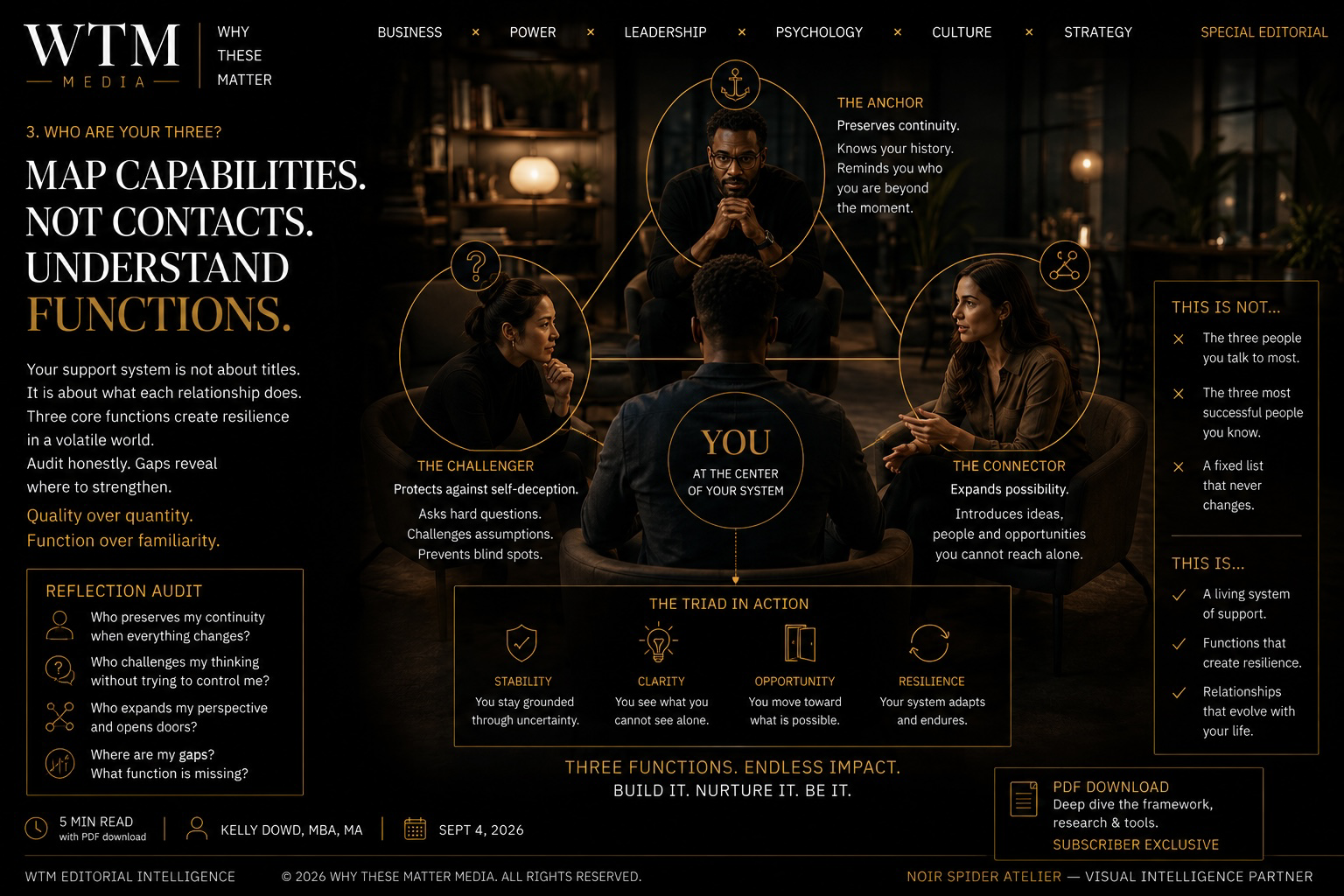
The Anchor preserves continuity. This is the person sufficiently familiar with your character to recognise when circumstances have displaced your centre of gravity. They remember who you were before the promotion, the divorce, the money, the illness, the fame, the failure or the reinvention. Anchoring is not unconditional agreement. In its healthiest form, it provides emotional safety without requiring intellectual dishonesty. The Anchor can say, “This is unlike you,” and the sentence carries weight because it comes from accumulated observation rather than momentary judgement. When external systems become unstable, the Anchor helps preserve internal continuity.
The Challenger protects against the danger of being beautifully understood and consistently wrong. This person has permission to introduce friction. They can ask whether the story we are telling ourselves is supported by evidence; whether grievance has become identity; whether ambition has become vanity; whether loyalty has become avoidance; whether confidence has become overreach. The Challenger is not a permanent contrarian. Chronic disagreement is not wisdom. Their value comes from sufficient independence to resist our preferred narrative and sufficient care to challenge us without needing to defeat us.
The Connector expands possibility. Sometimes that means introducing people, opportunities or institutions. More often, it means connecting us to a world beyond our current cognitive perimeter. The Connector knows something we do not, moves through spaces we do not, asks questions we have not considered or recognises possibilities our existing environment cannot generate. Sociological research has long demonstrated that networks matter not merely because relationships provide intimacy but because different ties carry different information and opportunity. The Connector therefore represents outward movement: the relationship that prevents a tightly bonded life from becoming a closed circuit.
There is useful empirical grounding for thinking about relationships in differentiated layers rather than searching for one universally perfect support person. The Convoy Model of Social Relations, developed from the work of Robert Kahn and Toni Antonucci, conceptualises individuals as moving through life surrounded by dynamic networks of meaningful relationships. These relationships differ in closeness and in the kinds of support exchanged, including aid, affection and affirmation. Convoys also change as people age and circumstances change. The research does not prescribe an Anchor-Challenger-Connector triad; that is WTM’s interpretive framework. But it supports the deeper proposition that social support is multidimensional, dynamic and structurally more sophisticated than counting friends.
Now perform the uncomfortable audit. Write three names, if three names emerge. Then remove the titles beside them. Do not write “husband”, “mother”, “best friend” or “business partner”. Write what the relationship does. Who can receive a call when the polished version of you has disappeared? Who can tell you something you do not want to hear without being expelled from your life? Who expands your possibilities without needing to own the outcome? And where is there a blank space? The blank may matter more than the names. It reveals where a life has reach without resilience, intimacy without challenge or security without expansion.
Human beings are remarkably talented at confusing familiarity with safety. Longevity can make a relationship important without making it healthy. Intensity can resemble intimacy. Constant communication can resemble reliability. Shared enemies can resemble shared values. And history can become an argument for continuing arrangements that no longer serve either participant. If the Personal Resilience Triad identifies functions that strengthen agency, an equally serious analysis must examine behaviours that weaken it. Otherwise “find your three” becomes sentimental self-help rather than systems intelligence.
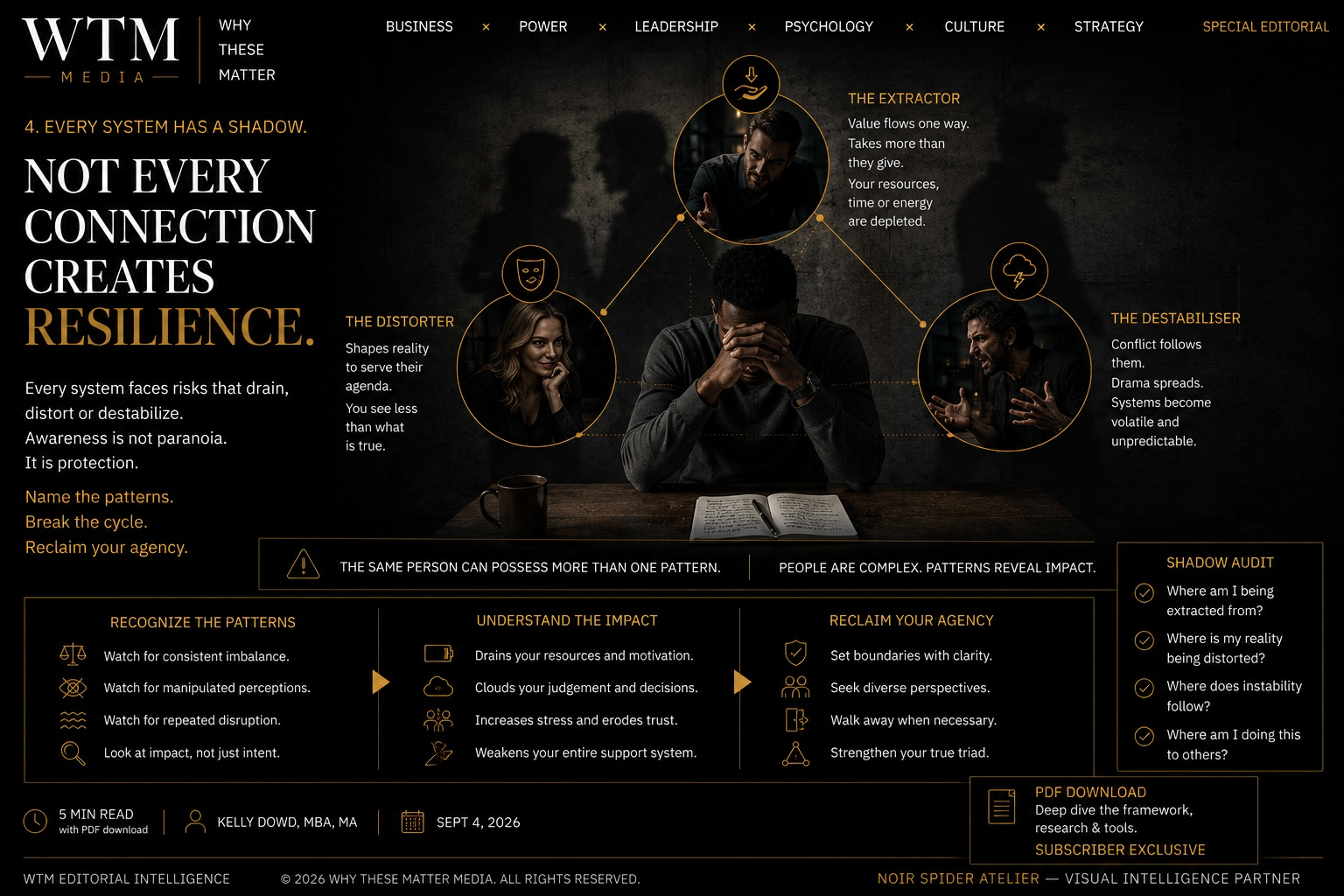
The first shadow function is the Extractor. Extraction is not measured by whether every exchange is immediately equal. Healthy relationships move through periods of profound imbalance: illness, grief, unemployment, caregiving, parenthood and crisis can require one person to carry far more than another. Extraction is different. It is a persistent architecture in which attention, labour, money, opportunity, emotional regulation, status or access travels disproportionately in one direction while reciprocity remains permanently deferred. The danger is not generosity. The danger is a system that survives only while one participant continues subsidising it.
The second is the Distorter. Every human being interprets reality imperfectly, so occasional bad advice does not make someone dangerous. Distortion becomes systemic when another person’s incentives repeatedly depend upon our misunderstanding what is happening. The flatterer who benefits when confidence outruns competence. The colleague who selectively transmits information. The relative who needs conflict to preserve control. The friend who reinforces every grievance because reconciliation would reduce their importance. Distortion is especially powerful because it often arrives disguised as loyalty: I am the only one telling you the truth. The appropriate defence is not paranoia. It is informational plurality.
The third is the Destabiliser. Some relationships repeatedly increase volatility across the wider network. Conflict follows them from person to person. Boundaries become emergencies. Small disagreements acquire audiences. Private information becomes social currency. Alliances shift according to immediate advantage. Again, the behaviour matters more than the label. People can destabilise systems temporarily because they themselves are distressed; human beings should not be permanently classified by their worst period. But recurring patterns deserve recognition. Acceptance means observing what a relationship consistently produces rather than continually judging it by what we hope it will eventually become.
And then comes the most uncomfortable systems truth: the same person can strengthen and destabilise us simultaneously. An Anchor can become possessive because our growth threatens the relationship’s familiar architecture. A Challenger can cross into humiliation. A Connector can begin treating access as leverage. Someone can love us sincerely and still participate in a pattern that damages us. Human relationships resist the clean categories beloved by frameworks because people are adaptive, contradictory and contextual. The framework earns its usefulness only if it helps us see complexity rather than giving us new labels with which to prosecute one another.
The mature response is therefore not to compile a list of three enemies. It is to understand three risks: extraction, distortion and destabilisation — and then examine our own behaviour under the same light. Where do we extract? Whose reality do we distort because their clarity would inconvenience us? Which systems become more volatile when we enter them? Authority begins when diagnosis becomes reciprocal. Otherwise systems thinking becomes an elegant method for explaining why everyone else is the problem.
There is a subtle selfishness hidden inside much contemporary language about relationships. We are encouraged to find our tribe, build our network, establish boundaries, identify mentors, attract better friends and surround ourselves with people who elevate us. Much of that advice can be useful. But it imagines social capital primarily from the perspective of acquisition: Who should I have around me? A functioning human system asks the reciprocal question: What becomes possible for other people because I am around them?

The reversal changes everything. If you want an Anchor, whose continuity are you preserving? Who can arrive without performing competence for you? Whose history do you remember accurately enough to distinguish a difficult season from a changed character? Reliability is rarely theatrical. It is returning the call. Remembering the appointment. Sitting in the waiting room. Reading the document. Showing up at the airport. Saying nothing when nothing intelligent needs saying. Social support research distinguishes network structure from the support actually exchanged within it. The distinction is fundamental: being in someone’s network is not the same as supporting them.
If you want a Challenger, whose truth are you willing to protect at the risk of temporary discomfort? This requires more than bluntness. Cruel people often describe themselves as honest because honesty sounds nobler than aggression. Effective challenge requires judgement: knowing when someone needs contradiction, when they need evidence, when they need time and when they already know the truth but are gathering enough courage to act upon it. Challenge without empathy becomes domination. Empathy without challenge can become collusion. The difficult intelligence lies between them.
If you want a Connector, whose name do you say when opportunity enters a room they are not in? Sponsorship is one expression of connection, but connection can be much smaller: forwarding an article, introducing two people, teaching someone a system, recommending a candidate, inviting someone into a conversation or making information legible to someone who lacks institutional familiarity. Connection is a form of infrastructure. It reduces the distance between capability and possibility. A powerful network becomes socially consequential when access can travel through it rather than accumulating permanently around its most connected members.
Reciprocity also corrects one of the central weaknesses in the “three friends” idea. No individual exists merely to perform a function in somebody else’s resilience architecture. People have their own lives, obligations, limits and changing capacities. The friend who once answered at midnight may become a parent caring for an infant. The sibling who once had financial flexibility may encounter hardship. The colleague who opened doors may retire. A resilient system therefore requires maintenance and adaptation rather than entitlement. Relationships are living infrastructure. They cannot be placed on autopilot and expected to remain load-bearing indefinitely.
This may be the most useful interpretation of the Angels after all. Their strength is not that each woman possesses two extraordinarily useful companions. Their strength comes from mutuality. Each is simultaneously protected by and responsible for the system. That is the difference between possessing allies and participating in an alliance. One is an inventory. The other is an obligation. The question Who are your three? becomes meaningful only when accompanied by the harder question: Who would write your name down?
The twenty-first century has performed an extraordinary linguistic trick: it has made connection and relationship feel interchangeable. They are not. A network measures reach. A support system measures reliability. A follower can observe you. A contact can recognise your name. A colleague can work beside you. A neighbour can know where you live. A friend can love you. But none of those categories automatically tells us what happens when circumstances change. Research on social connection distinguishes the structure, function and quality of relationships precisely because the number of people surrounding someone cannot, by itself, describe the support available to them.
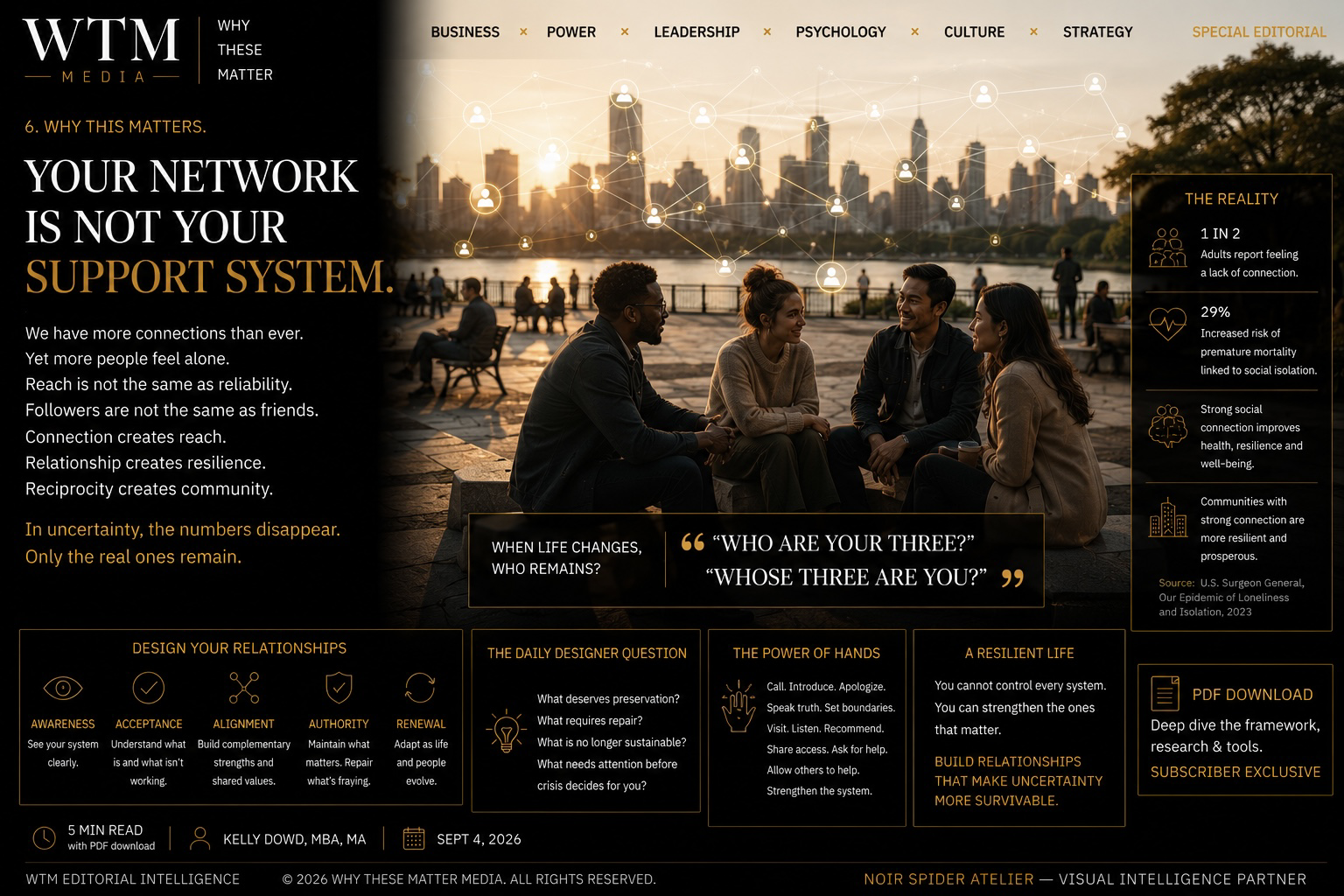
The distinction has consequences beyond sentiment. Social connection is associated with health, resilience and well-being, while isolation and weak social support are associated with substantial health risks. The US Surgeon General’s advisory describes social connection as an important contributor not only to individual health but also to community resilience and prosperity; it reports that social isolation is associated with a 29 per cent increased risk of premature mortality. Those findings do not mean friendship can be prescribed like medication or that three companions constitute some magical health threshold. They establish something more consequential: the architecture of human connection belongs among the serious systems affecting human life.
This becomes increasingly important as other institutions become less permanent. People change employers more frequently. Families can live across continents. Careers fragment into projects and portfolios. Digital communication allows relationships to persist across geography while simultaneously filling attention with low-intensity connection. AI may further mediate companionship, advice and professional interaction. Longevity means friendships can outlast multiple careers, homes and marriages. Under those conditions, relational resilience is not a nostalgic luxury. It becomes part of the infrastructure through which human beings navigate volatility.
But resilience should not become another optimisation project. You do not need to audit every dinner for return on investment or rank friends according to utility. That would destroy precisely what makes friendship valuable. Design does not always mean control. Sometimes design means noticing what already works, protecting it from neglect and removing conditions that prevent it from flourishing. The Daily DESIGNER question applied to relationships is therefore gentle but consequential: What deserves preservation? What requires repair? What has become structurally unsustainable? What relationship needs more attention before crisis reveals that neglect has already answered the question for us?
The Power of HANDS enters when observation becomes behaviour. Call someone. Introduce someone. Apologise. Tell the difficult truth with sufficient tenderness that it can be heard. Establish the boundary before resentment becomes architecture. Visit. Listen. Recommend. Share access. Ask for help before desperation. Allow another person to help without interpreting dependence as weakness. Human agency does not require controlling every system around us. Sometimes it means deliberately strengthening the few relationships through which uncertainty becomes more survivable.
So perhaps life does not come in threes after all. Perhaps three merely gives us a sufficiently small number to make an enormous question impossible to avoid. You may possess 20,000 followers, 2,000 professional contacts, 500 acquaintances, twenty colleagues and a telephone containing the names of almost everyone you have met since university. None of those numbers answers the question that matters when the architecture of life changes.
Who are your three? And then the question on which the entire idea turns: Whose three are you?
This editorial’s Personal Resilience Triad — Anchor · Challenger · Connector and its corresponding shadow analysis — Extractor · Distorter · Destabiliser — are WTM Editorial Intelligence interpretive frameworks. They should not be represented as established psychological models or empirically validated three-person prescriptions.
The underlying investigation draws upon several established bodies of scholarship: social-network research into triadic closure and core discussion networks; Kahn and Antonucci’s Convoy Model of Social Relations; organisational research on cognitive diversity, information processing, cohesion and conflict management; and public-health evidence concerning social connection, isolation and well-being. Research on diversity is particularly important to represent accurately: heterogeneous perspectives can improve information processing and creativity under some conditions, but difference can also generate conflict and coordination problems.
Principal research: Convoy Model of Social Relations — Antonucci, Ajrouch & Birditt; Linked Lives and Convoys of Social Relations; US Surgeon General — Social Connection; Team Diversity and Team Performance — Current Opinion in Psychology; Cognitive Diversity and Team Processes — Academy of Management Annals.
Cultural reference: Charlie’s Angels (2000), directed by McG and based on the television series created by Ivan Goff and Ben Roberts. The film functions here as cultural criticism and an interpretive doorway into a broader investigation of human systems; WTM makes no claim that its fictional team structure constitutes scientific evidence.
Author: Kelly Dowd, MBA, MA
Visual Intelligence: Noir Spider Atelier™ — A Division of WTM Media
Editorial Direction: Kelly Dowd, MBA, MA
© 2026 Kelly Dowd / Why These Matter Media. All rights reserved.
Personal Resilience Triad, Anchor · Challenger · Connector, and the associated WTM systems interpretation are original editorial constructs developed for this essay. References to third-party films, scholarship, institutions and research are provided for criticism, commentary, analysis and attribution. All third-party names, titles and trademarks remain the property of their respective owners.
Editorial methodology: WTM Editorial Intelligence distinguishes established research from WTM interpretation. Correlation is not presented as causation; the number three is not presented as a scientifically established requirement for friendship, resilience or health; and cultural metaphor is not presented as empirical evidence.
Why These Matter - WTM MEDIA is an independent editorial platform exploring the forces shaping our world—through people, culture, commerce, design, systems, and governance. Connecting the dots between today’s headlines and tomorrow’s realities.