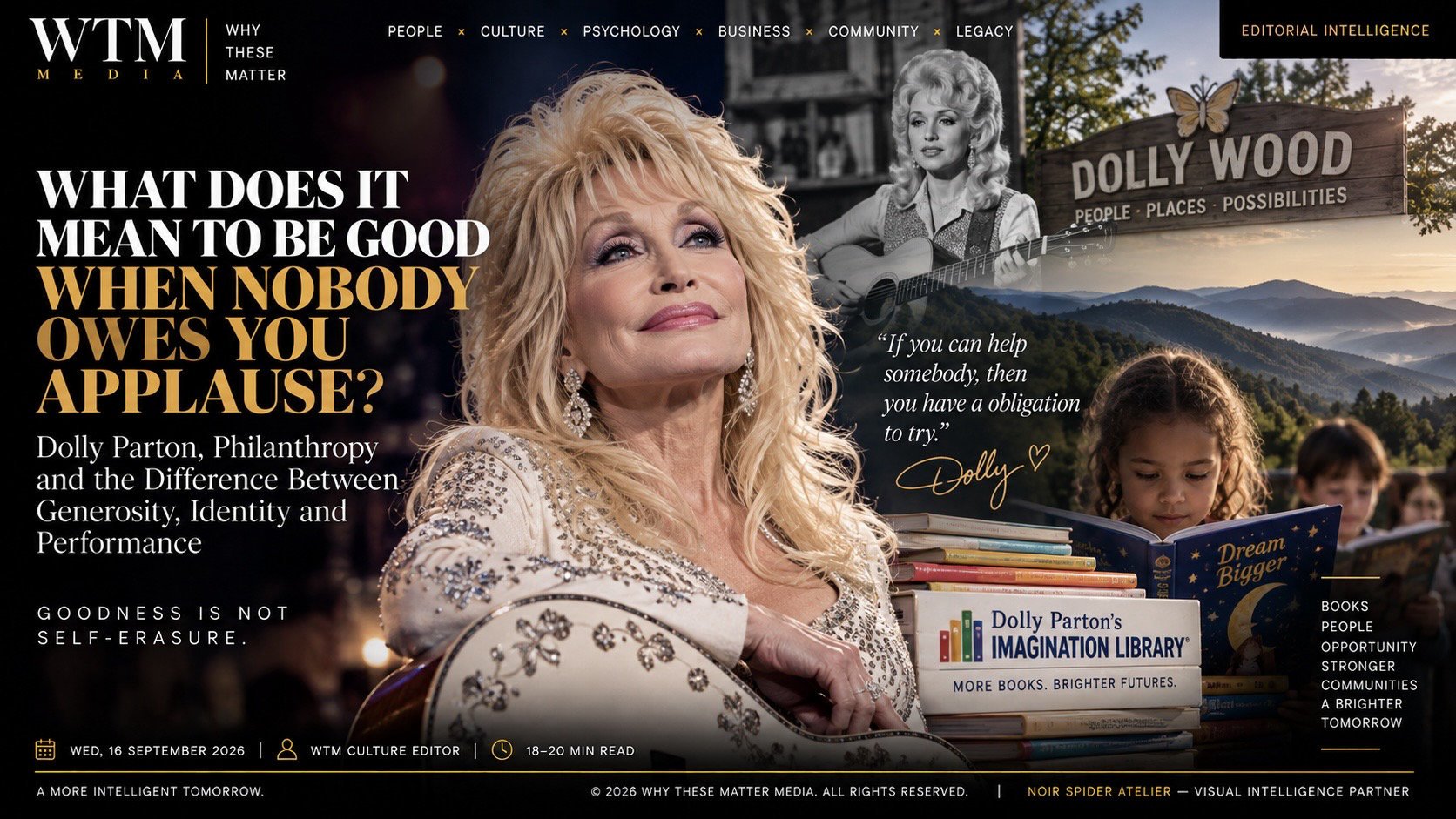
Dolly Parton died on 25 August 2026 at 80, leaving behind the obvious architecture of celebrity: songs, films, costumes, awards, businesses and an image recognisable across generations. Her official organisation described a seven-decade career and a legacy of philanthropy, compassion and resilience. But the more consequential inheritance may be found somewhere less glamorous. By June 2026, Dolly Parton’s Imagination Library was sending more than 3.5 million books a month to children across five countries and had distributed more than 325 million since the programme began in 1995. It started not as an abstract exercise in benevolence but from something personal: her father could not read or write. That distinction matters. We often describe goodness as though it requires the gradual disappearance of the self. Give more. Need less. Accommodate everyone. Remain available. Forgive endlessly. Never appear selfish. Under this model, goodness becomes a performance of personal depletion. But sustainable generosity requires almost the opposite. A person must possess enough self-knowledge to understand what they can give, enough boundaries to preserve the capacity from which giving occurs and enough judgement to distinguish helping someone from becoming responsible for their life. Parton offers a useful case study because her philanthropy did not require the destruction of her ambition, commercial instincts, aesthetic identity or ownership. She became extraordinarily successful and constructed mechanisms through which portions of that success could create value elsewhere. The mature architecture of goodness may therefore be: SELF → CAPACITY → RESPONSIBILITY → GENEROSITY → BOUNDARY → LEGACY. The question is not how much of yourself you can give away. It is whether what remains after you give is strong enough to keep generating value.
Celebrity creates a peculiar distortion. It makes visibility look like significance. We remember the dress, the voice, the quotation, the photograph and the performance because those things travel easily through culture. Character is harder to observe because character is not what someone says when the camera arrives. It is the pattern connecting decisions made across decades. Parton understood spectacle extraordinarily well. The hair, rhinestones, humour and exaggerated femininity were not evidence that she lacked seriousness. They were evidence that she understood attention. The more interesting question is what she did once she possessed it.
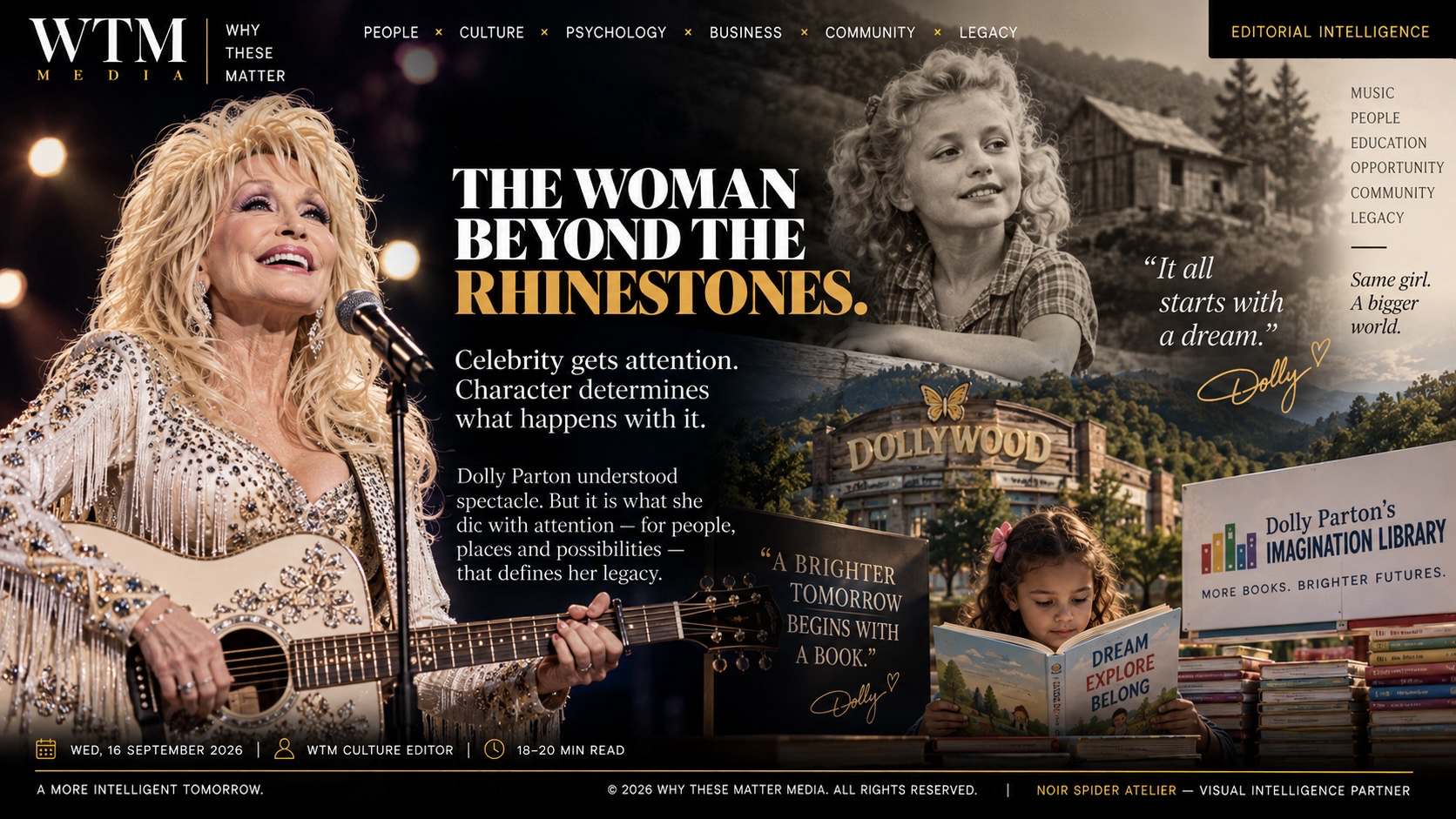
Her biography makes that distinction unusually revealing. Parton was born in rural East Tennessee, the fourth of twelve children in a poor family. She eventually constructed a commercial ecosystem spanning music, entertainment, hospitality, licensing and tourism. Her official biography says her East Tennessee theme park and affiliated businesses now attract more than four million visitors annually and have created jobs and opportunities for thousands in the region. That is not merely a celebrity attaching her name to merchandise. It is a transformation of cultural capital into economic infrastructure.
The same pattern appears in the Imagination Library. Parton’s father, Robert Lee Parton, could not read or write. She nevertheless described him as one of the smartest people she knew. The Dollywood Foundation says this experience directly informed her decision to establish the programme in 1995, initially for children in Sevier County, Tennessee. A private memory became a public intervention. Biography became architecture.
That is fundamentally different from philanthropy performed principally as reputational insurance. The distinction is not that public recognition invalidates generosity. Almost every large philanthropic intervention produces some reputational value. The better question is whether reputation is the principal product or a secondary consequence. When the cameras leave, does anything remain? Is there a mechanism, institution, capability, scholarship, book, job or piece of infrastructure that continues doing something?
By June 2026, the Imagination Library had distributed more than 325 million books and was sending more than 3.5 million every month across the United States, Canada, the United Kingdom, Australia and the Republic of Ireland. The scale changes the moral category. A book is a gift. A recurring international distribution system capable of placing millions of books into homes every month is institutional design.
That may be the first useful correction to our understanding of goodness. Goodness is not merely an emotion towards another person. Compassion can begin the process, but systems determine whether compassion survives contact with scale. Parton did not become consequential because she cared more intensely than everyone else. She became consequential because, repeatedly, she helped convert caring into mechanisms capable of functioning beyond the original emotional moment.
There is a version of goodness that is quietly destructive. It teaches people that generosity should have no boundary, that availability demonstrates love, that saying no indicates selfishness and that the needs of others acquire moral priority simply because they are needs. Under this architecture, the “good person” gradually becomes the person from whom everyone is permitted to withdraw resources.
That is not generosity. It is an unsustainable allocation system.
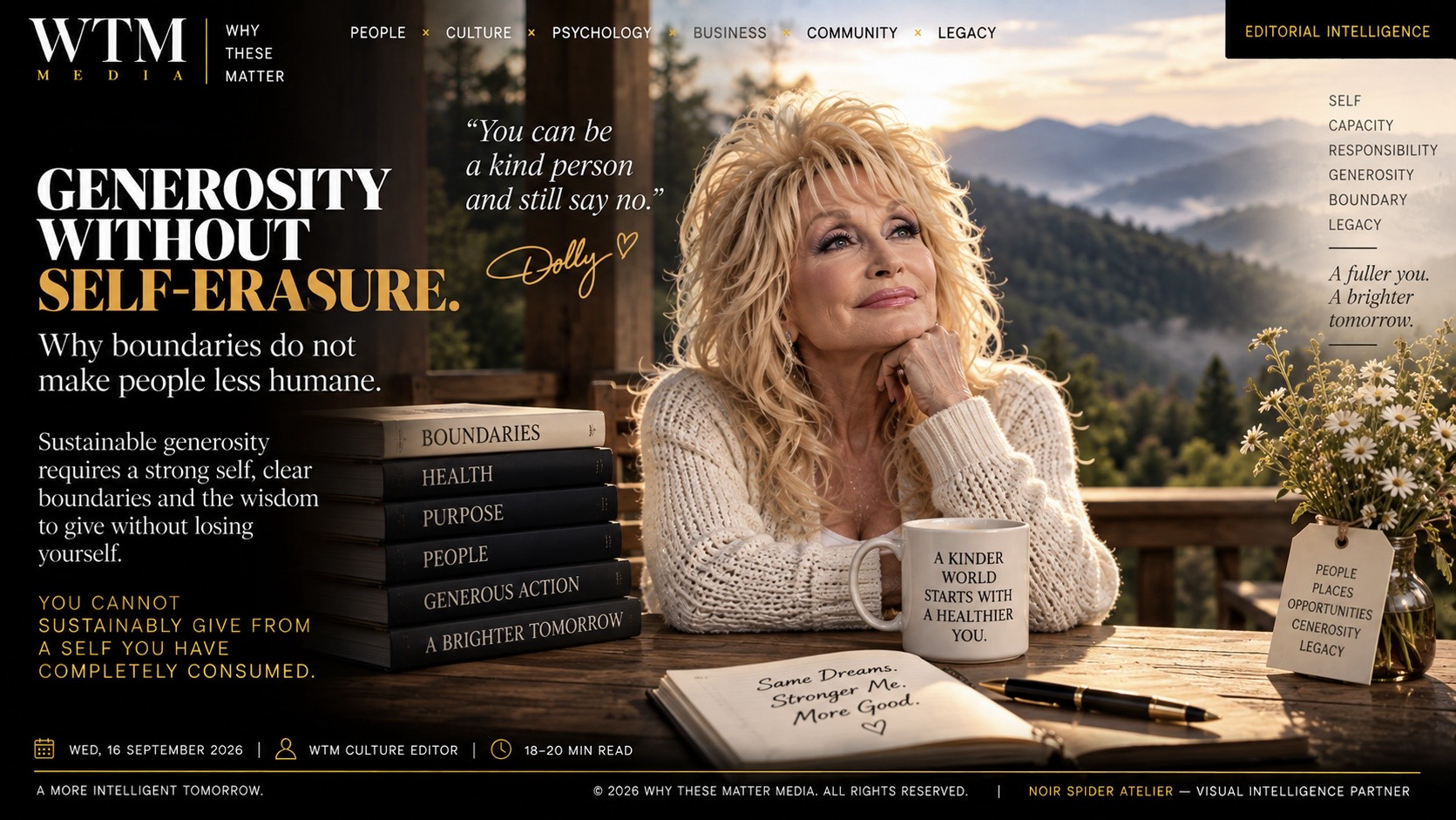
Human capacity is finite. Money is finite. Attention is finite. Time is finite. Emotional energy is finite. Even extraordinary wealth does not remove scarcity; it changes its dimensions. A person deciding how to help must therefore make choices. Which cause? Which person? How much? For how long? Under what conditions? Every yes contains an invisible no because resources directed somewhere cannot simultaneously be directed everywhere.
Parton’s life complicates the popular mythology that goodness requires modest ambition. She did not relinquish commercial success to prove that she cared about people. She expanded it. Dollywood, entertainment properties, licensing, hospitality and other ventures existed alongside philanthropy. Her businesses and philanthropic institutions were distinct but interconnected expressions of capacity. Her official biography describes an expanding commercial portfolio alongside millions donated to education, healthcare and disaster relief.
This matters psychologically because self-preservation and generosity are often presented as moral opponents. They are not. The person who continually gives beyond capacity eventually has only three options: depletion, resentment or withdrawal. Boundaries therefore need not be interpreted as barriers against compassion. Properly designed, they are infrastructure for maintaining it.
The same principle applies far beyond philanthropy. Parents can love children without solving every problem for them. Leaders can care for employees without making every employee happy. Friends can support friends without becoming their emergency operating systems. Partners can practise generosity without abandoning independent identity. A society that mistakes goodness for unlimited accommodation eventually rewards the people most willing to consume the accommodating person.
The mature sequence is therefore not SELF → SACRIFICE → DISAPPEARANCE. It is SELF → CAPACITY → RESPONSIBILITY → GENEROSITY → BOUNDARY. Know what you possess. Determine what responsibility reasonably follows from possessing it. Give where you can create meaningful value. Preserve enough of yourself to remain capable tomorrow. A boundary that allows generosity to continue is not the opposite of kindness. It is one of kindness’s operating conditions.
Charity frequently begins with an immediate deficit. Someone is hungry. A family has lost a home. A disaster has destroyed a community. A child lacks something necessary. The moral requirement can be immediate because the suffering is immediate. Parton’s organisations repeatedly operated in this territory. After the 2016 Sevier County wildfires, the Dollywood Foundation’s My People Fund ultimately distributed $13 million in direct recovery assistance. In 2024, Parton and organisations associated with her committed a combined $2 million to Hurricane Helene relief.
Relief matters. But relief and capability answer different questions. Relief asks: What does this person need now? Capability asks:What might allow this person to possess more agency later? Mature philanthropy needs enough intelligence to understand when each is required.
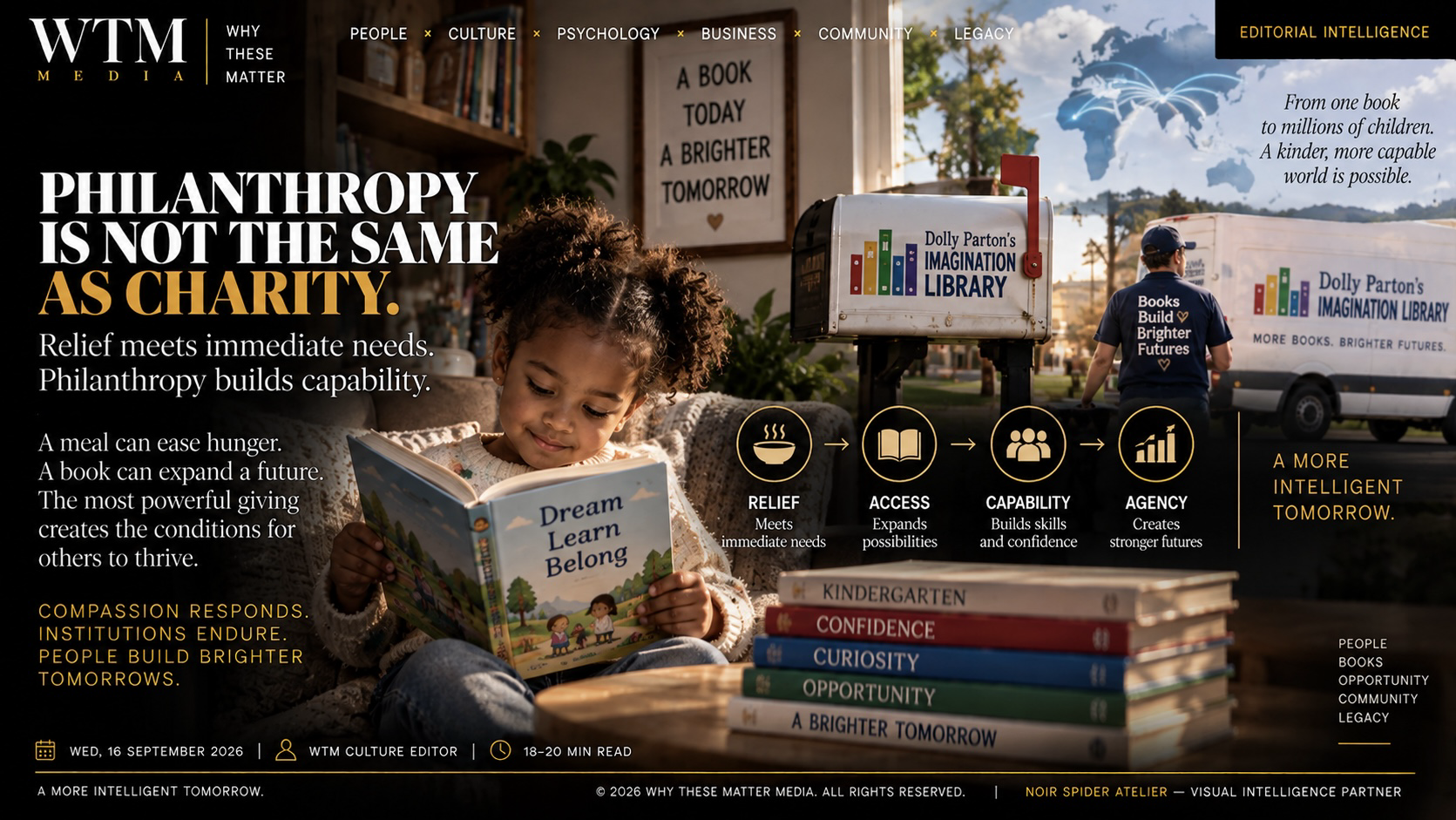
The Imagination Library occupies the second territory. Its product appears almost comically modest: a book arrives in the post. But repetition changes the intervention. One book becomes twelve. Twelve become years of books. Those books enter a household. They can alter what is available on shelves, what parents and children do together and how normal reading feels before formal schooling begins. The intervention does not attempt to manufacture an educated child. It alters one component of the environment in which education develops.
Evidence requires care here. The Dollywood Foundation’s review of research reports positive changes in book ownership, parent reading behaviour, attitudes towards reading and promising evidence around early literacy skills. A large recent international study reported associations between participation and stronger literacy and shared-reading behaviours, while peer-reviewed research has also examined Imagination Library participation alongside other literacy interventions. These findings are encouraging, but WTM should not convert them into a simplistic claim that receiving books alone determines educational outcomes.
The more interesting design principle survives even with that caution. Strong philanthropy can alter the environment surrounding human agency without attempting to replace agency itself. A book does not read itself. A scholarship does not complete a degree. Capital does not automatically build a viable business. But access changes the field of possibility. The recipient remains an actor rather than becoming merely an object of benevolence.
This gives us four useful categories of giving. Giving as guilt attempts to resolve discomfort about possessing more. Giving as performance converts generosity into social status. Giving as rescue makes the giver psychologically necessary to the recipient. Giving as architecture creates conditions through which another person can acquire greater capacity. Real life will blur these categories, and human motives are rarely pure. The point is not moral classification. It is better design.
The strongest question for philanthropists, governments, companies and ordinary people is therefore not simply, How much did we give? It is, What became more possible because we gave it? Money spent is an input. Human dignity, capability, resilience and opportunity are closer to the outcome. Generosity becomes strategically consequential when the recipient eventually needs less of the giver rather than more.
Business and philanthropy are frequently placed on opposite sides of a moral ledger. One extracts value; the other gives it back. Reality is considerably more complicated. A well-designed enterprise can itself create employment, skills, tax revenue, supply chains, cultural institutions and reasons for people to travel to a place. A badly designed charity can waste resources, reproduce dependency or exist primarily to improve the benefactor’s reputation. Legal category does not settle social value.
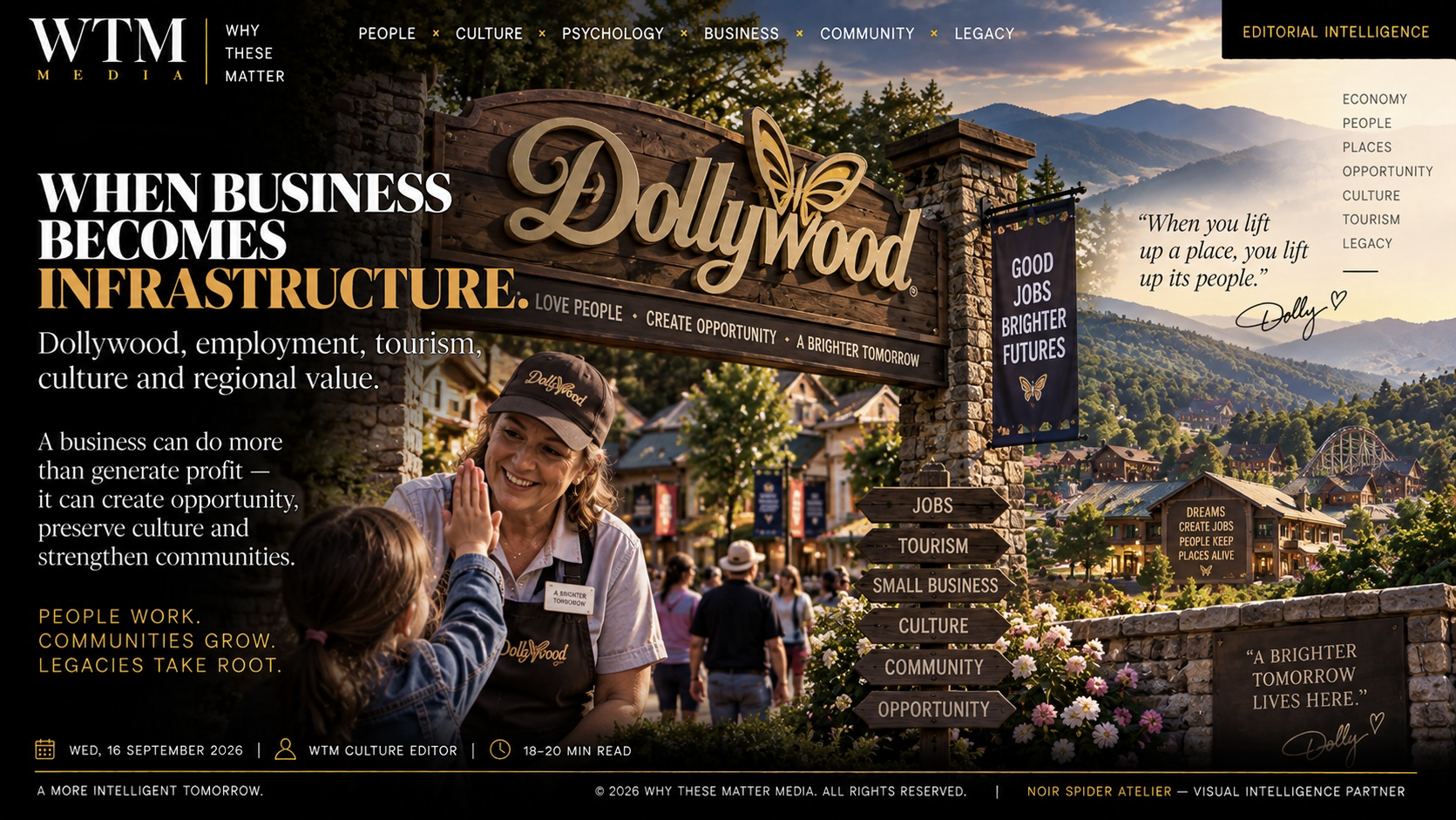
Dollywood makes the tension tangible. It is a commercial enterprise. People pay to enter. Workers are employed. Products are sold. Capital is invested with the expectation of economic return. Yet the enterprise also sits inside the cultural and economic architecture of East Tennessee. Parton’s official biography reports that Dollywood and affiliated businesses attract more than four million visitors annually and create jobs and opportunities for thousands. Its significance cannot be captured by asking whether it is a business or a social contribution. It is capable of being both.
That is particularly important because Parton could have extracted her identity from Appalachia after becoming globally famous. Instead, significant portions of her commercial and philanthropic architecture repeatedly returned to the region. The pattern suggests something more sophisticated than “giving back”. Capital did not merely leave the marketplace, become a donation and disappear into a cause. In several cases, celebrity, capital, place and institution reinforced one another.
Executives should examine this carefully. Corporate social responsibility is often positioned downstream from strategy: first make the money, then decide which socially acceptable activity should receive some of it. The stronger question is whether the enterprise itself creates forms of durable value alongside financial return. What happens to the communities in which it operates? What capabilities accumulate around it? What happens to employees after five years inside it? What would disappear locally if the organisation disappeared tomorrow?
None of this romanticises capitalism. Employment can be precarious. Tourism can distort local economies. Businesses can generate enormous private returns while externalising costs onto workers, communities or the environment. “We create jobs” cannot become an all-purpose moral exemption. The Four P’s require a more demanding assessment: People. Planet. Profit. Pragmatism. Where does value originate? Who captures it? Who bears its costs? Does the system remain viable?
Parton’s useful contribution is not proof that celebrity capitalism is inherently benevolent. It is evidence of another possibility: commercial capacity can become part of a broader architecture of place. The intelligent executive should therefore stop treating profit and contribution as sequential events. The more ambitious design problem is determining where they can become mutually reinforcing without pretending their interests are always identical.
“Be a good person” sounds like uncomplicated advice until goodness encounters power, conflict and scarcity.
Nice people frequently avoid necessary conversations because discomfort feels unkind. Generous people sometimes continue financing destructive behaviour because refusing feels cruel. Leaders protect underperforming employees from consequences until the burden migrates to everyone else. Parents remove every obstacle from children and inadvertently remove opportunities to develop competence. Friends become permanent rescuers. Partners confuse self-abandonment with devotion.
Good intention is therefore insufficient evidence of good consequence.
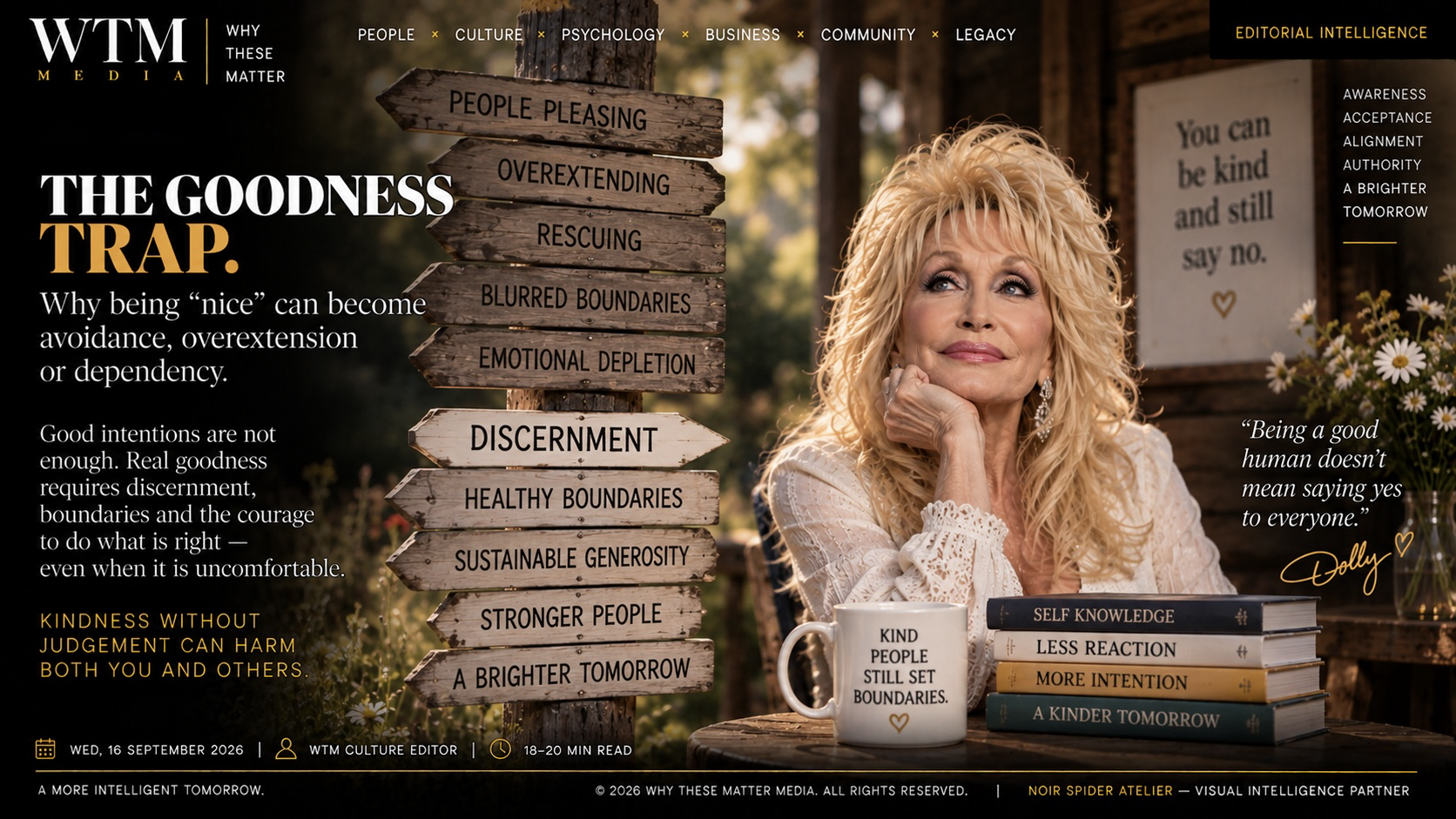
This is where goodness requires judgement. The Four A’s provide a useful architecture. Awareness: what is actually happening? Acceptance: what reality am I resisting because acknowledging it would make me uncomfortable? Alignment: what response serves dignity, responsibility and long-term consequence rather than immediate emotional relief? Authority: am I willing to act on that judgement, including when the humane decision is not the pleasant one?
Boundaries become essential because compassion without discrimination can be exploited. This does not justify cynicism. It demands discernment. There are people who need a meal and people who need an opportunity. People who need forgiveness and people who need accountability. People who need company and people from whom distance is necessary. Goodness incapable of making these distinctions becomes vulnerable to manipulation.
The same applies to public philanthropy. A spectacular donation can be genuinely useful while also improving reputation. A billionaire can fund important institutions while benefiting from systems that deserve scrutiny. A corporation can support a community and simultaneously pursue policies favourable to itself. Human behaviour does not become false merely because motives are mixed. The mature observer learns to hold two realities at once.
That is why sainthood is an intellectually weak standard for evaluating people. It requires us either to sanitise human beings or eventually to destroy them when evidence of contradiction appears. A better standard asks whether the pattern of someone’s choices, across time and under changing conditions, increased or diminished the agency and dignity of others while preserving legitimate responsibility for the self.
Goodness, then, is not niceness. It is not permanent sacrifice. It is not ideological purity. It is not never disappointing anyone. It is the repeated exercise of judgement about how one human being should use their capacity in relation to other human beings. Sometimes that produces a gift. Sometimes a system. Sometimes an apology. Sometimes a boundary. Sometimes the most humane word available is no.
Death performs an unusual audit. Status disappears from the person who possessed it. Titles can no longer be exercised. Wealth changes ownership. The applause belongs to memory. What remains operational reveals something different about what a life constructed.
Parton left an unusually literal example. The day after her death, her organisation announced that a team she had selected would continue projects already in development. Her longtime manager, Danny Nozell, said Parton had worked with that team for years on a roadmap intended to guide projects for decades. The pipeline included music, books, hospitality, theatre, consumer ventures and other projects extending into 2027 and beyond.
More consequentially, the Imagination Library does not require Parton to personally place a book into a mailbox. It has local partners, funding mechanisms, book-selection processes, distribution infrastructure and operations across five countries. The Dollywood Foundation itself dates to 1988. This is what distinguishes an act from an institution: an act ends when the actor stops. An institution can preserve intention while distributing execution.
That principle matters even for people who will never possess celebrity wealth. Legacy is often inflated into monuments, fortunes and names attached to buildings. Most human legacy is smaller and potentially more important. A child taught something. A colleague developed rather than merely managed. A family culture changed. A business made capable of surviving its founder. Knowledge documented rather than hoarded. A person treated with dignity at precisely the moment when indignity would have been easier.
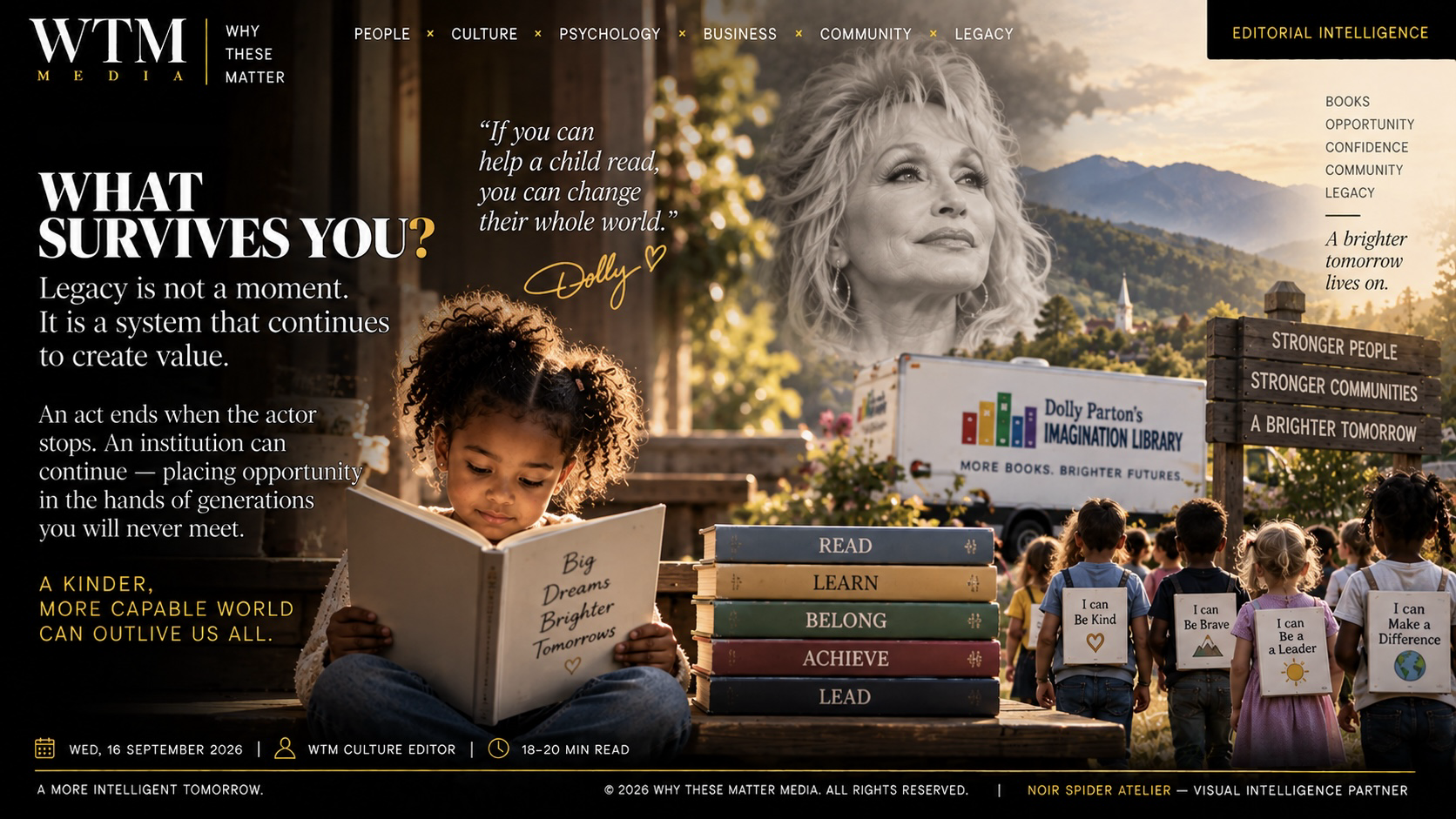
The question therefore changes from What will people say about me? to What will continue creating value because I was here?The first is reputation. The second is architecture. Reputation depends upon other people remembering you. Architecture depends upon something you built continuing to work.
That is the deeper intelligence hidden beneath Parton’s rhinestones. She demonstrates neither that wealth makes someone good nor that philanthropy absolves a person from scrutiny. She offers something more useful: a case study in converting identity into capacity, capacity into generosity and generosity into systems. The measure is not perfection. It is whether something valuable continues travelling after the person who initiated it can no longer carry it.
A good human is not someone who gives everything away. It is someone who learns how to convert what they have into value for others without disappearing in the process.
The factual foundation uses Parton’s official organisation for her death and biographical record; the Dollywood Foundation and Imagination Library for programme history, scale and philanthropy; and published research for literacy-related evidence. Parton’s official organisation confirmed her death in Nashville on 25 August 2026 at age 80.
The Imagination Library reported in June 2026 that it had distributed more than 325 million books and was sending more than 3.5 million books each month across five countries. The Dollywood Foundation documents that the programme began in 1995 and was inspired by Parton’s father, who could not read or write.
Parton’s official philanthropy record documents healthcare giving and disaster interventions including the My People Fund following the 2016 wildfires, assistance after Tennessee flooding and a combined $2 million commitment from Parton-associated organisations following Hurricane Helene. Research concerning the Imagination Library is presented with appropriate caution: evidence supports changes in home literacy environments and promising literacy outcomes, but the editorial does not treat programme participation as singular proof of later educational achievement.
The Good Human Test, the four modes of giving, the distinction between act and institution and the architecture SELF → CAPACITY → RESPONSIBILITY → GENEROSITY → BOUNDARY → LEGACY are original WTM Editorial Intelligence interpretations. They should be presented as frameworks for judgement rather than validated psychological or philanthropic measurement instruments.
Copyright
© 2026 Why These Matter Media. All rights reserved.
Author: WTM Culture Editor
Editorial Intelligence: Why These Matter Media
Visual Intelligence Partner: Noir Spider Atelier™
Dolly Parton, Dollywood, Dolly Parton’s Imagination Library, the Dollywood Foundation and other third-party names, organisations, trademarks, research and intellectual property remain the property of their respective owners and are referenced for reporting, commentary, criticism, cultural analysis and attribution.

Why These Matter - WTM MEDIA is an independent editorial platform exploring the forces shaping our world—through people, culture, commerce, design, systems, and governance. Connecting the dots between today’s headlines and tomorrow’s realities.