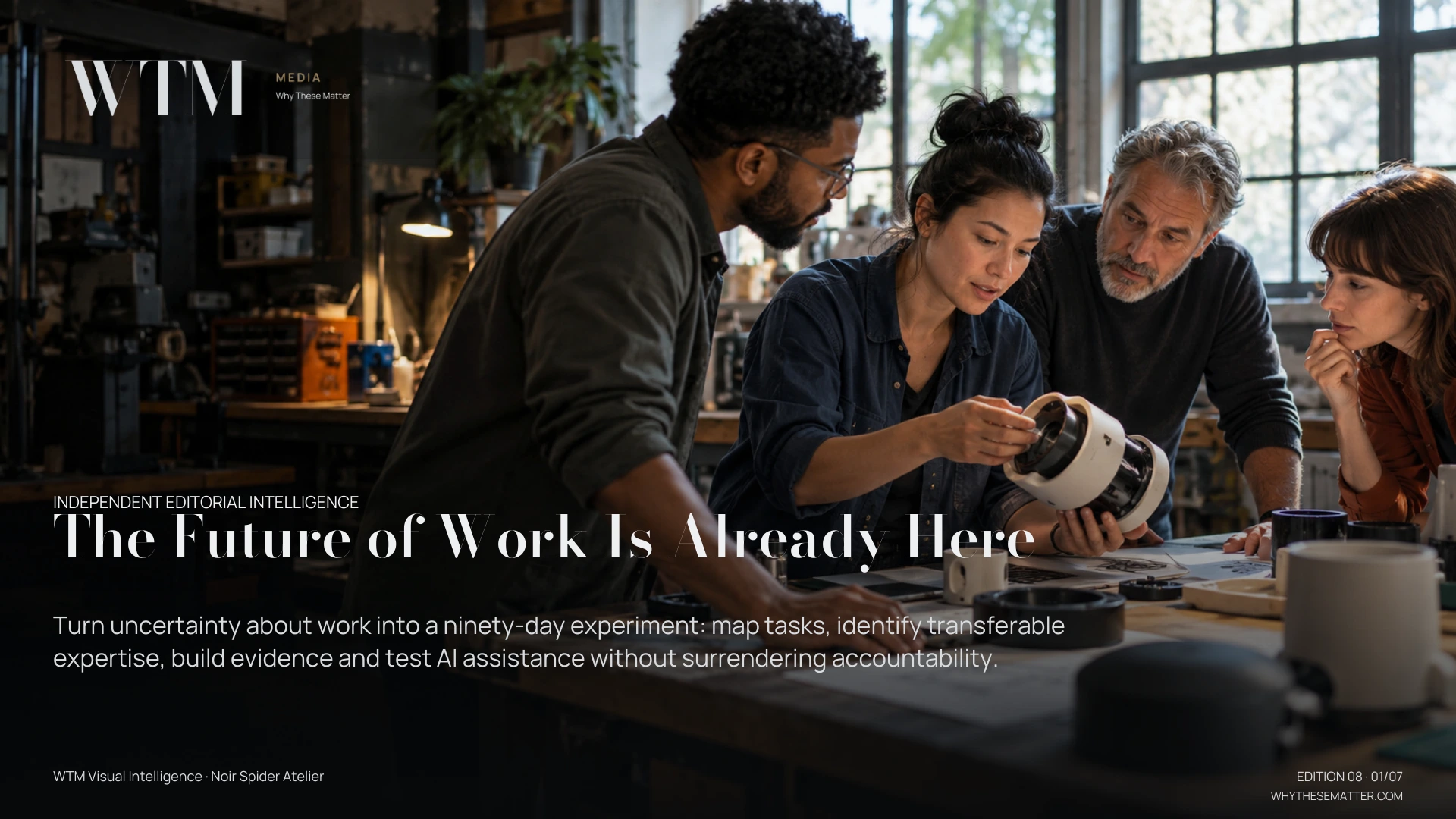

A practical protocol for AI and human judgement: verify fluent answers, retain essential understanding, count hidden workflow costs and assign responsibility for consequential decisions.
Artificial intelligence has made convincing language cheap. That does not make judgement cheap. The important question is not whether machines can produce more text, images or recommendations, but how people and institutions decide what to trust, what to delegate and who bears responsibility when an output is wrong.
Reader value: A practical protocol for AI and human judgement: verify fluent answers, retain essential understanding, count hidden workflow costs and assign responsibility for consequential decisions.

Generative models can produce useful summaries, explanations and ideas, but also plausible falsehoods, fabricated citations or incorrect calculations. Confidence of presentation is not a reliable measure of factual accuracy. A model's ability to imitate reasoning language should not be confused with a settled account of consciousness or human understanding. For consequential claims, open the primary source, confirm its date and reproduce any important calculation. Ask what evidence would disprove the output. Use the system to generate alternatives, not to replace verification.
NIST's Generative AI Profile identifies confabulation among the risks associated with these systems. [1] A plausible citation should therefore be opened and matched to the actual claim. Check the author, date, population and limitation, not merely whether the URL exists. A real source can still be used to support something it never established.
Separate a task asking for possibilities from one asking for an established fact. The first may benefit from variety; the second needs verification. If a system supplies a calculation, reproduce it with an appropriate tool. WTM's proposed rule is simple: fluency can help express a conclusion, but it cannot supply the missing evidence for it.
Check whether the output answers the actual question. A response can contain correct statements while omitting the relevant constraint or comparing the wrong alternatives. Restate the decision in your own words and identify what evidence it requires. Verification is therefore more than finding a working citation; it includes checking the fit between the evidence and the task.
Keep a distinction between the source and the tool's description of it. Open the document, locate the relevant finding and note its limitations. If the interpretation cannot be reproduced, leave the claim unresolved. A polished summary may be useful for navigation, but it should not quietly replace the material needed to assess a consequential conclusion.
Make correction part of the method. Record an important error and check whether it affects later statements built on the same premise. Rewriting the final sentence is insufficient if the underlying calculation or assumption remains wrong. The benefit of assistance is stronger when the user can inspect the route to the answer and recognise where it failed.

Humans have long relied on writing, calculators and search tools to extend memory and capability. AI changes the speed and scope of delegation, but research does not justify claiming that every user experiences identical cognitive harm. Effects depend on the task, learning goals, prior knowledge and habits of use. For skills you need to retain, attempt the task before requesting an answer. Use AI afterwards to test assumptions, expose omissions and explain difficult points. Distinguish efficient delegation from surrendering understanding.
Do not infer permanent cognitive damage from a person's use of a tool or from one experiment in a particular setting. The broader claim would require evidence about population, task, duration and outcome. This editorial does not establish a universal causal effect of AI on intelligence or consciousness.
Choose deliberately which capabilities to practise without assistance. For a skill you are learning, attempt an explanation, solve a small example or recall the main argument before consulting an answer. These are proposed learning habits, not clinical interventions. The useful test is whether you can recognise an error and explain the result afterwards, rather than whether the tool produced a polished page.
Set the learning objective before deciding what to delegate. If the aim is to practise an explanation, receiving a finished answer may bypass the activity you intended to learn. If the aim is to compare already understood alternatives, assistance may serve a different purpose. The same tool use can therefore deserve different safeguards in different tasks.
Test retained understanding with a new example or a question you can explain without reading the generated wording. This is a practical self-check, not a scientific measure of cognitive change. It can expose which parts of an answer were merely familiar and which parts you can actually use, challenge or teach to someone else.
Leave room for deliberate practice alongside convenience. Choose a capability that matters to your work or life and decide how you will continue exercising it. The question is not whether every task must remain unaided. It is whether the pattern of delegation preserves the understanding needed to notice error and remain responsible for the eventual decision.

Automation can save time for one group while shifting verification, moderation, data-labelling, energy or error costs elsewhere. Claims of productivity should be evaluated against total workflow cost and the people affected. The environmental footprint of AI also depends on hardware, electricity, utilisation and system boundaries. When evaluating a deployment, ask who benefits, who loses control, who provides data, how much review is required and whether performance has been measured against a credible baseline. Avoid both technological triumphalism and unsupported catastrophe claims.
Define the boundary of an efficiency claim. Did the reported saving include input preparation, human review, error correction and the people affected downstream? A faster output is not yet a measured improvement in the whole service. NIST's profile also discusses environmental and value-chain risks; it does not provide a universal footprint for every query. [1]
Ask who can decline, correct or contest a system's output. A deployment that reduces work for one team may increase the checking burden for another. These are questions for evaluating a particular workflow, not assertions that every automation causes the same harm. Report measured benefits with their conditions rather than turning a successful pilot into a claim about all uses.
Name whose time is being measured. A saving for the person requesting an output may create additional work for the person who must validate, explain or correct it. Draw the workflow far enough to include that handover. An efficiency claim becomes more informative when it shows both the immediate benefit and the obligations moved elsewhere.
Distinguish a cost that is measured from one that is suspected. Where information about energy, labour or downstream correction is unavailable, state the missing boundary rather than attach an invented number. This allows a useful comparison to proceed without pretending it is a complete account of every consequence.
Ask what evidence would justify expansion after a pilot. A successful test under close supervision may not establish performance at greater scale or under different conditions. Preserve the conditions of the result and identify the next uncertainty. Scaling should follow an assessable improvement in service, rather than the appeal of a demonstration alone.
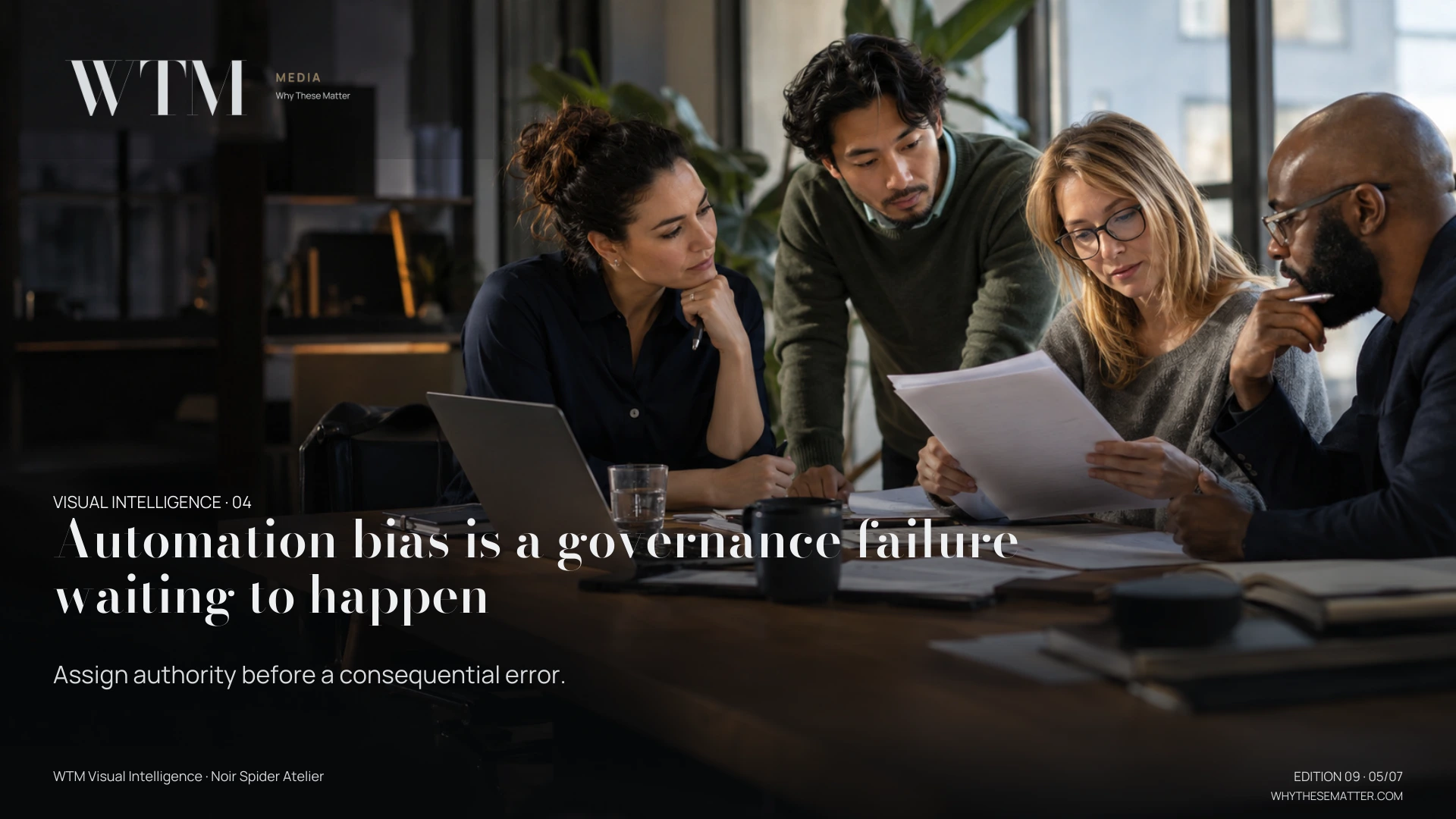
People may defer to systems that appear precise, particularly under time pressure. In hiring, healthcare, finance or public services, errors can have consequences beyond a poor answer. Risk management requires testing, documentation, oversight and meaningful avenues for correction. Specify what decisions the system may support but not make alone. Document failure cases, preserve human review, test for relevant disparities and give affected people a route to challenge outcomes. Responsibility cannot be outsourced to a tool.
NIST's AI Risk Management Framework organises work around governance, mapping, measurement and management of risk. [2] Its voluntary guidance does not certify a product or transfer responsibility from the organisation using it. A human reviewer also needs the time, information and authority to challenge an output; a nominal approval box is not evidence of meaningful oversight.
Before deployment, specify what requires independent review and how an affected person can request correction. Keep records appropriate to the context and protect sensitive information. The relevant safeguards differ between a headline suggestion and a hiring decision. The comparison should make the stakes visible rather than treating all tool use as equally safe or equally dangerous.
Place responsibility at the point where a decision can still change. A reviewer who sees an output only after implementation has a different role from someone authorised to stop it. Specify the timing, information and authority needed for review. The safeguard should fit the actual consequence, rather than exist solely as a reassuring label.
Consider the route available to the affected person. Can they discover that an error occurred, obtain an explanation and reach someone able to correct it? A technically documented system can still be difficult to contest. These questions connect organisational oversight to the experience of the person who lives with the decision.
Review the safeguard when the workflow changes. A new use, different population or altered consequence can make an earlier test incomplete. Record the assumption that supported the original approval and ask whether it still holds. Governance becomes a continuing responsibility when the organisation is willing to revisit permission, narrow use or stop deployment.

Different uses require different safeguards. Brainstorming a headline is not the same as interpreting a medical result or assessing an applicant. A practical protocol classifies tasks by stakes, sensitivity and need for independent evidence. Before use, define the question and permissible data. During use, request uncertainty and alternatives. Afterwards, verify consequential facts, record corrections and decide what remains your responsibility. The goal is not less technology, but more deliberate human authority.
Start with the question and permitted information. During use, ask for competing interpretations and identify what would change the recommendation. After use, return to the primary evidence and document any material correction. This sequence is WTM's proposed personal protocol, not a substitute for professional duties or an externally certified standard.
Choose a stopping rule: if the source cannot be verified, if sensitive data would be exposed or if a consequential error cannot be adequately reviewed, change the method. A tool should make the decision process more inspectable. Keeping responsibility visible is a practical expression of human authority, not a claim that unaided humans are free from bias or error.
Write a short record of the decision after using assistance. State what was accepted, which source supported it and what remained uncertain. This need not become bureaucracy for a trivial task. For a consequential choice, the record can preserve the distinction between a generated suggestion and the judgement the person or institution actually made.
Choose an alternative method when verification is unavailable. That may mean consulting an appropriate professional, returning to a primary document or postponing a decision whose evidence is insufficient. Continuing to ask for a more confident answer cannot supply missing facts. A useful protocol includes permission to stop as well as a sequence for proceeding.
Review the pattern of use rather than only an individual answer. Notice where assistance consistently helps, where correction consumes the saving and where important understanding is becoming difficult to explain. Adjust the boundary accordingly. The purpose is a dependable relationship between convenience and responsibility, with each tool serving a task that remains intelligible to its user.
AI becomes useful within a decision process whose purpose remains clear. A person should know what question is being answered, what evidence is required and which responsibility cannot be delegated. Producing a fluent page is a stage in that process, not sufficient proof that the underlying judgement has been made.
Preserving human authority does not mean pretending that people are free of bias or error. It means retaining the ability and obligation to inspect a claim, challenge a method and change course. Assistance is more valuable when it makes those activities easier rather than concealing them behind an attractive answer.
Return on Investment asks whether the whole workflow improves after preparation, review and correction are counted. Return on Integrity asks whether claims, permissions and consequences are honestly described. These questions can support useful deployment while also revealing where a narrower use or a different method is the stronger choice.
A personal protocol should fit the stakes. An exploratory idea may need little documentation; a consequential recommendation needs a clearer evidence trail and appropriate expertise. The boundary should be explicit enough that convenience does not silently convert a suggestion into an authorised decision affecting someone else's opportunities or wellbeing.
Keep a stopping rule that can be used in practice. An unverifiable source, unresolved permission or inadequately reviewable consequence may justify changing the method. Asking for a more confident answer cannot repair those conditions. The ability to stop is part of responsible tool use, rather than evidence of hostility to technological progress.
The point of human judgement is not to win a contest with a machine. It is to decide what matters, what evidence is sufficient and who is answerable for a consequence. Use tools where they help, preserve understanding where it is needed and make uncertainty visible before an attractive answer becomes a decision.
Evidence reviewed 18 October 2026. This is public-source educational editorial analysis. Numerical scenarios and WTM exercises are illustrations, not measured outcomes or personalised professional advice. Recheck changing guidance before release.
Visual provenance: AI-generated illustrative scenes of fictional adults. These visuals support the analysis; they do not document reported events, identify actual research participants or imply endorsement. WTM Visual Intelligence · Noir Spider Atelier.
Download the WTM Visual Intelligence PDF · Support independent WTM journalism
Why These Matter - WTM MEDIA is an independent editorial platform exploring the forces shaping our world—through people, culture, commerce, design, systems, and governance. Connecting the dots between today’s headlines and tomorrow’s realities.

article-support-3
Noir Spider Atelier

article-support-2
Noir Spider Atelier

article-support-1
Noir Spider Atelier

press-partnership
Noir Spider Atelier
press-reader-desk
Noir Spider Atelier

resource-access
Noir Spider Atelier
membership-example
Noir Spider Atelier

membership-tools
Noir Spider Atelier

membership-reader
Noir Spider Atelier
membership-public
Noir Spider Atelier
pathway-design
Noir Spider Atelier
pathway-institutions
Noir Spider Atelier
pathway-technology
Noir Spider Atelier