
Turn uncertainty about work into a ninety-day experiment: map tasks, identify transferable expertise, build evidence and test AI assistance without surrendering accountability.
The future of work is not a single forecast in which machines take every job or technology creates endless opportunity. Tasks, industries and regions change at different rates. Workers need a practical system for identifying where they create value, learning adjacent capabilities and demonstrating results without mistaking tool familiarity for professional competence.
Reader value: Turn uncertainty about work into a ninety-day experiment: map tasks, identify transferable expertise, build evidence and test AI assistance without surrendering accountability.
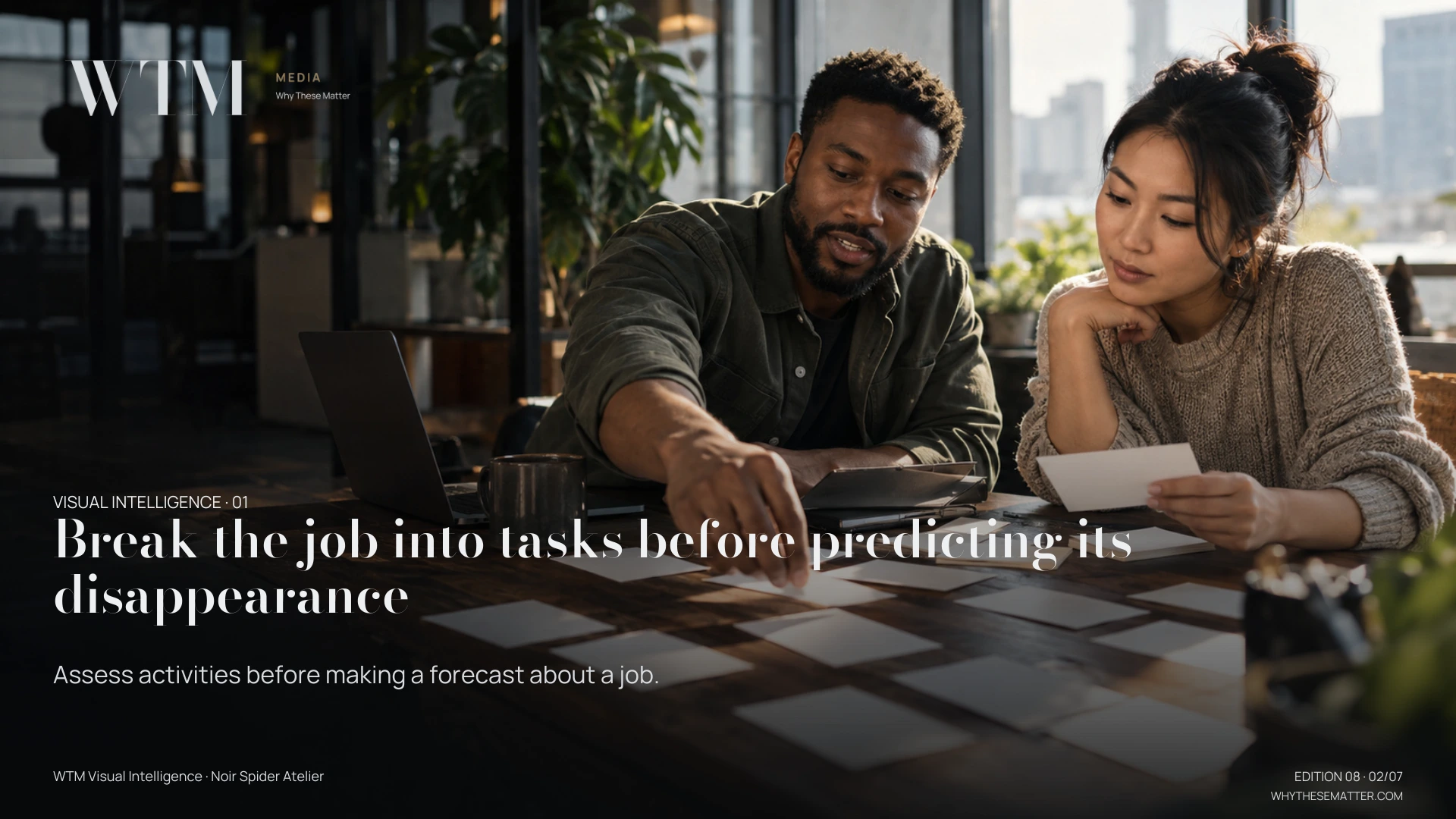
A job title combines repeatable processes, relationships, domain knowledge, accountability and judgement. Some activities can be automated while others are reorganised or expanded. A forecast about exposure to AI is not the same as evidence that a particular role will disappear. Create a task inventory showing frequency, consequence of error, information sensitivity and need for human interaction. Identify which tasks can be assisted, which need specialist review and which remain your strongest contribution.
The ILO's 2025 occupational-exposure study assesses potential exposure to generative AI; it does not count that exposure as a forecast of equivalent job losses. Its conclusions emphasise transformation as well as limits to automation. [1] Keep a research estimate separate from an employer's actual hiring or restructuring decision.
Map a normal week into activities: preparation, execution, verification, communication and accountability. Ask which could be assisted and what new checking work that would create. A task can become faster while the role remains necessary. Conversely, retaining a job title does not mean its conditions or responsibilities stay the same. Both possibilities deserve investigation rather than a slogan.
A task inventory should describe the work closely enough to examine its risks. Preparing a first draft, checking evidence and authorising a result are different activities even when they share a job title. Keep the connections visible. A tool that changes one stage does not by itself establish that the entire role has become unnecessary.
Identify where the organisation's context matters. A routine-looking answer may depend on a client's history, a regulatory condition or knowledge held by colleagues. Ask how that context is obtained and checked. This helps distinguish a plausible demonstration from a workflow that can meet the standard expected in actual service.
Include the person affected by the output in the assessment. A faster internal process can still create confusion, rework or a harder route to correction for someone outside the team. The useful question concerns the completed service. That boundary gives a more demanding test of improvement than the speed of producing an intermediate document.

Transferable value can include framing ambiguous problems, explaining complex ideas, validating evidence, building trust and understanding regulation or operations. Generic claims about creativity or leadership are weak unless supported by work. Local labour markets and credential requirements still matter. Compare ten credible role descriptions with your task inventory. Mark recurring requirements and identify one adjacent skill that strengthens existing expertise. Avoid expensive training decisions based solely on promotional claims.
Choose an adjacent capability that helps solve a problem you already understand. A technician might improve documentation; an analyst might strengthen source verification; a manager might learn to evaluate workflow risk. These are illustrative pathways, not predictions of demand. Compare them with current requirements in the market where you intend to work.
Use the BLS Occupational Outlook Handbook to understand occupation-specific entry routes and projections, then check actual opportunities and local conditions. [2] A national projection cannot promise a particular applicant a role. Before paying for a course, ask what practical output, recognised requirement or demonstrable capability it will add to existing experience.
Choose a learning goal with an observable application. 'Become more strategic' is difficult to assess; explaining the assumptions behind a recommendation or documenting a recurring process is more specific. Identify who could use the result. This connects development to a real need without pretending that one skill guarantees employment or a particular income.
Compare a course with alternatives before committing money and time. A small authorised project, feedback from an experienced colleague or a relevant public resource may answer a narrower learning need. A formal credential may be important in another context. The decision should concern the requirement being met, rather than the promotional prestige of training itself.
Keep existing strengths in view. Adaptation does not require starting again every time a tool changes. Ask which knowledge, relationships or operational understanding remain useful and which gap limits their application. A focused addition can create a clearer proposition than a long collection of unrelated courses that is difficult to connect to demonstrable work.

Recruiters and clients need evidence of judgement and delivery. A case study can explain the original problem, constraints, method, trade-offs and measurable result. Where work is confidential, abstract the process rather than exposing protected information. Create two short case studies using a baseline, your intervention and the outcome. Explain what did not work and what you changed. Evidence of responsible correction can be more credible than exaggerated success stories.
A useful case study separates team results from your own contribution. State the starting condition, what you did and what changed; identify whether the measurement is complete or preliminary. If a result cannot be quantified honestly, describe the decision or deliverable rather than attaching a fabricated percentage.
Respect confidentiality and ownership. Use an authorised public example or a clearly labelled demonstration where client work cannot be shown. Explain a correction or an unsuccessful approach when it reveals judgement. A portfolio is more credible when it makes its boundaries visible than when every project appears flawless and every outcome is credited to one person.
Explain the measurement behind a result. What was counted, over which period, and what else changed? A percentage without a baseline can look impressive while concealing a small or uncertain improvement. Where causal attribution is not justified, describe the contribution and its limits instead of claiming that one intervention produced the entire outcome.
Make the case understandable to a reader outside the original project. Define the problem, the constraints and the choice that required judgement. Avoid exposing confidential detail merely to make the story feel concrete. An authorised demonstration can show a method clearly when it is labelled as such, without borrowing credibility from protected client information.
Ask for feedback on the evidence, not only the design of the portfolio. Can another person identify what you contributed and why it mattered? A polished page may still leave those questions unanswered. Revise around the decision and the outcome so that the presentation supports an assessable claim rather than substituting for one.

AI tools can accelerate drafting, coding, analysis and research, but may generate errors or expose sensitive information. Their usefulness depends on verification, context, permissions and integration with actual workflows. Tool use is not equivalent to independent expertise. Choose one low-risk workflow and compare speed, quality and error correction against your existing method. Check source material, protect confidential data and define when a qualified human must review the result.
Choose a low-risk comparison with a clear definition of acceptable output. Record time spent preparing inputs, checking facts and correcting errors as well as time spent generating a draft. NIST's framework treats risk management as an ongoing organisational activity, not a badge automatically conferred by using a tool. [3]
Agree what information may enter the system and who can authorise consequential decisions. An impressive demonstration on a public example does not establish safe performance on confidential or high-stakes work. If a tool saves drafting time but creates unmanageable verification work, the pilot has produced a useful negative result. Stopping or narrowing the experiment can be responsible progress.
A comparison needs an agreed standard before the trial begins. Specify what a usable result must contain and which errors make it unacceptable. Otherwise a fast but incomplete output may be compared with a thoroughly checked one. Include the preparation and review stages so that the experiment answers a question about the whole method.
Record which material may enter the tool. Public examples, internal work and sensitive client information have different permission requirements. Where policy or ownership is unclear, obtain authorisation before use. A useful pilot should reveal the safeguards needed for the workflow rather than rely on discretion that nobody has explicitly agreed.
Keep a correction log during the trial. Distinguish an isolated mistake from a recurring failure that requires a different method or tighter scope. A negative result can justify stopping a deployment while preserving what was learned. Responsible adaptation includes the ability to explain why a promising demonstration did not meet the needs of the actual work.

A sustainable career strategy combines deliberate learning with relationships and financial resilience. Constantly chasing every new tool can become another form of distraction. A time-limited project makes progress observable. Days 1–30: identify a problem and capability gap. Days 31–60: build a small applied project. Days 61–90: obtain feedback and document results. Decide whether to deepen the skill, redirect effort or stop. Revisit the experiment as the market changes.
Define a modest outcome at the start: produce a usable prototype, improve an authorised process or complete a case study that another person can assess. Allocate a realistic amount of time and identify the feedback source. The proposed thirty-day stages are a planning device, not a scientifically validated retraining schedule.
At the review, decide whether to continue, change direction or stop. Look for evidence of useful capability, not only hours logged or certificates collected. Preserve relationships and financial room to choose as far as circumstances allow. Adaptation is stronger when learning connects to an actual need and the person can explain both the result and its limitations.
Define the person who will assess the applied project and what they will review. Feedback is more useful when it concerns a clear deliverable than a general impression of effort. Agree the scope at the beginning where possible. This prevents the final review from depending entirely on a standard that was never made explicit.
Keep the experiment small enough to complete alongside existing responsibilities. A missed week should lead to a revised plan, not a claim that adaptation has failed. Record the actual time available and remove work that does not contribute to the chosen outcome. A constrained project can still produce credible evidence of a useful capability.
At the end, document the next decision rather than simply celebrating completion. Continue if the work meets a real need, change the scope if feedback exposes a better question, or stop if the value is insufficient. That choice turns a learning exercise into a record of judgement, with a result that can inform future work.
The value of career intelligence lies in a more specific next move. A worker should be able to identify the task changing, the capability worth developing and the evidence that would demonstrate useful work. Broad predictions about the future are less helpful when they leave those practical questions unanswered.
Exposure to a technology is not an individual employment verdict. A role sits within institutions, demand, permissions and local conditions. Keeping those distinctions visible makes room for an applied response without pretending that every person can overcome structural change simply by purchasing another course or mastering a fashionable tool.
Return on Investment concerns the resources committed to learning and the usefulness of the result. Return on Integrity concerns honest attribution, protected information and an accurate account of performance. A portfolio or pilot should make both assessable rather than turn polished presentation into a substitute for evidence.
Give adaptation a boundary. Choose a deliverable that can be completed, obtain feedback and decide what follows. The proposed ninety-day sequence is an organising device, not a promise about how quickly a person can retrain. Its value comes from a completed enquiry with a real decision at the end.
Institutions carry responsibility alongside individuals. Workers need clear expectations, appropriate permissions, useful training and routes to question changes affecting their work. A technically possible automation is not yet a well-designed service. Examine the handovers and people affected before describing a faster output as a complete improvement.
A career cannot be secured by a fashionable tool list. It can be strengthened by understanding a real problem, demonstrating responsible work and learning from evidence. Choose one useful experiment rather than promising a total reinvention. Your value is not reducible to how quickly a machine can produce an answer.
Evidence reviewed 18 October 2026. This is public-source educational editorial analysis. Numerical scenarios and WTM exercises are illustrations, not measured outcomes or personalised professional advice. Recheck changing guidance before release.
Visual provenance: AI-generated illustrative scenes of fictional adults. These visuals support the analysis; they do not document reported events, identify actual research participants or imply endorsement. WTM Visual Intelligence · Noir Spider Atelier.
Download the WTM Visual Intelligence PDF · Support independent WTM journalism
Why These Matter - WTM MEDIA is an independent editorial platform exploring the forces shaping our world—through people, culture, commerce, design, systems, and governance. Connecting the dots between today’s headlines and tomorrow’s realities.

article-support-3
Noir Spider Atelier

article-support-2
Noir Spider Atelier

article-support-1
Noir Spider Atelier

press-partnership
Noir Spider Atelier
press-reader-desk
Noir Spider Atelier

resource-access
Noir Spider Atelier
membership-example
Noir Spider Atelier

membership-tools
Noir Spider Atelier

membership-reader
Noir Spider Atelier
membership-public
Noir Spider Atelier
pathway-design
Noir Spider Atelier
pathway-institutions
Noir Spider Atelier
pathway-technology
Noir Spider Atelier