
The contemporary living room is no longer a neutral domestic space; it is a behavioural system engineered to capture attention, suppress movement, and normalise passive consumption. What appears as elegant interior design is, in practice, a convergence of architecture, media infrastructure, and psychological conditioning. The consequence is not merely aesthetic—it is civilisational. We have not just redesigned rooms; we have redesigned how humans inhabit time, attention, and one another.
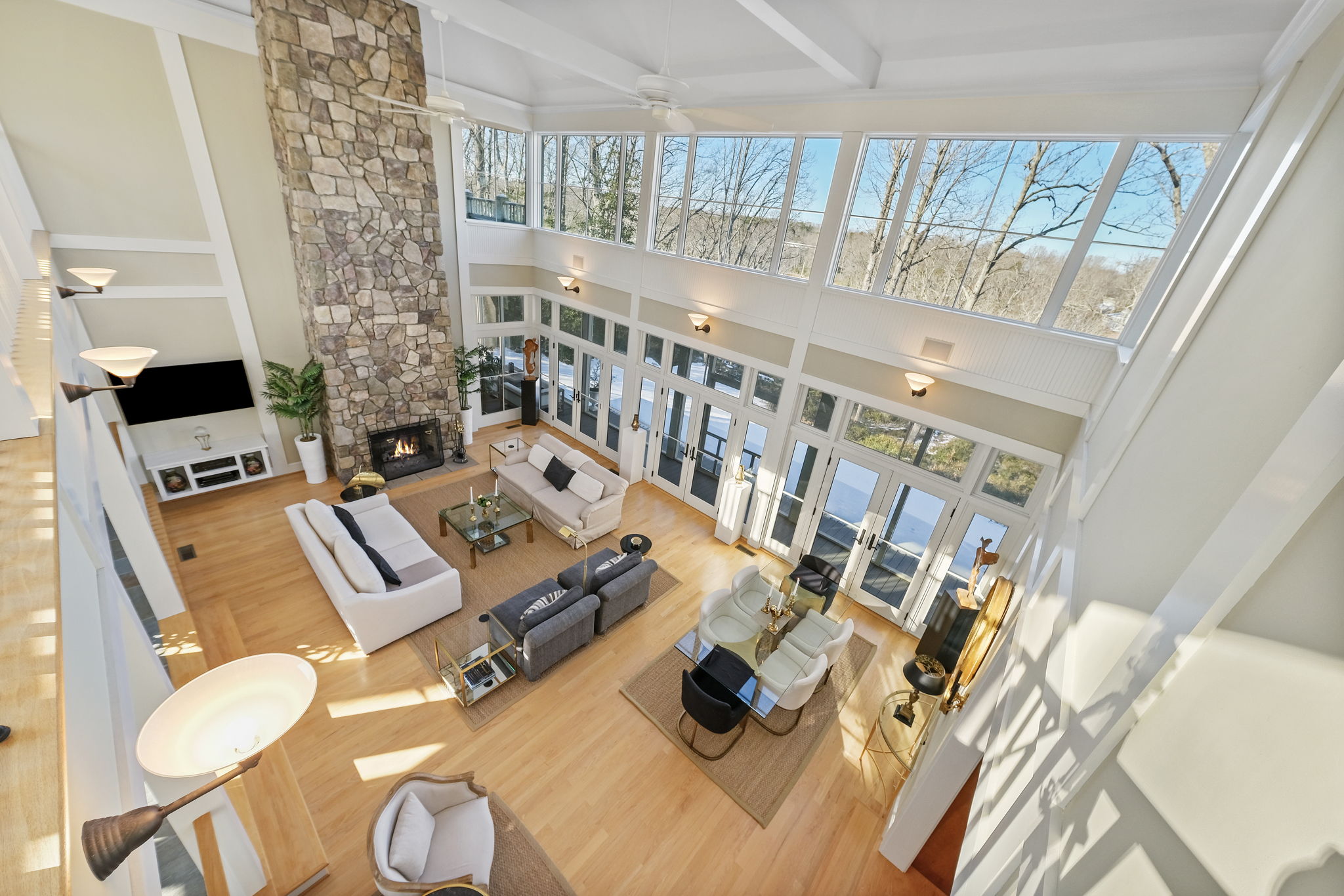

The Screen Became the Centre — Then the System. For most of human history, the centre of a room was a social technology. The hearth, the table, the courtyard—each organised bodies into reciprocal presence. Orientation was circular. Authority was distributed. Conversation was the medium.
The modern living room has inverted that geometry. A single luminous plane now commands the axis of the room. Seating aligns forward. Sightlines converge. Acoustic design favours projection from one source rather than exchange between many. Even lighting schemes—backlit walls, dimmed perimeters—amplify the dominance of the screen. This is not an incidental shift in taste. It is a reconfiguration of power within space.
When orientation becomes linear rather than relational, behaviour follows. Interaction collapses into observation. Dialogue yields to broadcast. The room ceases to be a field of participation and becomes a corridor of attention. The screen is not furniture. It is governance.
Comfort Is Not Neutral — It Is Instruction. The contemporary interior prides itself on seamlessness: smooth materials, calibrated lighting, minimal visual noise, optimised acoustics. Everything is designed to reduce cognitive and physical friction. This is often described as “good design.” It is, more precisely, effective design—effective at producing a specific behavioural outcome.
Friction, in human systems, performs a critical function. It interrupts automaticity. It creates moments of choice. It demands adjustment—physical, cognitive, emotional. Remove friction entirely and you do not produce ease; you produce inertia.
Inertia is not rest. It is the absence of activation. The modern living room removes micro-frictions that once triggered interaction: the need to rearrange chairs, adjust light, engage objects, shift posture. In their place, it offers a continuous, low-effort state of consumption. The result is a behavioural loop: sit, watch, remain. Comfort becomes a silent instruction set. It does not command; it nudges. It does not restrict; it narrows the range of alternatives until passivity feels like preference.

Minimalism is often framed as a moral or aesthetic refinement—less clutter, more clarity. In practice, it performs another function: it reduces competing stimuli, allowing a single focal system to dominate attention more efficiently. A sparse room is not empty. It is prioritised.
Objects that do not serve the primary behavioural pathway—conversation pieces, tactile artefacts, instruments of activity—are removed. What remains is a clean visual hierarchy that directs attention with precision. This is behavioural maximalism disguised as aesthetic restraint.
The fewer the elements, the stronger the signal. The stronger the signal, the more predictable the behaviour. The room becomes legible to the body in seconds: where to sit, where to look, what to do. And increasingly, what to do is nothing.
Time Is Being Redesigned at Home. The most significant transformation is not spatial—it is temporal. Traditional domestic environments segmented time. There were rhythms: gathering, eating, working, resting. Each activity was spatially anchored, creating natural transitions that structured the day.
The contemporary living room collapses these distinctions. Work screens become entertainment screens. Communication platforms merge with media platforms. Day bleeds into evening without clear thresholds. The body remains in the same posture while the content shifts endlessly.
Time loses texture. This is not a trivial consequence. Human cognition depends on temporal differentiation to process experience, form memory, and regulate energy. When time becomes continuous and undifferentiated, attention fragments and fatigue accumulates. The room is not just holding the body in place; it is flattening the experience of time itself.
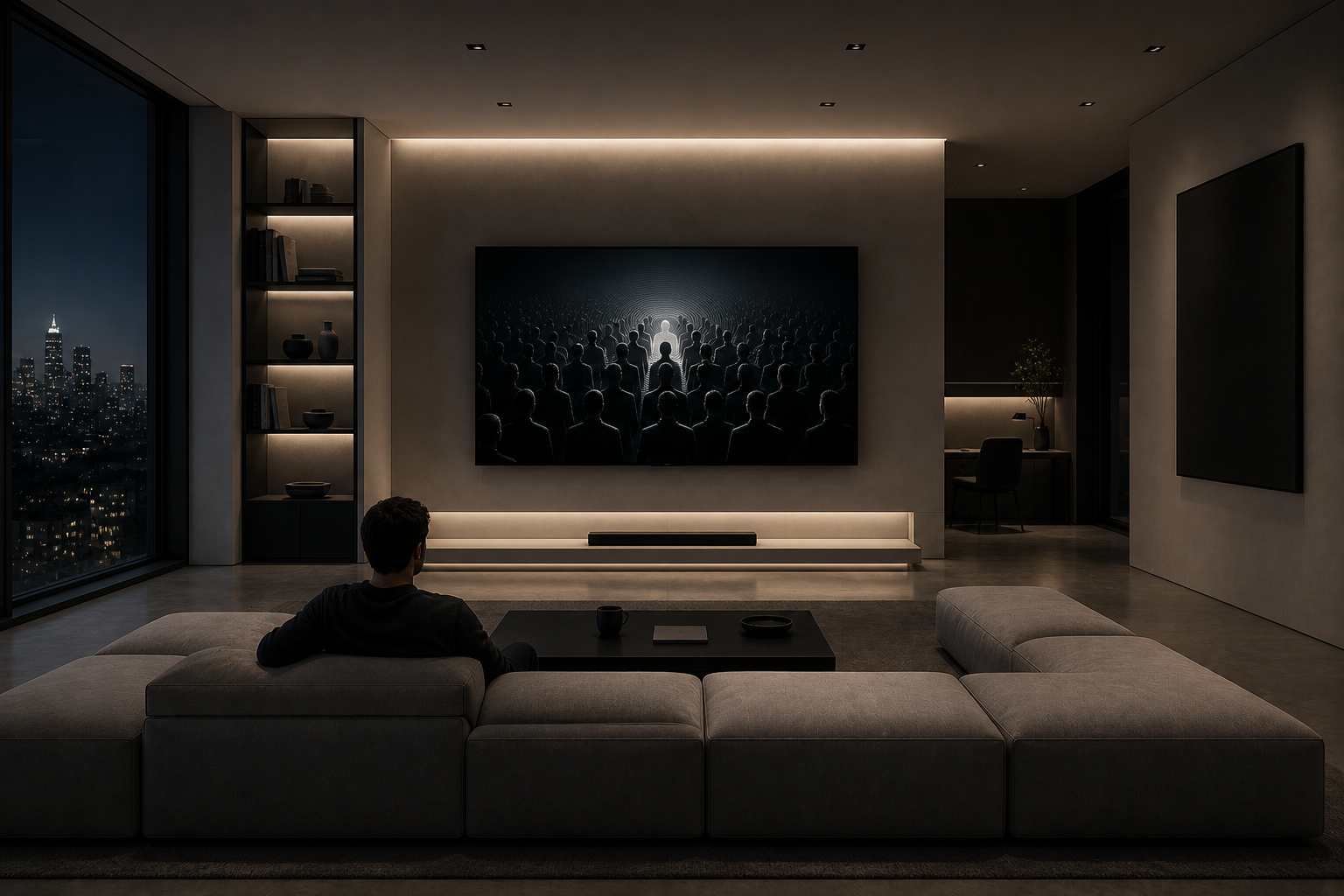
The most profound shift is existential. To inhabit a room once implied a degree of authorship—you could shape the environment, initiate interaction, create outcomes. The room was responsive.
In the current configuration, the primary mode is reception. Content arrives. Narratives unfold. Decisions are made elsewhere and delivered through the screen. The individual’s role is to interpret, react, and continue consuming. Agency narrows.
This is not a moral critique of individuals; it is a structural observation. Systems that centralise production and distribute consumption inevitably produce spectators. The living room has become the domestic interface of that system. It trains the body to remain, the eyes to follow, and the mind to accept externally generated sequences as the primary form of engagement.
The Invisible Architecture of Control. What makes this system durable is its invisibility. There are no explicit constraints. No prohibitions. No visible mechanisms of control. The environment feels open, calm, and self-directed.
Yet behaviour within it is highly patterned. This is the distinction between overt control and architectural control. Overt control restricts options. Architectural control arranges them.
By designing a space in which one pathway is vastly more convenient, comfortable, and immediately rewarding than others, the system does not need to enforce behaviour. It simply makes alternatives improbable. The occupant experiences freedom. The system experiences compliance.

The response is not regression. Technology is not the problem; unbalanced integration is. A human-centred living room would reintroduce multiplicity—of orientation, of activity, of engagement. It would distribute focal points rather than consolidate them. It would design for transitions rather than continuity. This is not a stylistic adjustment. It is a systems recalibration.
The goal is not to eliminate the screen, but to dethrone it. A room should not prescribe a singular behaviour. It should expand the range of possible ones. Domestic space is not isolated from broader systems; it is where they are internalised.
When the primary environment of rest and reflection is structured around passive consumption, the implications extend outward. Attention becomes easier to capture, narratives easier to steer, and collective behaviour more predictable. The living room becomes a micro-infrastructure of a larger attention economy. This is how systems scale—not by force, but by design replication at the level of everyday life.
We Designed This — We Can Redesign It. The current living room did not emerge by accident. It is the result of aligned incentives across industries: media, technology, furniture, architecture, and real estate. Each optimised for efficiency, desirability, and scalability.
The outcome is a space that works exceptionally well—for the system. The question now is whether it works for the human.
Design is not neutral. It encodes values, priorities, and assumptions about how life should be lived. If those assumptions produce passivity, fragmentation, and diminished agency, then the design—however beautiful—requires interrogation. The living room is not failing. It is succeeding at the wrong objective.

Why These Matter - WTM MEDIA is an independent editorial platform exploring the forces shaping our world—through people, culture, commerce, design, systems, and governance. Connecting the dots between today’s headlines and tomorrow’s realities.