
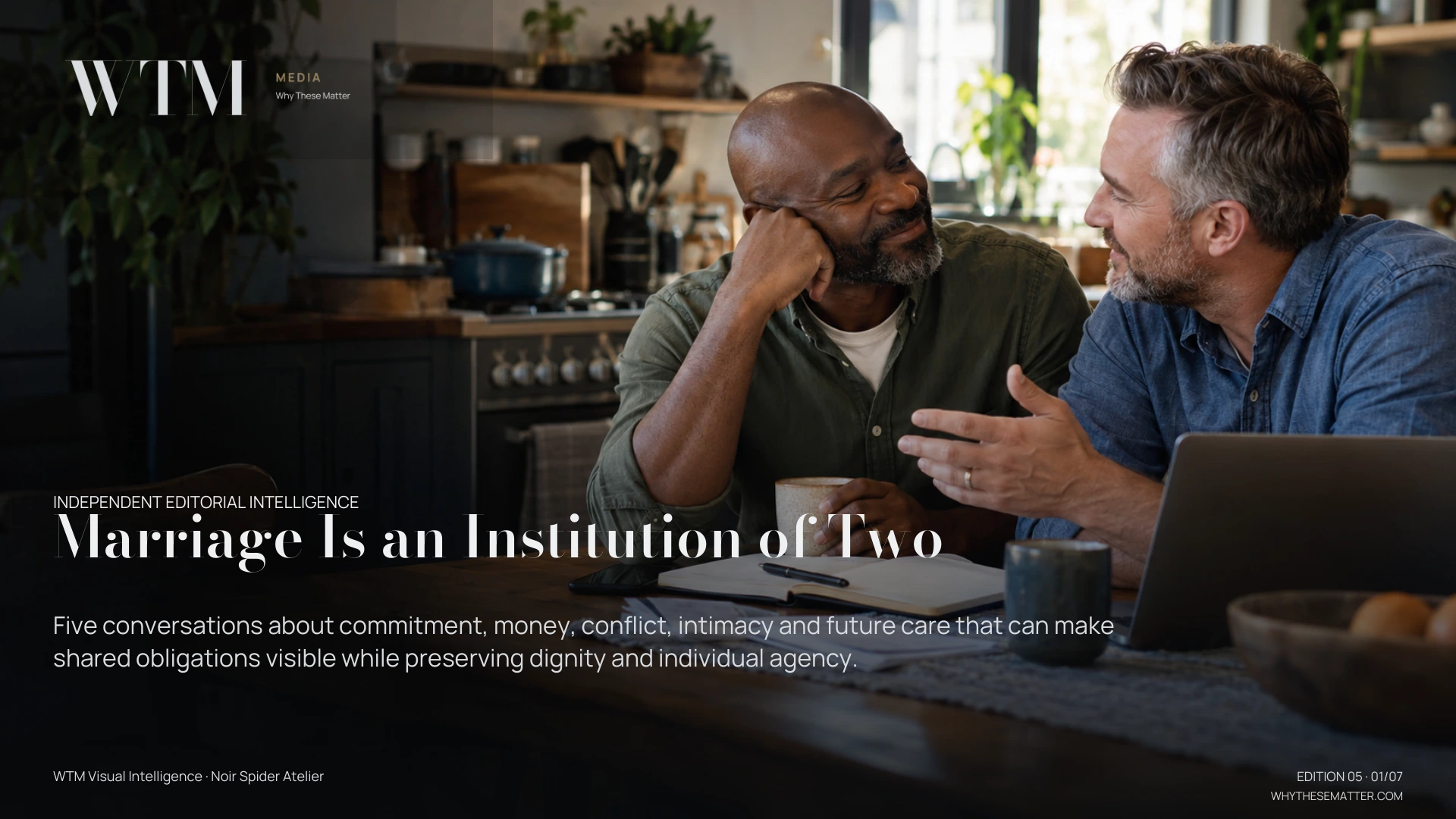
Five conversations about commitment, money, conflict, intimacy and future care that can make shared obligations visible while preserving dignity and individual agency.
Marriage can be a profound personal commitment, but love alone does not automatically resolve competing expectations about money, time, care or identity. A durable partnership requires conversations that preserve dignity and make practical obligations visible. There is no single correct division of roles.
Reader value: Five conversations about commitment, money, conflict, intimacy and future care that can make shared obligations visible while preserving dignity and individual agency.

Partners can agree that they are committed while disagreeing about privacy, fidelity, family involvement, personal independence or domestic responsibilities. Assumptions are especially vulnerable during relocation, career changes and illness. The point is not to negotiate every emotion but to clarify consequential expectations. Individually answer five questions: What does loyalty mean? Which decisions are shared? What requires privacy? What support feels meaningful? Which boundaries are essential? Compare responses without assuming disagreement is disloyalty.
Begin with one recent situation rather than a theory of the ideal partner. What happened, what did each person expect and what would a fairer arrangement look like next time? Two reasonable answers may differ. The purpose of the conversation is to make the difference visible before it hardens into an accusation.
These are WTM discussion prompts, not validated measures of relationship quality. Partners of any gender or cultural background may decide differently about household roles, family involvement or privacy. Ask whether both can disagree without punishment. An agreement matters only if each person can participate freely and revisit it when circumstances change.
Expectations often become visible through small recurring decisions. Who is consulted before an invitation, how much notice is welcome and which family requests can be declined? Discuss one example in enough detail to understand both perspectives. A principle such as loyalty becomes more useful when each person can recognise what it asks in ordinary life.
An agreement should leave room for a person to change their mind. A role accepted during one stage of work or care may become burdensome later. Name how the arrangement can be revisited and what information each partner needs. Revisiting an expectation can be an act of responsibility rather than evidence that the original commitment was insincere.
Do not measure fairness only by identical contributions. Partners may bring different time, money, capacity or responsibilities. Ask whether the arrangement is understood, freely accepted and open to challenge. These questions make room for a variety of partnerships without presenting one division of domestic life as a universal model of love.

Differences in income, assets or financial experience can create asymmetries. Discuss household costs, debts, saving priorities, large purchases, retirement and what happens if one partner stops earning. Transparency should coexist with appropriate personal autonomy and safety. Schedule a monthly money meeting. Review shared commitments, upcoming expenses and decisions requiring agreement. For complex property ownership, inheritance or cross-border issues, seek qualified legal and tax advice rather than relying on informal assurances.
Separate three questions: who contributes money, who contributes unpaid work and who has authority over decisions. They need not follow the same pattern. A practical agenda might cover bills, debt, discretionary spending and the economic effect of caregiving. Discuss access to information without demanding surveillance or surrender of all personal resources.
Financial control can form part of abuse; the National Domestic Violence Hotline describes abuse in terms of power and control, including financial behaviour. [1] A proposed money meeting is appropriate only where participation is safe and voluntary. It is not a remedy for coercion. Complex ownership and inheritance arrangements deserve advice suited to the jurisdiction and the couple's circumstances.
Money conversations benefit from a shared account of the next decision. A major purchase, a change in work or an unexpected expense is more concrete than a general argument about spending. Set out the available information and what remains unknown. Avoid turning income into a proxy for whose preferences automatically deserve greater weight.
Discuss the position of the person providing unpaid care. What happens to their access to money, rest, longer-term plans and ability to make independent choices? The answers will depend on the partnership and relevant rules. The point is to make that contribution visible before a temporary arrangement becomes an assumed economic hierarchy.
Keep financial planning separate from coercive monitoring. Sharing agreed information can support a joint commitment; demanding control of every transaction or resource can mean something different. Where there is fear, seek confidential specialist guidance rather than using a joint budgeting exercise. A fair process requires the ability to participate without intimidation or punishment.

Conflict is not proof of incompatibility, but repeated contempt, intimidation or coercion requires attention. In ordinary disagreements, describing a specific behaviour and its effect is more useful than attacking character. A pause can help when both partners are becoming overwhelmed. Agree on a non-punitive way to pause and resume difficult conversations. Ask what each person understood and identify one repair action. Where violence, coercion or fear is present, prioritise safety and specialist support rather than joint conflict exercises.
For ordinary disagreement, make a pause concrete: what is being paused, when will the conversation resume, and what question will be addressed? This is a suggested communication practice, not a claim that a technique reliably prevents separation. Listening does not require accepting an unfair demand or abandoning a boundary.
Distinguish a disagreement between people who can speak freely from a pattern of intimidation or coercion. The Hotline does not recommend couples counselling in abusive relationships because the conditions differ from ordinary relationship conflict. [2] Where someone is afraid of consequences for speaking, prioritise confidential specialist support and safety rather than a joint exercise.
Focus a repair conversation on something that can change. Describing the specific action and its effect gives the other person a clearer issue to answer than a claim about their entire character. It also allows disagreement about what happened. The purpose is mutual understanding and a workable next step, not a technique for extracting an admission.
A pause is useful only if it does not become a way to avoid the subject indefinitely. Where it is safe, agree when and how to return to the conversation. A person may need time, a different setting or outside help. The arrangement should protect participation rather than give either partner unilateral authority over which concerns can be discussed.
Notice whether a promised repair becomes an observable change. An apology can matter, but recurring conduct also deserves attention. Neither partner has to erase their experience to preserve a story of harmony. If attempts to speak bring fear or threats, the appropriate question changes from communication technique to safety and confidential specialist support.

A partnership can include affection, sexuality, friendship, solitude, cultural identity and personal development. Consent remains essential. Changes in health, age, work or caregiving may alter how partners connect, without making either person less worthy of respect. Set aside unhurried time for each other and ask what forms of care feel welcome. Keep room for individual friendships and interests. Do not turn intimacy or affection into a scorecard.
Discuss connection without treating either partner as responsible for meeting every need. Time with friends, solitary interests and cultural or community life may be valuable alongside shared time. Agree what is welcome rather than assuming that the same gesture means the same thing to both people.
Consent is ongoing and specific; affection, financial support or marriage is not an entitlement to another person's body. If health or stress changes what feels possible, discuss what forms of closeness are welcome now. These reflections are not a clinical treatment programme. Persistent distress or health concerns may call for an appropriately qualified professional whom the person can consult freely.
Make invitations specific enough to answer freely. A request for a walk, conversation or quiet time together gives more room for a genuine response than an accusation that someone never cares. A refusal can lead to a different proposal without becoming a punishment. This is a way of discussing connection, not a claim about a treatment outcome.
Respect the difference between closeness and complete access. A committed relationship can include personal interests, private reflection and friendships outside the partnership. Agree boundaries rather than assume that independence is evidence of distance. The useful question is whether both people retain dignity and a voice while building a life they value together.
Changes in desire or capacity should not become an assessment of someone's worth. Discuss what feels welcome now and what support might help, without promising that a particular routine will restore an earlier stage of the relationship. If professional advice is sought, it should support the person's freely chosen goals rather than enforce another person's entitlement.

Partners age, careers evolve and family responsibilities change. Discussions about medical decisions, caregiving, housing, retirement and end-of-life wishes protect future agency. Legal documents may be important, but they cannot replace ongoing communication. Review major plans annually and after significant changes. Identify who should be consulted, what formal documents may be needed and which choices remain individual. The purpose is to make uncertainty more manageable, not eliminate it.
Use a practical future-care conversation: who should be contacted, which preferences matter and which decisions require formal documentation? A shared expectation is not necessarily legally enforceable. Ask an appropriate professional about local requirements rather than assuming that marriage automatically resolves every medical, property or inheritance issue.
Plan also for the labour of care: time, income, rest and outside support. Revisit an arrangement after illness, relocation or a change in work. The goal is not a contract for every future emotion. It is a record of what matters now and an agreed willingness to return to it, with each person's autonomy intact.
Consider a realistic care scenario before it becomes urgent. If one person could not manage a familiar task, who would help and what would they need to know? A conversation can reveal missing contacts, assumptions about availability or a need for formal advice. It should not assume that a partner or relative can provide unlimited care.
Keep wishes understandable to the people who may need to act on them. A clear record, a known location and appropriate professional documentation can serve different functions. Review what should be shared and with whom. Privacy remains relevant even when planning for assistance; preparation does not require handing every personal decision to another person now.
Revisit plans as the household changes. A new job, illness, relocation or changed family relationship may make an earlier arrangement impractical. Ask what is still wanted, what is no longer possible and what outside support is needed. The commitment lies in returning to the conversation with respect, rather than preserving a document that no longer represents either person's life.
A partnership is an institution because its repeated decisions shape two people's options over time. Money, care, privacy and affection are not separate from that architecture. They determine whether each person can participate with dignity and whether an agreement remains meaningful when circumstances no longer resemble the beginning.
The proposed conversations are an invitation to understanding, not an examination a couple must pass. Different partners may reach different arrangements. The essential question is whether each can speak, decline and revisit an expectation freely. A neat division of roles is not evidence of fairness if consent is absent.
Double ROI takes a particular form in intimate life. Shared resources and practical cooperation may create capacity, while honesty, care and respect preserve the integrity of the relationship. Neither should become an accounting system that prices affection or treats a person as an instrument for another person's comfort.
Changes need not make an earlier commitment meaningless. They can reveal a need for new information, outside support or a revised arrangement. The discipline is to return to the decision with attention to both lives. Preserving an appearance of permanence is less important than understanding what each person is actually being asked to carry.
Where coercion, threats or fear are present, do not turn these exercises into another obligation. Confidential specialist support and safety take precedence over a joint discussion. The distinction matters because ordinary communication advice assumes a freedom to participate that an abusive situation may deny.
The value of a partnership is not that it removes uncertainty. It is that two people can face change with their voices, boundaries and dignity intact. These prompts offer a starting point for that conversation, not a test that a relationship must pass. Safety and consent remain more important than preserving an appearance of harmony.
Evidence rechecked 30 October 2026. This is public-source educational editorial analysis. Numerical scenarios and WTM exercises are illustrations, not measured outcomes or personalised professional advice. The companion Visual Intelligence PDF retains its 18 October 2026 research cut-off.
Visual provenance: Illustrative scenes depict fictional adults. These visuals support the analysis; they do not document reported events, identify actual research participants or imply endorsement. WTM Visual Intelligence · Noir Spider Atelier.
Download the WTM Visual Intelligence PDF · Support independent WTM journalism
Why These Matter - WTM MEDIA is an independent editorial platform exploring the forces shaping our world—through people, culture, commerce, design, systems, and governance. Connecting the dots between today’s headlines and tomorrow’s realities.

article-support-3
Noir Spider Atelier

article-support-2
Noir Spider Atelier

article-support-1
Noir Spider Atelier

press-partnership
Noir Spider Atelier
press-reader-desk
Noir Spider Atelier

resource-access
Noir Spider Atelier
membership-example
Noir Spider Atelier

membership-tools
Noir Spider Atelier

membership-reader
Noir Spider Atelier
membership-public
Noir Spider Atelier
pathway-design
Noir Spider Atelier
pathway-institutions
Noir Spider Atelier
pathway-technology
Noir Spider Atelier