
Jensen Huang’s return settles who leads NVIDIA, not who bears the risks of AI’s next wave. A record quarter and an Ohio guarantee make that distinction visible.
George’s editorial narration · 10:16
Recorded synthetic narration. Open the MP3.
Jensen Huang’s return settles who runs NVIDIA. It does not settle how much risk the company, its customers and power systems are taking on to make the next generation of AI possible. A record quarter and an Ohio guarantee show why those questions now belong together.
The person commissioning an AI data centre has a different question from the person buying a chip. A buyer wants to know what the system can do. A commissioning engineer wants to know whether the racks, cooling and power will be ready on the same day. A board has to ask one more question: if they are not, who pays? In the week NVIDIA reported record results and restored its founder, that last question moved from the background to the centre of the story.

NVIDIA’s SEC filing says its board reinstated Jensen Huang as president, chief executive and a director on 22 November, effective immediately; it announced that decision on 23 November. Colette Kress remains CFO and Harvey Jones remains board chair. Kress had stepped in after the company announced Huang’s resignation on 12 November. The company says an investigation led by independent directors will continue. It also announced an independent National Security and Export Control Committee and the search for a chief compliance officer. The reinstatement is a decision about who leads the company, not a finding that closes the inquiry.
There is a reason to keep that distinction visible. The same company is being asked to deliver hardware, navigate export controls and support infrastructure used by governments, researchers and private companies. Founder continuity may help with execution, but it is no test of whether decisions can be challenged. For NVIDIA’s partners and employees, the more useful measure is whether responsibilities are clear and escalation works even when the person at the top is central to the company’s identity.
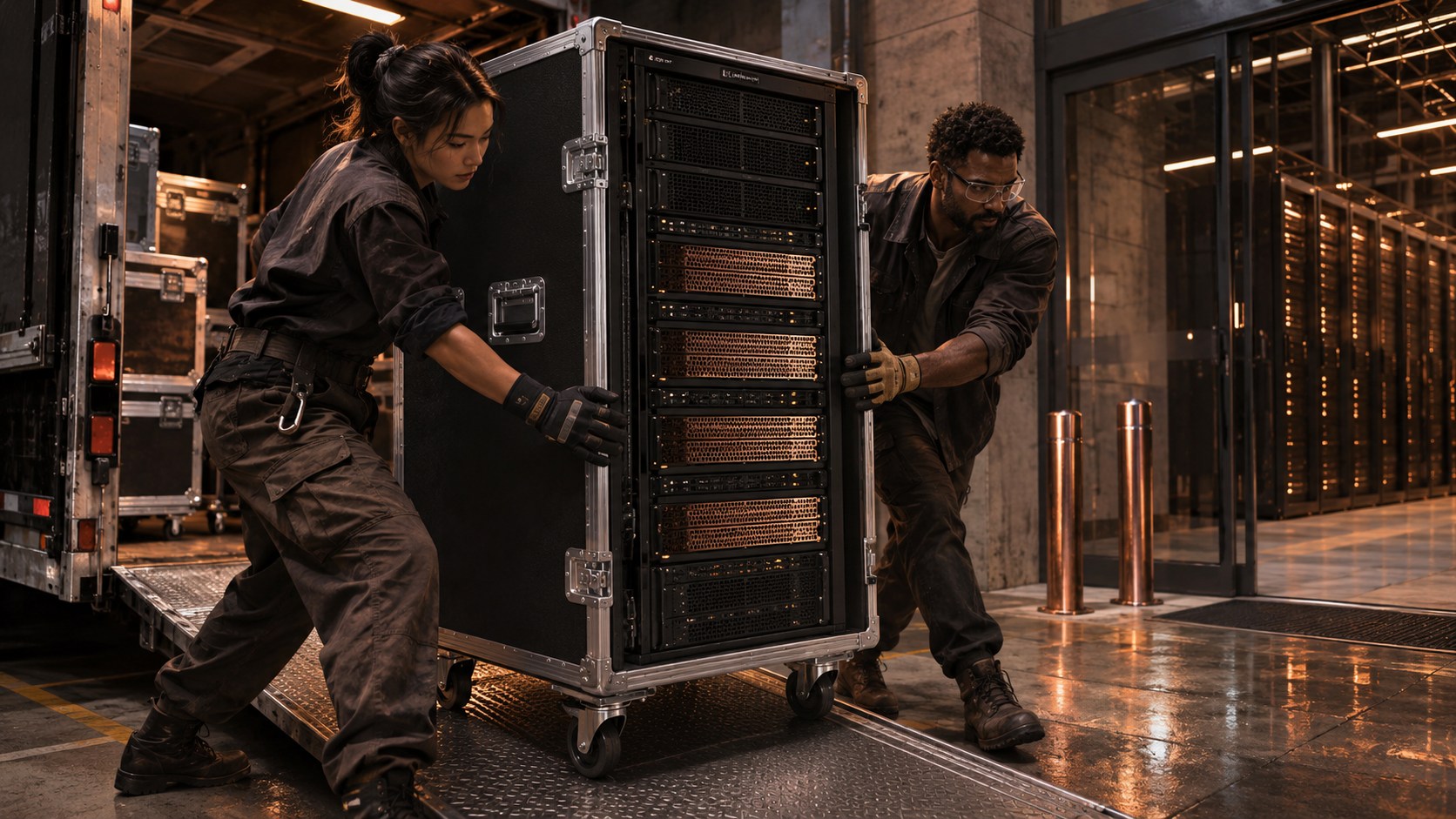
For the quarter ended 25 October, NVIDIA reported $115.8 billion in revenue, up 103% year on year. Its Data Center market platform accounted for $107.6 billion, roughly 93% of total revenue. Operating cash flow was $48.3 billion. These are substantial recorded sales and cash flows, not merely announced capacity. NVIDIA says it began shipping its Vera Rubin NVL72 systems, and on 19 November described an expanded collaboration with Microsoft spanning Azure and Windows.
But an NVIDIA sale, a commissioned rack and a profitable customer workload do not occur at the same moment. NVIDIA’s $130 billion next-quarter revenue outlook, plus or minus 3%, is management guidance, not earned revenue. Its fiscal quarter includes an extra week and assumes no Data Center compute revenue from China. A customer deciding whether to expand should ask not only whether it can secure new hardware, but whether it can use it well enough and often enough to justify the bill.

NVIDIA’s CFO commentary disclosed $118 billion of maximum gross exposure under guarantees. Up to $105 billion of that total supports land, power and building shells at SB Energy’s PORTS-Pike campus in Ohio, a planned site of approximately 4.25 gigawatts across nine buildings with long leases to OpenAI. The Ohio guarantees take effect building by building as each is completed and ready for service. The first phase was expected in NVIDIA’s fiscal 2029. NVIDIA said it had made no guarantee payments as of its November commentary. The $105 billion is included in the $118 billion; neither figure represents a loss already incurred.
The physical timetable matters as much as the financing. The International Energy Agency says data centres can typically be built in one to three years, while planning, permitting and building new grids can take five to fifteen. Those are general timeframes, not an estimate for this Ohio site. The IEA also warns that power connection queues can include speculative or duplicate requests. For a utility worker, a nearby household or a small factory sharing the grid, the practical question is which upgrades will actually be needed, when they will be paid for and who is responsible if the expected load does not materialise.

NVIDIA also separately reported $390 billion in supply commitments, up from $279 billion in the preceding quarter, and $102 billion in cloud-service and data-centre lease commitments, up from $74 billion. It described additional arrangements with specialist cloud providers under which commitments depend on financing, operating capacity and NVIDIA’s acceptance. A supply commitment, a lease and a guarantee serve different purposes and may have different timing and conditions. Adding their headline amounts would misstate what is owed or at risk.
This is where the business model is changing. Helping partners get projects financed can open markets, secure scarce inputs and put equipment to work sooner. It can also tie the economics of a chip sale to what happens at a power connection, a leased building or a customer years later. None of that means the disclosed demand is fictitious. It means a buyer or lender should trace which payments come from end customers and which rely on a partner’s financing, purchase or support. The same strong quarter can coexist with a larger exposure to future execution.
Nor does financing remove the cross-border dependencies. On 17 November, NVIDIA announced additional substrate work with Kinsus in Taiwan and Samsung Electro-Mechanics in South Korea, alongside packaging work with Amkor, SPIL and TSMC. That is a capacity announcement, not a claim that these supply chains can be substituted quickly. A board considering supplier alternatives should ask what it can actually switch: the chip, the software stack, the packaging capacity or the cloud contract.

Read the build-out on three clocks: delivery, power and payment. Delivery means installed and accepted equipment, not merely an order. Power means energised, usable capacity and known connection costs, not an announced gigawatt. Payment means cash collected from customers and repeat use, not just contracts signed or pilot workloads run. Track who owns each milestone and who absorbs the cost if it slips.
This is also a test for readers who are not buying chips. A public agency can ask how much new grid capacity is operating and who funds it. A research lab can ask which teams have dependable access, on what terms, and for how long. A board can ask who is authorised to pause a deployment if utilisation or collections lag. If a company cannot answer those questions separately, it cannot yet tell whether it is building an enduring service or simply bringing forward the cost of building it.
NVIDIA’s return to founder leadership and its extraordinary quarter are both real. So is the work still ahead: connecting buildings, collecting cash from customers, and showing that oversight can hold under pressure. Double ROI: look for the return on investment in useful, paid-for computing and transparent costs. Look for the return on integrity in independent oversight, evidence behind claims, and a clear account of who bears the downside. The question is not only whether NVIDIA can sell the next machine. It is whether the system around it can earn the trust and the revenue it needs to keep running.
Visual Intelligence by Noir Spider Atelier. Human scenes are conceptual illustrations, not documentary images of NVIDIA staff, sites or directors. © 2026 WTM Media | Why These Matter.
Why These Matter - WTM MEDIA is an independent editorial platform exploring the forces shaping our world—through people, culture, commerce, design, systems, and governance. Connecting the dots between today’s headlines and tomorrow’s realities.

article-support-3
Noir Spider Atelier

article-support-2
Noir Spider Atelier

article-support-1
Noir Spider Atelier

press-partnership
Noir Spider Atelier
press-reader-desk
Noir Spider Atelier

resource-access
Noir Spider Atelier
membership-example
Noir Spider Atelier

membership-tools
Noir Spider Atelier

membership-reader
Noir Spider Atelier
membership-public
Noir Spider Atelier
pathway-design
Noir Spider Atelier
pathway-institutions
Noir Spider Atelier
pathway-technology
Noir Spider Atelier