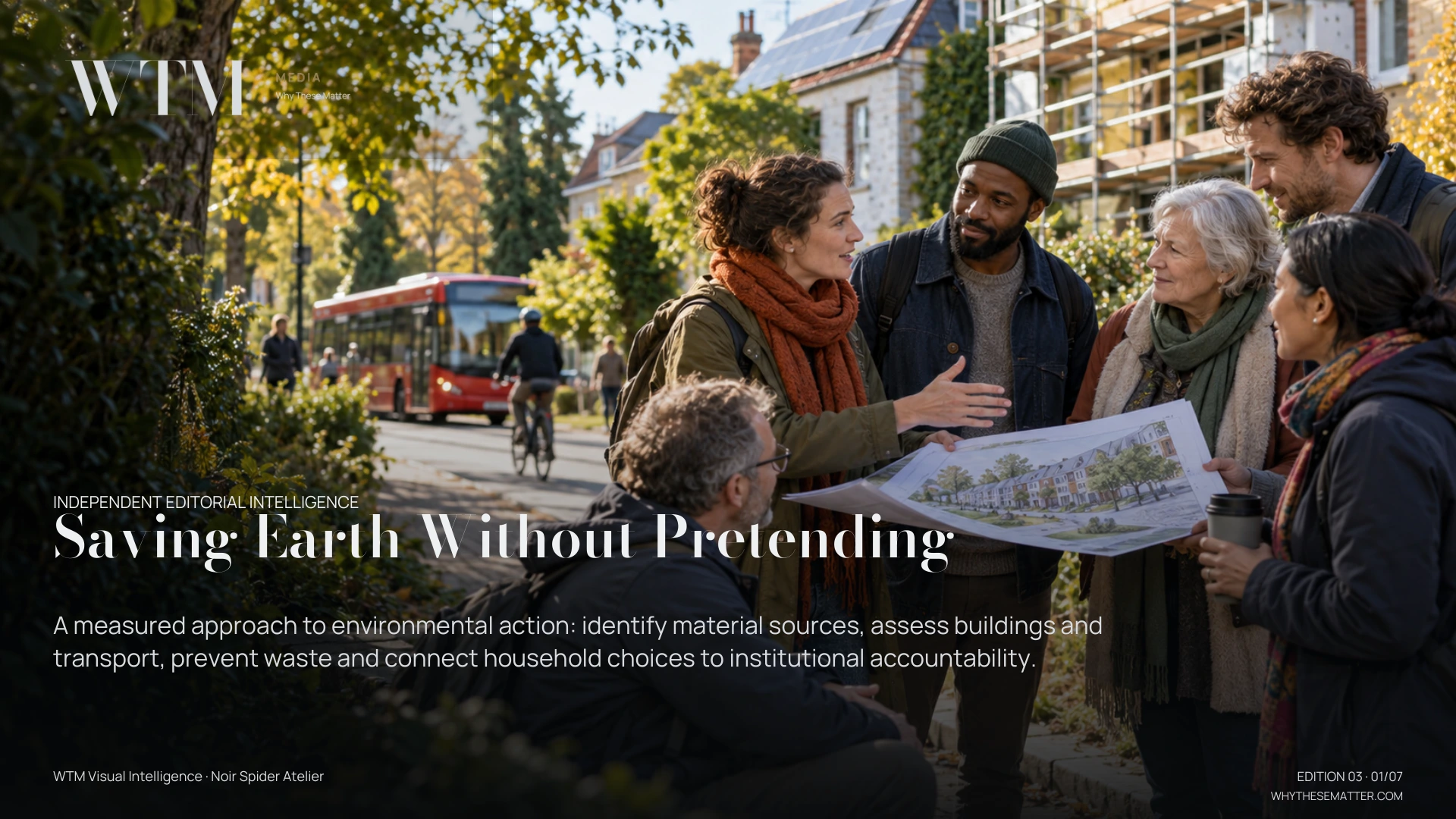
A measured approach to environmental action: identify material sources, assess buildings and transport, prevent waste and connect household choices to institutional accountability.
Environmental action becomes credible when its results can be measured. The most visible gestures are not always the most consequential. Buildings, transport, energy systems, food and institutional decisions must be considered together, with local constraints acknowledged.
Reader value: A measured approach to environmental action: identify material sources, assess buildings and transport, prevent waste and connect household choices to institutional accountability.
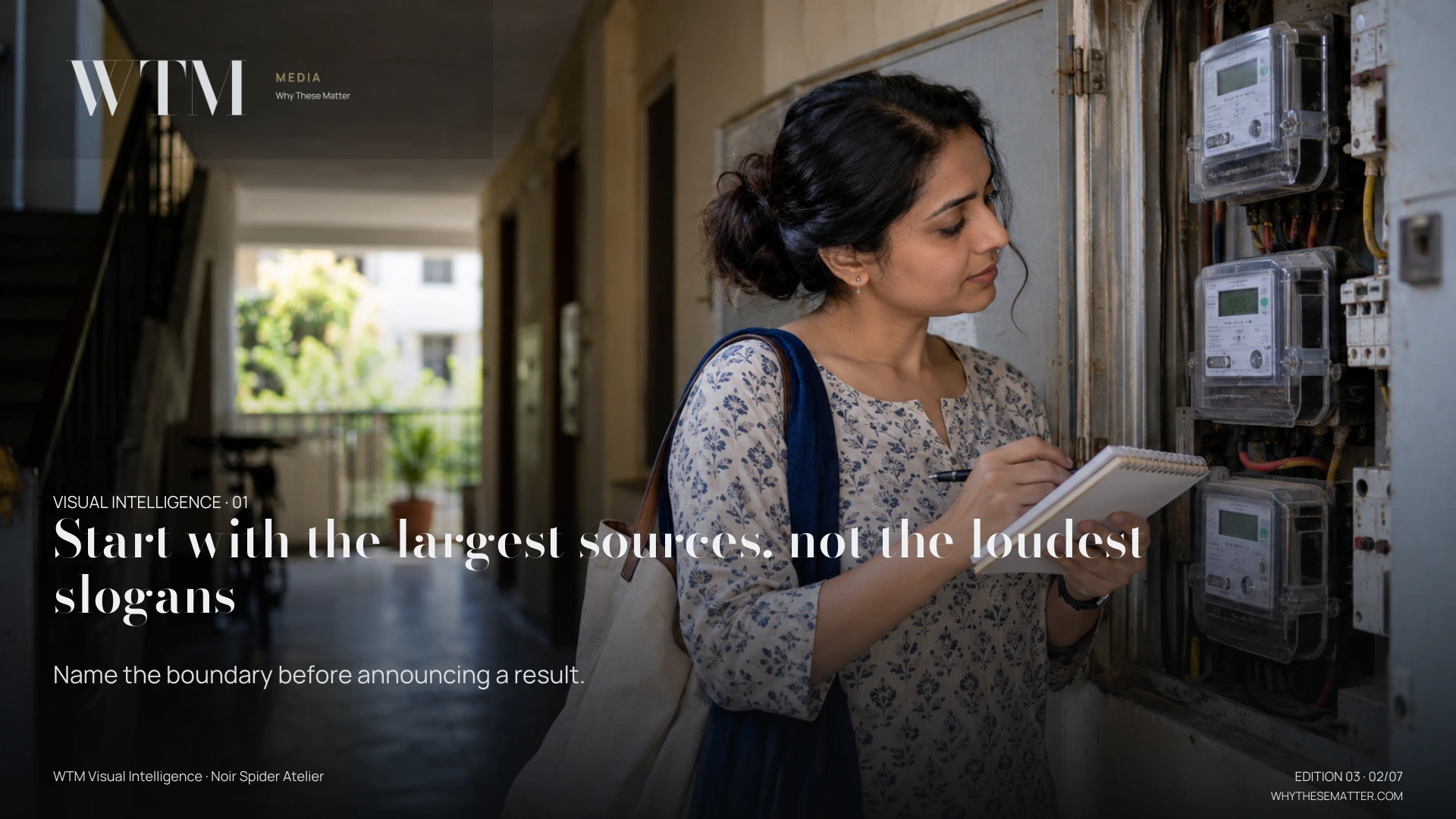
Review electricity and heating bills, travel patterns, food waste and replacement purchases. Different households have different footprints; a universal ranking can mislead. Establish a baseline before claiming improvement. Choose one measurable unit: kilowatt-hours, fuel use, kilometres travelled or kilograms of discarded food. Compare like-for-like periods and document seasonal changes.
A lower electricity bill may reflect price changes as well as reduced consumption. A lower consumption figure may reflect a milder season or fewer occupants. Keep the unit and the comparison period visible, and note what changed. If you cannot calculate a credible emissions result, report the activity measure honestly rather than inventing precision.
WTM's proposed first step is a modest evidence ledger: what was used, over which period, and which change is being tested? It need not become a personal carbon-ranking exercise. The IPCC's synthesis places demand, infrastructure and technology within wider systems transitions; a household action and a structural policy are related but not interchangeable contributions. [1]
A credible comparison names both the starting condition and the alternative. An improvement relative to an old appliance is different from an improvement relative to another new one. Keep the choice being assessed visible. Otherwise an apparently precise percentage can answer a question that the household or institution never actually faced.
Record the things the measurement leaves out. A household electricity reading does not describe every impact of the products it purchases, and a transport record does not describe an entire city. A boundary makes a claim useful without pretending it is complete. It allows another reader to understand what would be needed for a broader assessment.
Use uncertainty to guide the next question. Where data are weak, explain the direction of the proposed change and what remains unknown instead of manufacturing a numerical score. An honest partial account can support a practical decision. A confident total assembled from incompatible assumptions can obscure which intervention is worth examining.
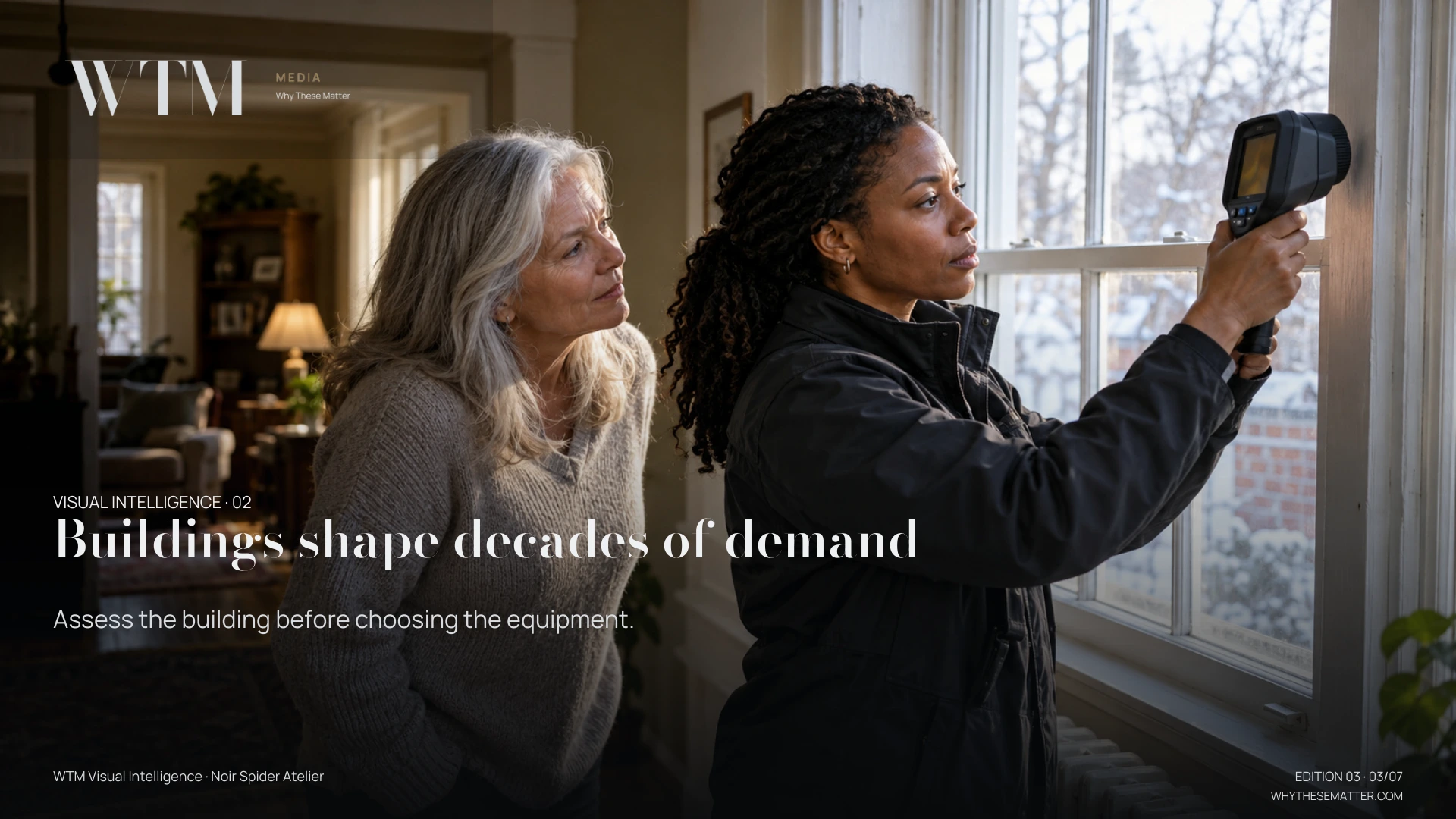
Heating, cooling, insulation, air leakage and equipment efficiency influence ongoing energy consumption. The appropriate sequence depends on building condition, climate and ownership. A costly upgrade without a baseline can disappoint financially and environmentally. Investigate an energy assessment and compare capital cost, maintenance and plausible savings. Preserve ventilation and safety; sealing a building without addressing indoor air can create other problems.
An energy assessment can help identify where a particular building uses or loses energy. [2] Ask what the proposed work addresses and what assumptions underpin the saving. In a rented building, separate changes within the resident's control from work requiring the owner's agreement. A technically attractive option that cannot be installed, maintained or financed is not yet a workable plan.
Compare options over a plausible period of use rather than only the first invoice. Include disruption, servicing and the condition of existing equipment. Do not claim that one intervention always comes first in every climate or building. Preserve ventilation and investigate moisture alongside energy efficiency; the purpose is a better-performing home, not a lower reading achieved by neglecting other needs.
Distinguish a technical recommendation from an implementable project. Access to the building, permission, installer availability, financing and maintenance all shape what can happen. A resident may reasonably choose a smaller feasible improvement while a larger one remains unresolved. The assessment should explain those constraints rather than turn them into a judgement about commitment.
Ask how proposed measures interact. A change to equipment may depend on the condition of the surrounding building, and a change to the fabric may alter other needs. Evaluate the package with suitable expertise. This is a reason to examine the particular home carefully, not a claim that one standard sequence is right everywhere.
After work is completed, compare actual operation with the assumptions used to choose it. Note weather, occupancy and changes in use. A discrepancy may reveal an installation issue, a mistaken estimate or a different household routine. Following the result matters because a paid invoice is evidence of expenditure, not by itself evidence of performance.
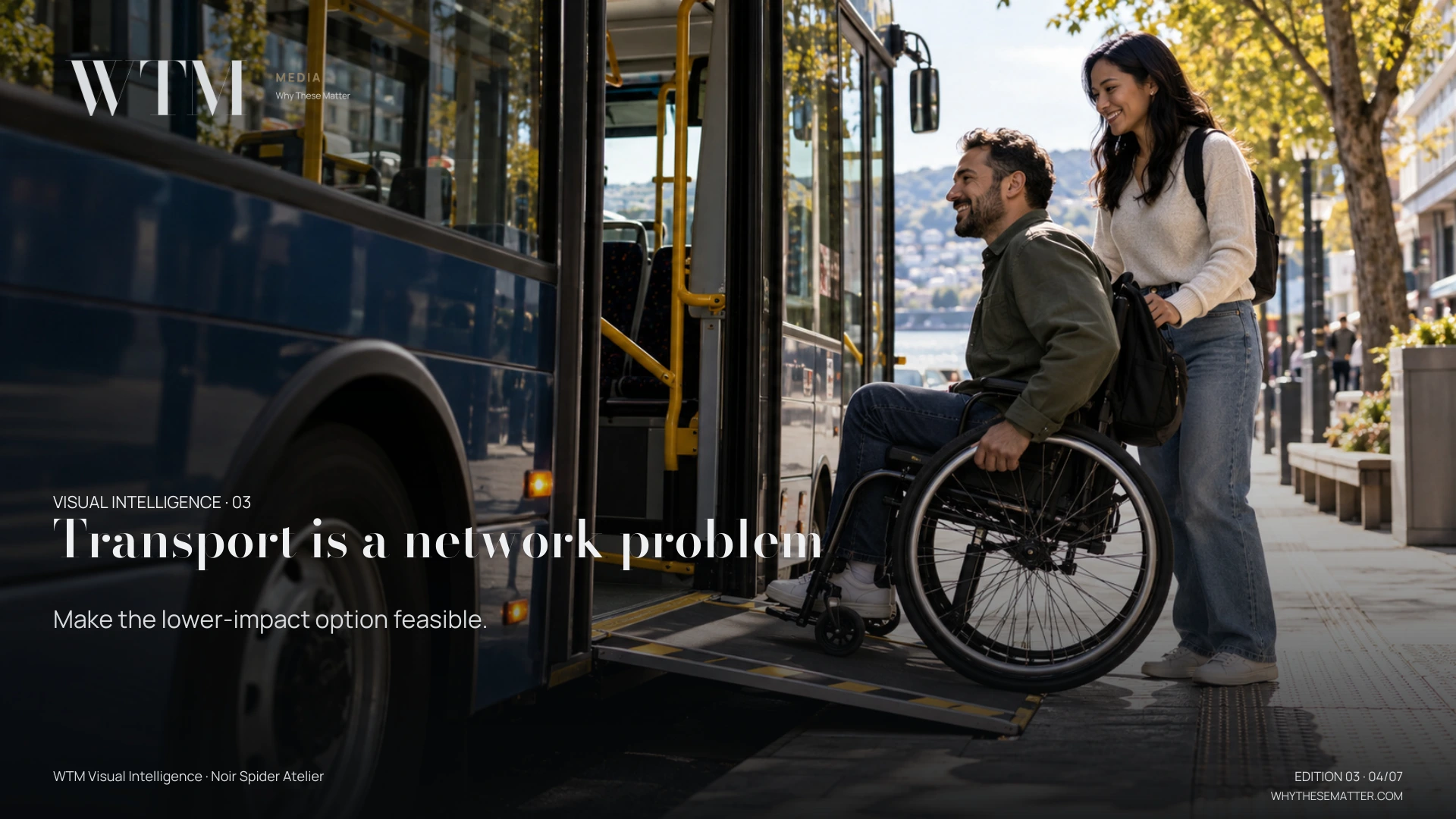
Transport choices depend on distance, accessibility, safety, public infrastructure and vehicle ownership. Reducing unnecessary journeys or combining trips can be useful even when a household cannot replace its vehicle. Electric vehicles can reduce some operational emissions, but their full case depends on electricity sources and lifecycle factors. Record common journeys and test one feasible change. Compare purchase, maintenance, insurance and energy costs rather than treating a label as proof of sustainability.
A transport choice is constrained by the route that exists. Test a real journey at the time it is needed: does the bus run after a late shift, is the pavement accessible and can a parent complete the care journey? These questions shift the discussion from judging individuals to evaluating available service.
Where a vehicle change is under consideration, compare the whole use case rather than a single technology label. The IPCC transport assessment considers vehicles, fuels, infrastructure and lifecycle effects together. [3] WTM's practical recommendation is to examine both a near-term change, such as combining a feasible trip, and the institutional improvement that would make a larger change possible. Neither requires a promise of zero impact.
Include time and access in the transport comparison. A cheaper journey that cannot accommodate work or care responsibilities may not be a feasible substitute. Identify the specific missing connection, timetable or accessible route. This turns a general preference for a different transport system into a concrete service question that an institution can address.
Separate a vehicle decision from a mobility decision. Replacing a car is one intervention; changing the frequency, distance or organisation of journeys is another. Each has costs and constraints. Examining them together can reveal an option that fits the household better without pretending that everyone has an equal ability to change how they travel.
An institutional demand should be as specific as a household experiment. Ask for the connection, reliability information or access improvement that would make a real journey possible. Then examine delivery rather than the announcement alone. Infrastructure becomes useful when people can depend on it at the time and place their lives require.

Food waste represents lost food, labour, land, water and energy. Plan meals, store food appropriately and measure avoidable discards. Extend the life of safe repairable products and avoid buying replacement items merely to signal virtue. Weigh discarded edible food weekly for a month, then set a realistic reduction goal. Verify local recycling rules; not every labelled package is accepted by local systems.
Begin with what the household already buys and discards. A simple record of avoidable edible waste can reveal whether the problem is portion size, forgotten ingredients or a schedule that changes after shopping. EPA guidance prioritises planning, appropriate storage and using food already available. [4] Follow food-safety guidance rather than treating waste prevention as a reason to eat unsafe food.
Apply the same purchasing question to durable goods: what problem is the replacement solving, and could the existing item safely be maintained? This is an editorial decision prompt, not a universal claim that repair is always preferable. Ask for evidence when a product is marketed as environmentally superior, and distinguish a packaging claim from the impact of the whole product.
Measure waste in a way the household can sustain. A short record of what was discarded and why may identify more useful changes than an elaborate tracking system that is quickly abandoned. Distinguish an avoidable excess purchase from an item that was unsafe. Prevention should improve planning without encouraging people to ignore food safety.
Repair decisions need a boundary too. Check whether the item can be repaired safely, whether suitable parts or service exist and whether the repaired object will meet the actual need. Keeping an unsuitable or hazardous product is not automatically a sustainable outcome. The comparison should concern useful service over time, rather than ownership as a symbol.
For institutional procurement, ask what happens after purchase. Maintenance access, parts, training and responsibility for disposal can determine whether an apparently durable product remains usable. These questions help test a supplier's claims. They also reveal whether a low upfront price depends on costs being carried later by another team or community.
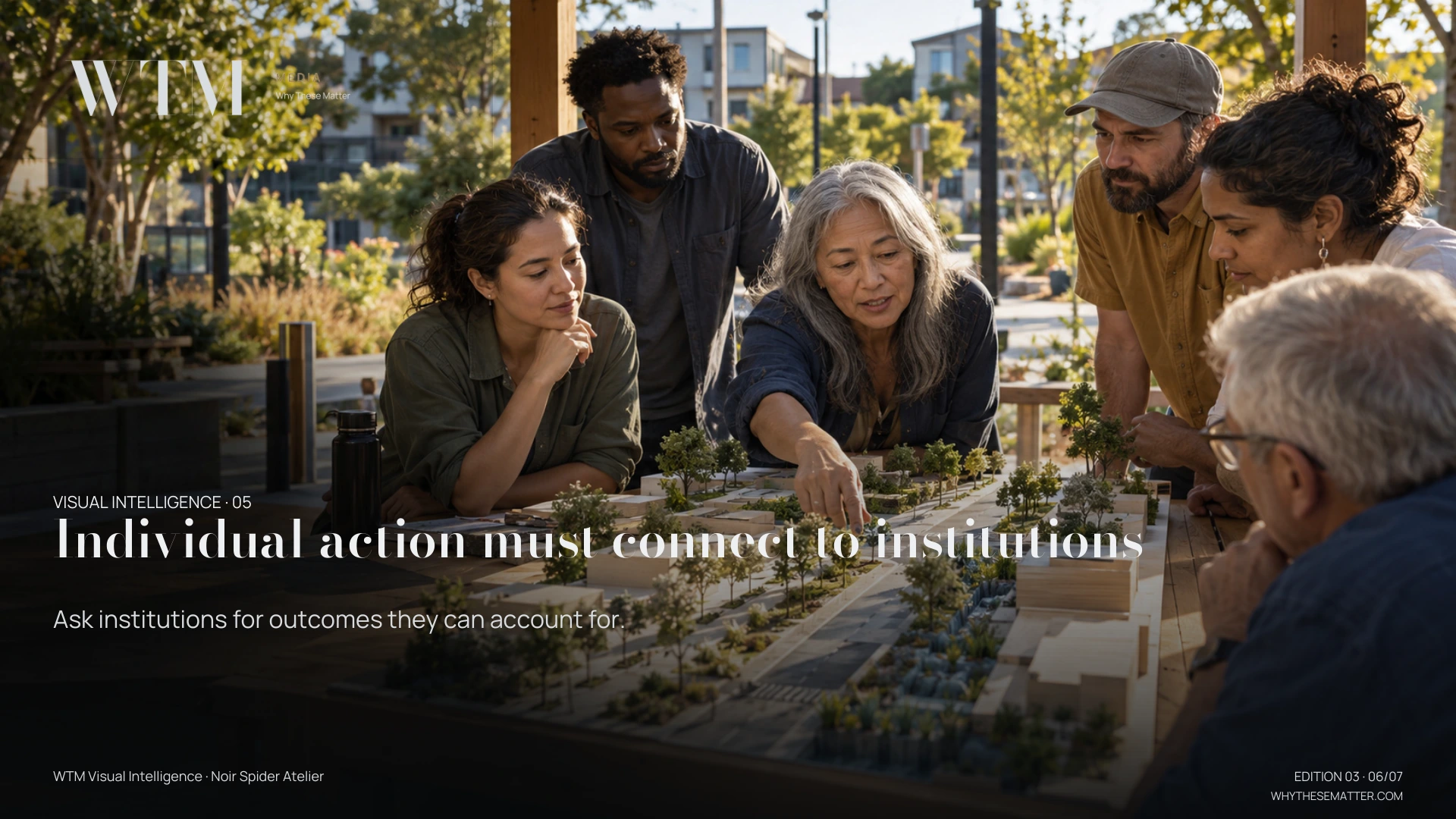
Climate mitigation reduces the causes of warming; adaptation addresses exposure and vulnerability. Neither can be achieved solely through consumer choices. Local planning, resilient infrastructure, procurement and transparent corporate commitments determine much of the wider outcome. Ask organisations for baselines, timelines, audited results and accountability. Support policies that match local needs, and distinguish emissions reductions from resilience improvements.
A commitment needs an owner, a starting point and a time horizon. Ask whether an organisation is describing a future target, a measured reduction or a resilience investment. Check which activities and locations are included. A single successful project should not quietly become a claim about an entire organisation.
Mitigation and adaptation address different questions: reducing the drivers of climate change and adjusting to its effects. [1] A shaded public space may contribute to a local adaptation plan without proving an emissions reduction. WTM's Double ROI test here is evidential: does the project deliver a useful result, and can the organisation explain the boundary, trade-offs and people affected? It is a framework for scrutiny, not a certification.
A target becomes more inspectable when an organisation names who owns it. Ask which decisions that person can influence and what happens when progress falls short. A commitment without authority or resources may remain an aspiration. Scrutiny should follow the decision process, rather than treating the existence of a pledge as proof of delivery.
Public participation also needs a clear scope. Which choices remain open, what evidence can change them and when will the response be explained? Consultation after every material decision is fixed has a different value from participation that can alter the design. Naming that distinction makes the institutional claim more accountable to the people affected.
Keep the two returns visible. A project may provide a useful service while making a weak environmental claim, or disclose its limits honestly while still needing stronger economics. Double ROI asks for both judgements. It should help reveal trade-offs and needed corrections, rather than provide a flattering combined label that makes weaknesses disappear.
Environmental intelligence should connect concern with an assessable choice. A reader needs to understand which activity is changing, over what period and within what boundary. That account may be incomplete, but it can still be useful when its limits are visible and its proposed improvement is feasible.
Fairness matters to implementation. People do not begin with equal control over housing, transport, money or time. A recommendation that ignores those differences can mistake an unavailable option for a failure of willingness. Institutions have a responsibility to make lower-impact choices usable, rather than transfer the entire burden to individual consumption.
Return on Investment asks what useful service a project provides and what resources it requires over time. Return on Integrity asks whether the environmental claim matches the evidence and whether affected people can influence the decision. Neither return should disappear into an appealing sustainability label that cannot be examined.
Look for delivery rather than announcements alone. A measured change in use, an accessible journey or a maintained piece of equipment provides a different kind of evidence from a promise. Ask what has happened, what remains dependent on future action and who is responsible for explaining the gap.
Choose a household experiment and an institutional question that belong together. A transport record can identify a missing service; an energy assessment can reveal an owner-dependent improvement. This makes personal action part of a wider enquiry, with a realistic account of what the reader can change and what requires collective provision.
Environmental credibility comes from the relationship between a claim, a boundary and a result. Choose one improvement you can measure, and one institutional decision you can question constructively. People should not have to perform perfection to participate. They need feasible options and organisations willing to show what changed.
Evidence reviewed 18 October 2026; primary source links rechecked 26 October 2026. This is public-source educational editorial analysis. Numerical scenarios and WTM exercises are illustrations, not measured outcomes or personalised professional advice. Recheck changing guidance before release.
Visual provenance: Illustrative scenes of fictional adults. These visuals support the analysis; they do not document reported events, identify actual research participants or imply endorsement. WTM Visual Intelligence · Noir Spider Atelier.
Download the WTM Visual Intelligence PDF · Support independent WTM journalism
Why These Matter - WTM MEDIA is an independent editorial platform exploring the forces shaping our world—through people, culture, commerce, design, systems, and governance. Connecting the dots between today’s headlines and tomorrow’s realities.

article-support-3
Noir Spider Atelier

article-support-2
Noir Spider Atelier

article-support-1
Noir Spider Atelier

press-partnership
Noir Spider Atelier
press-reader-desk
Noir Spider Atelier

resource-access
Noir Spider Atelier
membership-example
Noir Spider Atelier

membership-tools
Noir Spider Atelier

membership-reader
Noir Spider Atelier
membership-public
Noir Spider Atelier
pathway-design
Noir Spider Atelier
pathway-institutions
Noir Spider Atelier
pathway-technology
Noir Spider Atelier