
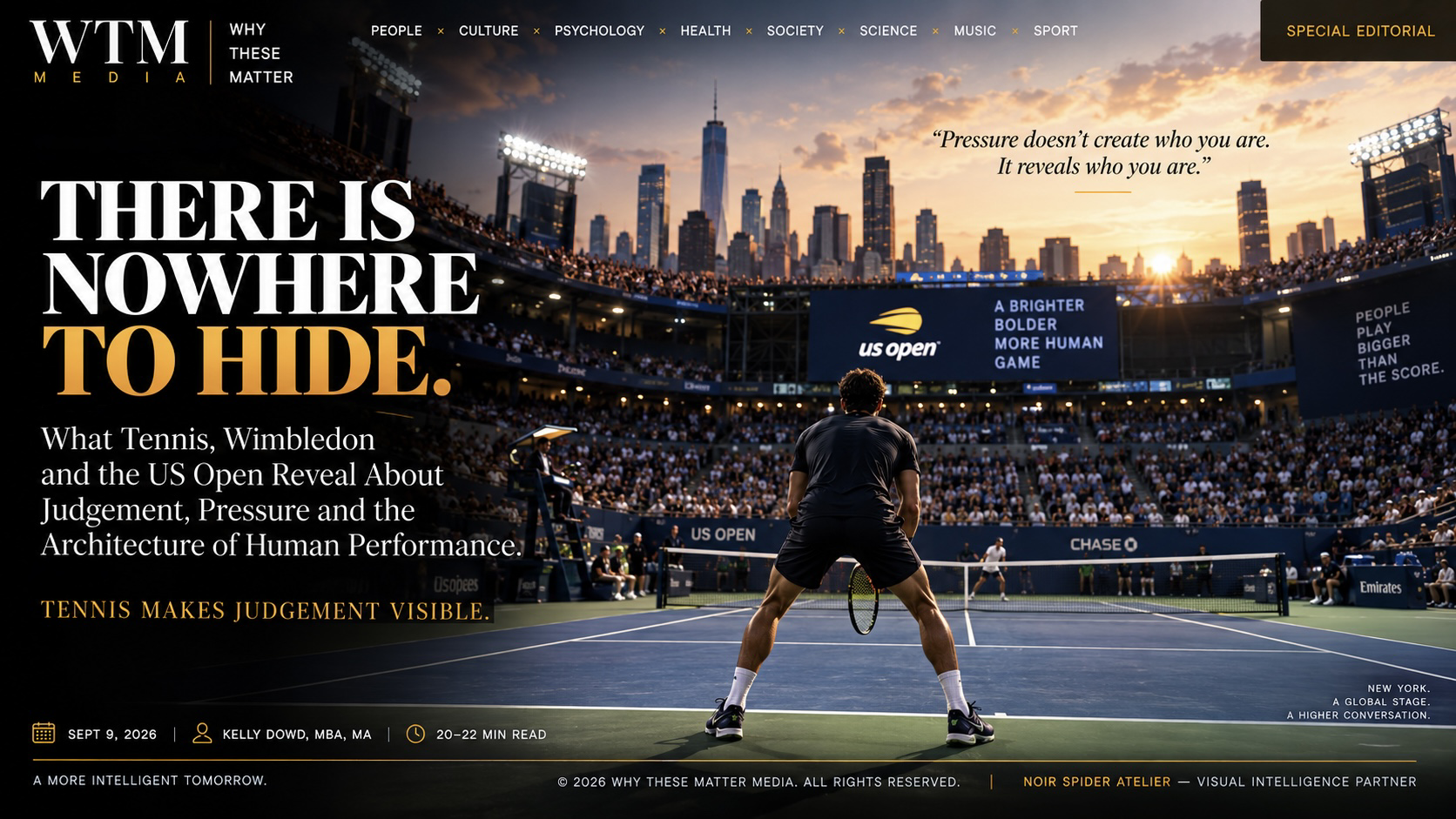
Tennis appears to be a contest between two people separated by a net. Look closer and it becomes something considerably more useful: a controlled experiment in human judgement. There is nowhere to hide in singles tennis. The player must observe what is happening, accept when a strategy has stopped working, adapt without surrendering confidence and execute the next decision while the consequences remain visible on a scoreboard. Wimbledon and the US Open intensify that experiment through two radically different institutional architectures. One derives extraordinary value from continuity, restraint and ritual. The other converts reinvention, spectacle, access and commercial energy into cultural power. Together they reveal something useful far beyond sport. Performance is rarely determined by capability alone. It emerges from the interaction of talent, environment, judgement, technology, incentives, psychology, institutional design and the ability to adapt under pressure. For consumers, the lesson is personal. For executives, it is organisational. The question is not whether you possess a winning strategy. It is whether you can recognise when the strategy that made you successful has stopped working.
A tennis court is an unusually honest environment. There are lines. There is a net. There is an opponent. There is a score. Almost everything else is stripped away. In singles, when the serve misses, you served it. When the opponent discovers that your backhand breaks down under pressure, it is your backhand being tested. When momentum changes, you cannot substitute yourself out. The architecture concentrates responsibility.
That is one reason tennis can teach us something that many discussions about performance obscure. We frequently evaluate people through outcomes while ignoring the decisions producing those outcomes. A promotion is won. A company grows. An investment succeeds. A relationship survives. We then construct narratives around the result. Tennis makes the underlying sequence easier to see because decisions recur every few seconds. Serve wide or down the middle. Attack or defend. Approach the net or remain at the baseline. Continue exploiting the pattern or anticipate that the opponent has recognised it.

Elite performance therefore contains two contests. The first concerns execution. Can you hit the shot? The second concerns judgement. Should you hit that shot now? Organisations routinely confuse these capabilities. Technical competence earns promotion until the technically exceptional employee encounters a problem for which expertise alone is insufficient. Leadership begins where the playbook becomes ambiguous.
Pressure complicates the distinction because the human nervous system does not behave identically when consequences rise. The shot that feels effortless during practice acquires different psychological weight at break point. Executives know the equivalent. A strategy can appear obvious in a planning session and considerably less obvious when millions of dollars, thousands of employees, public reputation or one’s own position depend upon it. Pressure does not merely reveal what we know. It reveals whether we can still access what we know when it matters.
The consumer encounters the same architecture at a smaller scale. The difficult conversation with a spouse. The decision to leave a job. The temptation to keep investing in something because of what has already been spent. The moment when pride makes changing direction feel like admitting failure. Life rarely gives us a scoreboard as clean as tennis does, but it repeatedly presents the same problem: new information arrives after we have already committed ourselves to a course of action.
The useful lesson is not “be resilient”. That phrase has been flattened through overuse. The deeper lesson is that resilience requires information. You must first recognise what the environment is telling you. A player who loses six consecutive points because an opponent has identified a pattern does not need motivational language. The player needs perception. What changed? Where is the pressure coming from? What assumption has become wrong? What remains under my control?
This is where tennis becomes a systems-intelligence exercise. Performance begins with the capacity to see the system accurately enough to intervene in it.
Strategy becomes dangerous when identity attaches itself to it.
A player enters a match with preparation, tendencies, data and a plan. So does an executive entering a market. So does an investor allocating capital. So does a person entering a negotiation. Preparation is rational. The problem begins when evidence changes and the plan does not.
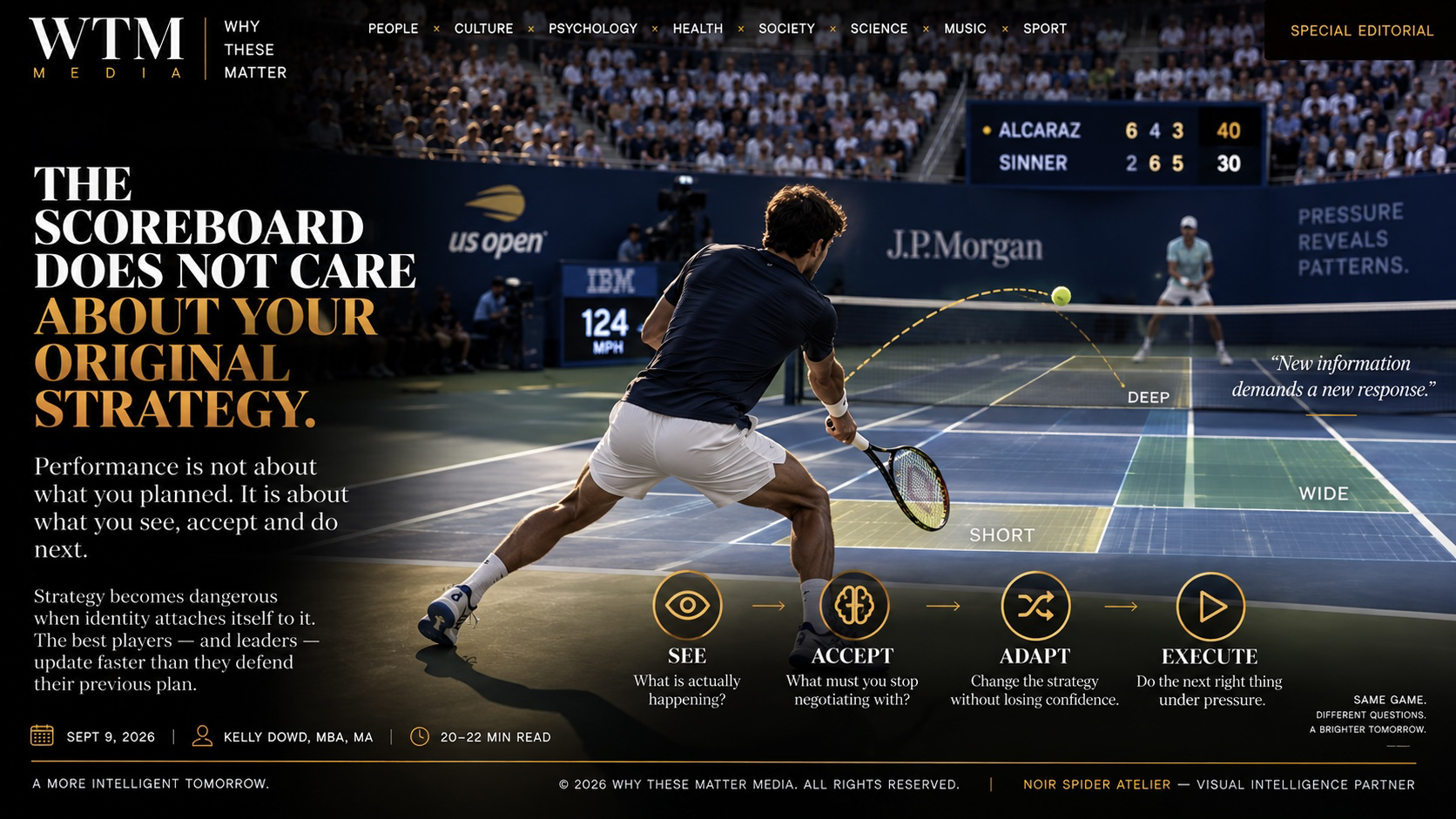
Tennis compresses this problem into minutes. An opponent who was expected to defend begins attacking. A serve pattern stops producing free points. Wind alters ball movement. Fatigue changes footwork. A weakness becomes unexpectedly reliable. Something that worked beautifully in the first set becomes predictable in the second. The successful player is therefore not simply executing a strategy. The player is continuously updating a model of reality.
This is the distinction between consistency and rigidity. Consistency protects standards. Rigidity protects assumptions. They can look identical until the environment changes.
Businesses make the same mistake at vastly greater scale. A profitable product becomes organisational identity. A distribution model that built the company becomes sacred. A customer segment that once produced growth receives investment long after behaviour has shifted. Management continues serving the strategy because the strategy once served management. Kodak is invoked so frequently in discussions about disruption that the example has become cliché, but the underlying pathology remains common: organisations can possess information about change without possessing the institutional willingness to respond to it.
Consumers do this too. We remain loyal to financial habits, careers, relationships, identities and ambitions partly because abandoning a strategy creates psychological cost. The previous decision begins arguing with the current evidence. “I have already invested five years” becomes a reason to invest a sixth. Tennis provides a brutal correction. The scoreboard contains no column for how strongly you believed the original plan would work.
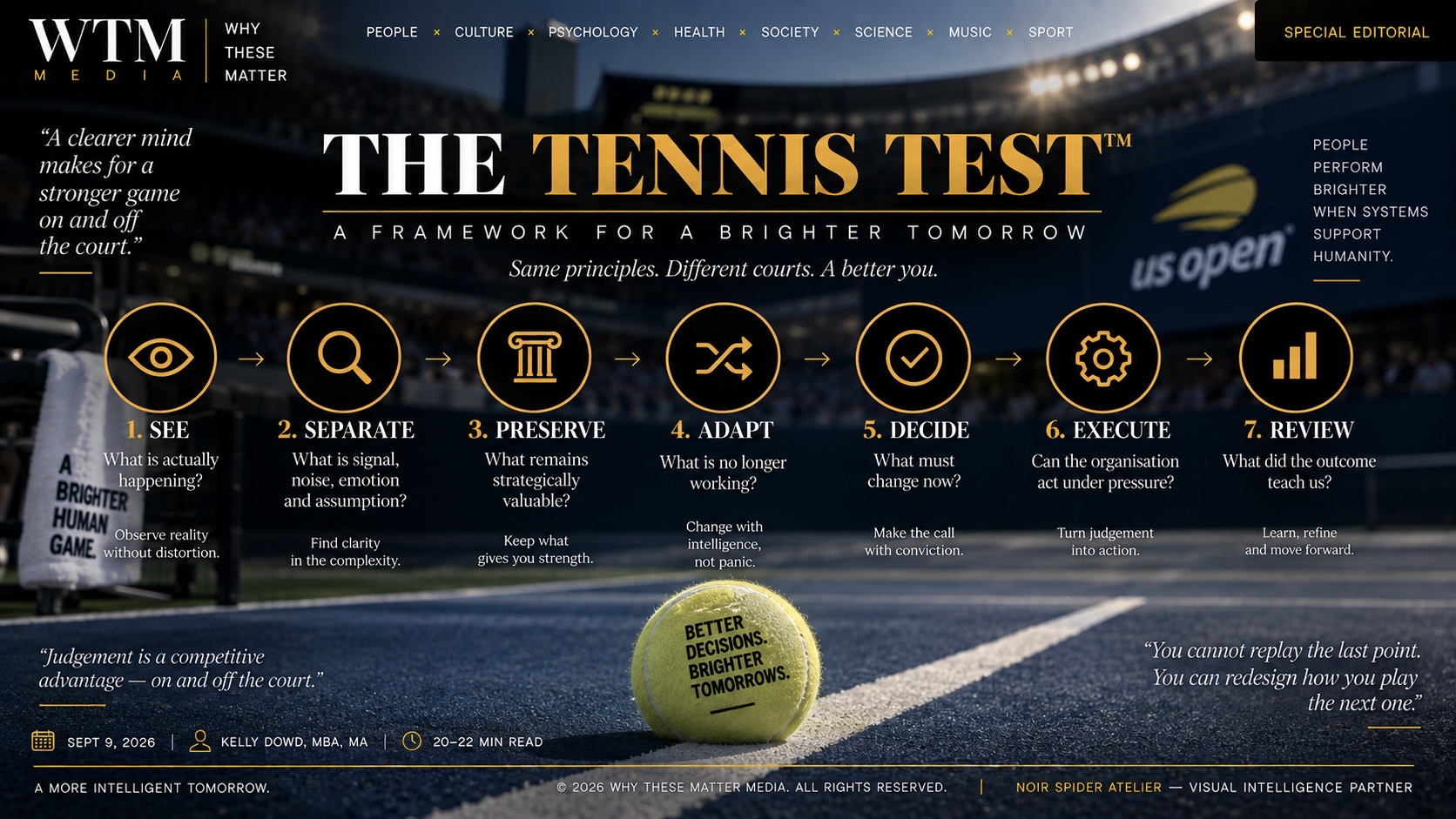
This is where the WTM Four A’s become practical rather than philosophical. Awareness: what is actually happening? Acceptance: what evidence must I stop negotiating with? Alignment: what response now fits the conditions? Authority:can I make and execute the decision? A player may travel through this sequence several times during a match. A competent executive should be capable of doing the same across a quarter, a crisis or a strategic cycle.
The lesson is therefore not constant reinvention. Changing strategy every time something becomes uncomfortable is not adaptability. It is instability. The higher-order capability is knowing what is signal, what is noise, what requires patience and what requires change. That is judgement. Tennis simply makes the cost of getting it wrong unusually visible.
Wimbledon presents a fascinating contradiction. It is one of the most recognisable sporting institutions in the world partly because it has spent decades appearing not to change.
Grass courts. Predominantly white clothing. Centre Court. The Queue. Strawberries and cream. Controlled visual language. The Championships rather than merely another tournament. These elements accumulate into something far more economically powerful than nostalgia. They constitute an institutional identity.
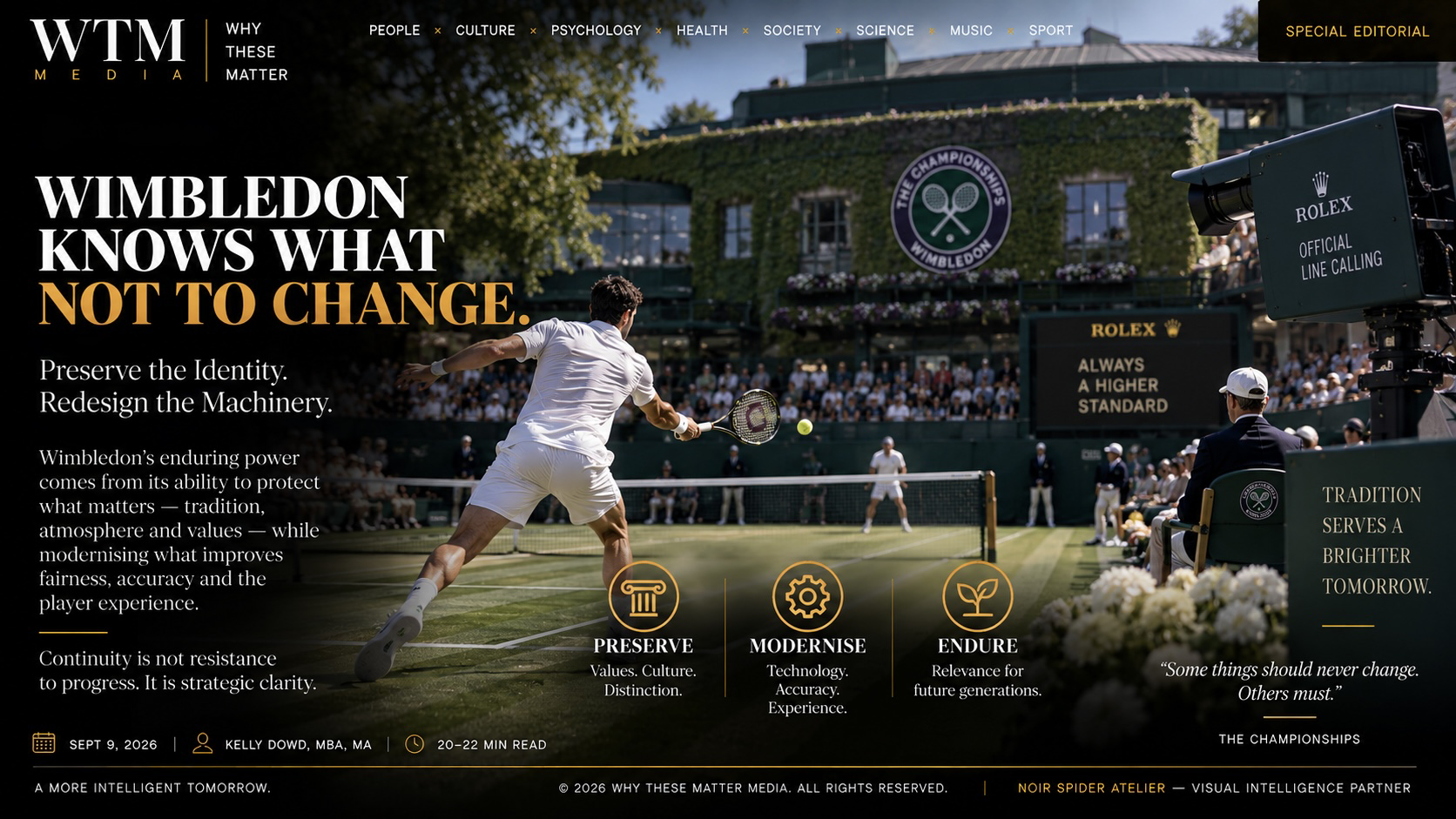
Executives should pay attention because contemporary management culture frequently confuses innovation with visible change. New logo. New strategy language. New organisational structure. New technology. New leadership programme. New customer experience. Motion becomes evidence of relevance. Wimbledon demonstrates the opposite possibility: an institution can modernise aggressively beneath a remarkably stable cultural surface.
Consider officiating. Wimbledon adopted live Electronic Line Calling from 2025, ending the familiar presence of human line judges after extensive testing. The All England Club described the decision in terms of accuracy and consistency with conditions players encounter elsewhere on tour. A deeply traditional institution therefore replaced a highly visible human ritual when evidence and technological capability justified doing so.
That is not hypocrisy. It is disciplined institutional design.
The important leadership question is not “Are we changing?” It is “What deserves preservation, and what has merely become familiar?” Those are different categories. Values may deserve preservation. Standards may deserve preservation. A distinctive customer experience may deserve preservation. A process that exists only because technology once required it does not acquire strategic importance merely by becoming old.
Wimbledon’s economics reinforce the point. The 2026 Championships offered £64.2 million in prize money, including £3.6 million each for the ladies’ and gentlemen’s singles champions. The tournament can operate at extraordinary contemporary commercial scale while maintaining an identity built around continuity.
For the consumer, there is an equally useful lesson. Reinvention does not require discarding everything that came before. Mature adaptation asks a more intelligent question: what about me is foundational, and what about me is merely habitual? People, like institutions, need continuity precisely because change is inevitable. Identity becomes useful when it gives change somewhere stable to occur.
If Wimbledon demonstrates the strategic power of continuity, the US Open demonstrates the strategic power of reinvention.
The difference is almost architectural. Wimbledon gives tennis an English garden. The US Open gives tennis New York. Arthur Ashe Stadium at night is scale, sound, commerce, movement and spectacle. The surrounding city does not disappear from the tournament’s identity. It becomes part of the product.
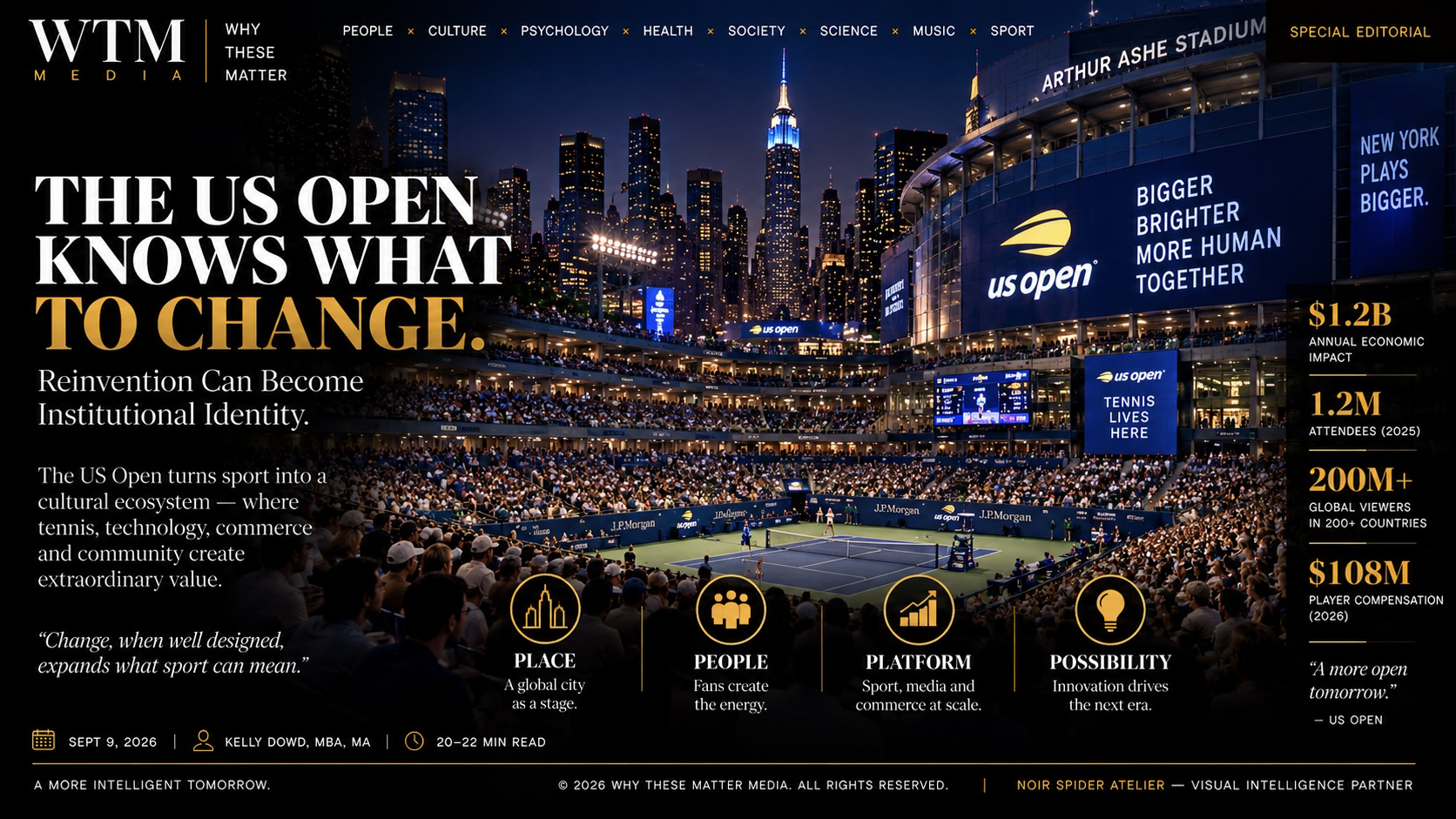
That product is economically substantial. The US Open says the tournament generates more than $1.2 billion in annual economic impact, welcomed nearly 1.2 million attendees in 2025 and reaches more than 200 million viewers across 200 countries and territories. The USTA is simultaneously undertaking an $800 million transformation of Arthur Ashe Stadium and a new Player Performance Center, funded without taxpayer money and scheduled for completion by the 2027 tournament.
For executives, that is not a sports statistic. It is a case study in ecosystem economics.
The customer is not buying tennis alone. There is ticketing, hospitality, food, sponsorship, broadcasting, merchandise, tourism, transport, digital engagement and cultural participation. Athletes generate value. Fans generate atmosphere. New York contributes place identity. Broadcasters extend distribution. Sponsors purchase association. Infrastructure converts attention into experience. One tennis match sits inside a much larger value system.
The US Open has also repeatedly used institutional change to influence the sport itself. Its history includes the introduction of equal prize money for men and women in 1973. Today the tournament is again pushing player economics. The 2026 event carries $108 million in total player compensation, 20 per cent above 2025 and 44 per cent higher than two years earlier. Singles champions receive $5.5 million each, while first-round main-draw singles players receive $140,000. A new Player Support Program begins with $2 million.
Technology has changed the operating architecture as well. At the 2026 US Open, electronic systems make line calls across all courts, while Video Review assists chair umpires with specified judgement calls. Notice the division of labour. Technology handles an increasingly precise measurement problem. Human officials remain responsible for other forms of interpretation and authority.
That is exactly the question executives confronting AI should be asking: where should technology replace judgement, where should it inform judgement and where must human accountability remain?
Elite tennis also destroys one of our favourite myths about success: the solitary genius.
The player appears alone on court. The system behind the player is anything but solitary.
Coaches. Physiotherapists. Strength specialists. Nutrition. Analytics. Agents. Equipment manufacturers. Tournament infrastructure. Travel logistics. Family. Sponsors. Medical professionals. Governing bodies. Practice partners. The visible performer sits at the edge of an enormous invisible architecture.
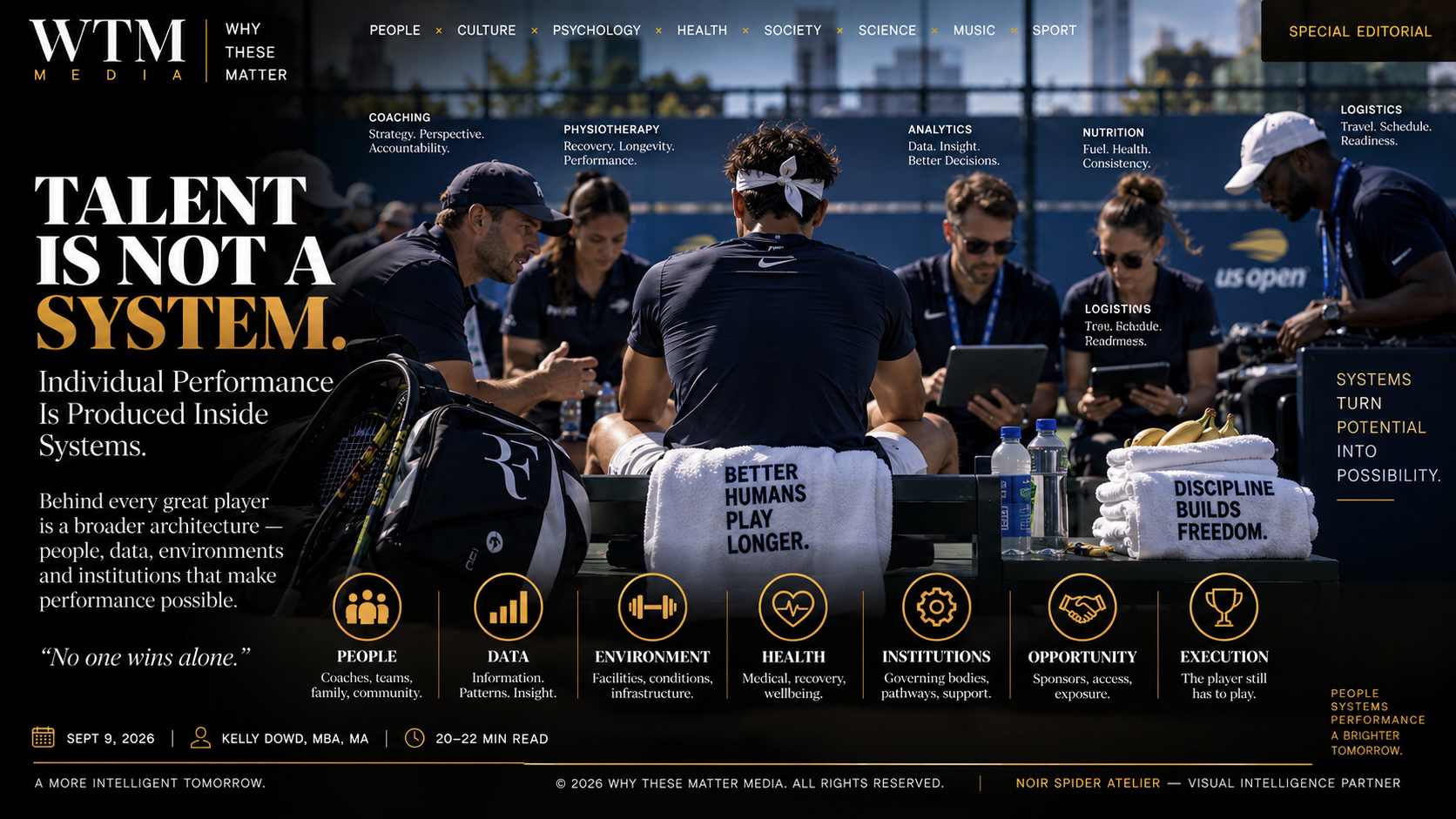
Corporations make the same analytical mistake when they attribute exceptional results entirely to exceptional individuals. A high-performing executive may indeed possess unusual capability. But performance is always interacting with capital, talent, information, governance, culture, incentives, timing and organisational support. Remove enough of the surrounding system and even extraordinary people begin producing ordinary results.
The inverse is also true. A beautifully designed system cannot indefinitely compensate for poor judgement at the point of execution. Tennis shows this with unusual clarity. A coach can prepare the player. Data can identify tendencies. Technology can measure movement. A physiotherapist can optimise recovery. None can hit the next forehand once the point begins.
That distinction is critical for executive design. Organisations need to determine where support should be systemic and where accountability should remain individual. Excessive individualism produces burnout and institutional fragility. Excessive systemisation produces bureaucracy and diffusion of responsibility. High performance requires both architecture and agency.
Consumers can apply the same principle personally. We often treat discipline as an individual moral characteristic while ignoring environmental design. Sleep, financial behaviour, exercise, learning and attention are all influenced by the systems surrounding them. Calendar design changes behaviour. Physical environments change behaviour. Social networks change behaviour. Defaults change behaviour. Technology changes behaviour. The strongest individual is still operating inside an architecture.
The practical question becomes more useful than “Am I disciplined enough?”
What system am I asking myself to perform inside?
The value of tennis to WTM is not that executives should begin playing tennis. It is that tennis makes invisible systems visible.
A match reveals the relationship between preparation and improvisation, information and judgement, confidence and evidence, individual responsibility and institutional support. Wimbledon demonstrates how an institution can preserve identity while changing its machinery. The US Open demonstrates how reinvention, technology, economics and cultural openness can expand an institution without eliminating its historical meaning.
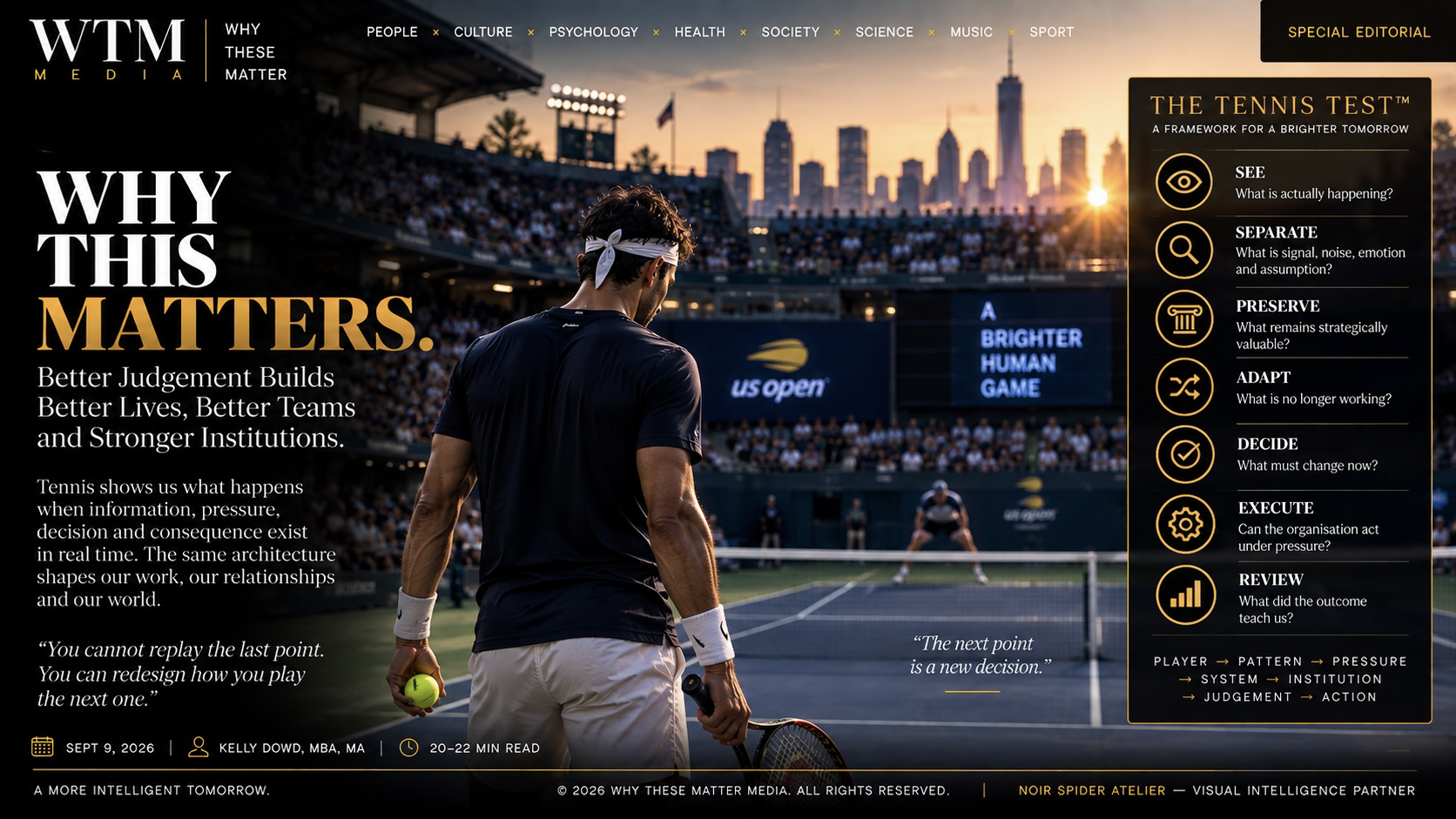
For the consumer, the transferable intelligence is immediate. When circumstances change, do not ask only whether you can work harder. Ask whether you are still solving the correct problem. Separate identity from strategy. Build environments that support the behaviour you want. Preserve what is foundational. Change what is merely familiar. Recognise that adaptability without principles becomes instability, while principles without adaptability become rigidity.
For middle managers, tennis offers another lesson: observe patterns before prescribing solutions. Your employee may not need motivation. The workflow may be poorly designed. Your team may not need another technology. It may need clearer decision rights. A performance problem may actually be an information problem, an incentive problem, a capability problem or an environmental problem. The visible error is not necessarily the system failure.
For executives, the stakes are larger. Organisations must know which traditions constitute strategic identity and which are legacy friction. They must understand where technology should automate, where it should augment and where human judgement must remain sovereign. They must build systems capable of supporting talent without making talent dependent upon bureaucracy. Most importantly, they must create organisations capable of receiving evidence that their own strategy is no longer working.
This is why the contrast between Wimbledon and the US Open is so valuable. They do not offer one formula for institutional longevity. They offer two different architectures. One demonstrates the economic power of carefully protected continuity. The other demonstrates the economic power of deliberate reinvention. Both survive because neither confuses its particular expression with the underlying purpose.
And that brings us back to the person standing alone behind the baseline.
The crowd disappears. The previous point is finished. The original strategy may have failed. Technology can tell you where the ball landed. A coach may have prepared you for the possibility. Data may explain what the opponent prefers.
None of it can make the next decision for you. The next point still has to be played. That is why tennis matters.
Primary institutional evidence comes from the US Open's official 2026 prize-money record , which documents $108 million in player compensation, the $5.5 million singles champion prizes, first-round increases and the new Player Support Program.
The US Open's Arthur Ashe redevelopment information provides the $800 million investment and $1.2 billion annual economic-impact figures, while current USTA material reports nearly 1.2 million 2025 attendees and an audience spanning more than 200 countries and territories.
The US Open officiating guide provides the current electronic line-calling and Video Review architecture. Wimbledon evidence comes from the All England Club's prize-money reporting and its official material documenting the transition to electronic line calling.
The Tennis Test™ and the broader application of tennis as a WTM framework for judgement, adaptation and institutional design are original WTM Editorial Intelligence interpretations. Tournament evidence is used as the case material; it should not be presented as scientific proof of the framework.
Copyright and Editorial Notice
Author: Kelly Dowd, MBA, MA
Visual Intelligence: Noir Spider Atelier™ — A Division of WTM Media
Editorial Direction: Kelly Dowd, MBA, MA
© 2026 Kelly Dowd / Why These Matter Media. All rights reserved.
Third-party company names, research, publications and trademarks remain the property of their respective owners and are referenced for reporting, criticism, analysis and attribution. Historical comparisons are interpretive devices, not predictions that artificial intelligence will reproduce the employment effects of previous technologies.
WTM Editorial Intelligence principle: the relevant question is not whether technology replaces humanity. It is whether humanity develops the judgement to redesign itself around what technology makes possible.
Why These Matter - WTM MEDIA is an independent editorial platform exploring the forces shaping our world—through people, culture, commerce, design, systems, and governance. Connecting the dots between today’s headlines and tomorrow’s realities.

article-support-3
Noir Spider Atelier

article-support-2
Noir Spider Atelier

article-support-1
Noir Spider Atelier

press-partnership
Noir Spider Atelier
press-reader-desk
Noir Spider Atelier

resource-access
Noir Spider Atelier
membership-example
Noir Spider Atelier

membership-tools
Noir Spider Atelier

membership-reader
Noir Spider Atelier
membership-public
Noir Spider Atelier
pathway-design
Noir Spider Atelier
pathway-institutions
Noir Spider Atelier
pathway-technology
Noir Spider Atelier