Artificial intelligence is dominating boardrooms, classrooms and governments. Yet the most important question is not whether AI will replace jobs. It is this: What becomes valuable when intelligence becomes abundant? Throughout history, every major technology has changed the value of human work rather than eliminating humanity itself. Steam power rewarded industrial organisation. Electricity rewarded scale. The internet rewarded information. Artificial intelligence rewards judgement. The companies creating the greatest long-term value are not reducing people. They are redesigning work around the capabilities machines cannot replicate. This is no longer an AI story. It is a human story.
Artificial intelligence is eliminating tasks faster than it is eliminating work. That distinction matters. Throughout history, every major technological revolution has displaced routines while creating new forms of economic value. The Industrial Revolution mechanised physical labour. The internet automated information exchange. AI is automating prediction, summarisation, pattern recognition, and increasingly software creation. Yet organisations still require people to determine what deserves solving, why it matters, and who ultimately benefits.
Many discussions frame AI as a contest between humans and machines. That framing is fundamentally flawed. Businesses are not asking whether AI or humans should perform the work. They are redesigning workflows that combine both. The highest-performing organisations are increasingly separating tasks into those machines perform exceptionally well and those where human judgement creates disproportionate value. The future belongs less to replacement than to intelligent orchestration.
This explains why companies investing heavily in AI continue hiring experienced designers, strategists, behavioural scientists, engineers, psychologists, storytellers, and systems thinkers. Their responsibilities are evolving rather than disappearing. Instead of producing every deliverable themselves, they increasingly curate, evaluate, challenge, integrate, and refine outputs generated at machine speed. Human leverage grows because the baseline productivity of every individual expands.
The organisations pulling ahead understand that competitive advantage no longer comes from producing more documents, writing more code, or generating more presentations. Those activities become increasingly abundant. Scarcity shifts elsewhere. Strategic clarity, institutional trust, ethical governance, organisational culture, and the ability to make wise decisions under uncertainty become more valuable precisely because information is no longer scarce.
This transition also changes leadership. Executives can no longer measure productivity simply by hours worked or tasks completed. Instead, they must evaluate whether AI is enabling employees to spend more time solving meaningful problems, strengthening customer relationships, improving institutional resilience, and creating new sources of value. Productivity becomes less about output volume and more about outcome quality.
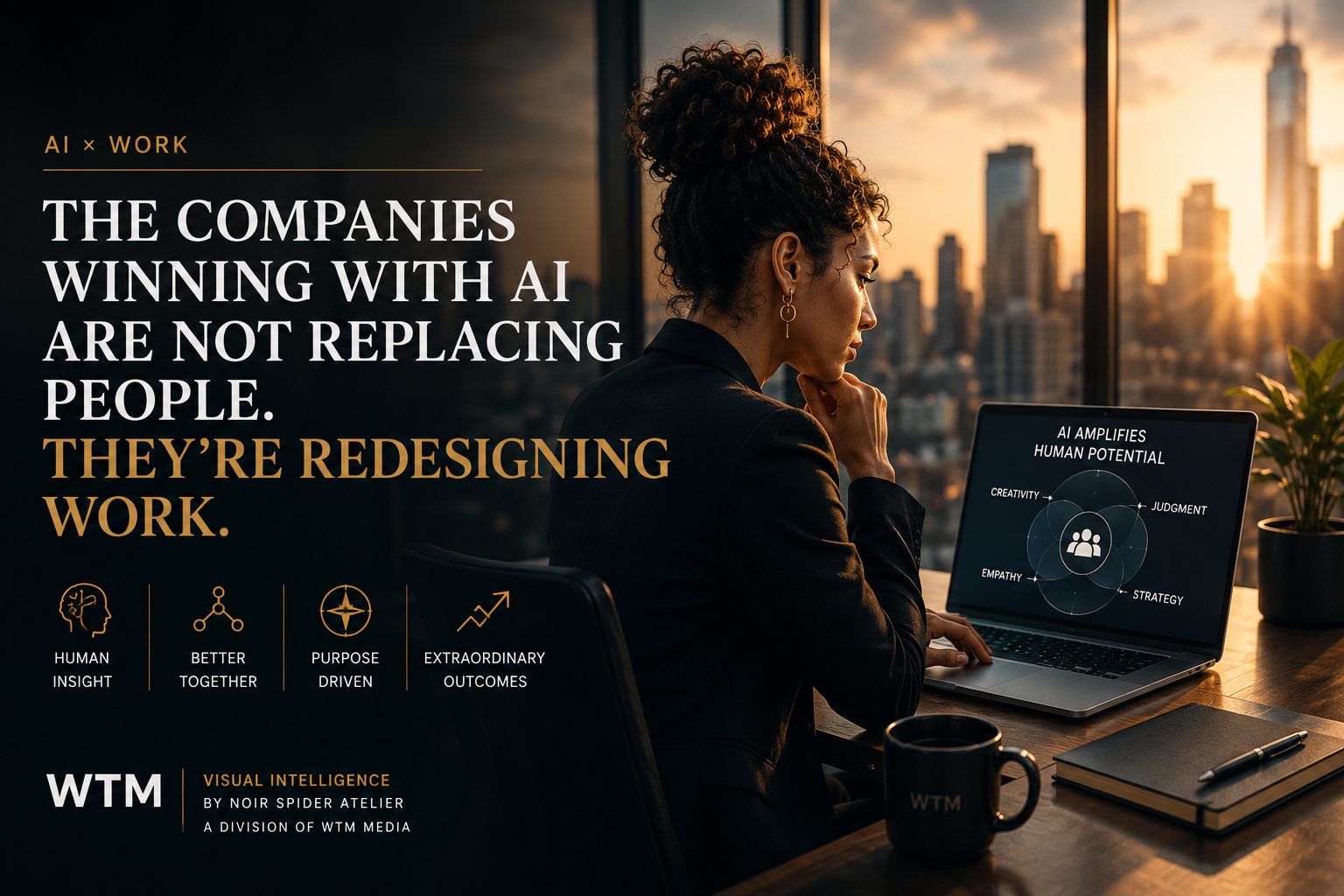
WTM calls this Human Leverage. AI compresses execution. Humans expand possibility. Machines multiply capability. People multiply direction. Organisations that confuse these roles will automate themselves into mediocrity. Those that understand the distinction will redesign work around what remains uniquely human and, in doing so, create advantages competitors cannot easily replicate.

Artificial intelligence is rapidly becoming infrastructure. Like electricity, cloud computing, or the internet, it will soon cease to be a meaningful differentiator because nearly every organisation will have access to similar models, similar computing power, and similar capabilities. When everyone possesses comparable technology, competitive advantage inevitably migrates elsewhere. The winners will not be those with the best AI. They will be those with the best decisions.
History repeatedly demonstrates this pattern. Spreadsheets did not create extraordinary companies. They improved accounting. Search engines did not create great businesses. They improved access to information. Smartphones did not create visionary leaders. They expanded communication. Technologies become democratised. Leadership remains scarce. As AI becomes universally available, judgement, wisdom, timing, institutional trust, and disciplined execution become increasingly valuable because they cannot simply be downloaded or licensed.
This is precisely why the organisations thriving with AI are investing heavily in culture rather than merely software. Culture determines whether employees challenge poor assumptions, collaborate across disciplines, share knowledge, adapt to change, and make ethical decisions when algorithms cannot. AI may recommend thousands of possible actions. Organisational culture determines which one is actually chosen. Technology scales capability. Culture scales judgement.
The same principle applies to individuals. As AI lowers the cost of producing reports, presentations, software, marketing campaigns, research summaries, and creative drafts, the marketplace increasingly rewards people who ask better questions instead of merely generating faster answers. Curiosity becomes an economic asset. Discernment becomes a professional advantage. Systems thinking becomes a leadership requirement. The ability to connect seemingly unrelated ideas across disciplines becomes increasingly rare precisely because machines optimise within patterns rather than intentionally redesign them.
This emerging reality transforms education as well. For decades, schools rewarded memorisation and procedural accuracy because information was relatively scarce. That scarcity has disappeared. The future belongs to those capable of synthesising knowledge, evaluating conflicting evidence, exercising moral judgement, collaborating across cultures, communicating complex ideas simply, and leading through uncertainty. AI accelerates learning, but it cannot replace the human responsibility of deciding what deserves to be learned and why it matters.

In the Human Leverage Economy, artificial intelligence becomes the engine, human judgement becomes the steering wheel, strategy determines the destination, and the institutions that invest exclusively in faster technology may gain temporary efficiency. Those that simultaneously develop wiser leaders, stronger cultures, ethical governance, and systems-level thinking will create enduring competitive advantage. In an age where intelligence is abundant, wisdom becomes the rarest form of capital.
Why These Matter - WTM MEDIA is an independent editorial platform exploring the forces shaping our world—through people, culture, commerce, design, systems, and governance. Connecting the dots between today’s headlines and tomorrow’s realities.