Most people believe David Beckham changed football in America because he was a great footballer. They are only partially correct. His greatest contribution had little to do with goals, trophies, or free kicks. Beckham helped redesign how America perceived the world’s most popular sport. His arrival accelerated investment, attracted international attention, reshaped Major League Soccer’s commercial strategy, encouraged youth participation, and demonstrated that culture can cross borders when trust arrives before the product. This is not simply the story of one athlete. It is a lesson in leadership, branding, economics, psychology, and institutional strategy. Every business seeking to enter a new market can learn from what Beckham accomplished without ever intending to become a case study in global systems thinking.
America did not wake up one morning and decide to love football. Its stadiums did not suddenly fill. Children did not suddenly swap basketballs for footballs.
Television executives did not suddenly discover the world’s most popular sport. Something changed. More accurately, someone changed it.
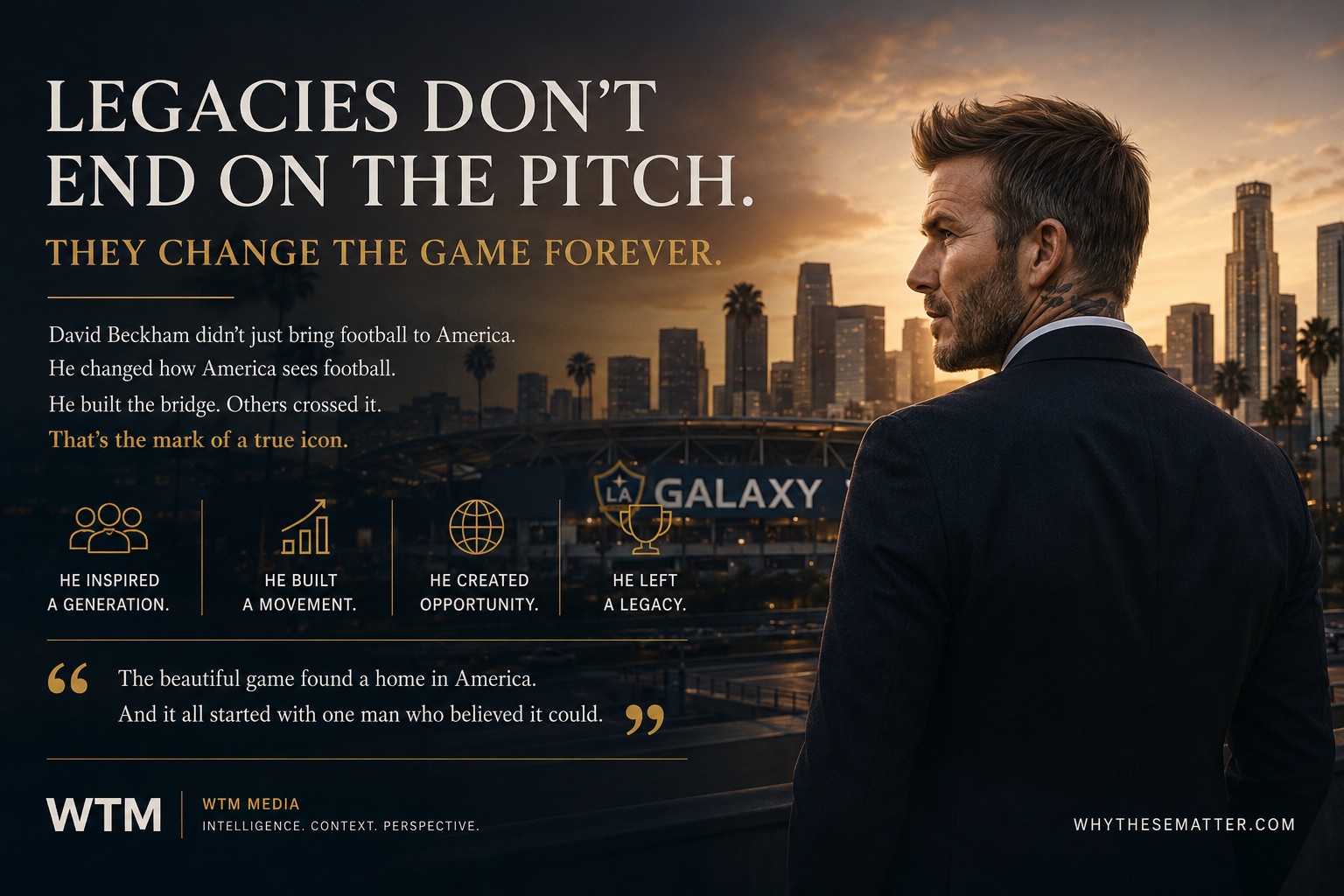
When David Beckham landed in Los Angeles in 2007, millions believed America had signed another ageing European football star looking for one final payday. History has quietly rewritten that assumption. Beckham’s greatest goal may never have been scored on a football pitch. It was scored inside the American imagination.
For generations, football occupied an unusual position in American life. While billions of people across Europe, South America, Africa and Asia treated football almost as a second religion, the United States remained devoted to its own sporting traditions. American football filled enormous stadiums every weekend. Basketball created global superstars. Baseball carried nostalgic symbolism stretching back more than a century. Ice hockey commanded loyal regional audiences. Football, despite being the world’s most popular sport, remained something many Americans associated with children playing on suburban weekends before eventually moving towards other sports. It was visible, but rarely central.
This disconnect was never simply about athletic preference. It reflected culture. Americans had built their own sporting identity around games invented or perfected within their own borders. Football arrived carrying foreign accents, unfamiliar traditions and competitions played thousands of miles away. Most Americans could not explain promotion and relegation, the Champions League, or why clubs carried histories older than many American cities. Football was not merely competing against other sports. It was competing against familiarity.
The leaders of Major League Soccer recognised this challenge. They understood that improving the quality of football alone would not automatically attract millions of new supporters. Better players help, but markets rarely transform simply because a product improves. Consumers must first believe the product belongs in their lives. That belief cannot be manufactured through advertising alone. It must be earned through trust, aspiration and relevance. MLS needed more than a footballer. It needed a cultural bridge.
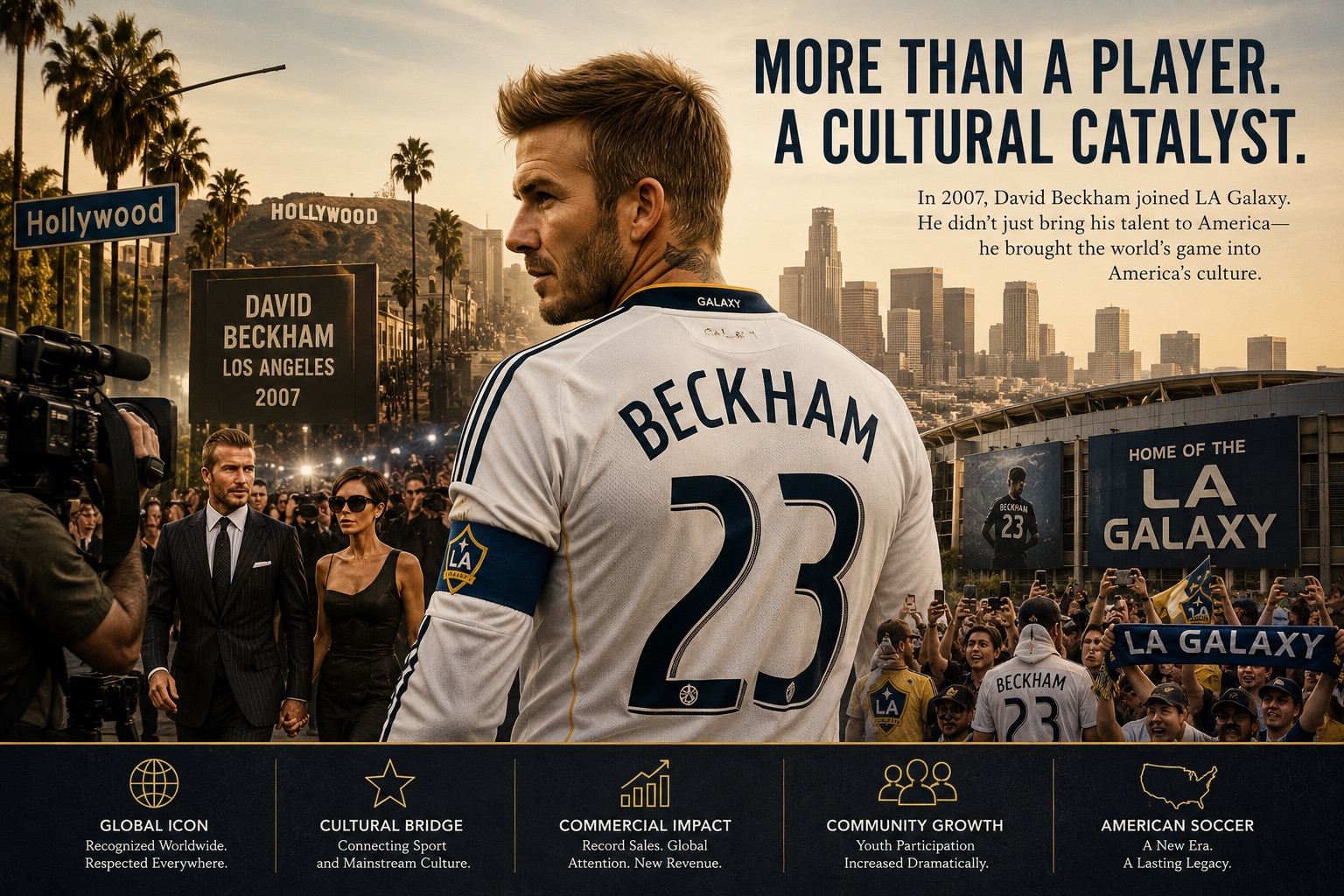
David Beckham represented precisely that bridge. He arrived as one of the world’s most recognisable athletes, yet his influence extended far beyond football. His marriage to Victoria Beckham had already connected sport with fashion, entertainment and celebrity. Together they occupied a rare position where sporting excellence intersected with popular culture. Americans who had never watched a Premier League match recognised Beckham from magazine covers, television interviews and international advertising campaigns. Long before many people understood football, they already understood Beckham.
Los Angeles proved equally important. Had Beckham signed for a smaller market, history might have unfolded differently. Los Angeles represented Hollywood, entertainment, fashion, global media and celebrity. Every public appearance generated headlines extending well beyond the sports pages. Beckham did not simply join the LA Galaxy. He entered the centre of American cultural production. Football suddenly appeared alongside film premieres, fashion events and entertainment news. Millions encountered the sport indirectly through conversations about Beckham himself.
That distinction matters because culture rarely changes through direct persuasion. People seldom adopt entirely new habits because someone explains the statistics. They adopt new habits because trusted individuals make unfamiliar ideas feel normal. Beckham normalised football for millions of Americans who previously viewed it as foreign. Before he changed the game, he changed the conversation. That was the first victory, and perhaps the most important one.
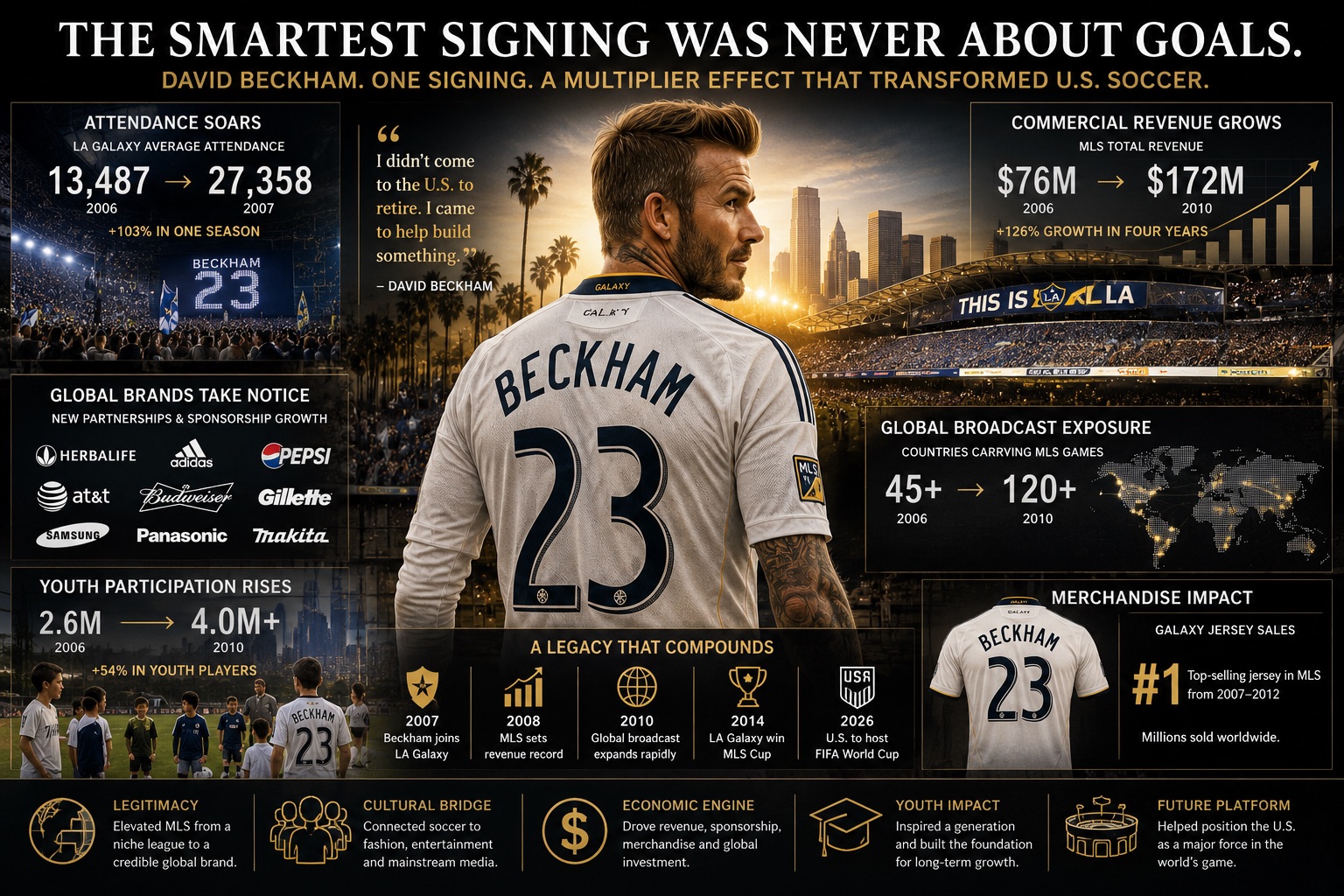
When David Beckham signed with the LA Galaxy in 2007, headlines focused on his left foot. Boardrooms focused on something entirely different. League executives were not simply acquiring one of the world’s most recognisable footballers. They were investing in visibility, legitimacy and belief. Beckham became an economic asset whose greatest returns would be measured not in goals scored, but in attention earned. His arrival transformed football from a niche sporting interest into a mainstream commercial conversation. Long before the trophies arrived, the investment had already begun paying dividends.
Professional sport is often misunderstood because people see only what happens on the pitch. The real business begins long before kick-off. Every successful league competes for television audiences, sponsorship agreements, licensing revenue, merchandise sales, international media rights and future generations of supporters. Beckham accelerated every one of those conversations. Ticket demand increased. Stadium attendance rose. International broadcasters became more interested in American football. Global brands suddenly viewed Major League Soccer as a platform worth watching. The league was no longer selling ninety minutes of football. It was selling a growing vision of America’s place in the world’s game.
Perhaps the most revolutionary outcome was not financial but structural. Beckham’s arrival led directly to the creation and validation of the Designated Player Rule, often referred to as the “Beckham Rule.” Until then, Major League Soccer operated under strict salary limitations designed to protect financial stability. Beckham demonstrated that strategic exceptions could generate far greater economic value than rigid equality. A carefully selected global icon could create commercial returns that benefited every club. The lesson extended far beyond football: sometimes disciplined flexibility creates stronger institutions than inflexible rules.
Corporate America also recognised something many observers overlooked. Beckham represented an unusually rare combination of credibility across multiple industries. Sports companies saw an elite athlete. Fashion brands saw timeless style. Luxury brands saw sophistication. Family-oriented advertisers saw professionalism and stability. Media companies saw compelling storytelling. Unlike many athletes whose commercial value remained confined to sport, Beckham became a bridge connecting audiences that rarely occupied the same marketplace. His personal brand reduced risk for advertisers because he appealed simultaneously to football supporters, casual consumers and aspirational lifestyle audiences.
The effects extended well beyond the professional game. Across the United States, youth football participation continued its long-term expansion as more families viewed the sport differently. Children who watched Beckham did not simply admire a player; they saw football receiving the same cultural attention traditionally reserved for basketball, baseball or American football. Investment followed participation. Participation attracted better coaching. Better coaching improved competition. Improved competition strengthened academies. Academies produced better players. Better players raised the standard of the domestic league. What appeared to be a celebrity signing quietly became a systems investment that strengthened multiple layers of American football over time.
This is how transformational institutions think. They understand that today’s transaction can become tomorrow’s ecosystem. Major League Soccer did not purchase David Beckham merely to improve one team’s performance. It purchased a catalyst capable of changing public perception, commercial confidence and international credibility simultaneously. Goals entertained supporters for ninety minutes. Trust reshaped an industry for decades. Beckham’s greatest contribution was not teaching America how to play football. It was convincing America that football deserved a permanent place within its sporting identity.
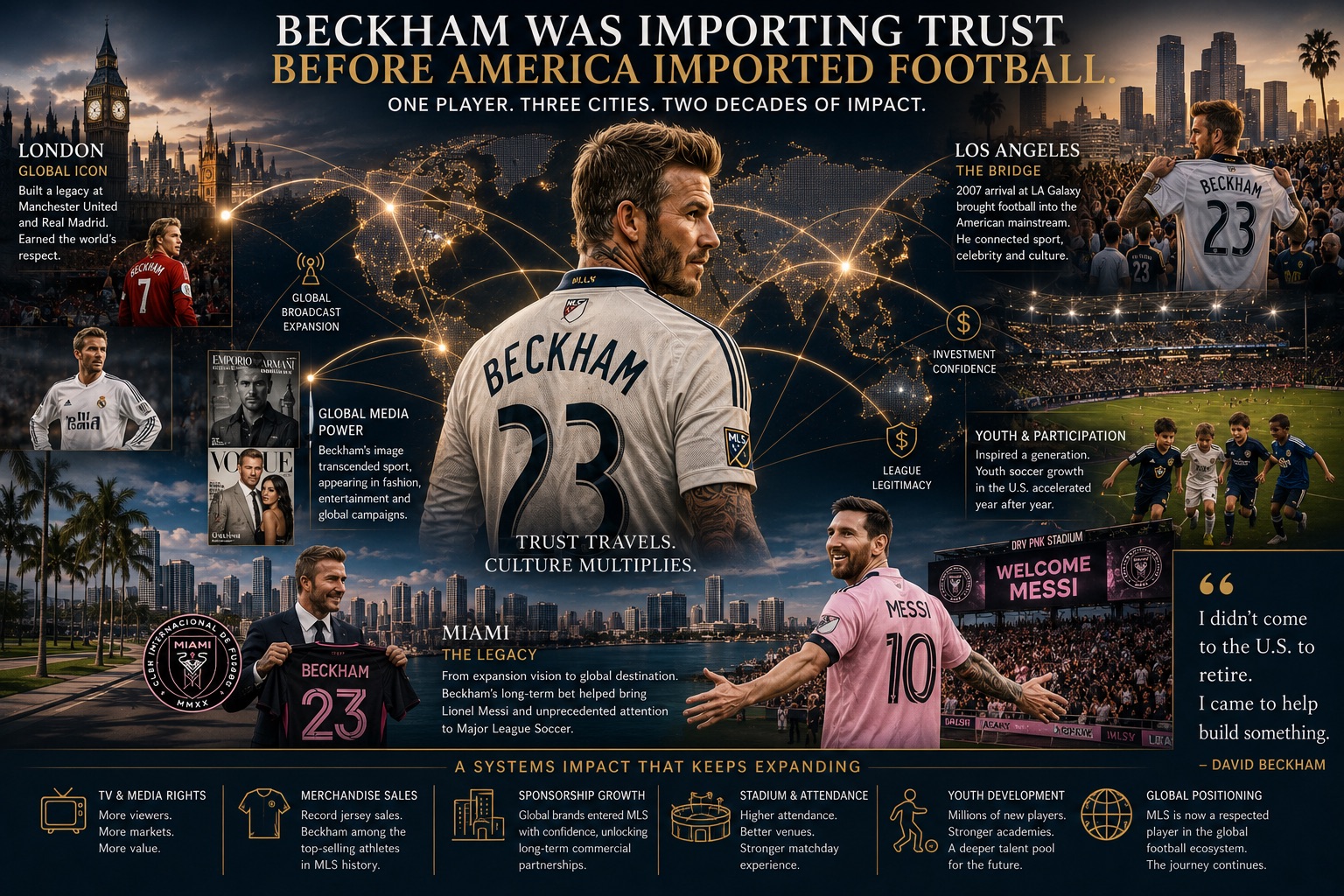
Every successful civilisation has imported ideas before it imported products. The Roman Empire adopted engineering from conquered societies. Britain transformed tea into a national ritual after importing it from Asia. Japan absorbed Western manufacturing techniques before becoming an industrial powerhouse. Silicon Valley itself grew by attracting the world’s brightest minds rather than inventing every breakthrough internally. Markets rarely change because a superior product appears. They change because a trusted messenger makes unfamiliar ideas feel familiar. David Beckham became that messenger for American football.
Trust is one of the least understood assets in business because it never appears on a balance sheet. Companies measure revenue, profit and market share, yet trust quietly determines all three. Before Beckham arrived, many Americans respected football but did not feel connected to it. The sport lacked cultural proximity. Beckham reduced that distance. Parents became more willing to enrol their children in football academies. Sponsors became more comfortable investing in Major League Soccer. Television executives gained confidence that audiences would grow. Investors began viewing football not as a niche pastime but as an emerging commercial platform. Beckham did not manufacture trust. He transferred it.
His influence also demonstrated the power of network effects. One respected individual can alter the behaviour of millions because every relationship creates another connection. Beckham attracted international broadcasters. Broadcasters attracted advertisers. Advertisers attracted investment. Investment improved facilities. Better facilities attracted stronger players. Stronger players elevated the quality of competition. Higher-quality football attracted larger audiences, creating additional commercial confidence. No single decision transformed American football. The transformation occurred because one trusted node strengthened every connection across the entire system. Institutions often underestimate this multiplier effect because they evaluate individual transactions rather than interconnected ecosystems.
Perhaps the most enduring consequence emerged years after Beckham retired. In 2014, he exercised an option negotiated as part of his original MLS contract to establish a new expansion club in Miami. That decision eventually became Inter Miami CF. Years later, the club signed Lionel Messi, arguably the greatest footballer of his generation. The arrival of Messi produced unprecedented global attention for Major League Soccer, generated record-breaking subscription growth for streaming platforms, increased international broadcasting demand and dramatically expanded commercial interest in the league. The road to Messi did not begin in Miami. It began when Beckham first demonstrated that America could become a credible destination for the world’s elite footballers.
This pattern extends far beyond sport. Every organisation entering a new market faces the same challenge. Technology companies expanding into healthcare must first earn clinical trust before selling software. Universities opening international campuses must establish academic credibility before recruiting students. Luxury brands entering emerging economies invest heavily in reputation before expecting sustained demand. Even governments rely upon diplomacy, cultural exchange and institutional confidence before securing long-term partnerships. Beckham’s story illustrates a universal principle: trust travels further than advertising. Credibility creates opportunities that money alone cannot purchase.
For WTM, this is the deeper lesson hidden beneath the football headlines. Beckham did not simply expand a league. He redesigned perception. He proved that culture is infrastructure. Institutions that understand culture build movements. Institutions that ignore culture merely launch products. Twenty years after Beckham arrived in Los Angeles, American football continues to grow, global investment continues to accelerate, and the United States prepares to co-host the 2026 FIFA World Cup before welcoming the 2028 Summer Olympics. Those milestones are the visible outcomes. The invisible achievement happened much earlier. America first learned to trust the world’s game because one footballer made an unfamiliar sport feel like it belonged.
Every organisation eventually asks the same question: how do we enter a market that already belongs to someone else? Most answer with larger advertising budgets, lower prices, celebrity endorsements, or louder marketing. Beckham’s story demonstrates that lasting market entry rarely begins with selling harder. It begins with creating trust before asking for transactions. America did not suddenly become interested in football because a foreign athlete arrived. It became interested because Beckham reduced uncertainty. He made an unfamiliar sport feel culturally familiar. That distinction separates marketing from systems design.
This lesson extends far beyond sport. Nations seeking investment, companies launching new technologies, universities recruiting international students, and publishers introducing unfamiliar ideas all face the same challenge. People rarely reject innovation because it lacks quality. They reject it because they lack confidence in it. Institutions that understand this spend less time convincing audiences to buy and more time helping audiences feel comfortable enough to explore. Trust is often the first product any institution truly sells.
The implications for leadership are equally profound. Executives frequently evaluate investments through quarterly financial statements, yet transformational investments often appear irrational in their early years. Beckham’s contract attracted criticism because it was expensive. Looking only at player statistics, many considered it a poor financial decision. Looking at the broader system, however, Major League Soccer acquired global media attention, corporate sponsorships, international legitimacy, and cultural relevance that would have been extraordinarily difficult to purchase through conventional advertising. Long-term strategic value frequently hides behind short-term accounting.
There is also an important lesson about culture itself. Successful institutions do not simply export products. They export narratives. Beckham brought with him professionalism, fashion, discipline, family values, celebrity appeal, and global aspiration. Those qualities reshaped perceptions of football in the United States far more effectively than any marketing campaign could. Culture moves through people before it moves through policy, commerce, or infrastructure. The individual often becomes the bridge through which an entire institution crosses into a new society.

Why These Matter - WTM MEDIA is an independent editorial platform exploring the forces shaping our world—through people, culture, commerce, design, systems, and governance. Connecting the dots between today’s headlines and tomorrow’s realities.