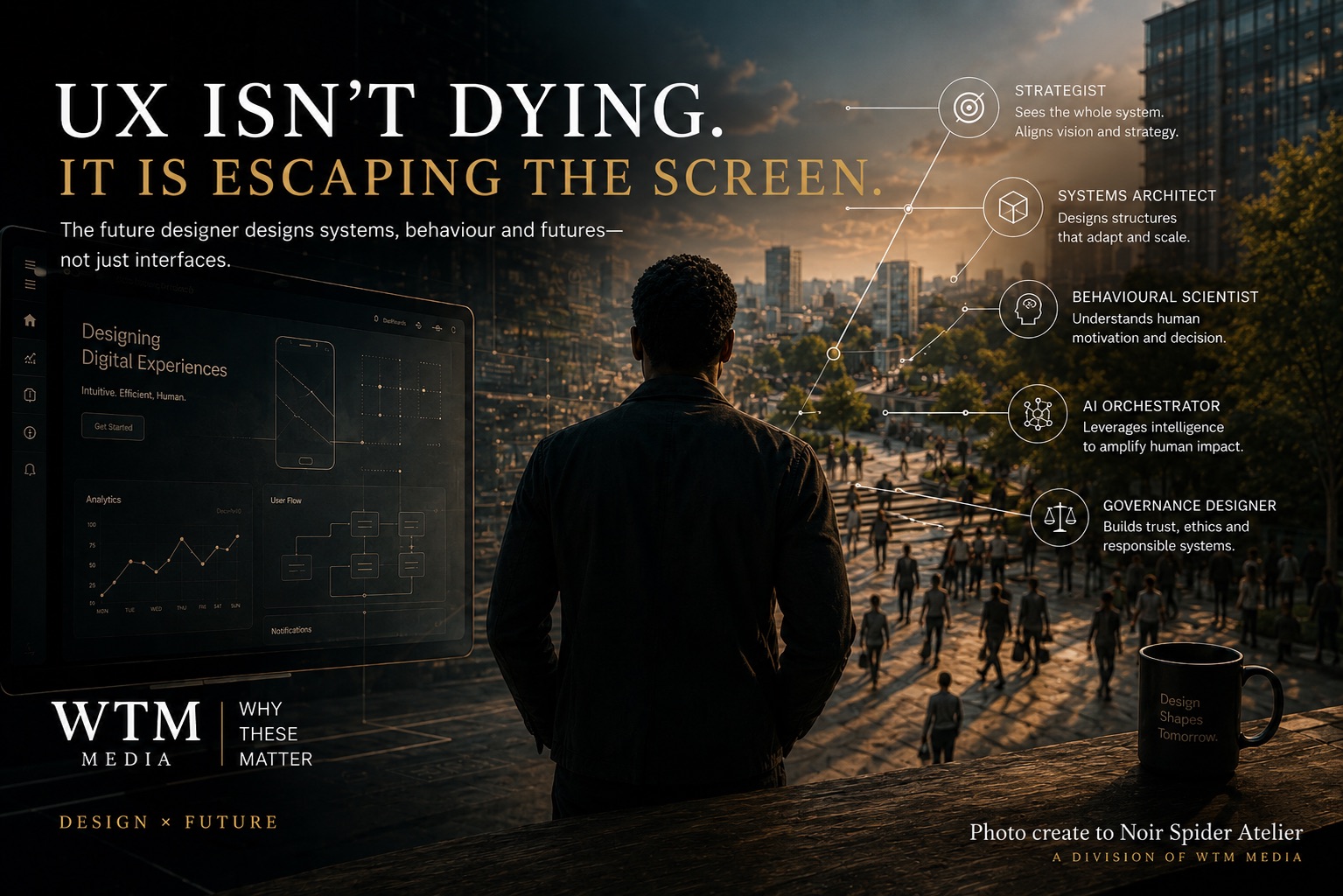
Every few years, the design industry announces its own demise. Print was supposedly replaced by digital. Graphic design would disappear beneath templates. User experience would be automated by artificial intelligence. Today, another familiar narrative is circulating: UX is dead. Yet this diagnosis mistakes a change in medium for a collapse in purpose. User experience is not disappearing. It is expanding beyond the screen into every system that shapes human behaviour. Louis Rosenfeld, one of the discipline’s foundational thinkers, has argued that UX is undergoing profound transformation rather than extinction. The growing influence of artificial intelligence, autonomous systems and organisational complexity demands designers who understand far more than interfaces. Increasingly, the most valuable practitioners are not pixel specialists but strategic thinkers capable of designing incentives, governance, decision-making, trust and institutional resilience. The future therefore belongs to a different kind of designer. Less concerned with arranging buttons, more concerned with orchestrating relationships between people, algorithms, organisations and society. UX is escaping websites, applications and devices because human experience has never been confined to screens. It has always been embedded within systems. As technology dissolves traditional boundaries, design itself is becoming one of the defining leadership disciplines of the twenty-first century.
For years, designers have asked one question. How do we improve the interface?
The next generation will ask a different one. How do we redesign the system behind it?
Those questions sound similar. They will produce entirely different careers.
The technology industry has spent decades teaching us to believe that design is what appears on a display. Beautiful interfaces became synonymous with good design, while usability testing, colour systems and component libraries evolved into the profession’s defining language. Yet most frustrations people experience have little to do with buttons or typography. They emerge from the invisible decisions governing policies, incentives, organisational priorities and institutional behaviour long before an interface is ever constructed.
Consider the experience of applying for a mortgage, navigating healthcare, boarding an aircraft or disputing a bank transaction. Poor experiences are rarely caused by the screen itself. They originate in fragmented organisations, conflicting objectives, outdated regulations or inefficient processes. The interface merely exposes deeper structural weaknesses. Designers who only redesign screens often treat symptoms while leaving underlying conditions untouched.
This distinction becomes increasingly important as artificial intelligence automates routine interface production. Large language models can already generate layouts, write interface copy, suggest colour palettes and construct functional prototypes in minutes. These capabilities reduce the scarcity of interface execution while increasing demand for those who understand why experiences succeed or fail in the first place.
Human experience has always extended beyond digital products. It includes expectations, trust, culture, waiting, communication, emotion and memory. A citizen interacting with a government service experiences legislation as much as software. A patient experiences hospital governance alongside medical treatment. A traveller experiences airport logistics before they ever interact with an application. Design therefore begins where systems begin, not where pixels appear.
The organisations adapting most successfully to technological change increasingly position design alongside executive decision-making rather than beneath software engineering. Designers participate in discussions involving organisational strategy, ethics, public policy and business transformation because these domains ultimately determine customer experience far more than interface aesthetics.
UX is therefore not shrinking. It is returning to its original purpose: understanding human experience wherever it occurs. The screen was simply one chapter within a much larger story.

Modern organisations no longer compete solely through products. They compete through systems capable of adapting faster than their environments change. Artificial intelligence accelerates this reality by reducing the cost of production while increasing the value of judgement. As execution becomes abundant, strategic thinking becomes scarce.
This transformation reshapes the designer’s role. Tomorrow’s practitioners must understand behavioural economics alongside interaction design, organisational psychology alongside accessibility, governance alongside automation. They become translators between executives, engineers, policymakers and citizens. Their value increasingly lies in orchestrating complexity rather than simplifying interfaces alone.
Systems thinking becomes essential because every design decision generates second- and third-order consequences. Recommendation algorithms reshape public discourse. Payment interfaces influence financial behaviour. Navigation systems alter urban development. Educational platforms redefine learning itself. Designers now participate in constructing social infrastructure whether they acknowledge it or not.
Artificial intelligence introduces another responsibility: governance. Every autonomous system embodies assumptions about fairness, accountability and acceptable behaviour. Someone decides which values become embedded within machine decision-making. Increasingly, that responsibility belongs to multidisciplinary teams where designers help translate ethical principles into practical human experiences.
The profession therefore begins converging with fields once considered distant. Public administration, architecture, economics, anthropology, cybersecurity and law increasingly intersect inside contemporary design practice. Future designers become institutional thinkers because institutions themselves are becoming programmable.
This explains why organisations now recruit design leaders into boardrooms rather than studios. They recognise that competitive advantage increasingly depends upon understanding relationships rather than interfaces. Systems become the product. Experience becomes governance.
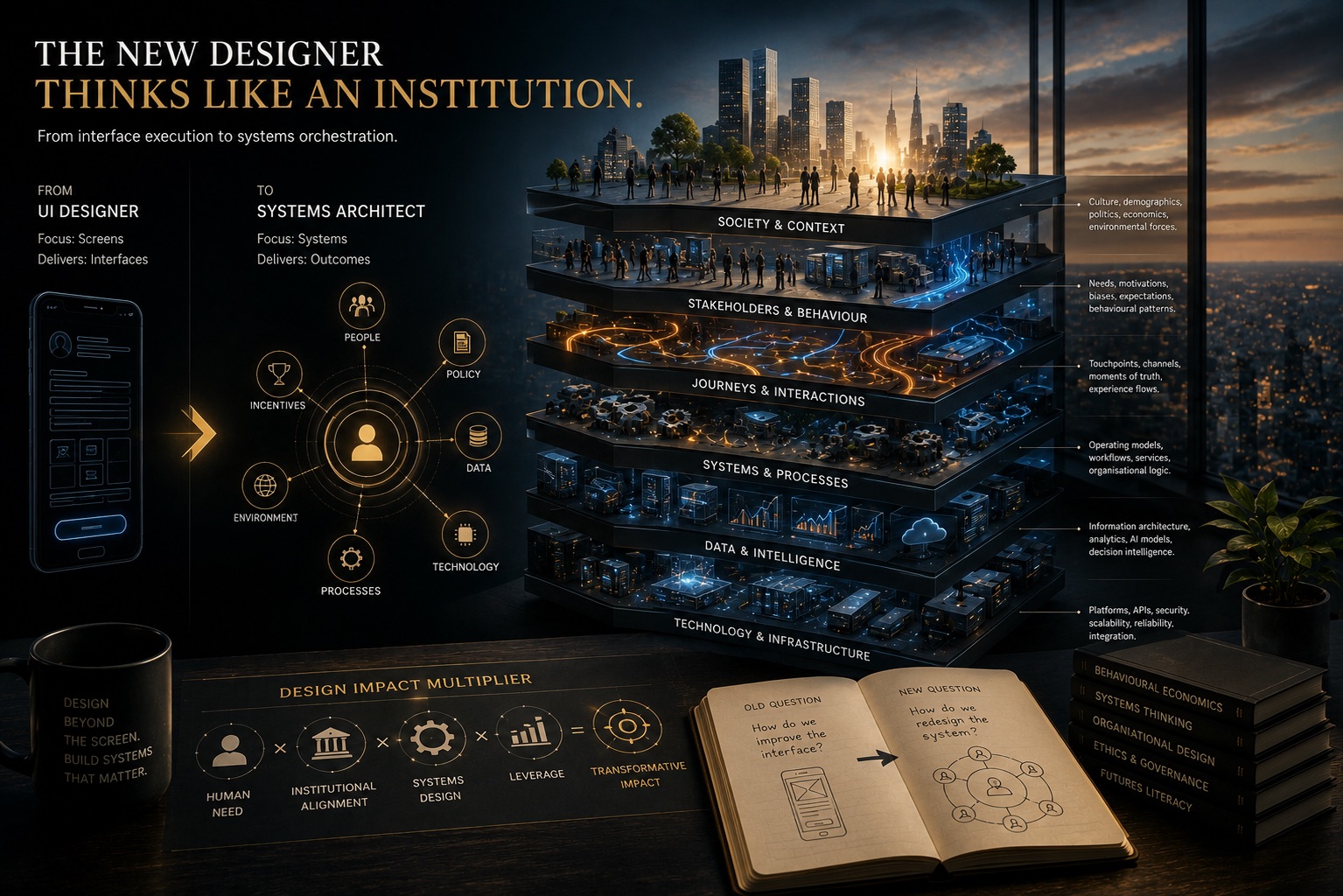
History suggests that every technological revolution eventually transforms the professions responsible for organising society around it. The Industrial Revolution elevated engineers. The Information Age elevated software developers. The emerging Intelligence Age may elevate those capable of designing relationships between humans and increasingly autonomous systems.
Louis Rosenfeld’s observations therefore extend well beyond professional development. They reveal a broader transition in how societies coordinate complexity. Designers become architects of institutional behaviour because institutions increasingly rely upon designed interactions rather than purely administrative processes.
Consider governments deploying AI-assisted public services, hospitals integrating predictive diagnostics, universities personalising education, financial institutions automating lending or cities managing transportation through autonomous infrastructure. None of these challenges can be solved by interface design alone. They require professionals capable of balancing efficiency, trust, ethics, resilience and human dignity simultaneously.
The most influential designers of the next two decades may never create consumer applications at all. They may instead redesign healthcare systems, climate adaptation programmes, judicial processes, educational ecosystems or democratic participation itself. Their work will shape millions of lives without most citizens ever knowing their names.
This evolution fundamentally changes design education. Teaching software alone becomes insufficient. Tomorrow’s curriculum increasingly incorporates philosophy, economics, behavioural science, complexity theory, geopolitics and organisational leadership. The designer becomes a generalist capable of integrating specialist knowledge across multiple domains.
Perhaps UX was never about users in isolation. Perhaps it has always been about civilisation—about designing environments where humans, institutions and technologies cooperate more intelligently. Artificial intelligence has not diminished that responsibility. It has magnified it.
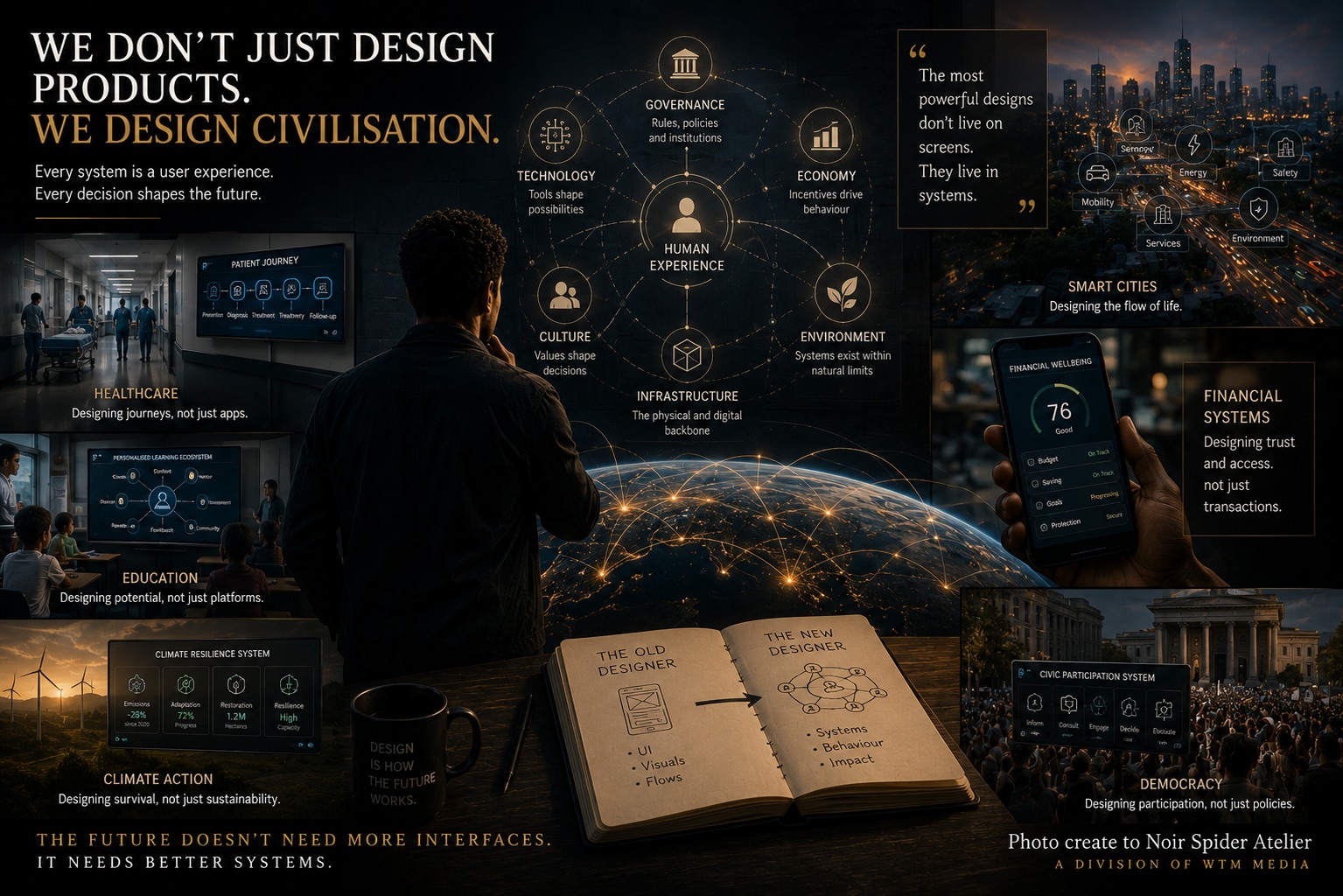
The debate over whether UX is dying is ultimately a distraction. The more consequential question is whether organisations recognise that experience has become infrastructure. Every interaction between people and institutions now influences trust, legitimacy and long-term societal resilience. Experience is no longer cosmetic. It is strategic.
For an eighth-grade student, this transformation means future careers will not be defined simply by learning software. The most valuable people will understand people. They will ask why problems exist before deciding how to solve them. Curiosity, empathy and critical thinking will become competitive advantages because artificial intelligence increasingly performs technical execution.
For business leaders, the implications are equally profound. Competitive advantage will emerge less from building another application and more from redesigning how organisations learn, decide and adapt. The companies that thrive will treat design as an executive capability rather than a production function. Strategy without human-centred design will become increasingly fragile.
A British philosopher might observe that civilisation progresses not merely through invention but through better arrangements of human cooperation. An African elder might add that a village flourishes because every path between people is carefully maintained. Both perspectives describe the same truth: systems matter because relationships matter.
In Nigeria, there is an enduring understanding that communities survive through interconnected responsibility rather than isolated achievement. The future digital economy demands precisely this philosophy. Artificial intelligence may automate tasks, but it cannot automate stewardship. Someone must continue designing the conditions under which humans trust, collaborate and prosper together.
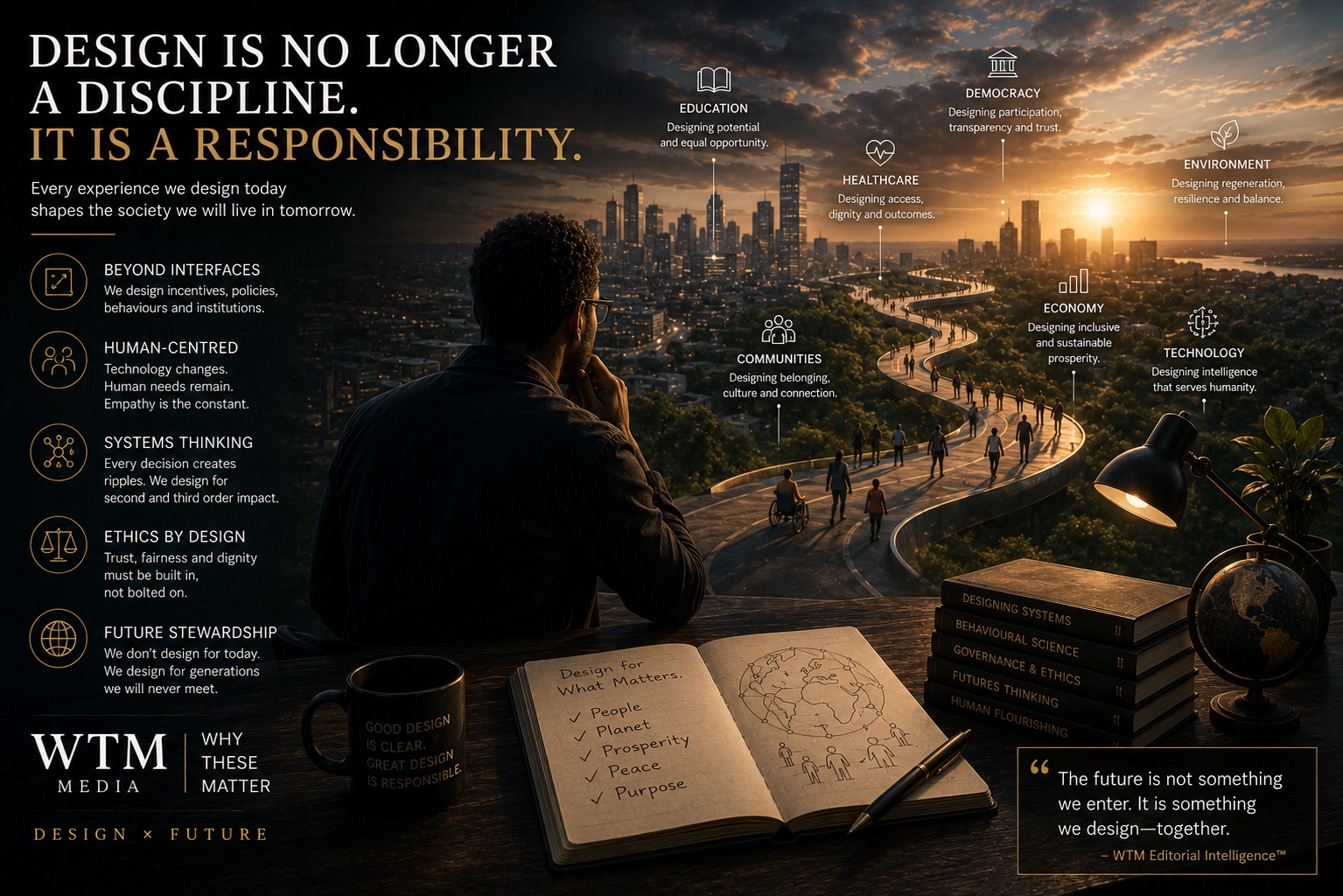
UX has not reached its end. It has reached its escape velocity. The designers who continue drawing screens will remain valuable. The designers who learn to shape institutions, incentives, governance and civilisation itself will define the next era. The future belongs not to those who design interfaces, but to those who design the systems that make better futures possible.
Reader Reflection
If artificial intelligence can increasingly design the interface, what uniquely human capability should designers spend the next decade mastering?
Sources & Further Reading
Editorial Credits
Written by Kelly Dowd, MBA, MA & WTM Design Editor
Editorial Intelligence by WTM Media
Visual Intelligence by Noir Spider Atelier — A Division of WTM Media
Image Credits
Editorial visuals conceptualised by Noir Spider Atelier.
© 2026 WTM Media. All Rights Reserved.

Why These Matter - WTM MEDIA is an independent editorial platform exploring the forces shaping our world—through people, culture, commerce, design, systems, and governance. Connecting the dots between today’s headlines and tomorrow’s realities.