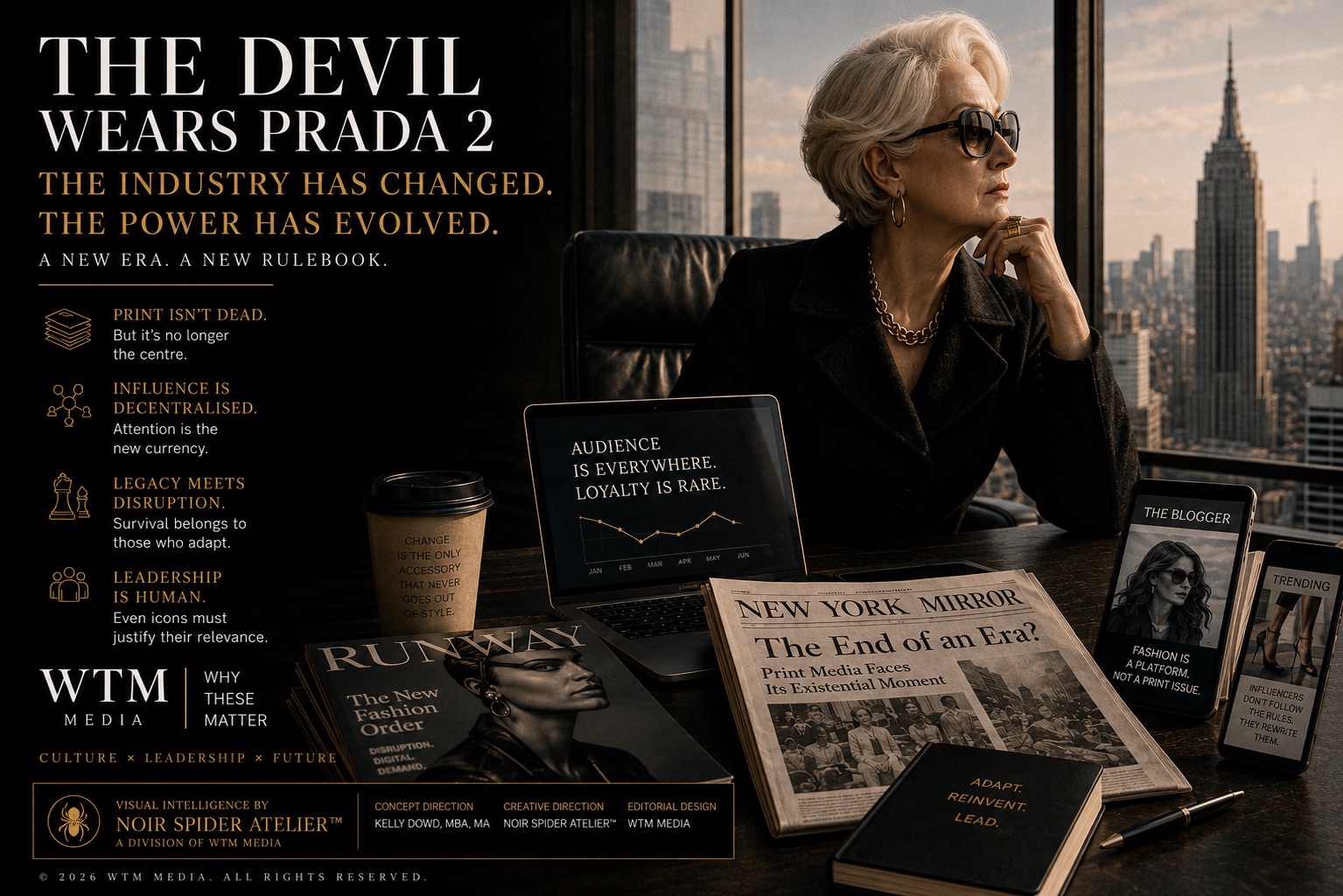
Twenty years after The Devil Wears Prada became one of the defining cultural films of the early twenty-first century, its sequel arrives with a noticeably different ambition. Rather than attempting to recreate the sharp glamour and quotable brilliance of the original, The Devil Wears Prada 2 examines what happens when an institution built for one era must survive another. Critics and audiences broadly agree that while the sequel lacks a cultural moment comparable to Miranda Priestly’s famous cerulean monologue, it succeeds by shifting the conversation from personal ambition to organisational adaptation. The film’s strongest contribution is not fashion, nostalgia or celebrity. It is its quiet recognition that industries age in much the same way people do. Print journalism confronts digital platforms. Hierarchical leadership collides with collaborative workplaces. Authority becomes accountable to governance. Influence competes with algorithms. The result is a story that reflects a broader transformation occurring across media, business and society. What appears to be a sequel about fashion is, in reality, an examination of institutional resilience in an era of accelerating disruption.
The original The Devil Wears Prada was frequently misunderstood as a film about luxury fashion. Fashion provided the visual language, but power supplied the narrative architecture. Miranda Priestly represented an institution whose authority shaped markets, careers and cultural taste. Her office functioned less like a magazine and more like a command centre within an analogue media ecosystem.
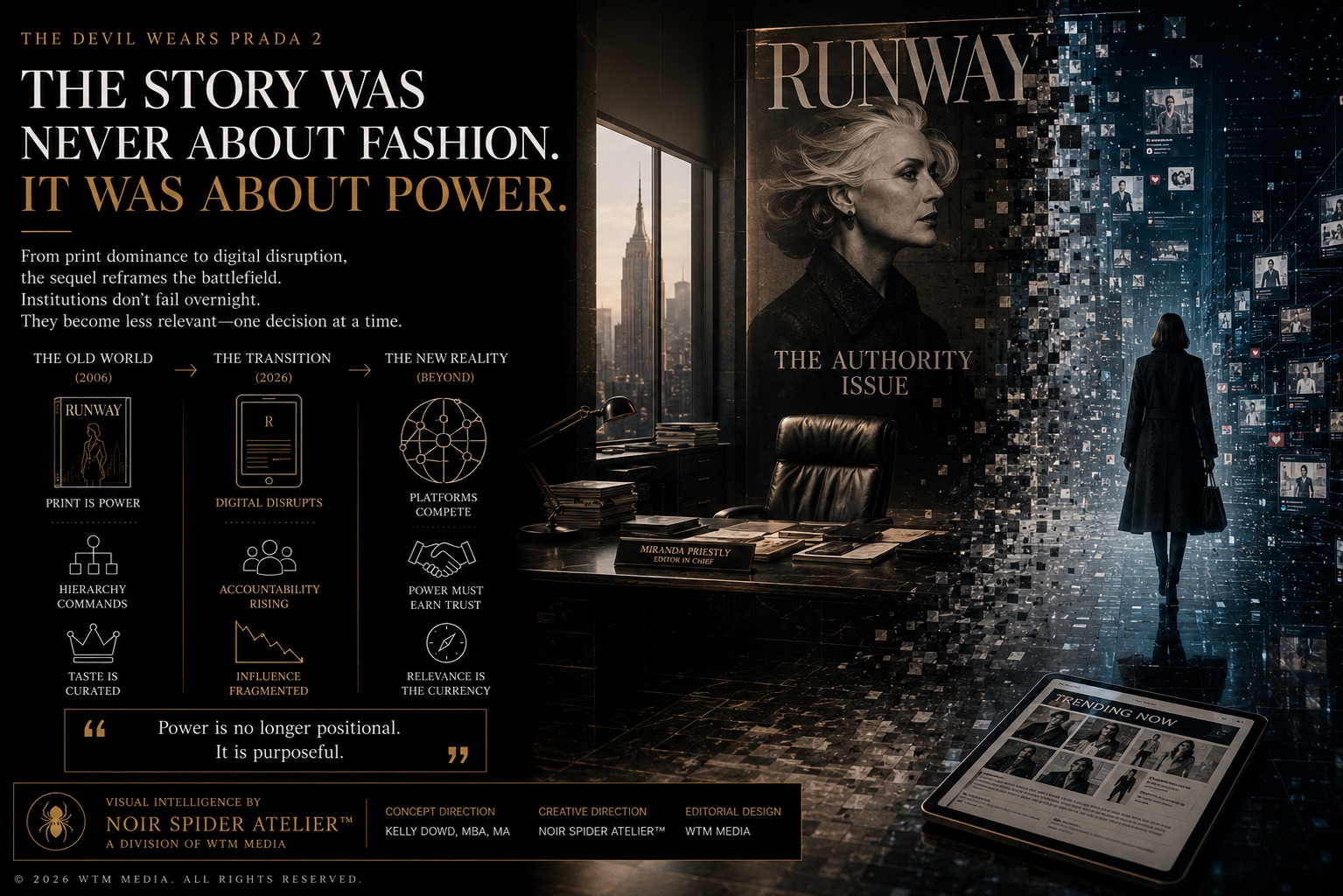
Nearly two decades later, that ecosystem has fractured. Print publications no longer monopolise attention. Social media democratises influence while simultaneously fragmenting it. Algorithms increasingly determine visibility where editors once exercised judgement. The sequel understands this transition and wisely positions fashion as the backdrop rather than the central conflict.
This shift mirrors transformations occurring far beyond publishing. Banks compete with fintech platforms. Universities face online learning ecosystems. Healthcare institutions integrate artificial intelligence into diagnosis. Even governments contend with decentralised information networks that bypass traditional gatekeepers. The underlying challenge is identical: maintaining legitimacy when technological infrastructure changes faster than organisational culture.
Miranda Priestly’s evolving character embodies this reality. She is no longer feared simply because she possesses authority. She must now justify that authority within a landscape governed by human resources, corporate oversight, shareholder expectations and digital metrics. Power has not disappeared; it has become accountable.
The sequel therefore reframes leadership. Rather than celebrating dominance, it explores adaptation. Institutions survive not because they resist change, but because they redesign themselves without abandoning the principles that originally made them valuable.
Viewed through this lens, the film ceases to be nostalgic entertainment. It becomes an allegory for every legacy organisation attempting to remain relevant in an increasingly digital civilisation.
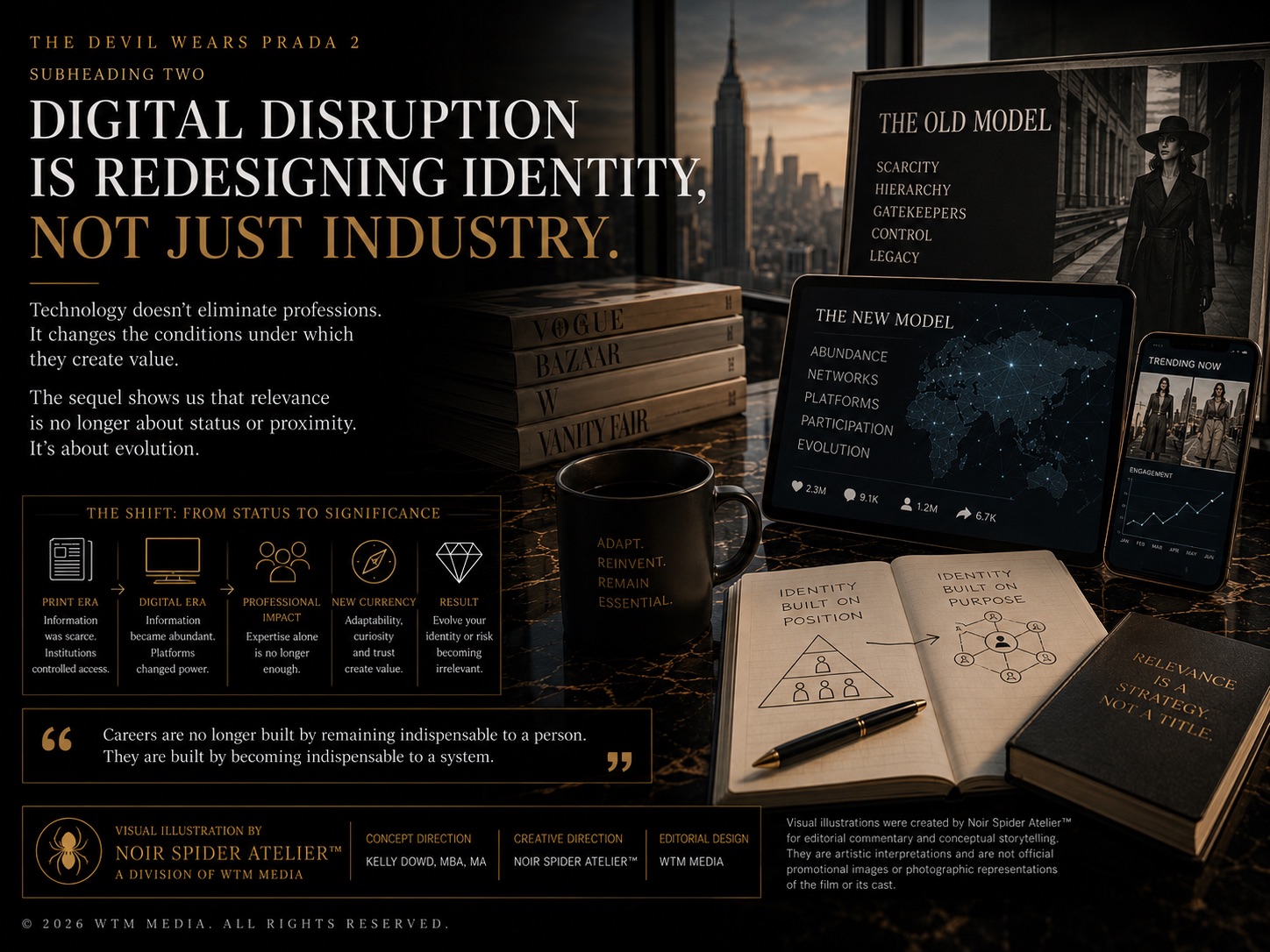
The sequel’s most compelling observation is that disruption rarely destroys industries first. It destabilises identity. Journalists question what journalism means when everyone publishes. Designers reconsider their role as interfaces give way to intelligent systems. Leaders discover that experience alone no longer guarantees influence.
Andy Sachs reflects this uncertainty. Professionally accomplished and personally more confident, she nevertheless spends much of the narrative responding to events rather than shaping them. Critics interpreted this as a weakness in character development. Strategically, however, it reflects a broader phenomenon affecting experienced professionals navigating structural disruption.
Emily Charlton offers a contrasting trajectory. Once defined by proximity to Miranda’s authority, she has developed independent influence. Her evolution demonstrates that sustainable careers are built not by remaining indispensable to a leader, but by becoming indispensable to a system.
Nigel continues to provide the emotional centre of the story because he represents something increasingly scarce: institutional memory. Every industry undergoing technological transformation requires individuals capable of translating history into future relevance. Their value lies not in resisting innovation but in ensuring continuity through change.
These dynamics extend beyond fashion. Artificial intelligence challenges designers to redefine creativity. Automation compels accountants to emphasise judgement over calculation. Physicians increasingly differentiate themselves through empathy as diagnostics become computational. Professional identity is shifting from task execution towards uniquely human capabilities.
The sequel succeeds because it recognises that technology rarely eliminates professions outright. It transforms the conditions under which those professions create value. The greatest risk is therefore not technological unemployment but professional stagnation.
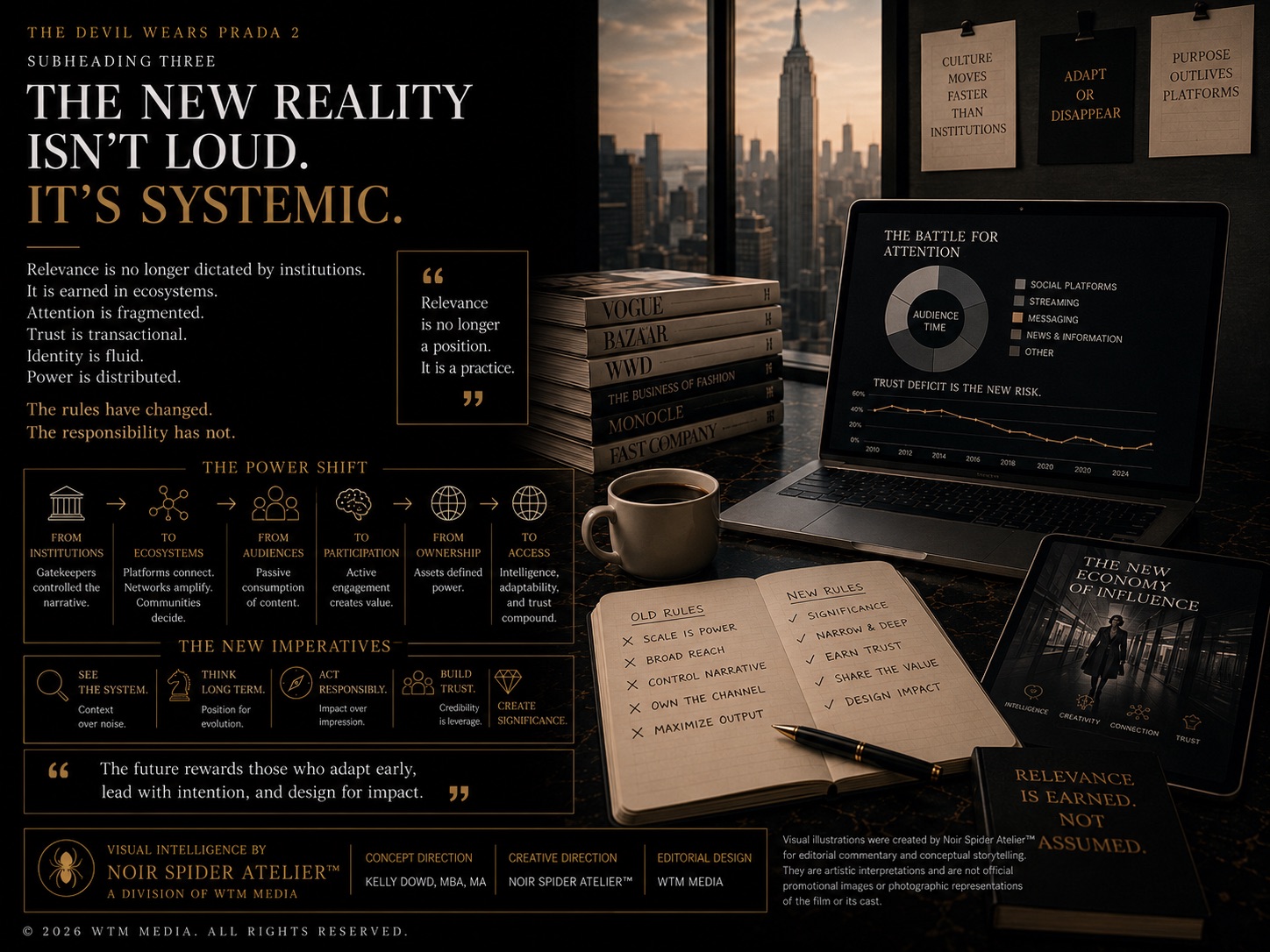
Perhaps the film’s most significant insight concerns institutional decline. Organisations seldom fail because of a single catastrophic mistake. More often, they lose relevance gradually by continuing to optimise systems designed for a world that no longer exists.
Print media illustrates this perfectly. Newspapers did not disappear because audiences stopped valuing information. They struggled because information distribution became effectively free while their business models remained tied to physical scarcity. The problem was architectural rather than editorial.
The sequel subtly presents Miranda facing precisely this dilemma. Her expertise remains extraordinary, yet expertise alone cannot preserve institutions whose economic foundations have shifted. Legacy becomes both an asset and a constraint.
Many critics argued the film relies heavily on nostalgia. That criticism is partially valid. Yet nostalgia itself becomes a strategic device. Every established institution possesses emotional equity accumulated over decades. The question is whether that equity becomes fuel for reinvention or an excuse for inertia.
History repeatedly supports this pattern. Companies including Kodak, Nokia and Blockbuster retained remarkable brands long after markets had changed. Conversely, organisations such as Microsoft and Adobe survived because they continually redesigned themselves despite past success. Institutional longevity depends less upon historical prestige than organisational adaptability.
Ultimately, The Devil Wears Prada 2 asks a question extending well beyond cinema: what should remain constant when everything else changes? The answer is neither tradition nor disruption in isolation. It is disciplined adaptation rooted in enduring purpose.
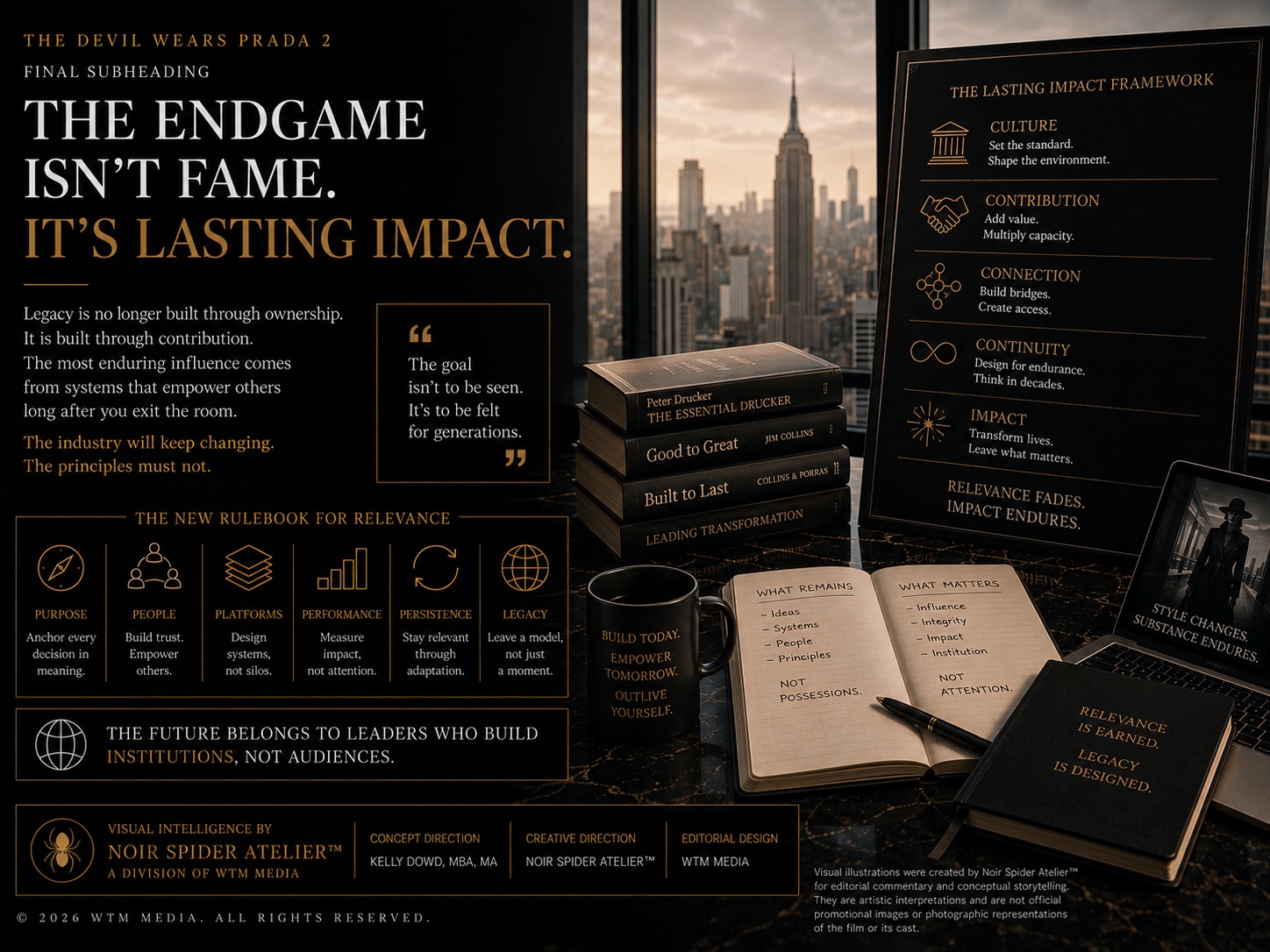
The film arrives at a moment when almost every institution confronts the same existential challenge. Artificial intelligence is redefining knowledge work. Digital platforms continue reshaping attention. Demographic shifts alter consumer expectations. Economic uncertainty rewards resilience over scale. Under these conditions, relevance becomes an organisational capability rather than a historical achievement.
For business leaders, the lesson is straightforward. Competitive advantage increasingly depends on redesigning systems before external pressure makes redesign unavoidable. Waiting until disruption becomes obvious usually means reacting rather than leading.
For designers, the sequel reinforces a broader transformation already underway. Design is moving beyond aesthetics into governance, behavioural architecture and institutional strategy. The designer of the future shapes incentives, trust and decision-making rather than simply interfaces.
For media organisations, the message is equally profound. Journalism’s value has never resided solely in publishing information. Its enduring purpose lies in verification, context and judgement. In an age saturated with content, discernment becomes more valuable than production volume.
For individuals, the film offers an equally practical lesson. Careers no longer progress through linear expertise alone. Adaptability, curiosity and systems thinking increasingly determine professional resilience. The question is no longer whether your industry will change. It is whether your identity evolves alongside it.
Perhaps this explains why the sequel resonates despite its imperfections. The original asked what ambition costs. The sequel asks what relevance requires. Those are fundamentally different questions, reflecting two fundamentally different eras.
The most enduring institutions are not those that preserve the past unchanged. They are those that reinterpret their founding purpose for a future their founders could never have imagined.
If your industry were rebuilt from scratch today, which parts of your expertise would remain indispensable—and which parts are valuable only because yesterday’s system still exists?
Sources & Further Reading
Editorial Credits
Written by Kelly Dowd, MBA, MA & WTM Entertainment Editor
Visual Intelligence
Visual illustrations were created by Noir Spider Atelier™ for editorial commentary and conceptual storytelling. They are artistic interpretations and are not official promotional images or photographic representations of the film or its cast.
Noir Spider Atelier™ — A Division of WTM Media
Copyright
© 2026 WTM Media. All rights reserved. WTM Editorial Intelligence™.

Why These Matter - WTM MEDIA is an independent editorial platform exploring the forces shaping our world—through people, culture, commerce, design, systems, and governance. Connecting the dots between today’s headlines and tomorrow’s realities.