
On 3 November, Americans will elect all 435 members of the House of Representatives and decide 35 Senate contests: 33 regularly scheduled Class II elections and two special elections. Yet describing the event as 470 congressional races understates what is actually being allocated. Congress is not simply another arena for the country’s political arguments. It is part of the machinery through which those arguments become law, money, appointments, investigations, military authority and international commitments. Its constitutional powers include appropriations and war authorities; the Senate participates in treaties and confirmations; and congressional committees oversee executive operations. The numerical paradox is striking. Every House district will vote, yet Reuters identifies only about 50 of 435 House contests as meaningfully competitive and reports that Democrats require a net gain of three seats to take the chamber. In the Senate, Reuters identifies nine especially consequential contests, with Democrats needing four additional seats for control. These are not predictions. They reveal something structurally important: enormous national power can turn on comparatively small electorates. And the country holding this election is operating in a world that is not waiting for the result. War and instability are affecting energy markets. Treasury yields have approached 5%. Russia’s war against Ukraine continues. Gulf states are pursuing diplomatic calculations of their own. Trade partners are developing leverage against American policy. WTM therefore treats the 2026 midterms not principally as a referendum on a president, party or ideology, but as an institutional allocation event. The relevant question is larger than who wins. What governing capacity will America possess after the votes are counted — and what will the rest of the world conclude from the answer?
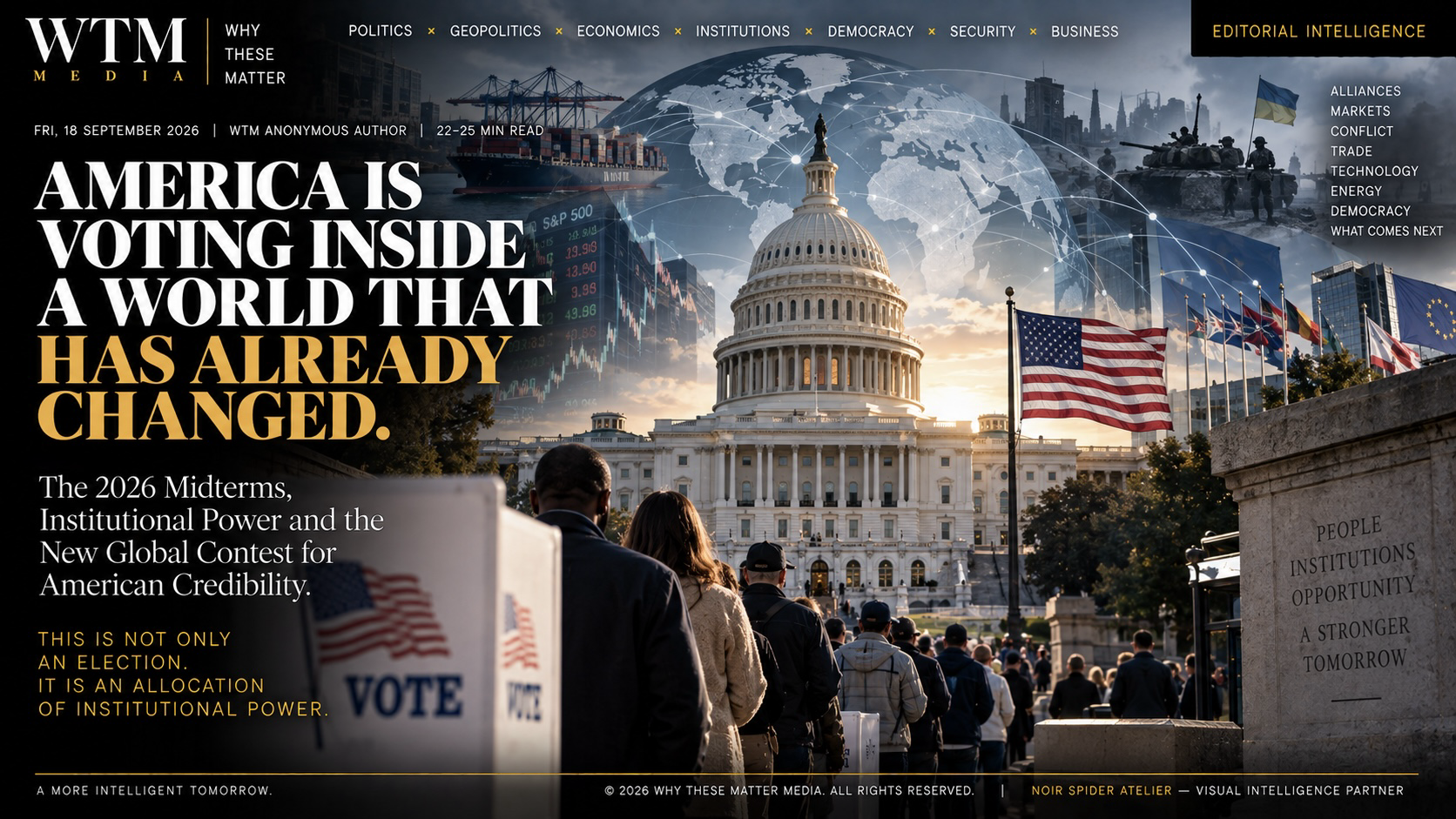
Election coverage naturally gravitates towards mood. Are voters angry? Is the economy helping one party? Is the president popular? Which demographic group is moving? Which message is breaking through? These questions matter because public sentiment helps determine elections. But sentiment is the input. Institutional power is the consequence. The analytical mistake is to confuse the emotional atmosphere surrounding an election with the machinery being allocated through it.
A House majority determines who controls committees, which legislation reaches the floor and which investigations receive institutional resources. Congress determines appropriations. The Senate participates in confirming senior executive officials, ambassadors and federal judges, and provides advice and consent on treaties. Congress possesses enumerated military powers and can shape foreign policy through funding, legislation, trade authorities and oversight. A congressional election therefore changes considerably more than the political temperature in Washington.
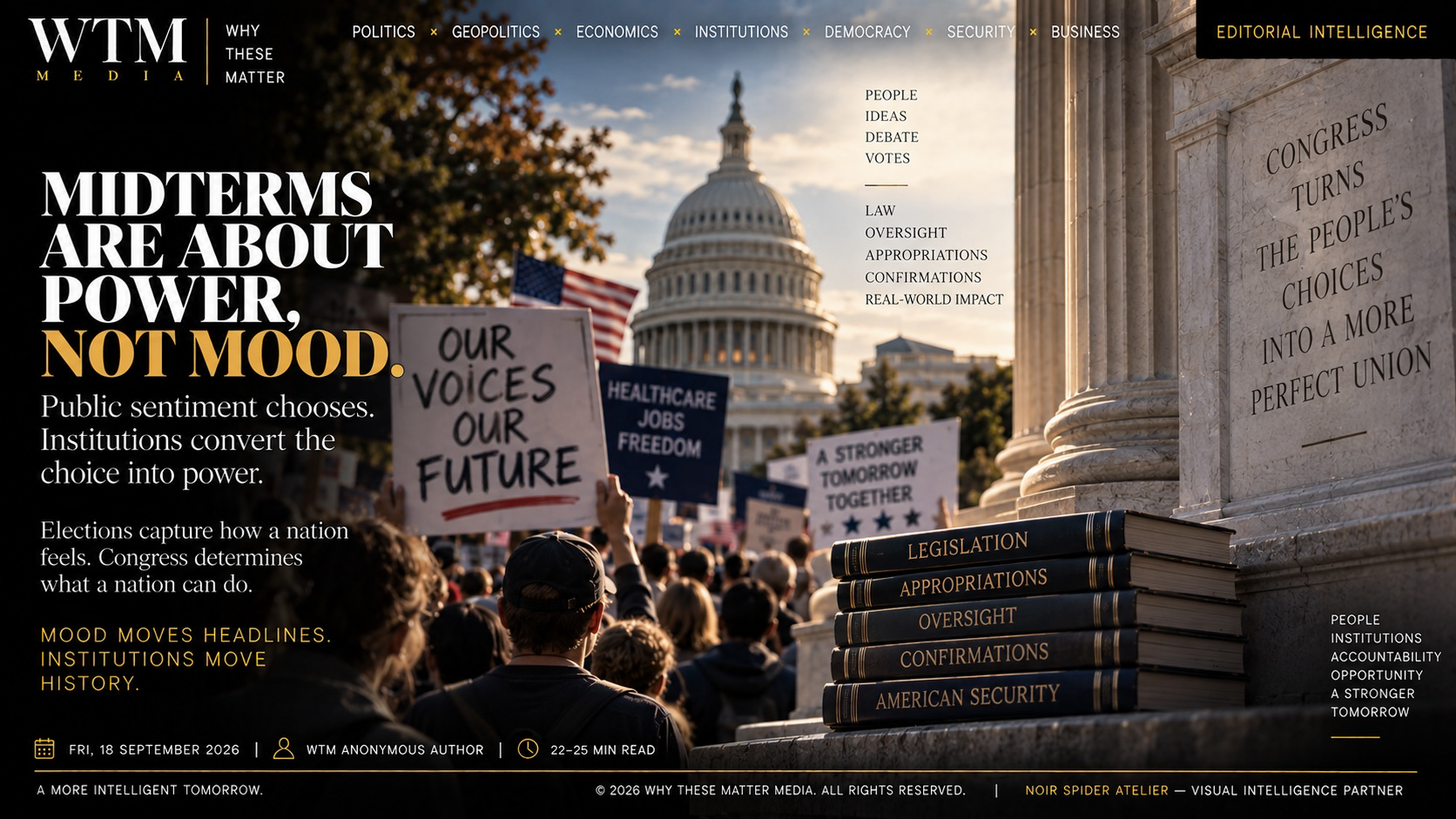
This becomes clearer when government is divided. An administration may retain substantial executive authority while losing legislative freedom. Appropriations can become harder. Oversight can intensify. Legislation can stall. Nominations can encounter resistance in the Senate. Conversely, unified control can reduce some institutional friction while increasing responsibility for the governing coalition to translate its programme into actual policy. Neither arrangement automatically produces good or bad government. They produce different distributions of authority and constraint.
That distinction is essential to understanding midterms. Voters may cast ballots because of grocery prices, war, healthcare, immigration, abortion, taxation, a candidate’s character or dissatisfaction with Washington. The constitutional system does not record the motive beside the ballot. It aggregates millions of individual reasons and converts them into institutional authority. A protest vote and an enthusiastic endorsement can produce exactly the same seat.
This is why the 2026 election cannot intelligently be reduced to whether Americans approve of Donald Trump. The president is politically relevant, and Reuters reporting indicates that his administration and record are prominent in the campaign. But the institutional consequence survives the campaign narrative. The 120th Congress will possess powers regardless of why voters selected its members.
The first discipline for the WTM reader is therefore separation: mood from power, message from authority, campaign from institution. Elections communicate public sentiment, but constitutional systems translate that sentiment into something harder and more durable. The decisive question is not merely what voters feel on 3 November. It is what those feelings will authorise government to do afterwards.
The scale of American democracy can conceal its concentration. More than a hundred million people may participate in a federal election cycle. Every voting House seat is contested. Thirty-five Senate seats are being decided. Yet control of the national legislature can depend on outcomes in a remarkably small number of places.
Reuters currently identifies roughly 50 House races as competitive enough to merit particular attention. Democrats require a net gain of three seats to take control, according to its September assessment. The important observation is not which party is favoured. It is that a chamber representing more than 340 million people can change institutional control because several districts move by comparatively small margins.
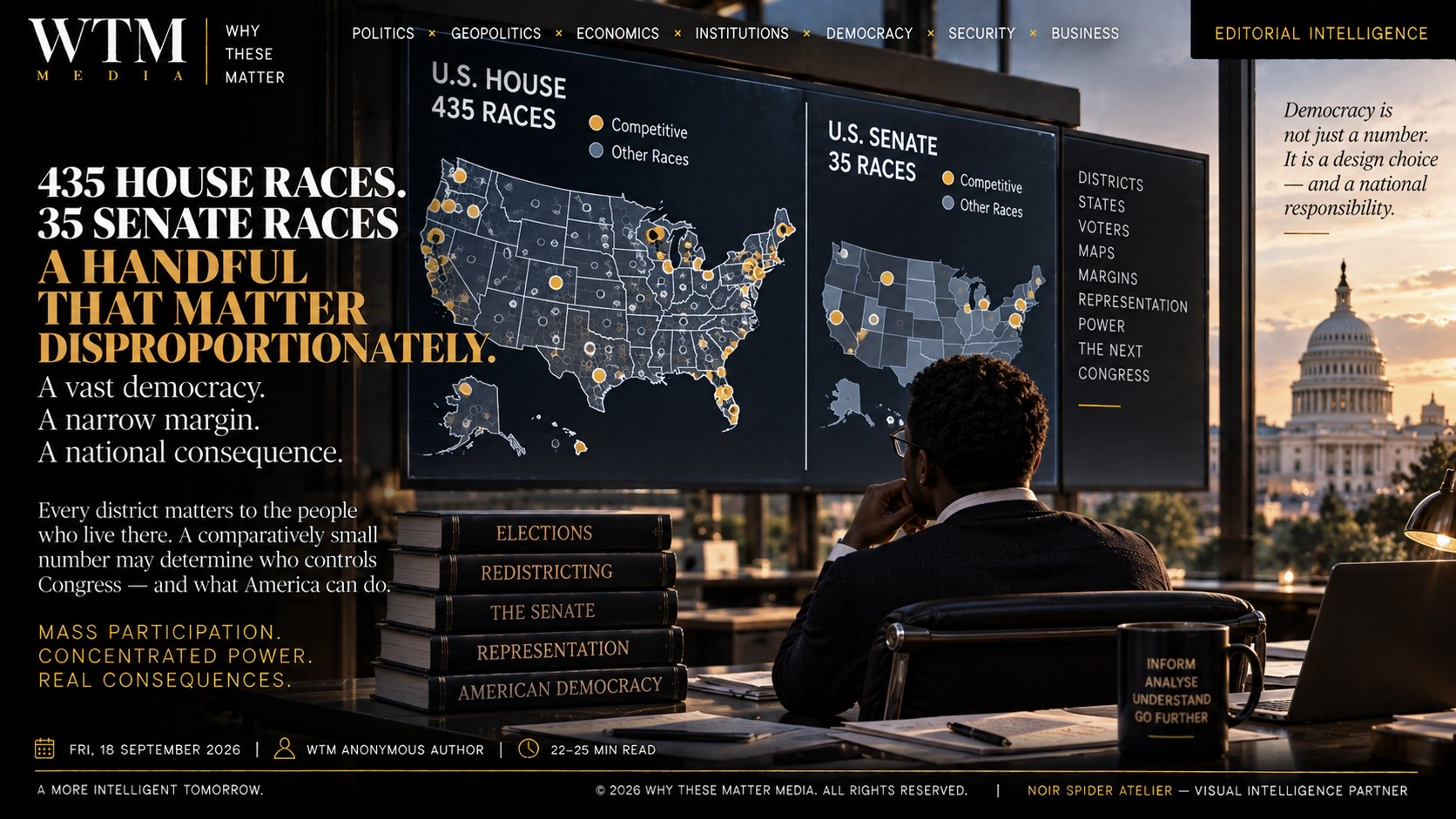
The Senate concentrates power differently. Thirty-three Class II seats face their regular elections, while two additional special elections bring the 2026 total to 35. Reuters highlights nine races as particularly important to control of the chamber and reports that Democrats need four additional seats. Again, WTM’s purpose is not prediction. It is structural literacy.
Representation also depends upon the architecture preceding Election Day. District boundaries determine which voters are aggregated together. Rules determine ballot access and voting procedures. Courts can determine which maps may be used. In Missouri, for example, a dispute over a Republican-drawn congressional map returned to the U.S. Supreme Court in September after conflicting federal and state-court developments over which map should govern the election. Similar redistricting conflicts have shaped the broader House battlefield.
This exposes a deeper democratic reality. Votes do not float directly from individual citizens into national policy. They pass through districts, electoral rules, federalism, staggered Senate classes, constitutional powers, courts and legislative procedure. Representation is therefore partly preference and partly architecture. Two societies with identical voter preferences but different institutional designs could produce different governing outcomes.
That does not make elections illegitimate or predetermined. It means democratic intelligence requires understanding the machinery between VOTE and POWER. The 2026 midterms are simultaneously hundreds of local contests and one national institutional event. Most races may not change party control. A relatively small number may change it profoundly. Democracy is mass participation operating through concentrated decision points.
Americans are accustomed to seeing the president as the face of foreign policy. Presidents meet heads of government, command the armed forces, negotiate internationally and dominate television coverage during crises. This can make Congress appear domestic by comparison. Constitutionally and practically, that is incomplete.
Congress controls money. The Appropriations Clause establishes that Treasury funds require appropriations made by law. Congress also possesses enumerated powers concerning war and the armed forces. The Senate participates in treaties and confirms ambassadors and senior national-security officials. Congressional legislation can structure sanctions, trade, defence expenditure and foreign assistance. Oversight committees can compel testimony, expose failures and alter the political conditions under which executive policy operates.

This means congressional control matters far beyond Washington. A foreign government calculating the durability of American military assistance must consider Congress. An ally assessing whether an agreement will survive domestic political change must consider Congress. A defence company modelling future procurement must consider appropriations. An administration planning a sustained international strategy must consider whether legislators will finance, constrain or investigate it.
The distinction is particularly important during military conflict. The constitutional allocation of war powers has generated recurring disputes between presidents and Congress, but the legislature’s authorities are substantial: declaring war, raising and supporting armies, maintaining a navy, regulating the armed forces and appropriating money. The modern presidency can act quickly; Congress can influence whether action becomes financially and politically sustainable.
The same principle applies outside warfare. American financial power is itself an instrument of foreign policy. Treasury Secretary Scott Bessent recently argued explicitly for using U.S. financial capacity to advance American and allied objectives. Sanctions, trade restrictions, financial assistance and market access sit at the intersection of economics and statecraft. Legislative authority therefore enters areas that voters may initially perceive as distant from congressional elections.
The useful mental model is consequently not President = foreign policy; Congress = domestic policy. American power is distributed. The executive may provide speed, direction and diplomatic visibility. Congress supplies or withholds law, money, consent, oversight and endurance. On 3 November, Americans are not choosing a commander-in-chief. They are nevertheless choosing a substantial part of the institutional architecture through which that commander-in-chief can operate.
For several decades after the Cold War, much American strategic thinking rested upon an unusually favourable premise: whatever crises emerged, the United States would remain the indispensable centre of a broadly Western, rules-oriented international system. That premise was never universally accepted, and American predominance was never absolute. But it provided an organising assumption for governments, businesses and institutions across much of the world.
The environment of 2026 is harder to organise around a single centre. Russia’s war against Ukraine continues more than four years after the full-scale invasion, with renewed diplomacy occurring alongside continuing strikes and territorial disputes. China and India possess greater geopolitical weight than in the early post-Cold War era. Middle Eastern powers are demonstrating greater diplomatic autonomy. The international system is increasingly characterised not by one replacement order but by overlapping centres of leverage.
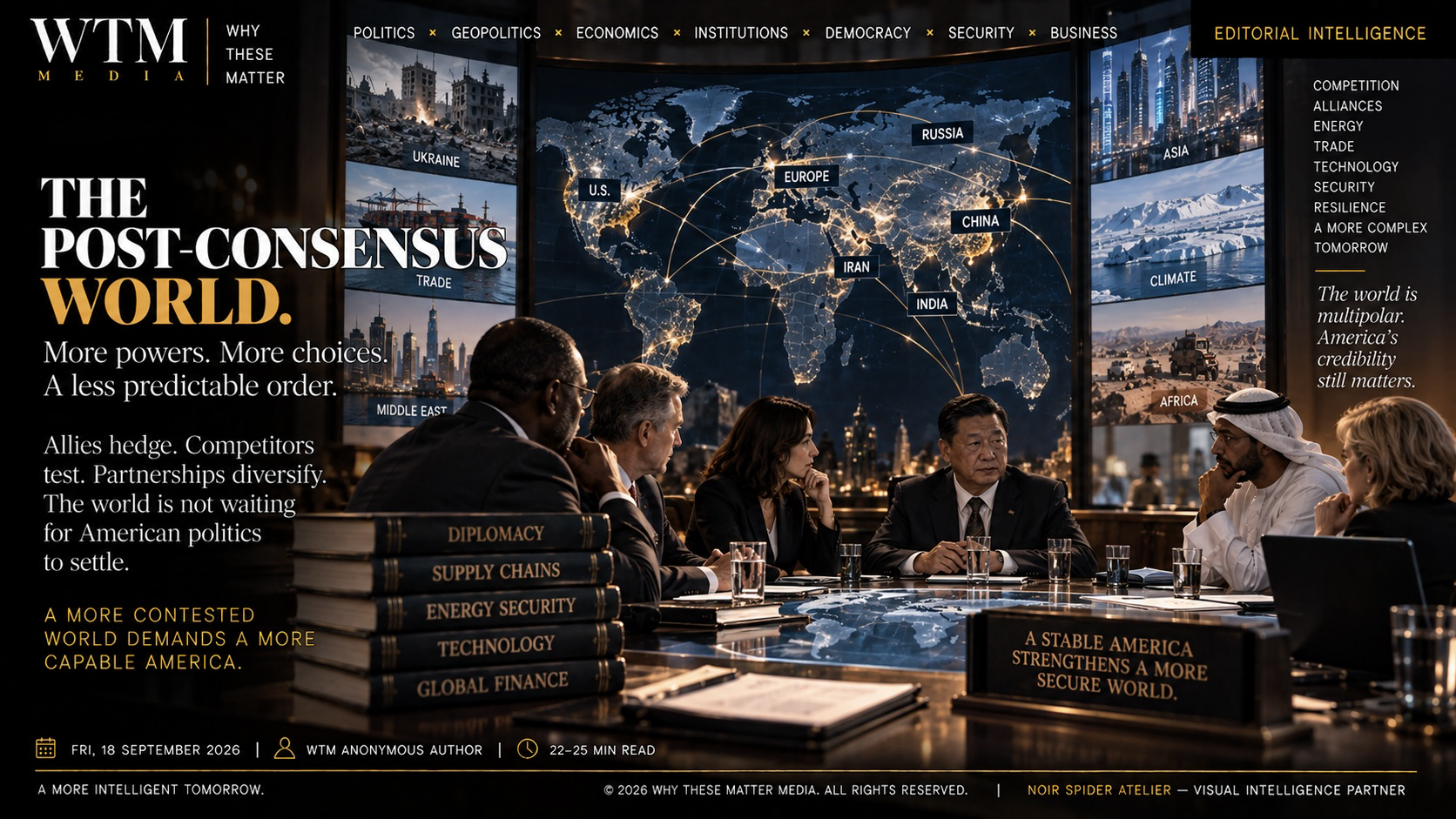
The Gulf illustrates the change. Reuters reports that Saudi Arabia and other Gulf governments have been considering regional security arrangements and direct engagement with Iran amid threats to shipping and energy infrastructure. This does not demonstrate the disappearance of American influence. It demonstrates something subtler: partners confronted with immediate risk will build options rather than simply wait for Washington.
Economic relationships are becoming political instruments as well. Canada’s retaliatory tariffs against U.S. goods have been targeted towards economically and politically sensitive American sectors and states. The important point is larger than Canada. Supply chains, tariffs, currencies, energy routes, technology controls and industrial policy have become tools through which states attempt to alter one another’s behaviour.
WTM calls this the post-consensus world, not because international cooperation has ended, but because fewer assumptions can remain implicit. Alliances must be maintained. Deterrence must be believed. Trade arrangements must survive political change. Institutions must demonstrate usefulness. Credibility increasingly depends upon whether commitments can endure across administrations, legislatures and electoral cycles.
The United States therefore enters the 2026 midterms with extraordinary power but less strategic permission to assume that the world will wait. Other states possess agency. Allies hedge. Competitors test openings. Companies reprice risk. Markets respond before political arguments conclude. The global significance of an American election lies not in foreigners possessing a vote. It lies in their need to interpret what American institutions will be capable of doing after Americans have used theirs.
Credibility sounds diplomatic. In practice, it has a price.
The United States sits at the centre of an extraordinary financial architecture. Treasury securities function as foundational assets throughout global finance. The dollar remains deeply embedded in trade and reserves. American capital markets finance companies around the world. Defence commitments shape investment decisions far beyond defence companies. When investors assess the United States, they are therefore assessing more than GDP. They are pricing expectations about institutions.
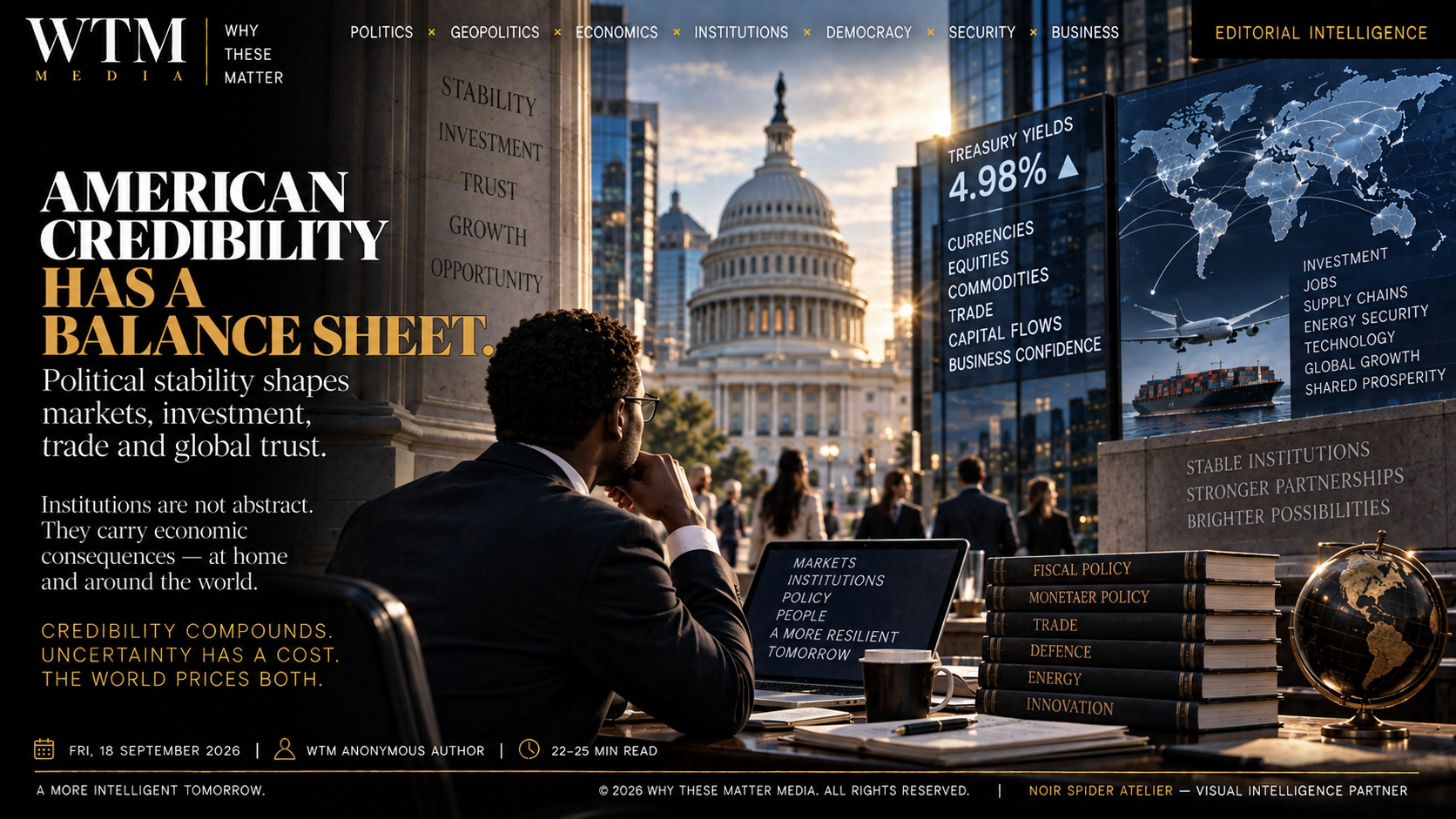
In September, the U.S. 10-year Treasury yield has moved towards 5%, while Reuters has reported concerns about inflation, geopolitical tensions, government spending and borrowing costs. Higher yields can raise financing costs for companies, pressure equity valuations and complicate mergers and acquisitions. None of this can responsibly be attributed to the midterms alone. Markets process employment, inflation, Federal Reserve policy, energy prices, fiscal expectations, wars and global capital flows simultaneously.
That qualification is precisely the point. Institutional credibility operates inside a system. An election result does not mechanically move a Treasury yield by a predetermined number of basis points. Instead, political outcomes can alter expectations about deficits, taxation, regulation, trade, defence spending, energy policy and the probability of legislative conflict. Those expectations enter models. Models influence capital allocation. Political architecture becomes financial information.
Businesses perform similar calculations. A multinational deciding where to construct a factory needs some confidence about tariffs, taxes and trade relationships years into the future. A defence company needs visibility into procurement. An energy company models sanctions and geopolitical disruption. A bank cares about regulation and sovereign risk. Political instability becomes economically expensive when companies must price a wider range of possible institutional outcomes.
Credibility therefore behaves like a balance sheet even though no government accountant records it as an asset. Consistent institutions accumulate trust. Abrupt reversals consume it. Successful crisis management can strengthen it. Repeated inability to implement commitments can weaken it. But credibility is neither permanent nor binary. Allies can distrust one American policy while continuing to depend heavily upon American security. Investors can worry about fiscal politics while continuing to purchase Treasuries.
This is why claims of either inevitable American decline or effortless American dominance are analytically weak. The United States retains enormous structural advantages. The more useful question is how effectively those advantages are converted into durable capacity. Economic size creates power. Institutional reliability determines how efficiently that power travels.
On the morning after Election Day, the United States will still inhabit the same planet.
Russia’s war will not disappear because Americans have voted. Energy infrastructure will remain vulnerable. China will continue making strategic decisions. Iran and Gulf states will continue theirs. Companies will continue allocating capital. Markets will open. Allies will assess Washington. Competitors will assess it too.
What will have changed is the future distribution of authority inside one of the institutions responsible for responding to those realities.
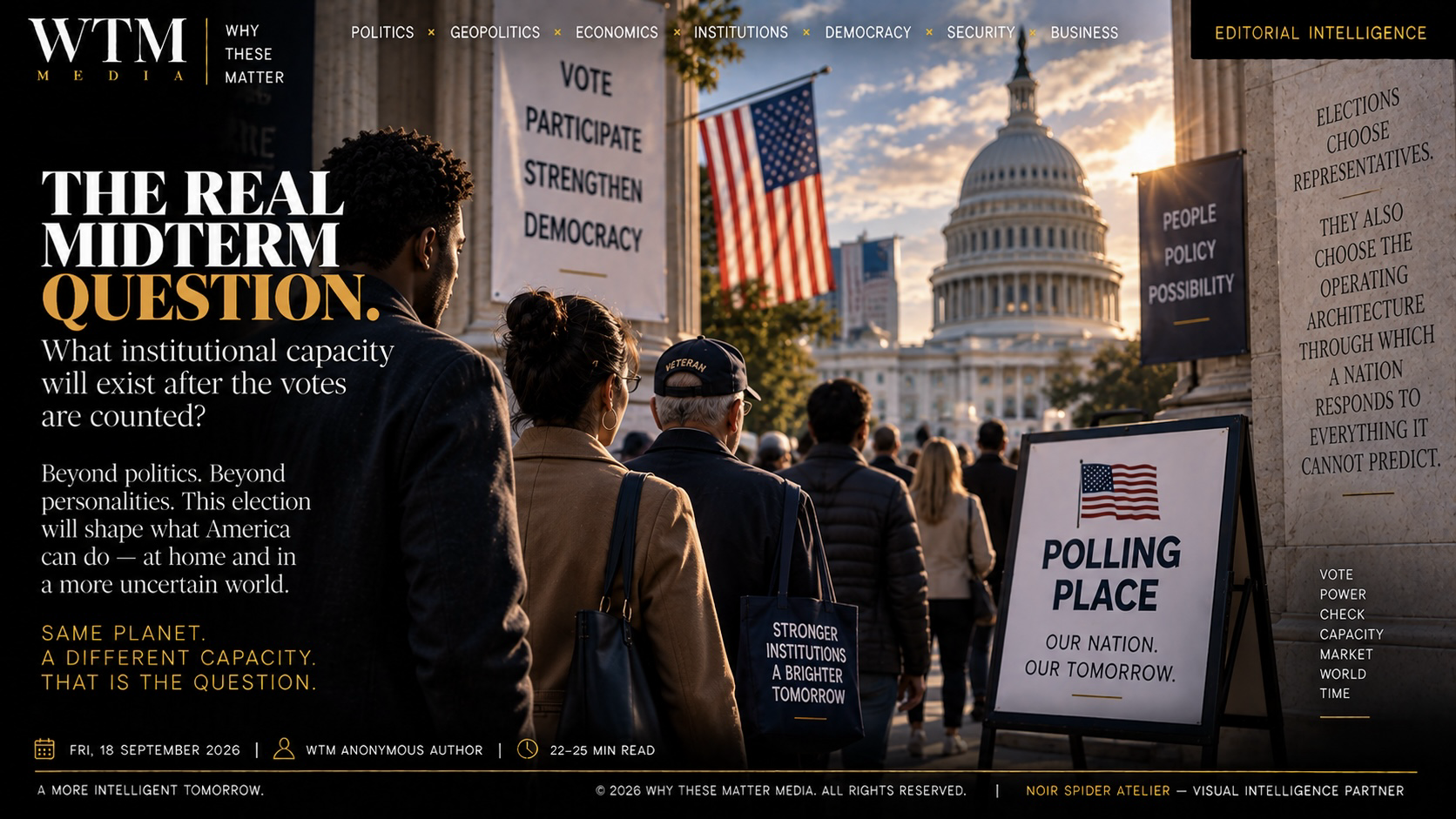
That is why the most useful question is not Which team won? Partisan control plainly matters, because parties possess different priorities. But WTM’s analytical task is one level deeper: What institutional capacity will exist when the 120th Congress convenes? What can pass? What can be funded? What can be investigated? Which appointments can be confirmed? Where will executive action encounter constraint? Where might cooperation remain possible?
This also changes the responsibility of the voter. Democratic participation does not require encyclopaedic knowledge of every geopolitical crisis. It does require recognising that a congressional vote has consequences beyond the campaign advertisement attached to it. A representative elected partly because of local prices may later vote on military appropriations. A senator elected because of healthcare may later decide a judicial or diplomatic confirmation. Representative government delegates judgement as well as preference.
For the rest of the world, the test is different. Allies and competitors should resist interpreting a single American election as a complete statement of national identity. The American system deliberately disperses power across branches, chambers, states, courts and electoral cycles. Midterms alter that architecture; they do not replace it. Understanding the United States therefore requires watching institutions rather than merely personalities.
The 2026 midterms matter because they arrive at the intersection of domestic constraint and international volatility. The election cannot determine which crisis arrives next. It can determine something more fundamental: the configuration of the institutions that will have to confront it.
Elections choose representatives. They also choose the operating architecture through which a nation responds to everything it cannot predict.
This editorial was researched against current September 2026 reporting and primary/nonpartisan institutional material. Reuters reporting supports the electoral structure used here: approximately 50 House contests are currently treated as competitive, Democrats require a net three-seat gain for House control, and nine Senate contests are especially consequential, with Democrats requiring four additional seats for control. These figures describe the current institutional arithmetic, not a WTM forecast of either chamber’s outcome.
The Bipartisan Policy Center confirms that all 435 House seats and 35 Senate seats are contested in 2026. U.S. Senate material identifies the regularly scheduled Class II seats, while the total includes two special Senate elections.
Constitutional and congressional-power analysis draws principally on Congressional Research Service and Constitution Annotated material. Congress possesses appropriations and enumerated war powers; the Senate exercises advice and consent concerning treaties and specified appointments; and Congress influences America’s international role through legislation, funding, military authorisations, trade matters, confirmations and oversight.
The global and market analysis draws on Reuters reporting concerning Russia and Ukraine, Gulf security and Iran, U.S. financial statecraft, Canadian trade retaliation, energy disruption and Treasury yields approaching 5%. The editorial deliberately treats these as examples of a changing operating environment rather than evidence that any single election outcome would produce a predetermined geopolitical or financial result.
Copyright
© 2026 Why These Matter Media. All rights reserved.
Author: WTM Anonymous Author
Editorial Intelligence: Why These Matter Media
Visual Intelligence: Noir Spider Atelier™
Third-party names, institutions, publications and intellectual property are referenced for reporting, analysis, commentary and attribution. No party, candidate or electoral outcome is endorsed.
WTM governing proposition: An election is a moment. Institutional power is what the moment becomes.

Why These Matter - WTM MEDIA is an independent editorial platform exploring the forces shaping our world—through people, culture, commerce, design, systems, and governance. Connecting the dots between today’s headlines and tomorrow’s realities.