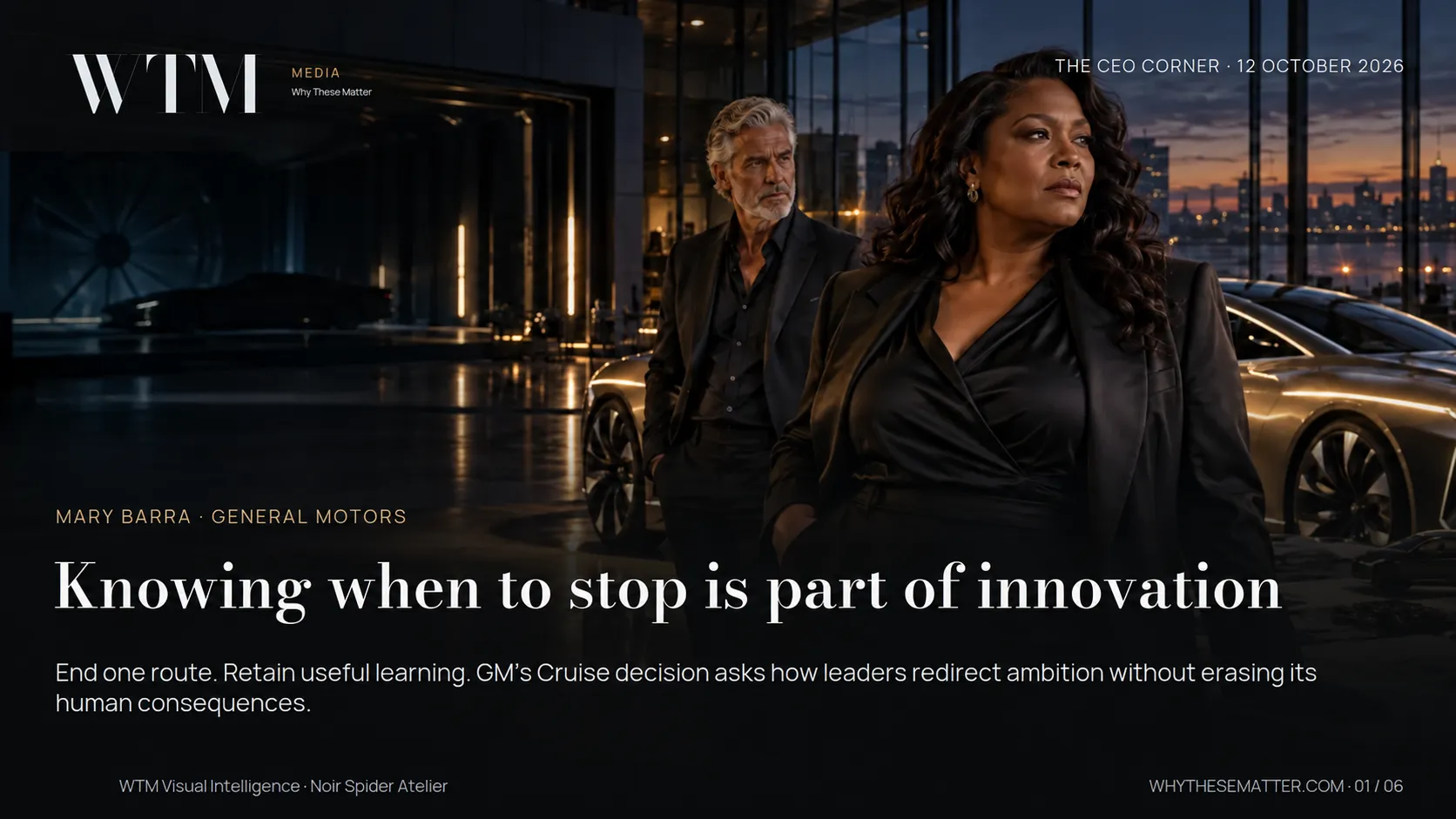

Design has crossed a critical threshold. What was once a specialised discipline built on training, taste, and time is now being industrialised through artificial intelligence. Execution—the act of making—is no longer scarce. It is abundant, fast, and increasingly indistinguishable across outputs. This does not democratise creativity; it compresses its value. The consequence is a structural shift: design is no longer defined by skill, but by thinking. Those who remain at the level of execution will be replaced. Those who operate at the level of systems, meaning, and direction will redefine the field.

For decades, design was anchored in craft. Mastery required time—learning composition, hierarchy, colour, proportion, and the subtle judgement that distinguishes competent work from exceptional work. That scarcity justified value. AI has removed that constraint.
Interfaces now translate intention into output with minimal friction. A prompt can generate layouts, identities, imagery, and environments in seconds. The technical barrier has collapsed, and with it, the economic value attached to execution alone. What once required years can now be approximated instantly, and approximation is sufficient for most market needs. This is not a marginal shift. It is a structural one.
When execution becomes abundant, it ceases to be differentiating. The market does not reward what is easily replicable, and AI has made replication effortless. The designer who operates primarily as a maker is now competing with a system that produces at scale, without fatigue, and at near-zero marginal cost. The craft has not disappeared. It has been absorbed.

As tools improve, the baseline quality of design rises. More people can produce work that meets conventional standards of “good”—balanced layouts, coherent typography, visually pleasing compositions. At first glance, this appears beneficial. It expands access and raises overall output quality. The deeper effect is dilution.
When the average improves, the distinction between average and excellent narrows. Visual language begins to converge. Patterns repeat. Outputs resemble each other—not because designers lack creativity, but because systems optimise toward known successful configurations. Difference becomes harder to perceive, and therefore harder to value.
Markets respond predictably. When differentiation declines, price follows. Design becomes faster, cheaper, and more interchangeable. Clients prioritise speed and cost over depth and originality, not out of neglect, but because the system rewards those criteria. The result is a paradox: more design is produced than ever before, yet less of it carries distinct meaning.

As execution loses scarcity, value migrates upward—to thinking. Design is no longer about producing artefacts; it is about defining systems. The designer’s role shifts from creating outputs to shaping the logic that governs those outputs. This includes understanding context, framing problems, orchestrating components, and embedding meaning into form. Intelligence becomes the differentiator.
This is not abstract intelligence, but applied intelligence—the ability to connect design decisions to business strategy, cultural signals, human behaviour, and long-term consequences. It requires moving beyond aesthetics into architecture: how systems function, how they scale, and how they endure.
The designer who can articulate why something should exist, how it should operate, and what it should achieve will remain essential. The one who focuses solely on how it looks will be replaced. The field is not disappearing. It is stratifying.

This matters because design sits at the intersection of culture, commerce, and communication. When its value shifts, it reshapes how organisations operate, how products are built, and how meaning is conveyed at scale.
For individuals, the implication is immediate: skills anchored in execution alone will decline in relevance, while capabilities rooted in strategy, systems thinking, and interpretation will increase in demand. For organisations, the shift challenges traditional models of hiring and valuation, requiring a reassessment of what constitutes expertise.
For the broader system, the commodification of design raises a more fundamental question: if the production of form is automated, who determines its purpose? When tools can generate infinite variations, the responsibility for direction becomes more critical, not less. Design is not ending. It is being redefined.
And in that redefinition, the difference between those who adapt and those who are replaced will not be talent—it will be position within the system.
Why These Matter - WTM MEDIA is an independent editorial platform exploring the forces shaping our world—through people, culture, commerce, design, systems, and governance. Connecting the dots between today’s headlines and tomorrow’s realities.