
Catherine Connolly’s landslide election as President of Ireland can easily be reduced to the language contemporary politics understands best: left versus right, establishment versus insurgency, Palestine versus Israel, or populism versus institutionalism. That would miss the more consequential story. Ireland has elected an independent, outspoken critic of militarisation and Western foreign policy to an office whose formal executive powers are limited, but whose symbolic authority is substantial. Connolly secured 63.4% of the vote against Heather Humphreys’s 29.5%, after building support among younger voters and receiving backing from a broad collection of opposition parties. Yet the same election produced an unusually high level of spoiled ballots. Ireland did not deliver one uncomplicated political message; it delivered several simultaneously. That contradiction makes the election useful. Across Western democracies, political legitimacy is becoming increasingly detached from traditional party loyalty. Voters may remain committed to democracy while becoming considerably less deferential towards the institutions, parties, geopolitical assumptions, and political vocabularies that have historically organised it. Ireland offers a particularly revealing case because its transformation is occurring inside a prosperous, highly globalised, overwhelmingly pro-European democracy. Connolly’s victory therefore does not prove that Ireland has rejected the West, the European Union, capitalism, or representative democracy. It suggests something subtler: Western citizens increasingly want the right to question the architecture of the Western consensus without being treated as though questioning it amounts to abandoning democracy itself.
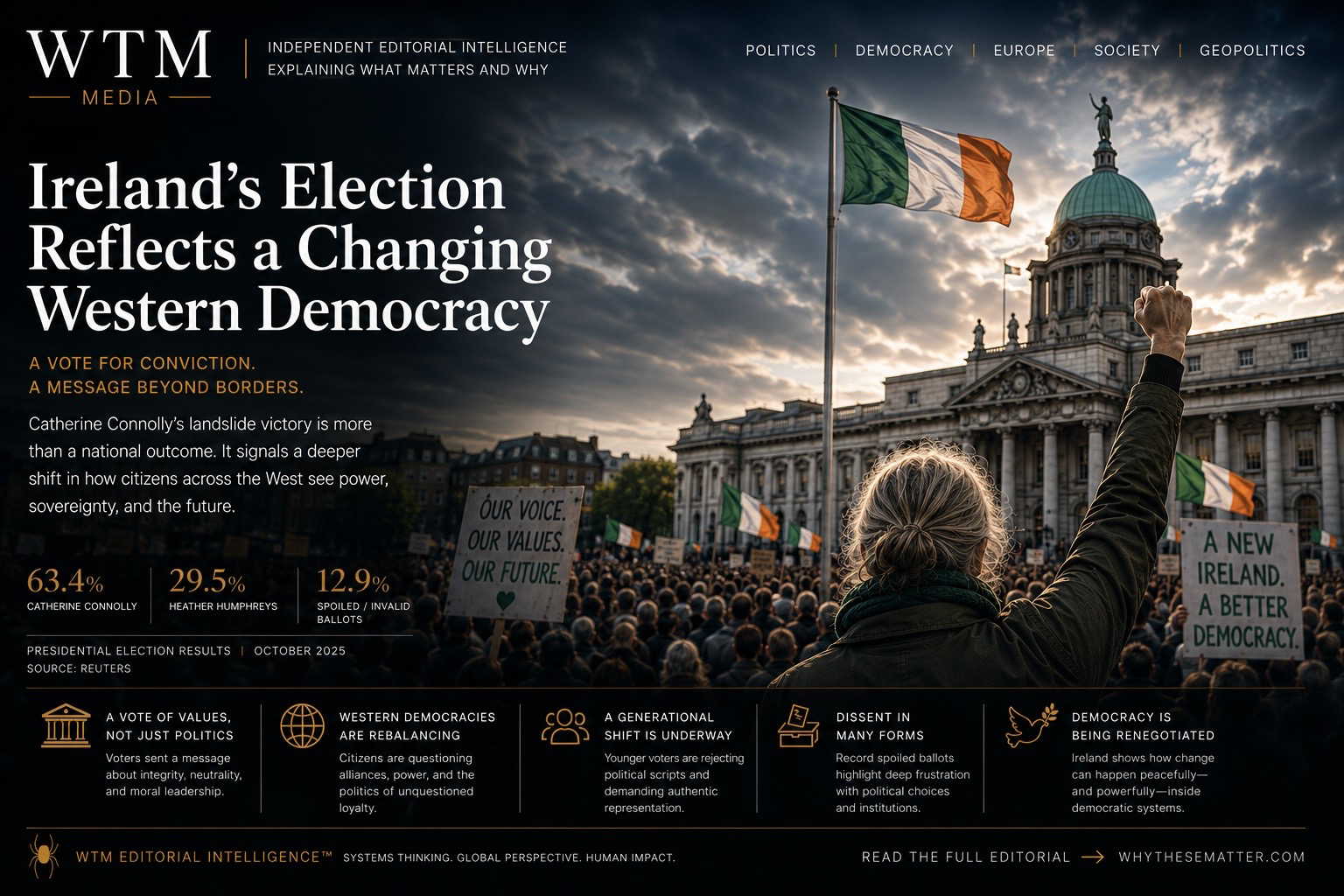
Political landslides invite intellectual laziness. A large electoral margin appears to provide an irresistible mandate for equally large conclusions: the country has moved left; the establishment has been rejected; foreign policy has changed; younger voters have revolted. Connolly’s 63.4% result certainly warrants attention, but presidential elections are peculiar political instruments. Ireland’s presidency is largely ceremonial, although it possesses constitutional functions and considerable cultural authority. A vote for president is consequently not identical to a vote for government. Citizens can use the office to express values they may not translate directly into parliamentary preferences.
That distinction makes Connolly’s victory more interesting, not less. The Irish electorate selected someone positioned conspicuously outside the governing centre-right establishment. Connolly was an independent parliamentarian, former barrister, clinical psychologist, and deputy speaker of the Dáil. Her candidacy gathered support across Ireland’s left, including parties that ordinarily compete against one another. Reuters reported that she energised younger voters and benefited from deeply troubled campaigns by the governing parties. The result was therefore simultaneously an endorsement, a protest, and an institutional warning.
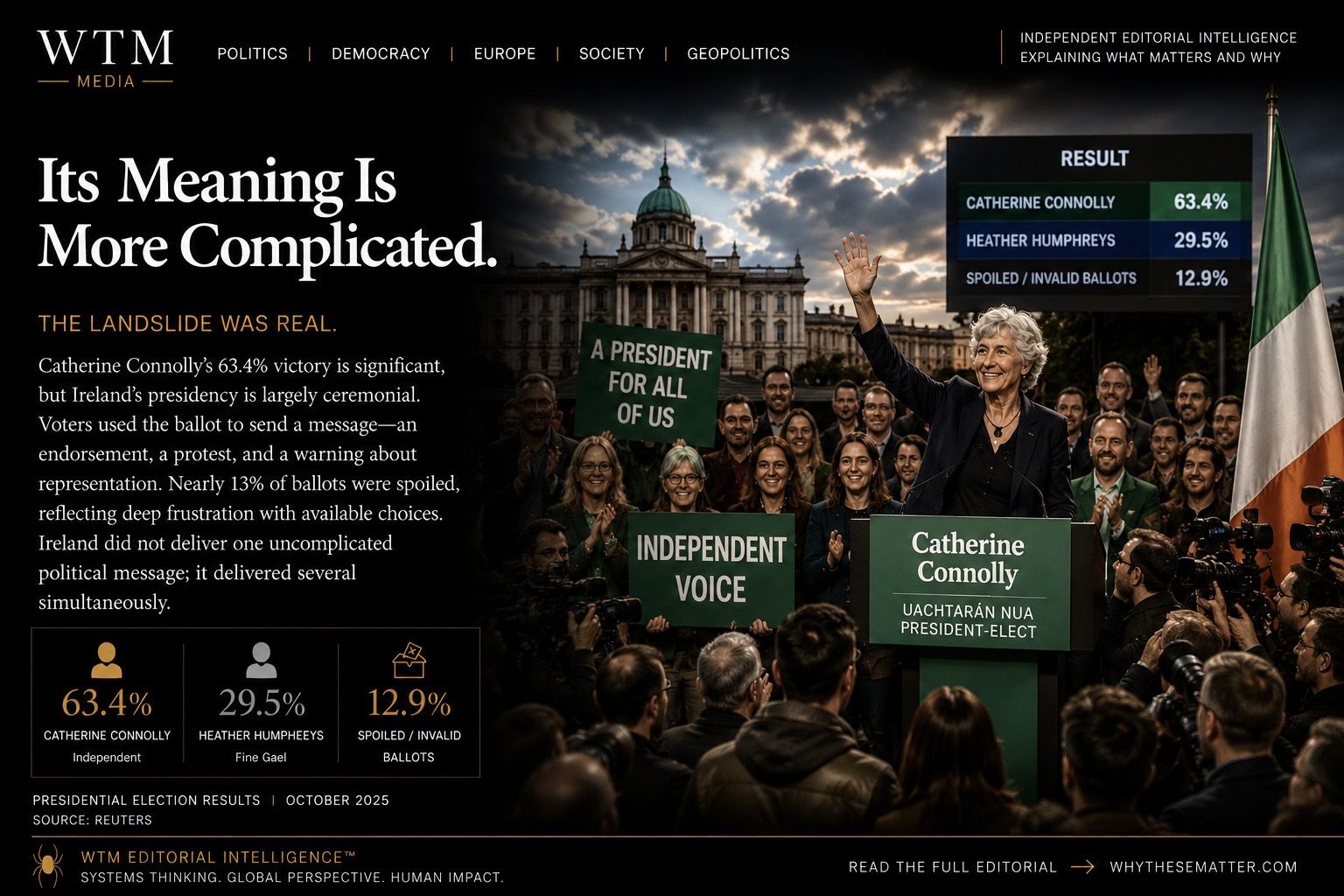
The warning concerns representation. Political systems become vulnerable when citizens believe the choices offered by established institutions no longer describe the choices they actually wish to make. Connolly gave some Irish voters a vehicle for positions that sit awkwardly inside conventional centrist politics: scepticism towards increased European militarisation, stronger advocacy for Palestinian rights, defence of Irish neutrality, criticism of powerful Western governments, and frustration with domestic political orthodoxy. Those positions are not interchangeable, but the coalition surrounding her demonstrated that electoral movements need not possess perfect ideological coherence to possess political force.
Yet there was another electorate inside the electorate. Nearly 13% of ballots were invalid or spoiled, an extraordinary proportion for a modern Irish presidential election. Some of that reflected dissatisfaction with the available candidates and frustration over the absence of alternatives, particularly on the political right. That matters enormously. Democracy cannot be understood solely by counting those who selected the winner. Sometimes the ballot deliberately destroyed tells us something the completed ballot cannot.
Ireland therefore did not simply “turn left”. A more defensible interpretation is that its political centre of gravity has become less obedient. Some voters moved towards Connolly’s progressive politics; others rejected the governing parties; younger citizens responded to a candidate they considered more authentic; still others effectively rejected the ballot itself. These behaviours differ politically, but they share one characteristic: weakened automatic deference towards established political machinery.
That is the first intelligence signal from Ireland. The stability of a democracy should not be confused with the stability of its political establishment. Citizens can remain deeply democratic while becoming profoundly dissatisfied with the organisations claiming to represent democracy. Indeed, peaceful electoral disruption is one of democracy’s corrective mechanisms. Ireland’s election did not demonstrate democratic collapse. It demonstrated democratic renegotiation.
Ireland occupies an unusual position in contemporary geopolitics. It is a member of the European Union, economically intertwined with the United States, deeply integrated into global capitalism, and home to substantial operations of major American multinational corporations. Yet it also possesses a powerful tradition of military neutrality, an anti-colonial historical consciousness, and a political culture that has often interpreted international conflicts through the language of sovereignty, occupation, and self-determination.
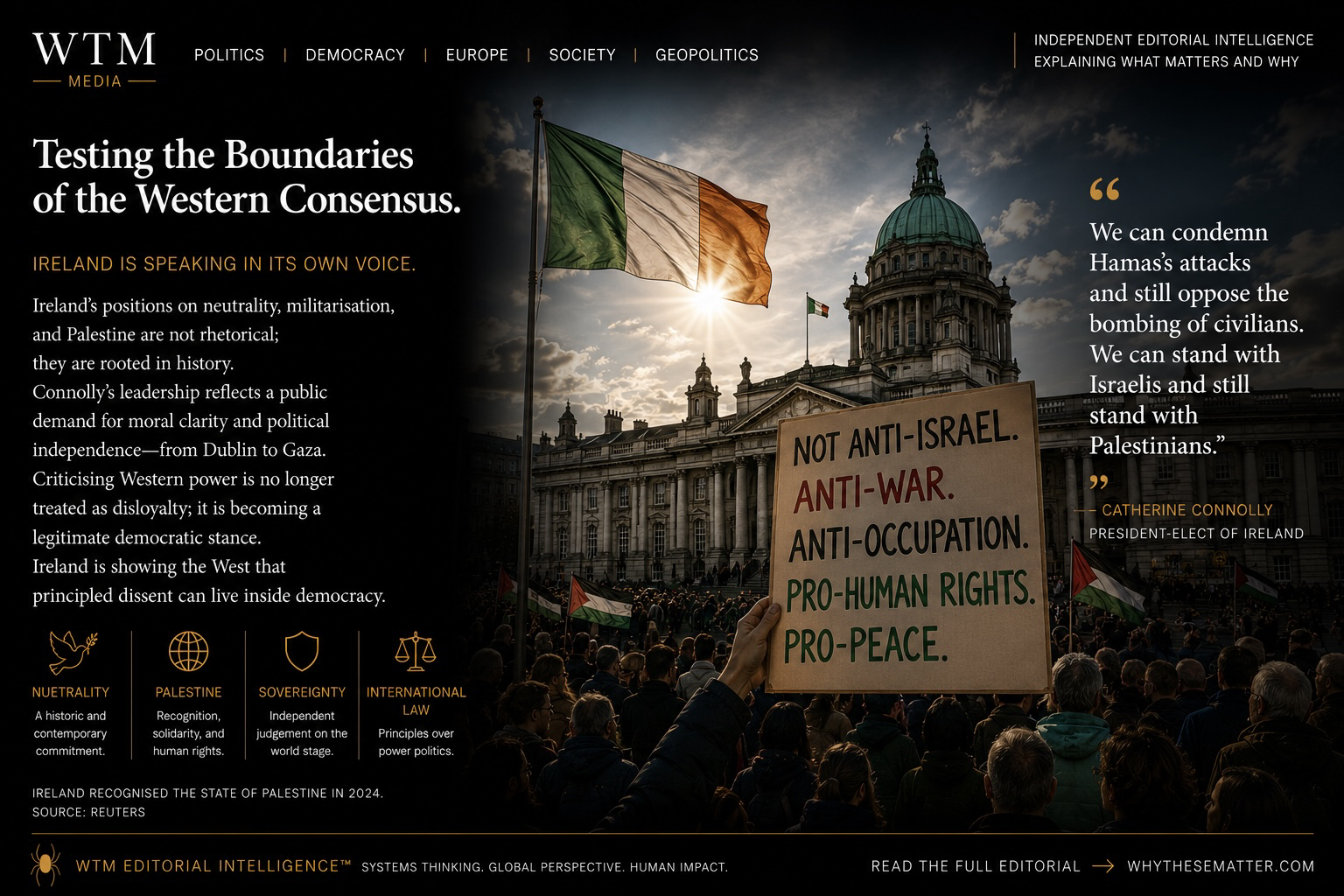
Palestine sits directly inside that historical imagination. Ireland formally recognised the State of Palestine in 2024, alongside Spain and Norway, and Irish governments have been among Europe’s strongest critics of Israeli policy in Gaza. Israel subsequently announced the closure of its Dublin embassy, accusing Ireland of “extreme anti-Israel policies”; Ireland rejected accusations that its position was anti-Israel and maintained that its approach was grounded in international law and human rights.
Connolly operates further along that political continuum. During the presidential campaign, she criticised Israel’s conduct in Gaza, opposed increasing European militarisation, defended Ireland’s neutrality, and questioned the reliability of the United States, Britain, and France in the context of war and geopolitical power. Those positions attracted criticism, including from Irish political leaders. They also resonated with voters who increasingly question whether alliance politics should automatically determine moral judgement.
Precision matters here. Connolly condemned Hamas’s 7 October attacks and described violence as unjustifiable. She also argued that both Hamas and Israel had committed war crimes, and maintained that Palestinians themselves must ultimately determine their political representation. Those distinctions disappear rapidly inside partisan media ecosystems, where complex positions are compressed into labels designed primarily to trigger allegiance or outrage.
That compression is itself part of the democratic problem. Western political discourse increasingly struggles to accommodate positions that cross established ideological boundaries. Criticism of an ally becomes hostility towards a people. Concern about militarisation becomes sympathy for an adversary. Defence of Palestinian civilians becomes endorsement of Hamas; defence of Israeli civilians becomes endorsement of every action undertaken by an Israeli government. Once political language loses the ability to distinguish between governments, states, peoples, militaries, ideologies, and civilians, democratic reasoning deteriorates.
Ireland’s election consequently matters beyond Ireland. It demonstrates an emerging Western constituency that remains inside democratic institutions while demanding considerably greater independence in judging Western power. That constituency may be progressive in Dublin, populist in another country, nationalist elsewhere, or generational almost everywhere. Its manifestations differ. The underlying question is increasingly shared: must belonging to the West require intellectual obedience to every assumption of the Western establishment?
For much of the twentieth century, Western politics could be organised reasonably effectively along a left-right axis. Labour versus capital, redistribution versus markets, social liberalism versus conservatism, and state intervention versus individual enterprise provided recognisable political coordinates. Those distinctions remain consequential, but they no longer explain the full behaviour of contemporary electorates.
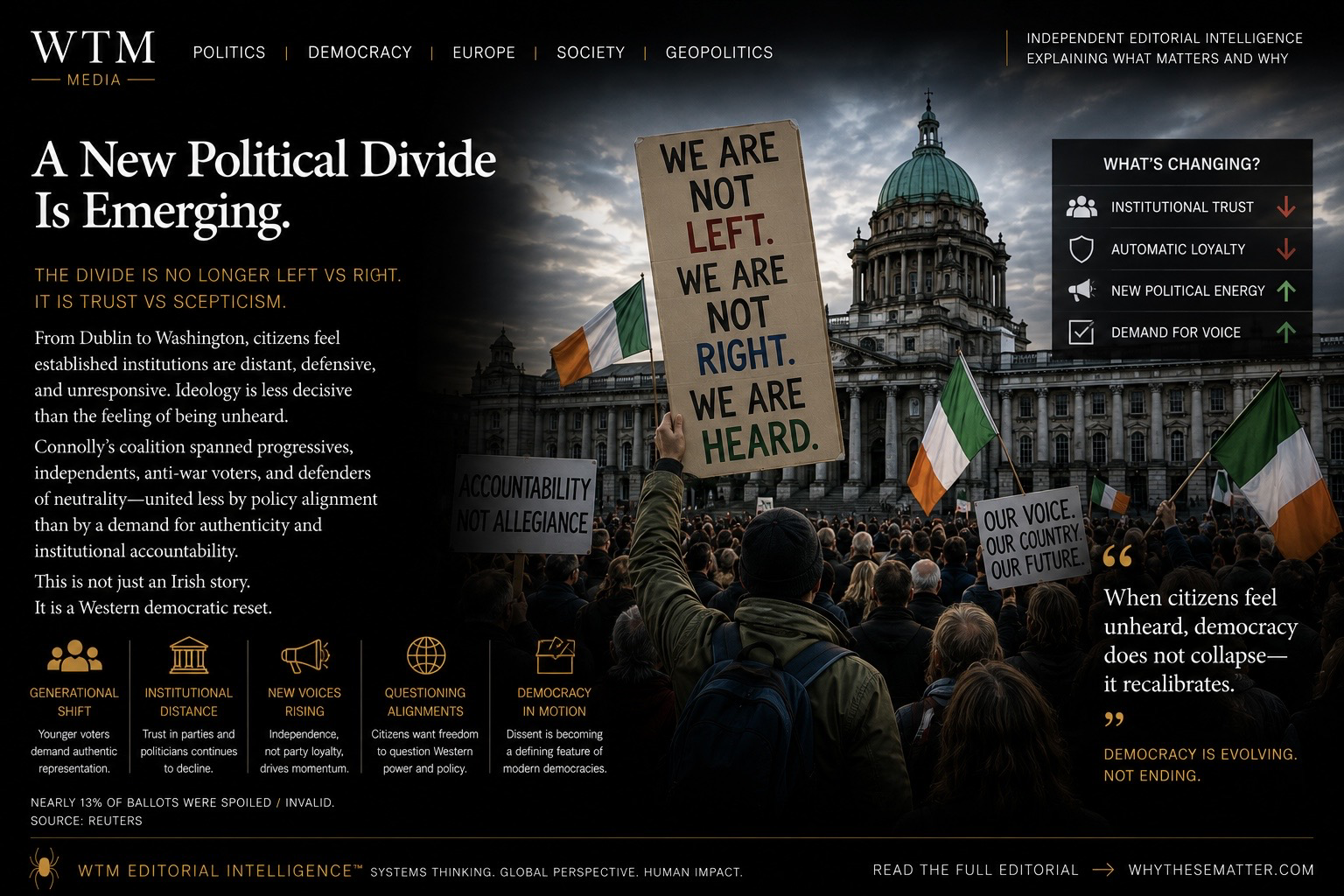
A second axis has emerged: institutional trust versus institutional scepticism. A progressive university graduate questioning military alliances and a conservative tradesman distrusting government bureaucracy may share almost no ideological beliefs, yet both can believe that established institutions are insulated from ordinary citizens. The political implications are enormous because dissatisfaction can now travel horizontally across ideologies rather than merely vertically between left and right.
Connolly’s coalition illustrates part of this phenomenon. Her supporters included established opposition parties, younger progressives, independents, anti-war voters, advocates of Irish neutrality, and people dissatisfied with the governing coalition. They did not necessarily agree on every economic or social question. What united sufficient numbers was a judgement about voice, authenticity, and distance from conventional political power.
This helps explain why personality and symbolic office have become unusually consequential across democracies. When trust in parties weakens, voters search for individuals who appear capable of speaking outside institutional scripts. Authenticity consequently becomes political capital. It can produce courageous independence; it can also reward recklessness, demagoguery, and theatrical outrage. The democratic challenge is not merely finding leaders who sound different. It is distinguishing independent judgement from performative rebellion.
Ireland presents the more institutionally restrained version of this phenomenon because its presidency is constitutionally bounded. The president cannot simply convert personal popularity into executive government. The office instead provides something democracies increasingly need: a symbolic arena in which national values can be contested without automatically producing radical changes in administrative power.
This separation between symbolic authority and executive authority deserves attention. Democratic systems require spaces for disagreement that do not transform every disagreement into existential warfare. When every election is treated as the final battle for civilisation, compromise becomes treason and losing becomes psychologically intolerable. Constitutional structures that distribute different forms of legitimacy can reduce that pressure.
Ireland therefore offers a useful counterpoint to the hyper-presidentialisation visible elsewhere. Connolly’s victory can alter national conversation without giving one individual command over the machinery of government. That may appear inefficient to political absolutists. Institutionally, it is rather sophisticated: democracy allows citizens to send a thunderous message while preventing the thunder from immediately burning down the house.

The first practical lesson is simple: never confuse an election result with a complete explanation of an electorate. A 63.4% victory is a fact. “Ireland has become far-left” is an interpretation. Those are different categories of information. Intelligent citizenship begins by separating what happened from the story somebody wishes the event to prove.
Second, examine the institution being elected. A presidential vote in Ireland cannot be interpreted identically to a parliamentary election because the offices possess different powers. The Irish president represents the state, performs constitutional duties, and can exercise certain limited constitutional powers, but does not govern Ireland in the manner of an American or French president. Political meaning must always be read through institutional architecture.
Third, study the losers and the non-participants. Connolly’s victory matters; so do the governing parties’ campaign failures and the unusually high spoiled-ballot rate. Elections contain negative information as well as positive preference. Ask not merely, “Who won?” Ask, “What failed badly enough to make this victory possible?” That question frequently produces better political intelligence.
Fourth, resist social-media compression. The screenshot that inspired this editorial turns a complicated democratic event into a single geopolitical proposition concerning Israel. It is designed for circulation, not comprehension. The underlying issue is legitimate and consequential, but the election also involved neutrality, militarisation, generational politics, party credibility, candidate quality, institutional trust, and dissatisfaction with available choices. Information becomes propaganda surprisingly quickly when context is treated as inconvenient furniture.
Fifth, watch Ireland as a leading indicator rather than assuming it is an exception. Housing pressures, migration, generational inequality, geopolitical instability, distrust of elites, and frustration with traditional parties exist across many Western democracies. The specific Irish political settlement cannot simply be exported elsewhere, but the underlying pressures are recognisable from Canada and Britain to France, Germany, and the United States.
Finally, develop what might be called democratic systems literacy. Read institutions, incentives, electoral structures, demographics, media environments, economic pressures, and historical memory together. Politics becomes considerably less bewildering when viewed as a system rather than an endless sequence of personalities and scandals. The person on the ballot matters. The architecture that made that person politically possible matters more.
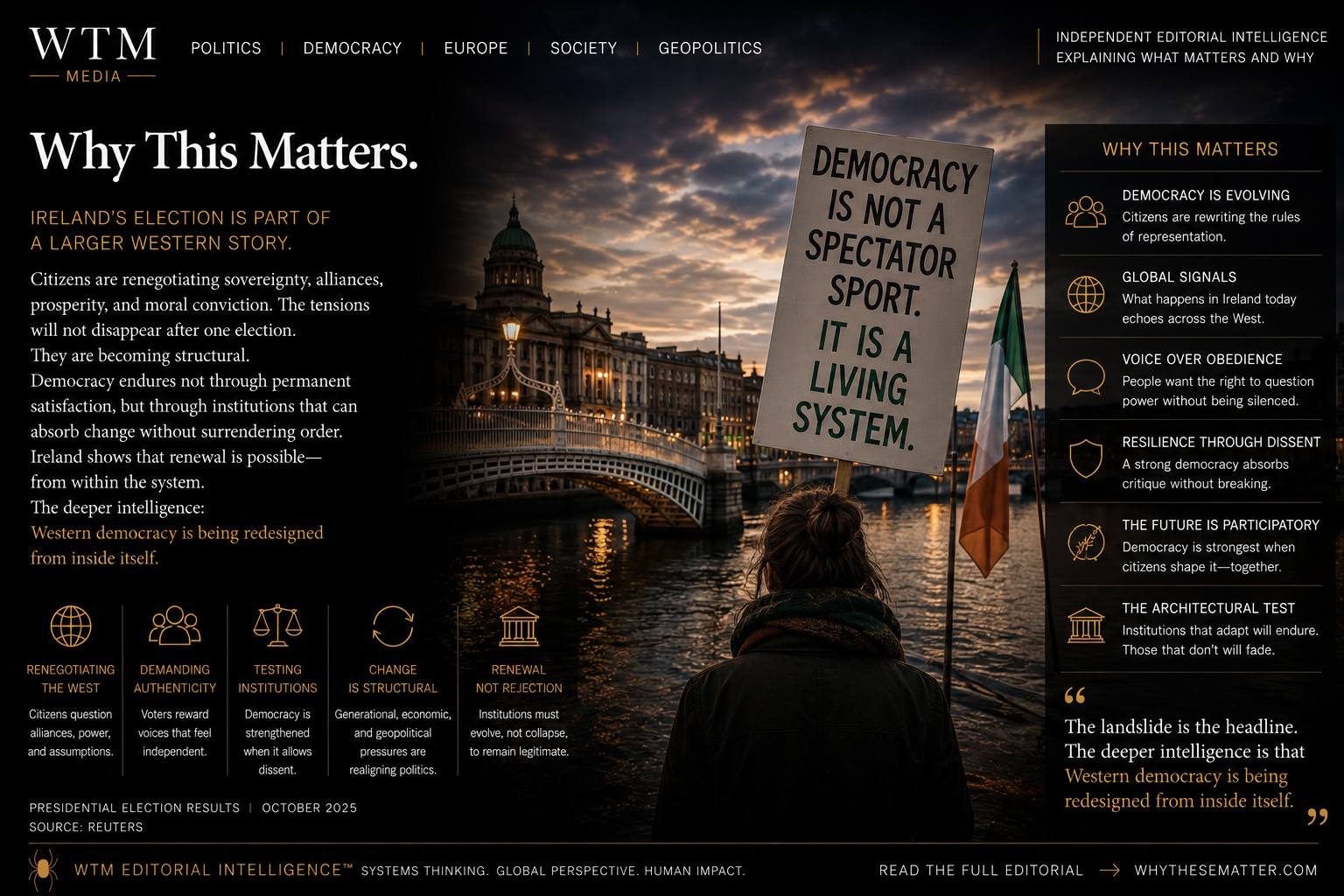
Ireland matters because democracies rarely transform at the moment everyone finally agrees transformation has occurred. They change incrementally: through declining party loyalty, altered moral priorities, generational turnover, new information systems, institutional disappointments, and voters becoming willing to choose candidates previously considered outside the conventional centre.
Connolly’s election embodies several of those movements simultaneously. An independent candidate backed by a fragmented opposition defeated the candidate associated with the governing establishment by a remarkable margin. Younger voters were energised. Foreign policy became part of domestic political identity. Neutrality remained politically potent. And dissatisfaction also manifested through a striking number of spoiled ballots.
None of this means Ireland has repudiated liberal democracy. The opposite interpretation may be more useful. Irish voters used democratic institutions to challenge assumptions within the existing political order. A democracy capable of absorbing such challenges without treating political disagreement as institutional catastrophe possesses a form of resilience increasingly absent from more polarised systems.
There is nevertheless a warning. Institutional scepticism can improve democracy when it demands accountability, transparency, intellectual independence, and better representation. It can destroy democracy when it mutates into contempt for evidence, constitutional restraint, expertise, pluralism, or the legitimacy of political opponents. The difference between democratic renewal and democratic corrosion is not dissatisfaction itself. It is what citizens and leaders build from that dissatisfaction.
Ireland’s experience therefore belongs inside a much larger Western story. Citizens are renegotiating the relationship between national sovereignty and international alignment, between economic prosperity and social legitimacy, between establishment expertise and democratic consent, and between moral conviction and geopolitical pragmatism. Those tensions will not disappear after one election. They are becoming structural features of twenty-first-century democracy.
Why this matters is ultimately architectural. Democracies endure not because citizens remain permanently satisfied with their institutions, but because those institutions can accommodate changing citizens without surrendering constitutional order. Ireland has just demonstrated that an electorate can challenge its political establishment, elevate a radically different voice, and still operate through the ordinary machinery of democratic succession. The landslide is the headline. The deeper intelligence is that Western democracy is being redesigned from inside itself.
Visual Intelligence: Noir Spider Atelier™ — A Division of WTM Media
Editorial Direction: Kelly Dowd, MBA, MA
Copyright: © 2026 WTM Media. All rights reserved.

Why These Matter - WTM MEDIA is an independent editorial platform exploring the forces shaping our world—through people, culture, commerce, design, systems, and governance. Connecting the dots between today’s headlines and tomorrow’s realities.