For two centuries, civilisation rewarded scale. The largest economies, the biggest corporations, the most extensive supply chains, and the most powerful institutions often dominated global affairs. Size became synonymous with strength. Efficiency became synonymous with progress. Yet the twenty-first century is exposing the limitations of this model. Pandemics disrupted global logistics. Artificial intelligence is reshaping labour markets. Climate instability is altering economic assumptions. Geopolitical fragmentation is redrawing alliances. In increasingly volatile environments, scale alone offers diminishing protection. The fastest system does not always survive. The most powerful organisation does not always endure. More often, survival belongs to those capable of adapting. The defining advantage of the next civilisation may not be intelligence, wealth, or speed in isolation. It may be agility—the capacity to sense change, respond rapidly, learn continuously, and evolve without collapsing under complexity.
The modern world was largely built on industrial logic. Factories rewarded standardisation. Bureaucracies rewarded predictability. Globalisation rewarded efficiency. Success depended upon reducing uncertainty and maximising output. Governments expanded. Corporations consolidated. Supply chains stretched across continents. The dominant assumption was simple: larger systems were inherently stronger because they possessed greater resources, reach, and influence.

For much of the twentieth century, this assumption appeared correct. Industrial economies generated unprecedented wealth. Large corporations outperformed smaller competitors through economies of scale. National power became closely associated with population size, manufacturing capacity, and resource control. Growth itself became a proxy for success. Expansion was not merely encouraged—it became institutional doctrine.
Yet scale introduces hidden vulnerabilities. Large systems often become optimised for stable conditions. Their procedures, hierarchies, and infrastructures assume a degree of predictability. When environments remain relatively stable, efficiency compounds advantage. When environments become volatile, however, efficiency can transform into fragility. Systems designed to operate under specific assumptions frequently struggle when those assumptions change rapidly.
The COVID-19 pandemic exposed these weaknesses with extraordinary clarity. Global supply chains built for efficiency collapsed under disruption. Healthcare systems designed for normal demand encountered unprecedented strain. Educational institutions struggled to adapt to remote learning. Entire industries discovered that optimisation for one environment often creates vulnerability in another. Resilience and efficiency, once assumed to be aligned, increasingly appeared to exist in tension.
Climate change reinforces the same lesson. Weather systems no longer behave according to historical norms. Infrastructure designed for twentieth-century conditions faces twenty-first-century realities. Agricultural systems encounter new environmental pressures. Insurance models become less reliable. Across sectors, institutions are discovering that historical success offers limited protection against emerging uncertainty.
The next civilisation will likely reward a different capability. Not scale without flexibility. Not efficiency without resilience. Not growth without adaptation. The organisations, governments, and societies that thrive will increasingly be those capable of learning faster than conditions change. Adaptation is becoming a competitive advantage. Agility is becoming infrastructure.
Human beings often associate intelligence with knowledge accumulation. Yet biological evolution suggests a different interpretation. The species that survive are rarely the strongest, fastest, or largest. More often, they are the most adaptable. Intelligence emerges not as a measure of information possessed but as a measure of responsiveness to changing conditions. The same principle increasingly applies to institutions.
Artificial intelligence illustrates this shift dramatically. Traditional software followed predetermined instructions. Modern AI systems learn from data, adjust outputs, and improve through feedback. Their value lies not merely in computational speed but in adaptive capability. They function less like static tools and more like evolving systems. This distinction may ultimately prove more important than raw processing power.
Businesses face similar pressures. The most valuable companies of the twenty-first century are not necessarily those with the largest physical footprints. Many derive their strength from adaptability. They pivot products, reconfigure operations, integrate emerging technologies, and respond to market shifts faster than competitors. Organisational agility increasingly outperforms organisational size because uncertainty rewards flexibility.
The labour market is undergoing a parallel transformation. For much of industrial history, expertise was accumulated slowly and applied repeatedly throughout a career. Today, knowledge cycles evolve rapidly. Entire professions are being reshaped by automation, artificial intelligence, and digital transformation. Individuals who continuously learn, unlearn, and relearn often outperform those relying solely on established expertise. Adaptability itself has become a professional competency.
Families and communities encounter similar realities. Economic volatility, technological disruption, and cultural change require constant adjustment. The most resilient households are rarely those experiencing no challenges. They are often those capable of adapting collectively when challenges arise. Agility functions not only as a strategic advantage but also as a social and psychological one.
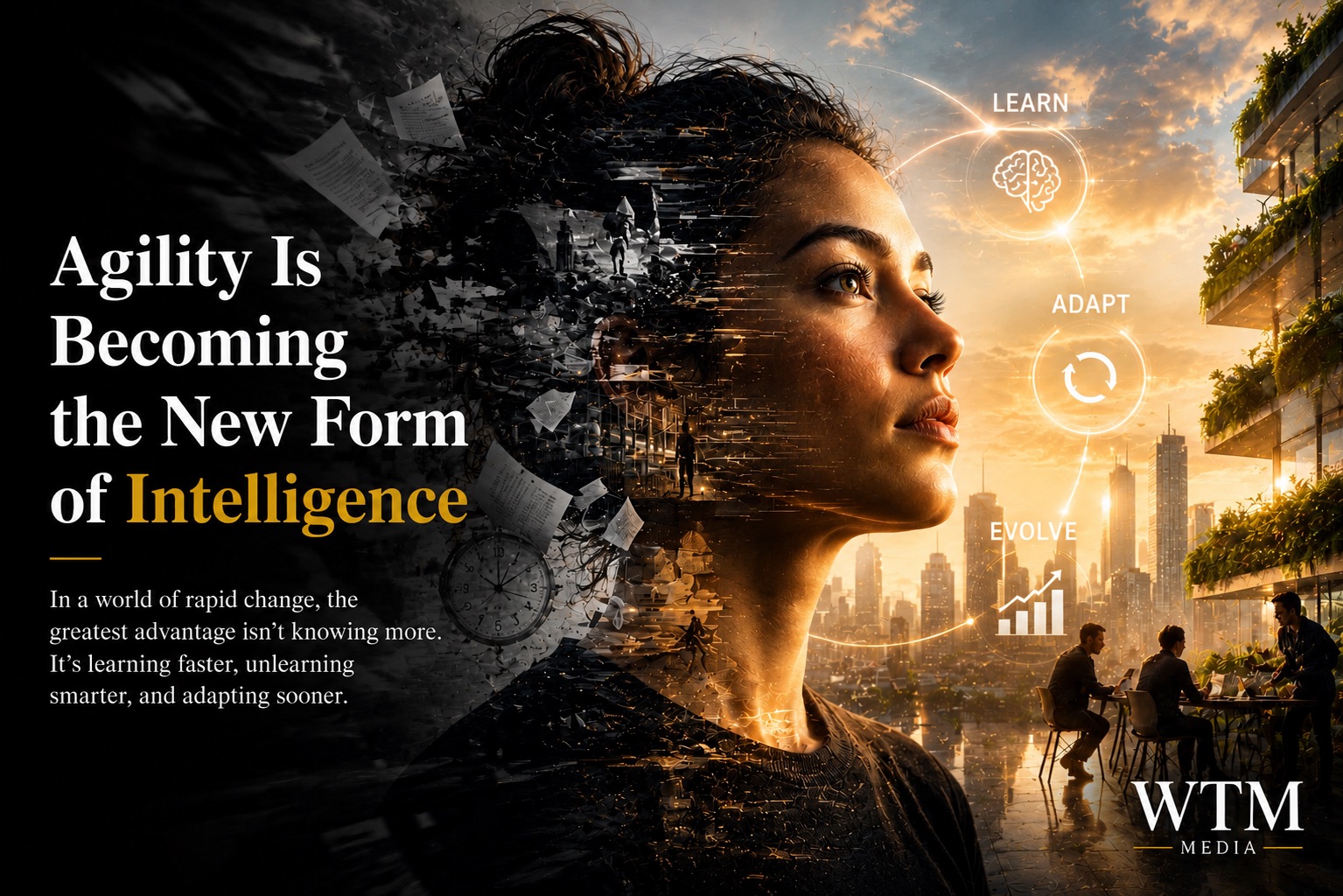
In this sense, agility represents a new form of intelligence. It is the capacity to process uncertainty without paralysis, to remain flexible without losing coherence, and to evolve without abandoning identity. As complexity increases, this capability becomes increasingly valuable. The future may reward adaptability more than certainty.

The industrial era encouraged humanity to think like engineers. Systems were designed as machines composed of predictable components. Inputs generated outputs. Problems could be isolated and fixed. This framework proved extraordinarily effective for manufacturing and infrastructure development. Yet many contemporary challenges behave less like mechanical failures and more like ecological systems.
Ecosystems offer a useful model for understanding the future. Forests survive not because individual trees are strong, but because relationships within the system enable resilience. Diversity creates adaptability. Redundancy prevents collapse. Feedback mechanisms support recovery. Living systems endure because they evolve continuously in response to changing conditions. Stability emerges through adaptation rather than control.
Increasingly, human institutions are encountering similar dynamics. Cities function as complex adaptive systems. Economies respond to countless interconnected variables. Artificial intelligence ecosystems evolve through feedback loops. Social networks amplify behaviours in unpredictable ways. Traditional command-and-control structures struggle to manage environments characterised by constant change. Agility becomes essential because complexity cannot be fully predicted.
This insight carries profound implications for leadership. The leaders of the future may be less focused on directing outcomes and more focused on creating conditions for adaptation. Their role shifts from controlling systems to enabling resilience within them. The objective becomes less about maintaining stability and more about sustaining adaptability.
The HANDS Framework—Humanity, Adaptation, Nature, Design, and Sustainability—captures this transition elegantly. Adaptation functions as the connective tissue linking all other dimensions. Humanity requires adaptation to flourish. Design must adapt to changing realities. Sustainability depends upon adaptive systems capable of enduring disruption. Nature itself demonstrates that resilience emerges through continuous adjustment rather than static perfection.
The next civilisation will not be defined by who moves fastest. Speed remains valuable, but speed without adaptability often accelerates failure. The defining advantage of the coming century may belong to those capable of evolving continuously while maintaining coherence. In an increasingly uncertain world, agility becomes more than a strategy. It becomes a survival mechanism.

The twenty-first century is forcing humanity to reconsider many assumptions inherited from the industrial age. Bigger is not always stronger. Faster is not always better. Efficiency is not always resilience. The systems that dominated previous centuries were optimised for predictability. The systems that succeed in the future must be optimised for uncertainty.
This principle applies equally to nations navigating geopolitical disruption, corporations confronting technological transformation, families adapting to economic change, individuals facing evolving career landscapes, and artificial intelligence systems learning within dynamic environments. The common denominator is adaptation.
The next civilisation will not be built by those who resist change most effectively. It will be built by those who learn how to work with it. Agility is no longer a desirable trait. It is becoming a prerequisite for survival.
Nature learned this lesson billions of years ago. Humanity is only beginning to catch up.

Why These Matter - WTM MEDIA is an independent editorial platform exploring the forces shaping our world—through people, culture, commerce, design, systems, and governance. Connecting the dots between today’s headlines and tomorrow’s realities.