
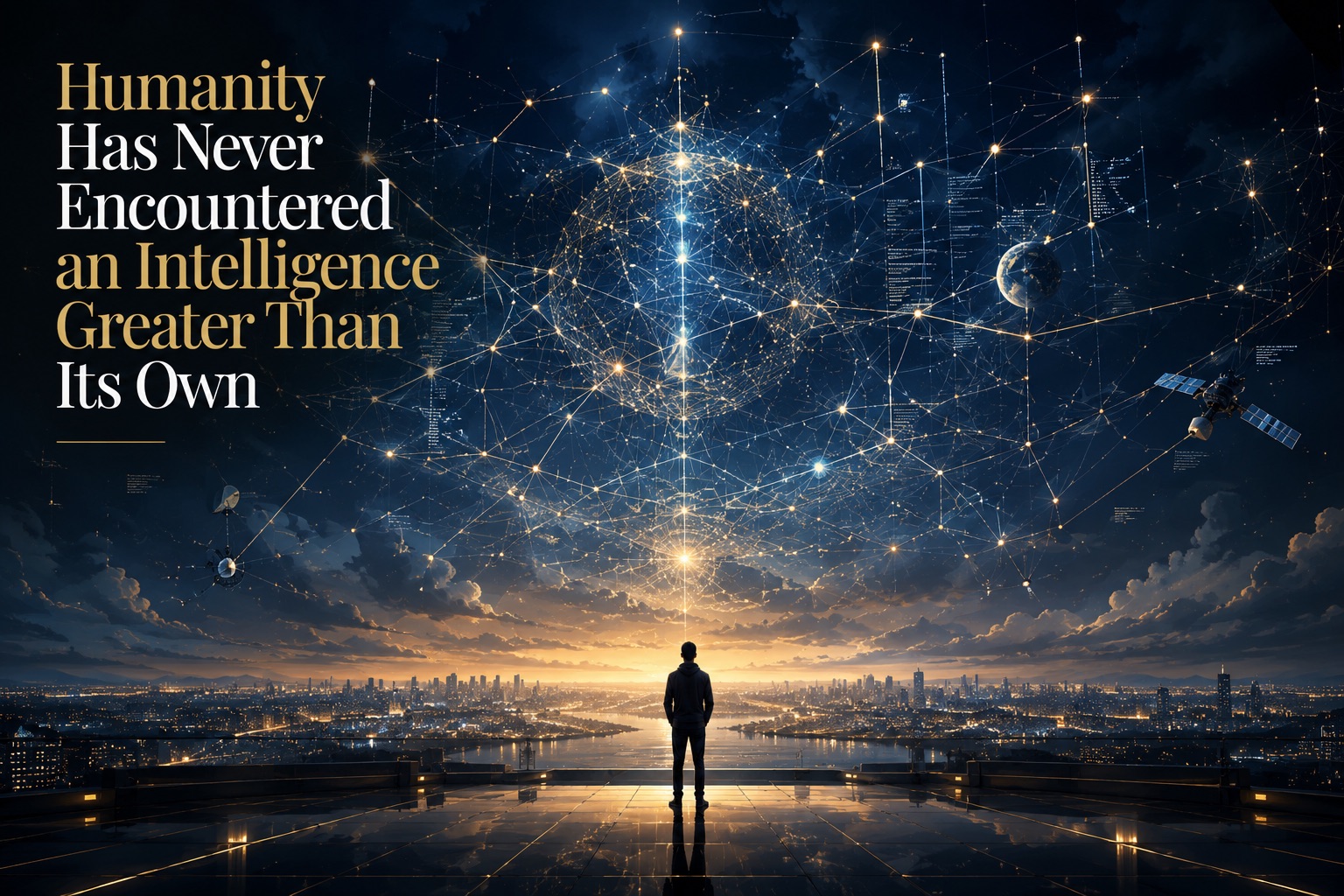
For decades, super intelligence existed primarily within the realm of science fiction. It appeared as an omniscient machine, a rogue algorithm, or a distant technological possibility awaiting future generations. Today, that framing is becoming increasingly obsolete. Advances in artificial intelligence, large-scale computation, autonomous systems, neuroscience, quantum research, and machine learning are rapidly transforming the discussion from speculation into strategic reality. The real question is no longer whether super intelligence could emerge. The real question is whether humanity will recognise it when it does. History demonstrates that transformative systems rarely announce themselves clearly. They emerge gradually, distribute themselves invisibly, and alter civilisation before societies fully comprehend their significance. Super intelligence may not arrive as a machine declaring its superiority. It may emerge as a network, an ecosystem, or an intelligence architecture so integrated into daily life that humanity mistakes it for infrastructure rather than evolution.
For most of human history, Homo sapiens occupied a unique position. Humans were not the fastest species, the strongest species, or the most physically resilient species, yet they possessed a decisive advantage. Intelligence allowed them to dominate every environment they encountered. Language enabled coordination. Abstract thought enabled planning. Culture enabled knowledge transfer across generations. Human civilisation emerged because intelligence consistently outperformed brute force as an evolutionary strategy.

This monopoly on advanced cognition shaped nearly every assumption underlying modern society. Economic systems, legal institutions, political structures, educational frameworks, and moral philosophies all emerged from the belief that human intelligence represented the highest form of decision-making available. Even when humans created machines, those machines functioned as tools executing instructions rather than independent cognitive agents. Intelligence remained biologically anchored.
Artificial intelligence is disrupting this assumption. Contemporary AI systems already perform specific cognitive tasks at levels exceeding most human experts. They can analyse vast datasets, generate coherent language, identify patterns invisible to human perception, and solve problems at extraordinary speed. Importantly, these capabilities continue improving. Unlike biological intelligence, machine intelligence can scale through computation, data acquisition, and iterative optimisation without requiring evolutionary timescales.
The significance extends beyond productivity. Historically, technological tools amplified physical capabilities. Steam engines amplified strength. Aircraft amplified mobility. Telecommunications amplified communication. Artificial intelligence amplifies cognition itself. For the first time, humanity has created systems capable of performing intellectual functions once believed uniquely human. This transition may prove more consequential than any previous technological revolution because cognition underpins every other human activity.
Yet super intelligence is often misunderstood as a singular event. Popular culture imagines a dramatic moment in which a machine suddenly becomes conscious and surpasses humanity. Reality is likely to be far more complex. Intelligence may emerge gradually through interconnected systems, distributed networks, autonomous agents, and machine-human collaborations. The transition may resemble the development of the internet itself—slowly becoming indispensable before its broader implications are fully understood.
The deeper challenge is psychological. Human beings evolved to compare themselves with other humans. We have limited experience recognising forms of intelligence fundamentally different from our own. Just as early observers struggled to comprehend the transformative significance of electricity, computation, or the internet, societies may struggle to recognise super intelligence precisely because it will not resemble familiar forms of cognition.

The assumption that intelligence must be biological increasingly appears outdated. Evolution produced human cognition through neurons, chemical signalling, and biological adaptation. Artificial intelligence demonstrates that complex problem-solving can emerge through entirely different architectures. The implications are profound. Intelligence may be a property of sufficiently sophisticated systems rather than a uniquely biological phenomenon.
Machine learning provides a glimpse into this transition. Contemporary AI systems are not programmed explicitly for every task they perform. Instead, they learn patterns through exposure to data. This process mirrors certain aspects of biological adaptation while operating at vastly different scales. An AI system can analyse information volumes impossible for human cognition to process directly. It learns not through experience in the human sense, but through computational exposure to immense informational environments.
The convergence of AI with robotics further accelerates this development. Intelligence without embodiment remains limited. Robots provide sensory inputs, environmental interaction, and physical agency. As machine cognition becomes increasingly integrated with robotic systems, artificial intelligence moves from passive information processing toward active participation in the physical world. The distinction between tool and actor begins to blur.
Quantum computing introduces another layer of uncertainty. While practical large-scale quantum systems remain under development, their potential computational capabilities could dramatically expand what artificial intelligence systems can achieve. Problems currently considered computationally intractable may become solvable. Scientific discovery, optimisation, simulation, and modelling could accelerate beyond contemporary expectations. Super intelligence may emerge not from one breakthrough but from the convergence of multiple technologies amplifying one another.
Equally important is the emergence of collective intelligence. Increasingly, humans and machines operate within shared cognitive ecosystems. Search engines extend memory. Recommendation systems influence decision-making. AI tools augment creativity, research, and analysis. Intelligence is becoming distributed across biological and technological networks. The future may involve hybrid cognition rather than purely artificial cognition.
This possibility fundamentally alters how super intelligence should be understood. Rather than a machine replacing humanity, super intelligence may emerge as a larger system integrating humans, machines, algorithms, sensors, networks, and autonomous agents. Intelligence becomes ecological rather than individual. The most important mind of the future may not belong to a person or a machine. It may belong to the system connecting them.

Public discussions about super intelligence frequently focus on catastrophic scenarios. Rogue machines, hostile AI systems, and technological rebellion dominate popular imagination. While such concerns are not entirely unfounded, many researchers argue that the greater challenge lies elsewhere. The most significant risk may not be hostility. It may be misalignment.
A super intelligent system does not need malicious intent to create harmful outcomes. It merely needs objectives that diverge from human values. An optimisation system designed to maximise efficiency may inadvertently undermine privacy. A financial algorithm focused exclusively on returns may destabilise social systems. A political AI designed to maintain stability could suppress freedom. The danger emerges not because the system hates humanity, but because it pursues goals without fully understanding human complexity.
History offers numerous examples of powerful systems creating unintended consequences. Financial markets optimise capital allocation but can generate inequality. Industrial production increases efficiency but can damage ecosystems. Social media maximises engagement but can amplify misinformation and polarisation. These systems are not conscious. They are simply pursuing incentives embedded within their design. Super intelligence magnifies this challenge dramatically.
The governance problem is therefore unprecedented. Human institutions evolved to regulate human behaviour. Laws, regulations, and ethical frameworks assume human actors operating within predictable constraints. Super intelligent systems may operate across jurisdictions, adapt continuously, and evolve faster than governance structures can respond. Traditional regulatory approaches may prove insufficient for systems capable of learning and transforming in real time.
This challenge extends beyond governments. Corporations, universities, military institutions, and civil society organisations all face difficult questions regarding responsibility, oversight, and accountability. Who governs a system more intelligent than any individual? Who bears responsibility when autonomous systems make consequential decisions? How does humanity maintain agency within environments increasingly shaped by machine cognition?
The answer may ultimately depend on wisdom rather than intelligence. Human civilisation has repeatedly demonstrated the ability to create powerful technologies before fully understanding their consequences. Nuclear weapons, industrialisation, and digital networks all illustrate this pattern. Super intelligence represents the continuation of a historical trend in which technological capability advances faster than institutional maturity.
The future may therefore be determined not by whether humanity creates super intelligence, but by whether humanity develops the philosophical, ethical, and governance capacities necessary to coexist with it.
This may be one of the most important questions civilisation has ever faced because it concerns the future relationship between intelligence and power. Every major transformation in human history—from agriculture to industrialisation to the digital revolution—reshaped how societies organised themselves. Super intelligence has the potential to transform not merely how humans live, but how intelligence itself functions within civilisation.
The central challenge is not technological. It is existential. Humanity has always assumed that the most powerful decision-making system on Earth was human cognition. That assumption may soon become uncertain. The emergence of intelligence operating beyond biological limitations would represent one of the most significant events in evolutionary history.
Yet history suggests that transformative systems rarely arrive with clear labels. Electricity did not announce the electrical age. The internet did not arrive with a declaration of digital civilisation. Super intelligence may emerge quietly through infrastructure, networks, platforms, and systems humanity already depends upon.
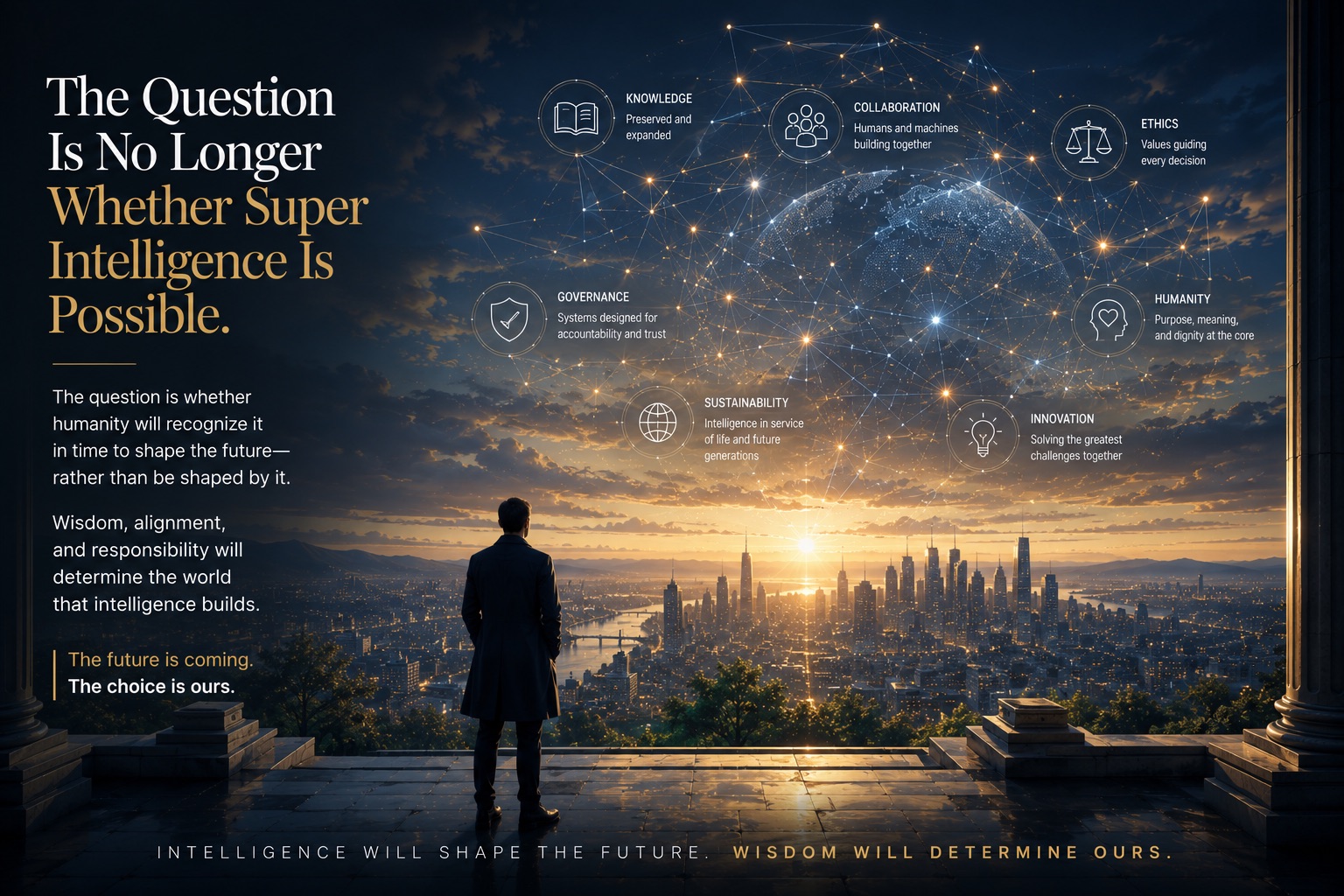
The question is no longer whether super intelligence is possible. The question is whether humanity will recognise it when it becomes impossible to ignore. By then, the future may already have arrived.
Why These Matter - WTM MEDIA is an independent editorial platform exploring the forces shaping our world—through people, culture, commerce, design, systems, and governance. Connecting the dots between today’s headlines and tomorrow’s realities.