
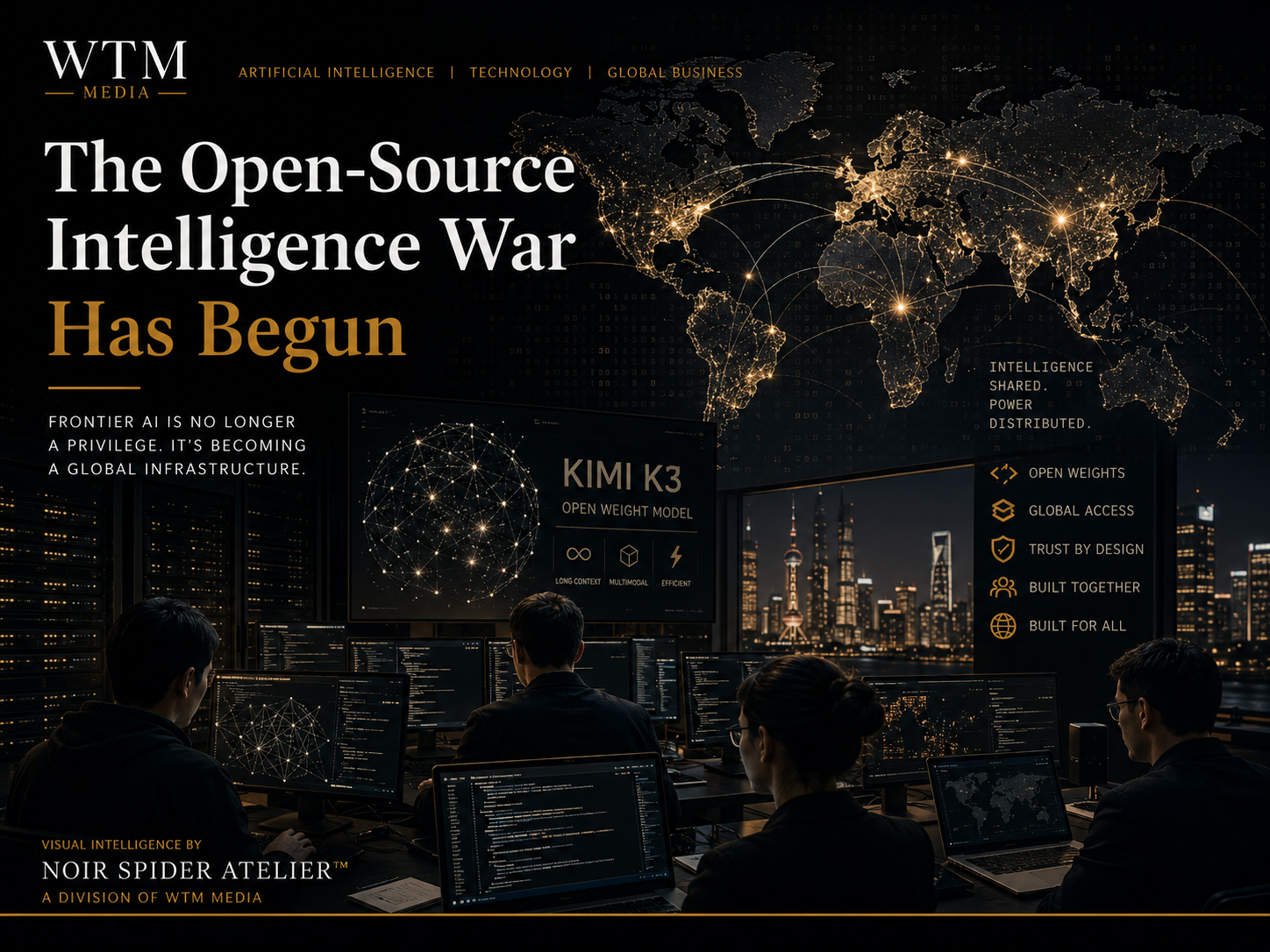
For years, the artificial intelligence race appeared destined to be dominated by a handful of Western companies capable of spending tens of billions of dollars training increasingly powerful frontier models. That assumption is now under sustained pressure. China’s Moonshot AI has introduced Kimi K3, an open-weight model claiming frontier-level capabilities at dramatically lower cost. Whether every benchmark ultimately withstands independent scrutiny is almost beside the point. The strategic significance lies elsewhere. Artificial intelligence is rapidly evolving from a competition over who builds the best closed model into a contest over who shapes the world’s intelligence infrastructure. The next decade may belong less to those who own intelligence than to those who successfully distribute it.
When ChatGPT captured public attention in late 2022, the dominant assumption was straightforward: larger models required larger budgets, larger computing clusters, and increasingly concentrated corporate power. Frontier artificial intelligence appeared destined to become one of history’s most centralised technologies. Only governments and trillion-dollar technology companies seemed capable of sustaining the enormous capital expenditure necessary to remain competitive.

That narrative held for nearly three years. OpenAI, Anthropic, Google DeepMind, Meta, xAI, and a handful of well-funded laboratories defined the frontier. Capability became synonymous with compute. Scale became synonymous with advantage. Investors increasingly believed that intelligence itself would become one of the world’s most concentrated industries.
Then another pattern quietly emerged. Chinese laboratories demonstrated an extraordinary ability to compress cost while narrowing capability gaps. Rather than attempting to outspend Silicon Valley dollar for dollar, many pursued algorithmic efficiency, engineering optimisation, and rapid iteration. The question gradually shifted from who possessed the largest models to who could achieve the greatest intelligence per unit of computation.
Moonshot AI’s introduction of Kimi K3 represents another important milestone in that transition. While many published benchmarks still require independent verification, the model’s reported combination of long-context reasoning, multimodal capability, and comparatively low operating cost reflects a broader strategic movement rather than an isolated product launch. Even if specific performance claims evolve, the direction of travel is becoming increasingly clear.
Equally significant is the commitment to open weights. Closed systems maximise control. Open systems maximise adoption. History repeatedly demonstrates that technologies achieving widespread distribution frequently reshape markets more profoundly than technologies achieving temporary technical superiority. The internet, Linux, Android, and many cloud technologies followed remarkably similar trajectories.
Artificial intelligence is therefore entering a second phase. The first phase rewarded invention. The second will reward distribution, ecosystems, integration, and trust. Intelligence is becoming infrastructure rather than merely software.

Technology markets rarely reward technical excellence in isolation. Superior products often lose to stronger ecosystems. VHS defeated Betamax. Android overtook numerous proprietary mobile operating systems. Cloud computing became dominant not because individual servers improved dramatically, but because ecosystems simplified deployment and scale.
Artificial intelligence is beginning to exhibit similar characteristics. Models increasingly compete across multiple dimensions simultaneously: reasoning quality, latency, operating cost, context length, developer tools, security, openness, integration, and deployment flexibility. Leadership is becoming multidimensional rather than singular.
Cost deserves particular attention. A model approaching frontier capability at substantially lower operating expense changes the economics of experimentation. Universities, startups, governments, researchers, and enterprises gain opportunities previously reserved for organisations possessing enormous computational budgets. Lower costs democratise innovation.
Openness further accelerates this dynamic. Developers can inspect architectures, fine-tune models, audit outputs, build specialised applications, and optimise performance for highly specific domains. This transforms artificial intelligence from a destination into a foundation upon which entirely new industries can emerge.
None of this eliminates the value of closed models. Highly secure environments, proprietary enterprise systems, safety-critical applications, and premium consumer experiences will continue benefiting from carefully managed architectures. Closed and open systems are unlikely to replace one another completely; instead, they will increasingly coexist across different strategic contexts.
The real competition therefore extends beyond benchmark scores. It concerns which intelligence ecosystems attract developers, businesses, governments, educators, researchers, and entrepreneurs. Winning the ecosystem often proves more enduring than winning a benchmark.

Artificial intelligence has become a strategic asset comparable to electricity, telecommunications, semiconductors, and the internet itself. Consequently, every major advance now carries geopolitical implications extending far beyond software engineering.
The United States continues leading many frontier research initiatives through extraordinary concentrations of capital, talent, cloud infrastructure, and private investment. Yet China’s rapid advances demonstrate that technological leadership is becoming increasingly contested rather than permanently settled. Innovation is no longer geographically monopolised.
This competition is reshaping industrial policy. Governments increasingly view AI infrastructure, semiconductor supply chains, energy generation, advanced networking, cybersecurity, education, and research funding as components of national resilience. Artificial intelligence policy has become economic policy, industrial policy, and national security policy simultaneously.
Developers now operate within this broader geopolitical environment whether they intend to or not. Decisions about frameworks, deployment models, cloud providers, data governance, and interoperability increasingly intersect with international regulation, export controls, and strategic alliances.
For businesses, this means AI procurement is becoming a board-level discussion rather than solely an IT decision. Questions surrounding sovereignty, resilience, transparency, vendor dependence, and long-term operational continuity are becoming commercially material. Intelligence architecture is emerging as a competitive differentiator.
The AI race therefore resembles less a sprint between individual companies and more an evolving competition between national innovation ecosystems. Whoever cultivates the healthiest ecosystem of talent, infrastructure, capital, openness, and trust may ultimately shape the global intelligence economy.

For business leaders, the expanding AI landscape creates leverage rather than confusion. More capable models entering the market increase competition, improve pricing, and reduce dependence upon any single provider. Optionality becomes a strategic advantage.
For developers, open-weight systems create unprecedented opportunities to build domain-specific solutions without requiring frontier-scale budgets. Innovation increasingly favours creativity, specialised expertise, and rapid execution over sheer financial resources.
For educators and students, accessible frontier-level models dramatically expand learning possibilities. Research, simulation, multilingual collaboration, software development, and scientific exploration become increasingly available to organisations of every size.
For policymakers, the challenge becomes balancing innovation with accountability. Excessive restriction risks slowing domestic competitiveness, while insufficient governance risks undermining public trust. Sustainable leadership requires both capability and legitimacy.
For investors, value creation may increasingly migrate away from foundation models themselves towards infrastructure, orchestration, cybersecurity, vertical applications, agent ecosystems, data quality, and enterprise integration. History suggests platform ecosystems often generate greater long-term value than underlying technologies alone.
For every professional, one lesson stands above the rest. Artificial intelligence should no longer be viewed as a single product. It is becoming an operating layer beneath virtually every industry. Understanding how intelligence systems interact will matter more than memorising which model currently tops a leaderboard.

The emergence of models like Kimi K3 should not be interpreted simply as another product announcement. It represents evidence that artificial intelligence is entering a new competitive era defined by efficiency, openness, and global participation rather than exclusive concentration.
History repeatedly demonstrates that transformative technologies become most influential after they become broadly accessible. Personal computers, smartphones, cloud computing, and the internet changed civilisation not because they remained scarce, but because they became widely distributed. Artificial intelligence appears to be following the same trajectory.
This evolution also shifts the strategic conversation. Future leadership will depend not only upon inventing more intelligent systems, but also upon building trustworthy governance, resilient infrastructure, ethical deployment, educational readiness, and human-centred design. Technology alone will not determine outcomes.
For WTM, this development reinforces a broader editorial principle. The defining question is rarely, “Who built the smartest model?” It is, “Which system changes how societies organise knowledge, power, work, and opportunity?” Systems ultimately outlast products.
The coming decade will not produce one winner in artificial intelligence. It will produce multiple competing ecosystems. Nations, organisations, and individuals capable of navigating those ecosystems intelligently will hold the greatest strategic advantage.
Artificial intelligence is no longer simply a technology story. It has become an institutional story, an economic story, and a civilisation story. The race is no longer just to create intelligence. It is to determine how intelligence will be shared, governed, and trusted.
Editorial Intelligence: Kelly Dowd, MBA, MA
Visual Intelligence: Noir Spider Atelier™ – A Division of WTM Media
Editorial Direction: Kelly Dowd, MBA, MA – Editor-in-chief
Copyright: © 2026 WTM Media. All rights reserved.
Why These Matter - WTM MEDIA is an independent editorial platform exploring the forces shaping our world—through people, culture, commerce, design, systems, and governance. Connecting the dots between today’s headlines and tomorrow’s realities.