

For the first phase of the generative AI revolution, companies rewarded adoption. Employees were encouraged to experiment, automate, prompt, accelerate and produce. Now a more difficult question is emerging. Once almost everyone has access to increasingly capable artificial intelligence, what actually distinguishes one worker, manager or organisation from another?. Ernst & Young’s US business has supplied an unusually concrete answer. In August 2026, EY announced a $100 million investment in employee rewards aimed not merely at technology adoption but at business acumen, judgement, adaptability, innovation, future-focused skills and exceptional client impact. The announcement is significant because compensation systems reveal what institutions believe has value. EY is effectively putting money behind a proposition that many organisations are only beginning to understand. The AI economy will require technical capability, but technical capability alone will not be enough. This is not the first time a machine has changed the value of human labour. Steam power changed physical production. Electricity reorganised factories. Mechanisation transformed textiles. Computers reorganised information work. ATMs automated transactions. Smartphones subsequently reorganised banking itself. Each revolution eliminated some activities, created others and, most importantly, changed what remained valuable for people to do. AI belongs to this history, but it introduces a profound difference. It reaches directly into work once assumed to demonstrate intelligence itself. The resulting challenge is not human versus machine. It is far more demanding. Organisations must decide what machines should do, what humans must continue to understand, how people will develop judgement when machines increasingly perform the tasks through which judgement was once learned and how value will be distributed when technology radically increases the productive capacity of labour. The machine can increasingly produce an answer. Someone still has to decide whether the answer deserves to become reality.
Human beings have a peculiar relationship with powerful inventions. We become fascinated by the object itself. The steam engine. The electric motor. The assembly line. The computer. The internet. The smartphone. Now artificial intelligence. We photograph the machine, name the revolution after it and imagine that possession of the technology constitutes transformation. History is less accommodating. An invention becomes economically important only when people redesign systems around what the invention makes possible.
Consider electricity. Replacing steam with an electric motor was useful, but the deeper transformation occurred when factories stopped organising themselves around the physical constraints of a central power source. Steam-powered factories depended upon shafts and belts that constrained where machinery could be positioned. Distributed electric motors eventually allowed machines to be placed where production logic demanded rather than where mechanical transmission permitted. Electricity therefore did more than provide power. It enabled people to redesign the architecture of work. Research on US manufacturing finds that electrification was accompanied by organisational change, capital deepening and substantial productivity gains.
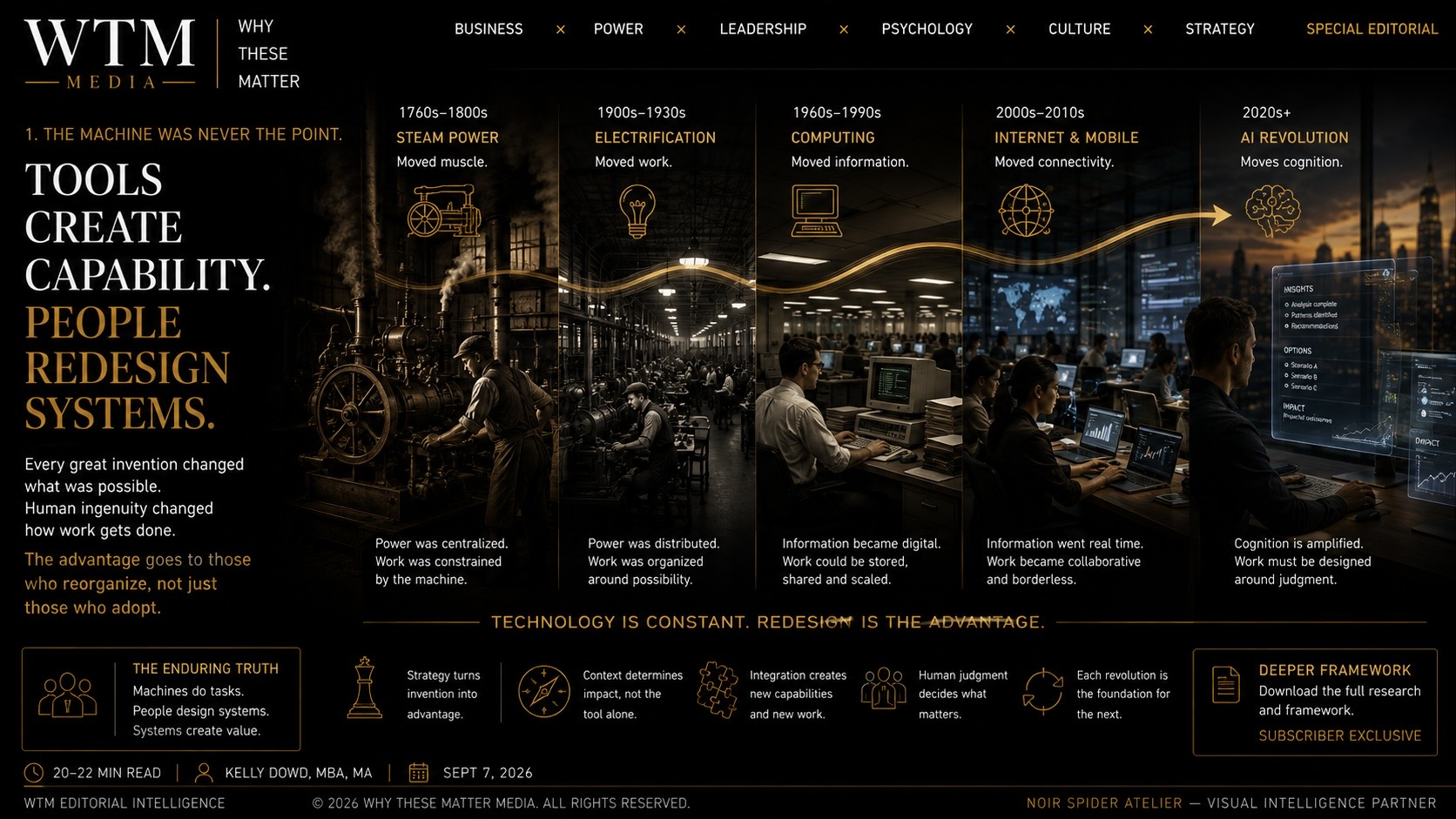
Mechanisation produced a similar lesson. Nineteenth-century power looms dramatically reduced the labour required to weave cloth. Yet technological efficiency did not translate mechanically into the disappearance of every weaving job. Falling production costs expanded demand, while the capabilities required of workers changed. Skills associated with coordinating machinery became more valuable even as particular manual activities became less important. Technology altered the task architecture before it altered the meaning of the occupation.
The ATM provides an even more familiar example. Cash dispensing and deposits were precisely the kinds of repetitive activities a machine could perform efficiently. Banks needed fewer tellers per branch. Yet lower operating costs initially helped banks expand branch networks, while teller work moved towards customer relationships and higher-value services. Automation removed part of the job and increased the relative importance of another part. Later, online and mobile banking changed the architecture again. The lesson is not that technology always creates jobs or always destroys them. It is that technologies interact with demand, business models, institutions, customer behaviour and subsequent innovations. The first-order effect of a machine rarely tells us the final shape of the system.
AI is now repeating this pattern at extraordinary speed. A professional who once spent three hours preparing an initial analysis may produce one in twenty minutes. A designer can generate variations. A developer can draft code. A consultant can synthesise research. A lawyer can interrogate documents. A communications team can create dozens of preliminary concepts before lunch. The obvious measurement is time saved. The more consequential question is what happens to the remaining time and who possesses sufficient judgement to use it well.
That distinction separates tool adoption from system transformation. Buying AI licences is adoption. Counting prompts is adoption. Mandating usage is adoption. Transformation begins when an organisation understands which work should disappear, which work should accelerate, which work requires greater human scrutiny, which capabilities become newly scarce and how the organisation itself must change. The history of technology suggests the winners of a revolution are rarely those who merely acquire its defining tool. They are the people and institutions that learn how to reorganise around it.
Generative AI arrived inside organisations with a seductive proposition. More intelligence, available faster, at lower marginal cost. Draft this. Analyse that. Summarise these documents. Generate alternatives. Compare strategies. Write code. Create an image. Model a scenario. The interface made sophisticated computational capability feel almost frictionless. That ease is precisely why the next phase is more difficult.
When production becomes easier, production itself becomes less differentiating. If ten competitors can produce a credible market analysis overnight, possession of the analysis provides less advantage. If every candidate can generate an immaculate cover letter, the polish of the cover letter communicates less information. If every executive can arrive at a meeting with an AI-generated strategic brief, possession of a brief is no longer evidence of strategic intelligence. Abundance does not eliminate value. It moves value somewhere else.

That movement is already visible in labour research. The International Labour Organization estimates that one in four workers globally occupies a job with some degree of exposure to generative AI, but concludes that transformation is more likely than wholesale replacement because most occupations still require human input. The distinction between a job and its tasks matters. AI can absorb significant pieces of an occupation without possessing the full economic, social or institutional function of the person performing it.
This creates what I consider the central AI management problem. Artificial intelligence can increase the supply of answers faster than organisations increase their capacity to judge them. A plausible answer is not necessarily a correct answer. A correct answer is not necessarily a useful answer. A useful answer is not necessarily an ethical answer. An ethical answer may still be commercially impossible. A commercially attractive answer may create unacceptable legal, reputational or societal consequences. Intelligence can generate possibilities. Judgement must navigate consequences.
That is why the language of “soft skills” has become dangerously obsolete. Judgement is not soft when an executive is allocating billions in capital. Adaptability is not soft when a business model is deteriorating. Trust is not soft when a client must decide whether to act on a recommendation. Curiosity is not soft when established expertise is ageing faster than the professional who possesses it. Empathy is not soft when organisational transformation requires thousands of frightened people to change how they work. These are operating capabilities. Their outputs are simply harder to count than prompts, transactions or lines of code.
There is also a more uncomfortable danger. The better AI becomes at producing competent work, the easier it becomes for humans to appear competent without developing competence. A junior employee can generate a polished answer without understanding the reasoning beneath it. A manager can mistake articulate synthesis for knowledge. An executive can confuse computational confidence with strategic certainty. AI therefore creates two simultaneous possibilities. It can extend human capability, or it can conceal human incapability. The difference is not in the machine. It is in the architecture surrounding its use.
Every profession contains work that senior people eventually stop doing but once needed to do. The analyst builds the spreadsheet. The junior architect draws the detail. The associate researches the precedent. The young consultant cleans the data and prepares the slides. The apprentice watches the craftsperson. These activities can be tedious. They are also often where professional intuition begins.
We tend to think of expertise as accumulated information. It is more accurately accumulated discrimination. The experienced person notices what the inexperienced person does not. Something in the numbers feels inconsistent. A client’s explanation does not fit the incentives. A material will behave differently once installed. A negotiation has changed even though nobody has said so. The proposal is technically sound but politically impossible. These judgements emerge through repeated exposure to situations where reality pushes back against theory.
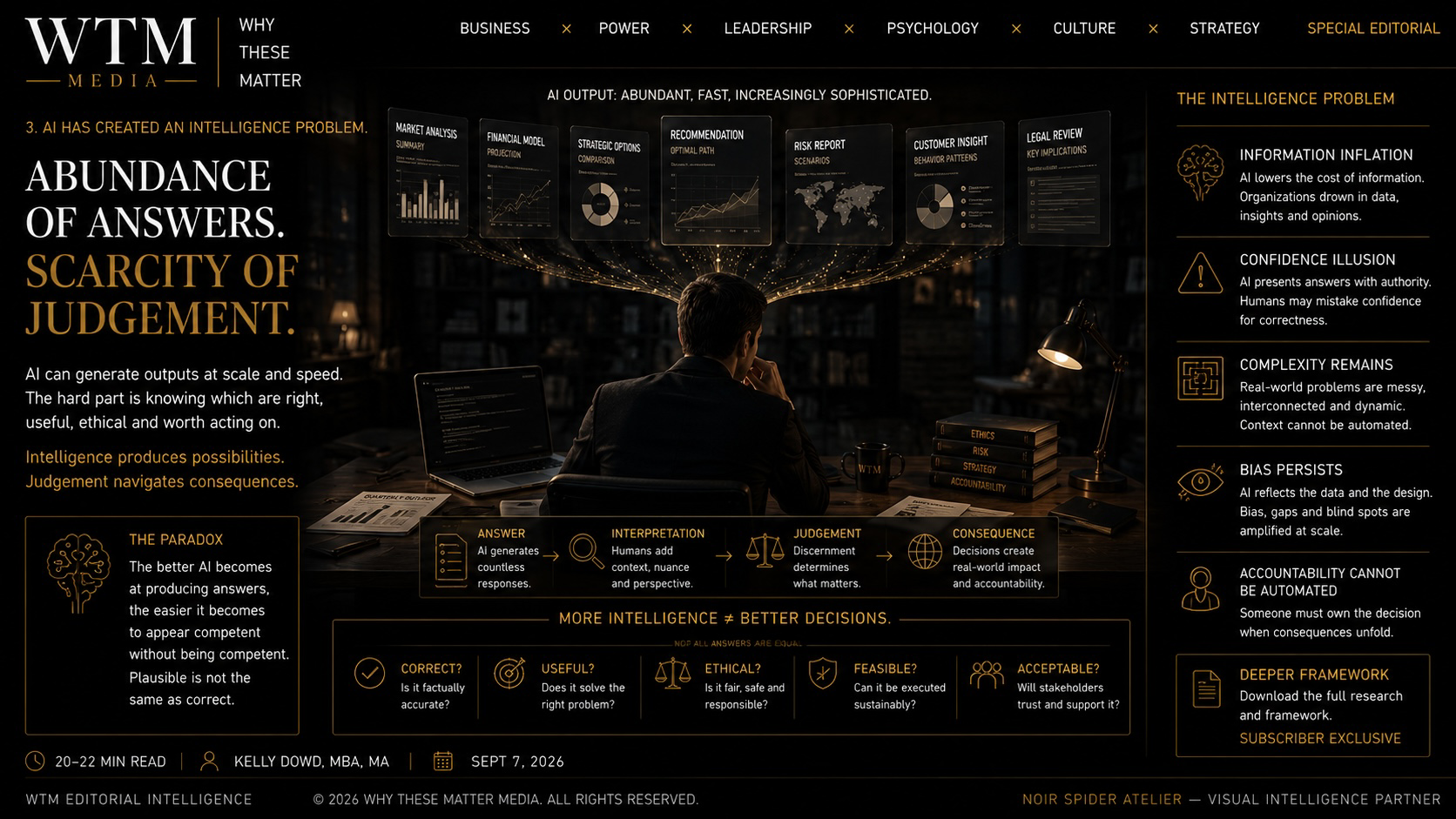
AI can remove precisely the friction through which some of that learning occurred. If the machine performs the first draft, the junior professional may never discover why the first draft is difficult. If it conducts the preliminary analysis, the analyst may receive conclusions without wrestling with the anomalies. If it writes the code, the developer may solve the immediate problem without developing an equivalent mental model of the system. Efficiency at the task level can therefore create fragility at the capability level.
Professional services firms appear to recognise the problem. EY’s new Career Residency programme explicitly emphasises judgement, curiosity and trust, alongside the mindset, skills and tools required for technology-led work. Consulting firms are also revisiting apprenticeship and in-person development as AI absorbs more technical work and human interaction, communication and judgement become more important.
This is where organisations must resist an obvious accounting temptation. If AI allows five inexperienced employees to produce the output previously requiring ten, eliminating five positions may improve the next quarter’s economics. But if those positions were also the developmental pipeline through which future managers, partners, engineers and executives acquired judgement, the organisation may be consuming its future capability to improve its present margin. What looks like labour efficiency can become institutional malnutrition.
The better design is neither protecting obsolete tasks nor romanticising inefficiency. Apprenticeship itself must be redesigned. Junior professionals should use AI, but they should also be required to interrogate it. Show the assumptions. Identify what could be wrong. Produce an alternative interpretation. Explain why one recommendation was rejected. Defend the decision without referring to the model. Compare machine output with direct observation. Sit beside experienced practitioners when ambiguity cannot be solved with information alone. The objective is no longer to prove that a person can manually reproduce everything the machine can do. It is to ensure the person develops sufficient understanding to recognise when the machine should not be trusted.
This is the paradox organisations must solve. We want AI to eliminate unnecessary work without eliminating necessary learning. That requires recognising that a task can have low economic value and high developmental value at the same time. Once leaders understand that distinction, workforce development changes completely.
EY’s $100 million decision matters because compensation is organisational language. Mission statements tell employees what institutions say they value. Budgets, promotions and compensation reveal what they actually value. EY says its rewards will recognise people developing future-focused capabilities, advancing culture, driving innovation and delivering exceptional client service, alongside the productive use of advanced technology. That begins moving AI from an adoption metric towards an impact metric.
For executives, the value signal is judgement under consequence. Their role is not to become the organisation’s most enthusiastic prompt engineer. Executives must decide where AI changes the economics of the enterprise, where it changes risk, which capabilities should remain sovereign, where human accountability cannot be delegated and how productivity gains should be converted into durable advantage. They must distinguish technological possibility from strategic necessity. The executive question is no longer simply, “Can AI do this?” It is, “What becomes possible if it can, what becomes vulnerable if we let it and what system should we build as a result?”
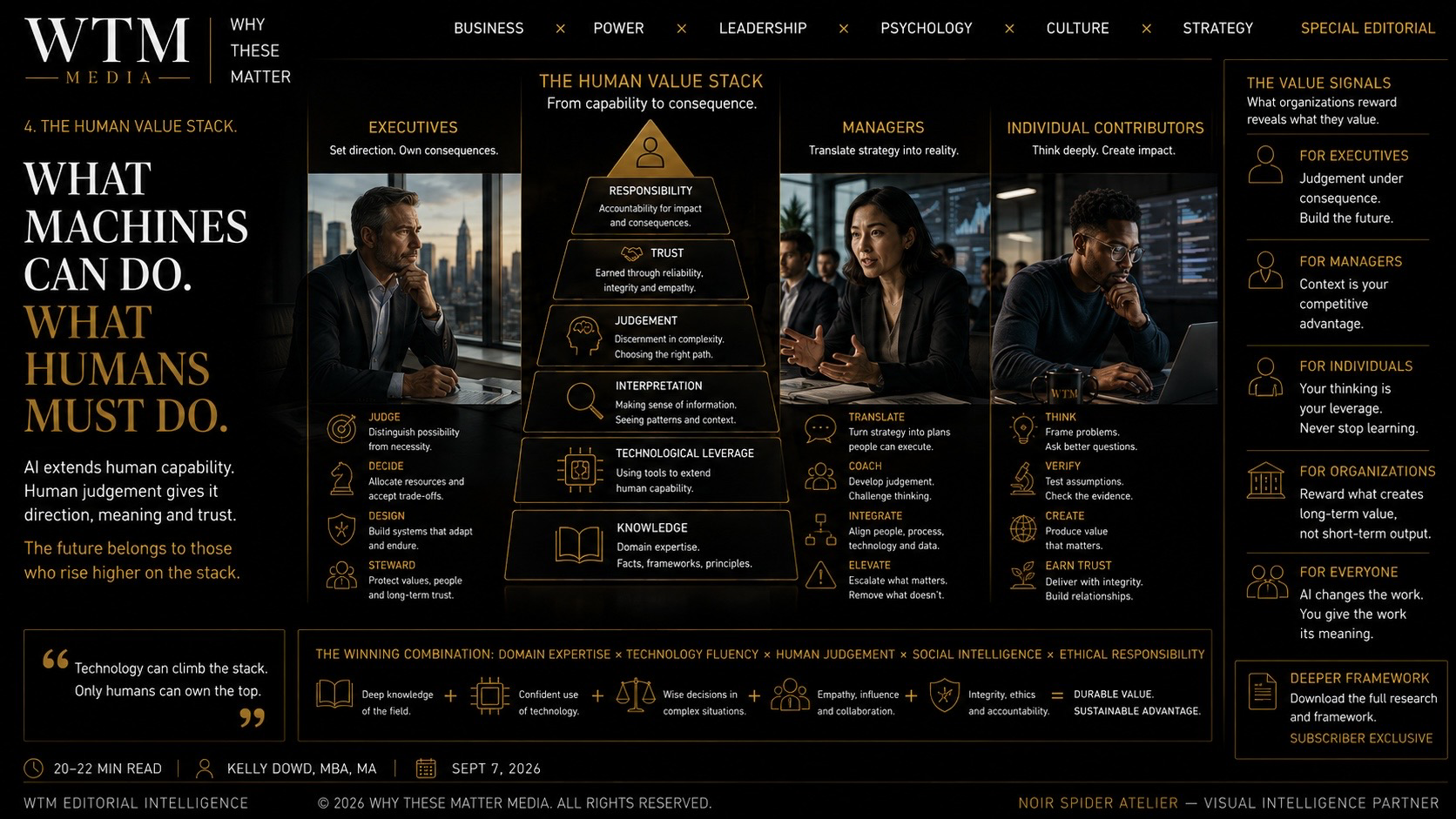
For middle managers, the value signal is translation. They occupy the difficult territory between strategic ambition and operational reality. They must redesign workflows, coach people, challenge low-quality machine output, recognise when employees are becoming dependent rather than capable and determine which problems deserve escalation. Their value increasingly lies in context. AI may know policy, but the manager knows why the policy exists. AI may identify a performance pattern, but the manager knows the human conditions behind it. AI may recommend an efficient sequence, but the manager sees where the organisation will resist. Middle management, properly designed, becomes the integration layer between machine capability and institutional reality.
For individual contributors, the value signal is no longer simply output. It is increasingly the quality of thought surrounding output. Can you frame the problem? Can you recognise a bad assumption? Can you ask a better question? Can you work across disciplines? Can you communicate uncertainty? Can you verify evidence? Can you build trust? Can you learn faster than your current expertise depreciates? Can you use AI without surrendering your own capacity to think? The World Economic Forum’s employer research points towards precisely this combination. AI and big data are among the fastest-growing technical skills, while analytical thinking, resilience, flexibility, creativity, leadership, curiosity and lifelong learning remain central or increasingly important.
The implication is not that technical expertise matters less. Quite the opposite. Human judgement without sufficient knowledge becomes opinion. Empathy without standards becomes avoidance. Creativity without execution becomes theatre. AI fluency without domain knowledge creates confident mediocrity. The future professional therefore requires a combination that organisations have too often separated: technological literacy, domain expertise, analytical reasoning, social intelligence, ethical judgement and the ability to act.
I think of this as the Human Value Stack. At its base sits knowledge. Above it sits technological leverage. Above that sits interpretation. Then judgement. Then trust. At the top sits responsibility. Machines may climb portions of this stack rapidly. The crucial question is not whether AI eventually demonstrates more of these capabilities. The organisational question is who remains accountable when a decision enters the human world. Until responsibility itself can be transferred to a machine in law, culture and moral consequence, human authority cannot simply disappear because computational capability improves.
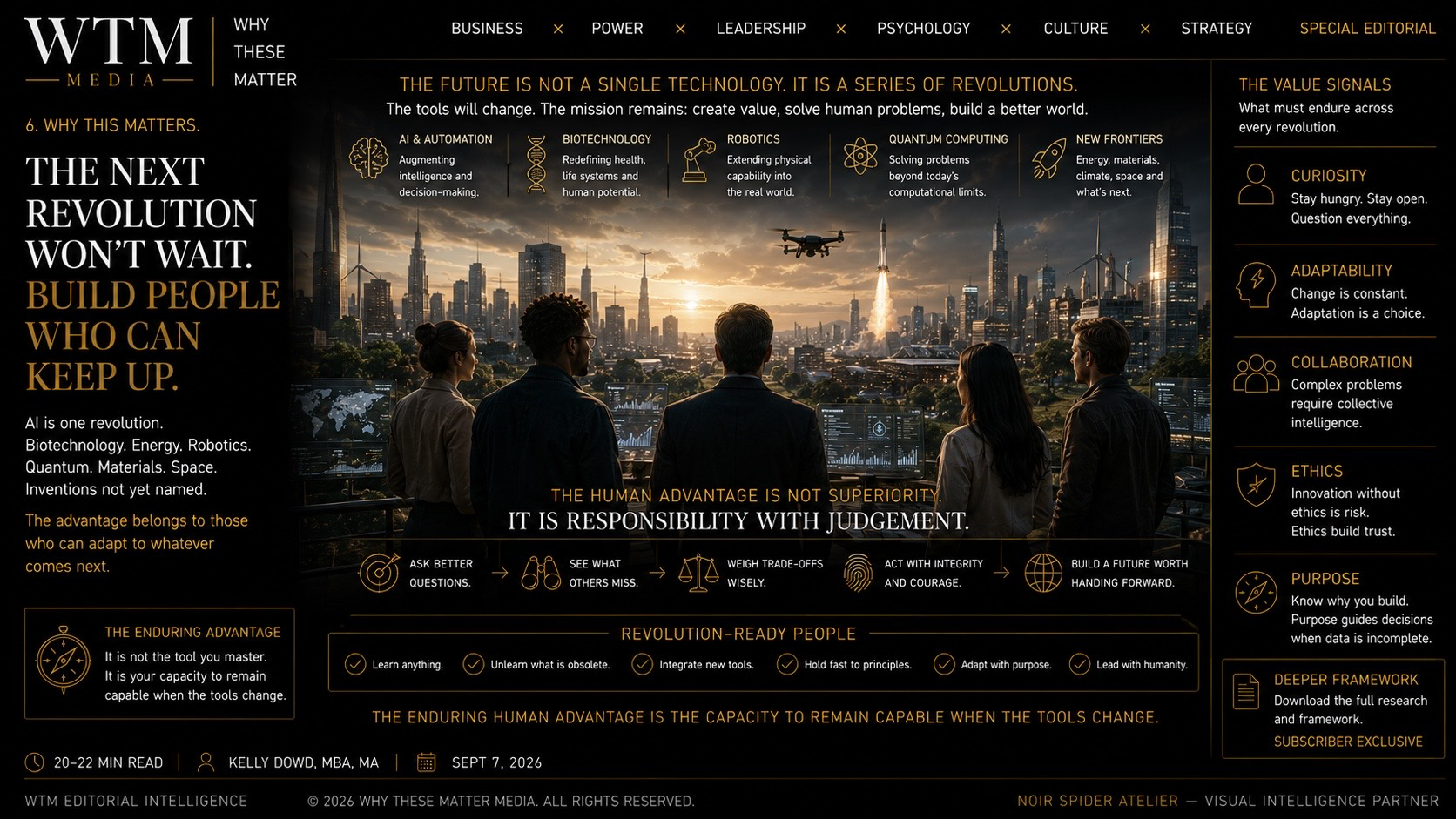
There is a trap hidden inside every future-of-work programme. Organisations observe today’s technology and begin training people to survive today’s disruption. By the time the programme matures, the disruption has moved. AI capabilities improve. Interfaces change. Agents become more autonomous. Robotics advances. Quantum computing may eventually alter particular computational domains. Biotechnology, synthetic biology, advanced materials, spatial computing, energy technologies and inventions not yet named will interact with one another in ways no workforce plan can accurately predict.
This is why teaching employees today’s AI tools cannot be the final strategy. Tools have half-lives. Interfaces disappear. Vendors rise and fall. Technical techniques become automated themselves. A worker trained exclusively around the operation of a particular technology becomes vulnerable to the next technology that removes the need to operate it manually. The durable capability is learning how to understand new systems as they arrive.
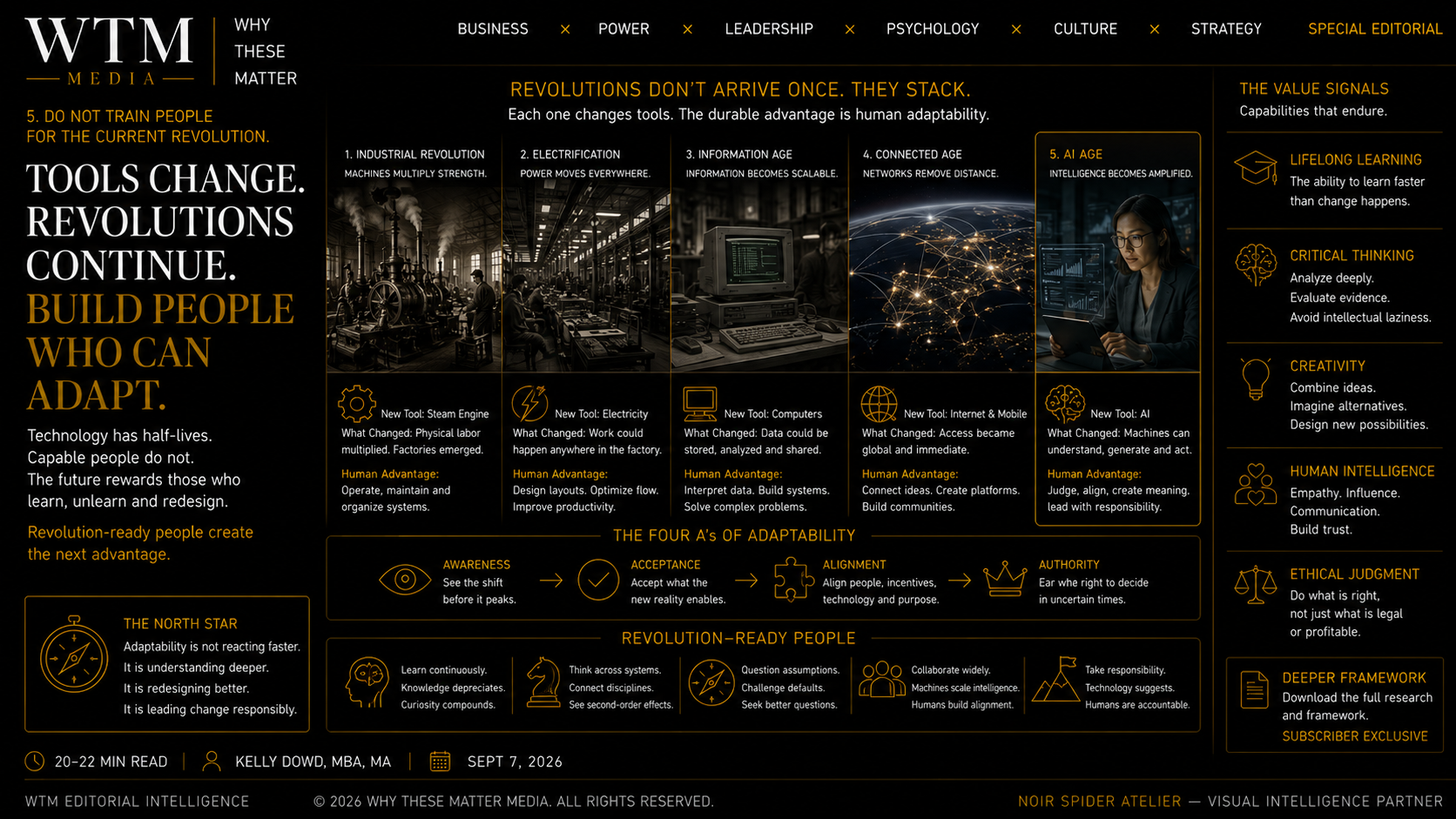
History repeatedly demonstrates this. Electrification did not merely reward people who knew how to operate electric motors. It rewarded organisations capable of redesigning production around distributed power. Computing did not merely reward typists who became faster typists. It created entirely new ways of storing, analysing, distributing and acting upon information. ATMs did not settle the future of banking because the internet and smartphone later changed the system again. Innovation does not arrive as a final destination. Each layer becomes infrastructure for the next.
This makes adaptability more than an employment skill. It is an institutional survival capability. The World Economic Forum estimates that nearly 40 per cent of skills required on the job are expected to change by 2030 and reports that 63 per cent of employers already identify skills gaps as a major barrier to transformation. Whether those forecasts land precisely is less important than the direction of travel. Organisations are attempting to build workforces for environments whose technologies will continue changing faster than traditional training systems.
The Four A’s provide a useful way of understanding what durable capability requires. Awareness asks people to see the emerging system rather than defend the disappearing one. Acceptance requires intellectual honesty about what a technology can now do, including capabilities that threaten one’s own expertise. Alignment asks how people, incentives, technology, economics and responsibility should fit together. Authority is the earned capacity to make a consequential decision after understanding those conditions. AI can participate in every stage. It does not absolve humans from any of them.
The objective, then, should not be to produce an “AI-ready workforce”. That phrase will eventually sound as dated as “internet-ready company”. Organisations need revolution-ready people. People capable of entering unfamiliar systems, learning quickly, distinguishing signal from fashion, preserving valuable principles, abandoning obsolete processes, integrating new tools and redesigning work without surrendering human responsibility. The next revolution after AI will test the same capability. So will the one after that.
The most important thing about EY’s $100 million announcement is not the amount. It is the signal. A major professional-services institution is attaching explicit financial recognition to capabilities that corporations have historically praised in speeches but struggled to price. Judgement. Adaptability. Business acumen. Innovation. Human capability alongside technological leverage. When compensation begins moving, an organisational belief is becoming operational.
But there is a larger economic question beneath it. If AI increases productivity substantially, who receives the value? Shareholders through margins? Customers through lower prices? Executives through compensation? Workers through higher wages and reduced drudgery? Society through greater abundance? The answer will not be determined by the technology. It will be determined by institutions, markets, labour power, regulation, leadership and design. Tools create possibilities. Human systems distribute their consequences.
That distinction should make us sceptical of both technological utopianism and technological fatalism. AI will eliminate some work. It will create some work. It will transform considerably more. The ILO’s current evidence points towards transformation as the dominant near-term effect across exposed occupations, but history warns against converting any present pattern into a permanent law. One technology may complement a profession before another technology changes the business model that sustained it.
The responsibility therefore falls differently across the organisation. Executives must design institutions capable of adapting without consuming their human foundations. Managers must convert technological capability into better work without allowing efficiency to become intellectual atrophy. Individual contributors must stop treating expertise as something acquired once and defended indefinitely. Everyone must learn to distinguish the value of producing work from the value of understanding what the work means.
This is ultimately a design problem. Every tool extends human capability while changing human behaviour. The hammer changes what can be built. The engine changes how far power can travel. Electricity changes where work can happen. The computer changes how information can be manipulated. The internet changes who can access it. The smartphone changes where the network lives. Artificial intelligence changes who, or what, can participate in cognition at scale. None of these inventions tells humanity what should be done with the capability it creates. That decision remains a question of values, incentives, judgement and authority.
The future of work therefore does not belong simply to people who know AI. It does not belong to people who reject it. It will favour people capable of doing something considerably harder. They will know when to use the machine, when to question it, when to override it, when to learn from it and when the problem itself needs to be redesigned. The machine will continue becoming more capable. Another machine will eventually follow it. The enduring human advantage is not mastery of the latest tool. It is the capacity to remain capable when the tools change.
This editorial distinguishes reported fact, historical evidence and WTM interpretation. The Human Value Stack and the framing of revolution-ready people are WTM Editorial Intelligence constructs rather than established scientific models.
The principal contemporary catalyst is EY US's official announcement, which confirms the $100 million rewards investment and its emphasis on business acumen, judgement, adaptability, innovation, culture and client impact. EY’s Career Residency announcement provides evidence for its parallel emphasis on judgement, curiosity, trust and redesigned early-career development. The Wall Street Journal independently reports the rewards initiative and broader professional-services shift.
Labour-market grounding comes from the International Labour Organization's 2025 Generative AI and Jobs research and its refined occupational exposure analysis, which finds substantial exposure while concluding that transformation rather than complete replacement remains the more likely effect for most jobs.
Skills evidence comes from the World Economic Forum Future of Jobs Report 2025. Its employer survey places analytical thinking among the most important core skills while identifying AI and big data as rapidly growing technical capabilities alongside resilience, creativity, leadership, curiosity and lifelong learning.
Historical automation context draws on James Bessen’s analysis published by the IMF concerning textiles, ATMs, computerisation and changing occupational skills, together with NBER research on electrification and the organisational redesign of manufacturing. These examples are used to demonstrate contingency, not to claim that AI must reproduce previous technological outcomes.
Author: Kelly Dowd, MBA, MA
Visual Intelligence: Noir Spider Atelier™ — A Division of WTM Media
Editorial Direction: Kelly Dowd, MBA, MA
© 2026 Kelly Dowd / Why These Matter Media. All rights reserved.
Third-party company names, research, publications and trademarks remain the property of their respective owners and are referenced for reporting, criticism, analysis and attribution. Historical comparisons are interpretive devices, not predictions that artificial intelligence will reproduce the employment effects of previous technologies.
WTM Editorial Intelligence principle: the relevant question is not whether technology replaces humanity. It is whether humanity develops the judgement to redesign itself around what technology makes possible.
Why These Matter - WTM MEDIA is an independent editorial platform exploring the forces shaping our world—through people, culture, commerce, design, systems, and governance. Connecting the dots between today’s headlines and tomorrow’s realities.