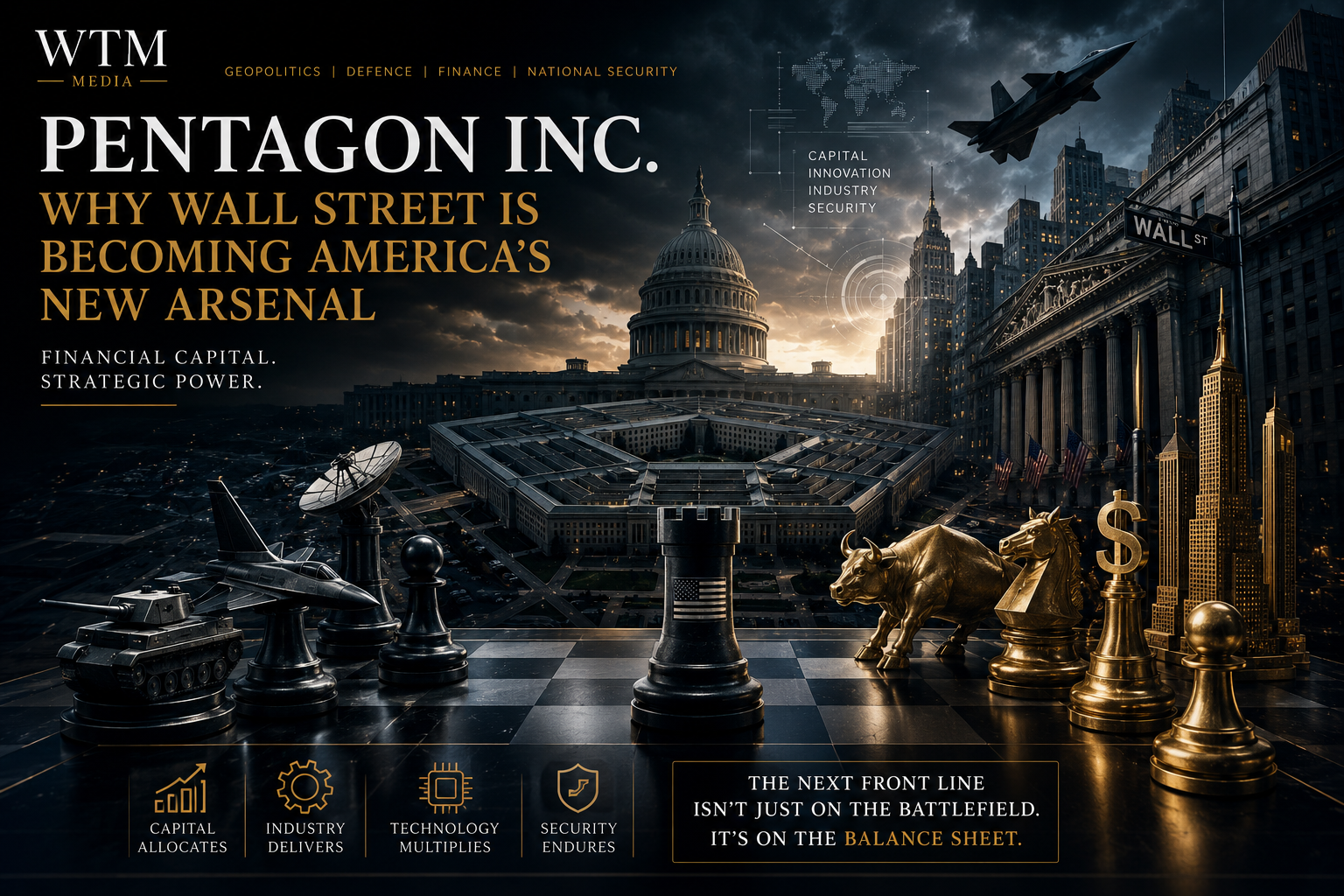
For generations, military power was measured by the size of armies, fleets, and weapons stockpiles. Today, another form of power is quietly moving to the centre of national defence: capital allocation. The Pentagon’s decision to recruit Wall Street bankers, private equity executives, investment professionals, and corporate financiers represents more than a staffing exercise. It signals a structural transformation in how governments intend to compete. Modern deterrence increasingly depends upon industrial capacity rather than battlefield tactics alone. Producing missiles, satellites, semiconductors, drones, rare-earth processing facilities, cyber infrastructure, and resilient supply chains requires financing as much as engineering. The emerging contest is no longer simply about who possesses superior weapons. It is about who can mobilise capital, accelerate production, and sustain innovation faster than geopolitical rivals. This is not the militarisation of finance. It is the financialisation of national security. Understanding that distinction may become one of the defining strategic competencies of the coming decade.
The twentieth century largely separated military planning from financial markets. Governments established defence budgets, military planners determined procurement priorities, and private industry fulfilled contracts through lengthy acquisition cycles. Capital remained a supporting function rather than the principal strategic instrument. Today’s geopolitical landscape is fundamentally different. The speed of technological competition has compressed those traditional timelines beyond recognition.
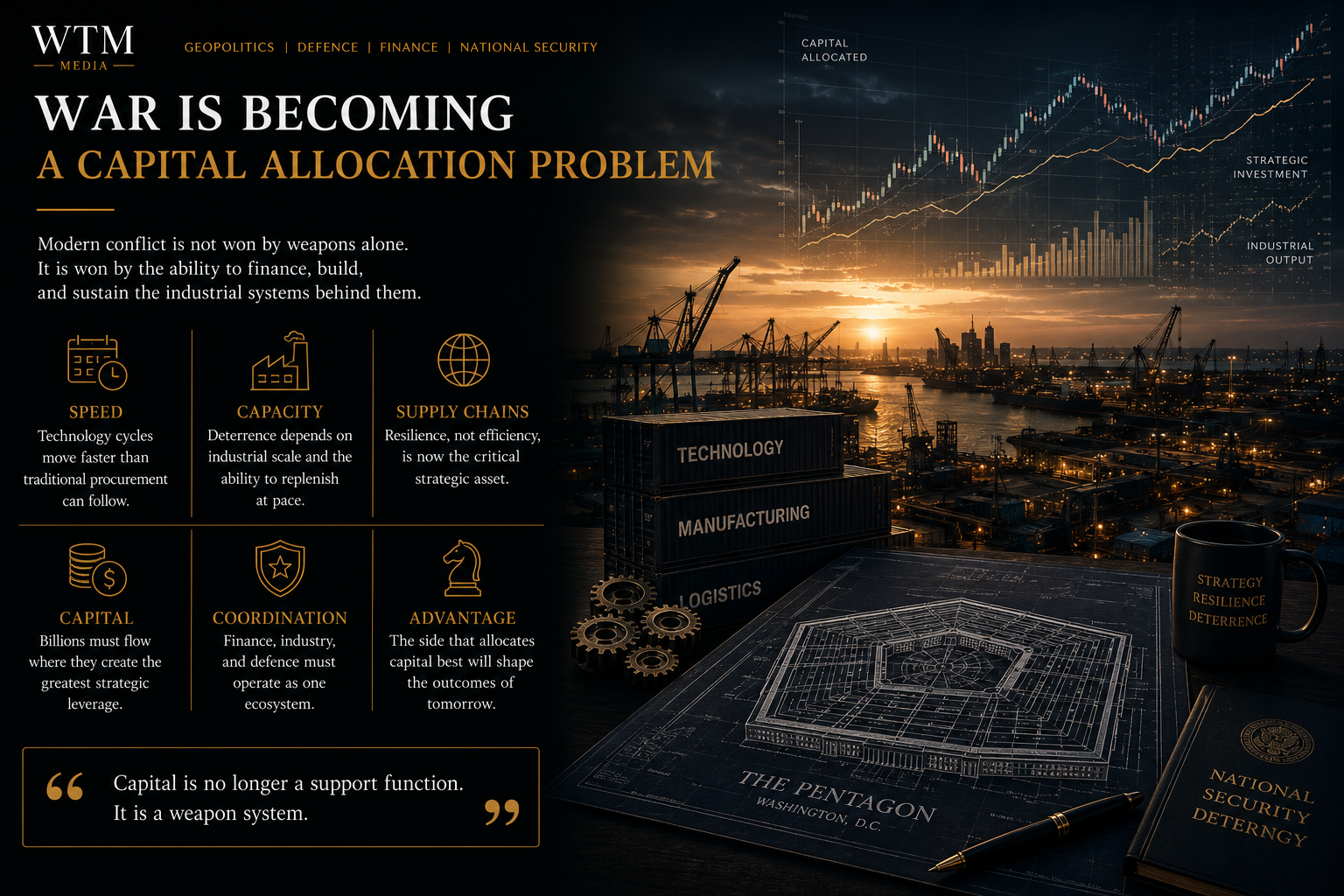
Russia’s invasion of Ukraine exposed an uncomfortable reality for Western governments. Winning conflicts depends not merely upon possessing sophisticated weapons but upon replacing them continuously. Stockpiles diminish quickly. Manufacturing capacity cannot be created overnight. Supply chains fracture under pressure. Industrial resilience, rather than battlefield brilliance alone, increasingly determines strategic endurance.
China has understood this relationship for years. Through coordinated industrial policy, state-supported financing, and vertically integrated manufacturing ecosystems, Beijing has fused economic development with long-term strategic planning. Rather than treating defence production as an isolated sector, it has embedded national security objectives across finance, infrastructure, technology, and industrial policy. The result is an ecosystem capable of scaling far more rapidly than fragmented competitors.
Against this backdrop, the Pentagon’s recruitment of Wall Street professionals begins to look less surprising. Large-scale industrial expansion requires expertise in project finance, mergers and acquisitions, infrastructure investment, risk management, and capital markets. Military officers understand operational requirements. Financial professionals understand how to move billions of dollars efficiently through extraordinarily complex economic systems.
The establishment of the Office of Strategic Capital reflects this changing reality. Rather than viewing capital markets as external actors, policymakers increasingly regard them as extensions of national capability. Financing becomes another theatre of strategic competition alongside cyber operations, diplomacy, intelligence, and military readiness.
This represents one of the most significant conceptual shifts in modern defence policy. National security is no longer secured solely by soldiers, sailors, pilots, or intelligence officers. Increasingly, it depends upon financiers capable of directing investment towards technologies and industries that will define future power.
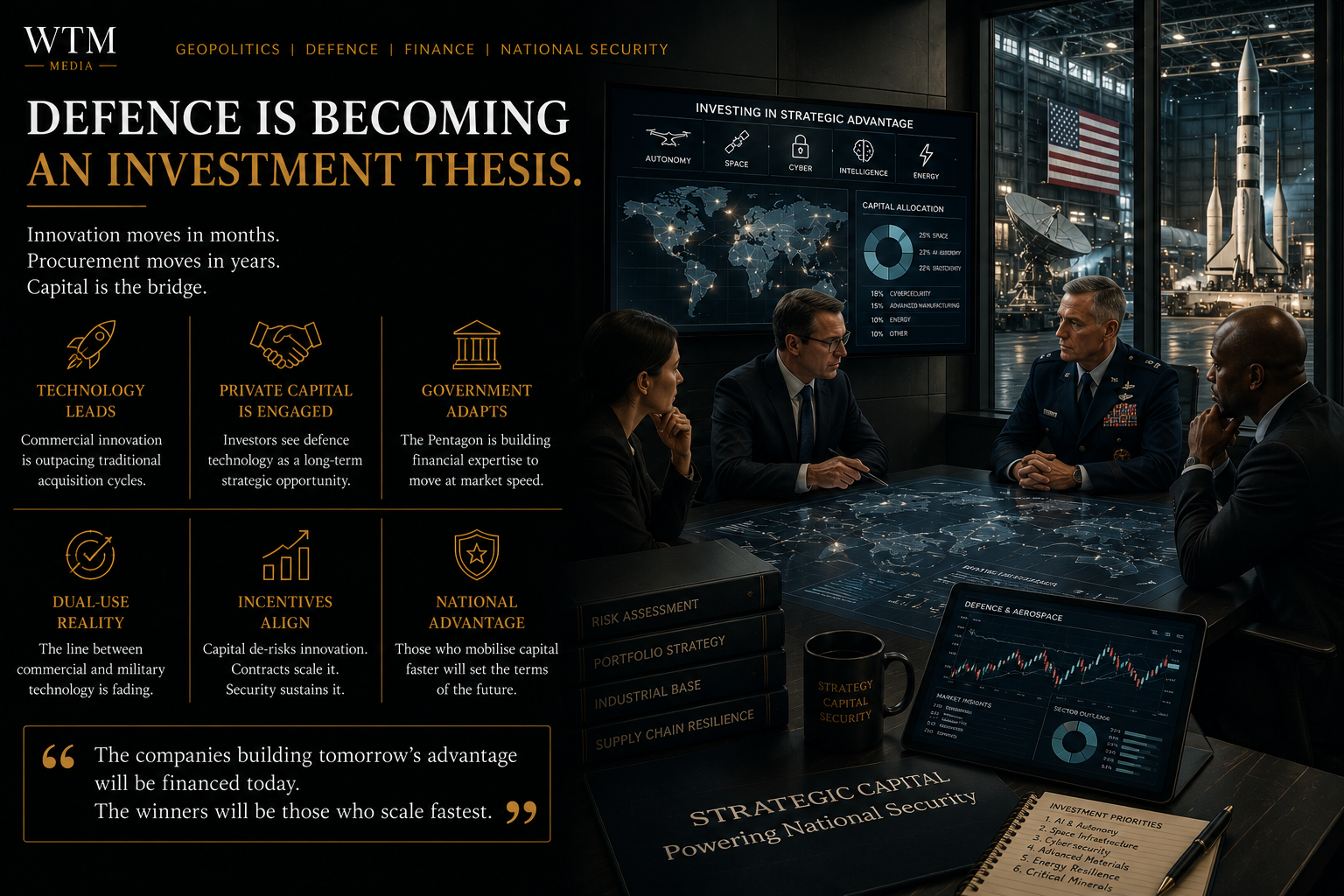
Traditional defence procurement operated within relatively predictable cycles. Governments identified requirements, appropriated budgets, selected contractors, and waited years for delivery. Emerging technologies have compressed those cycles dramatically. Artificial intelligence, autonomous systems, quantum computing, advanced materials, biotechnology, and commercial space capabilities evolve faster than conventional procurement systems were designed to accommodate.
Private capital has already recognised this opportunity. Venture capital firms, sovereign wealth funds, private equity groups, and institutional investors increasingly view defence technology as an attractive long-term sector. Start-ups developing autonomous drones, satellite networks, cybersecurity platforms, and advanced manufacturing techniques now attract investment levels once reserved primarily for consumer technology.
The Pentagon appears increasingly willing to harness these financial dynamics rather than resist them. By recruiting professionals who understand private capital, government gains access not simply to financial expertise but to institutional knowledge about scaling companies, structuring incentives, evaluating technological risk, and mobilising investment ecosystems.
This also reflects changing assumptions about innovation itself. Historically, governments funded research laboratories that eventually transferred technology into commercial markets. Increasingly, innovation flows in the opposite direction. Commercial companies pioneer breakthrough technologies that governments subsequently adopt for strategic purposes. Silicon Valley, venture capital, and defence are becoming progressively interconnected.
This convergence introduces new ethical questions. National security priorities may increasingly shape investment decisions, while financial incentives may influence strategic priorities. The relationship between profit and public interest becomes more complex, requiring stronger governance rather than weaker oversight.
Yet ignoring these dynamics would not prevent them from occurring. Strategic competition increasingly rewards nations capable of integrating financial systems with technological innovation while maintaining democratic accountability. That integration may become one of America’s principal competitive advantages if managed intelligently.
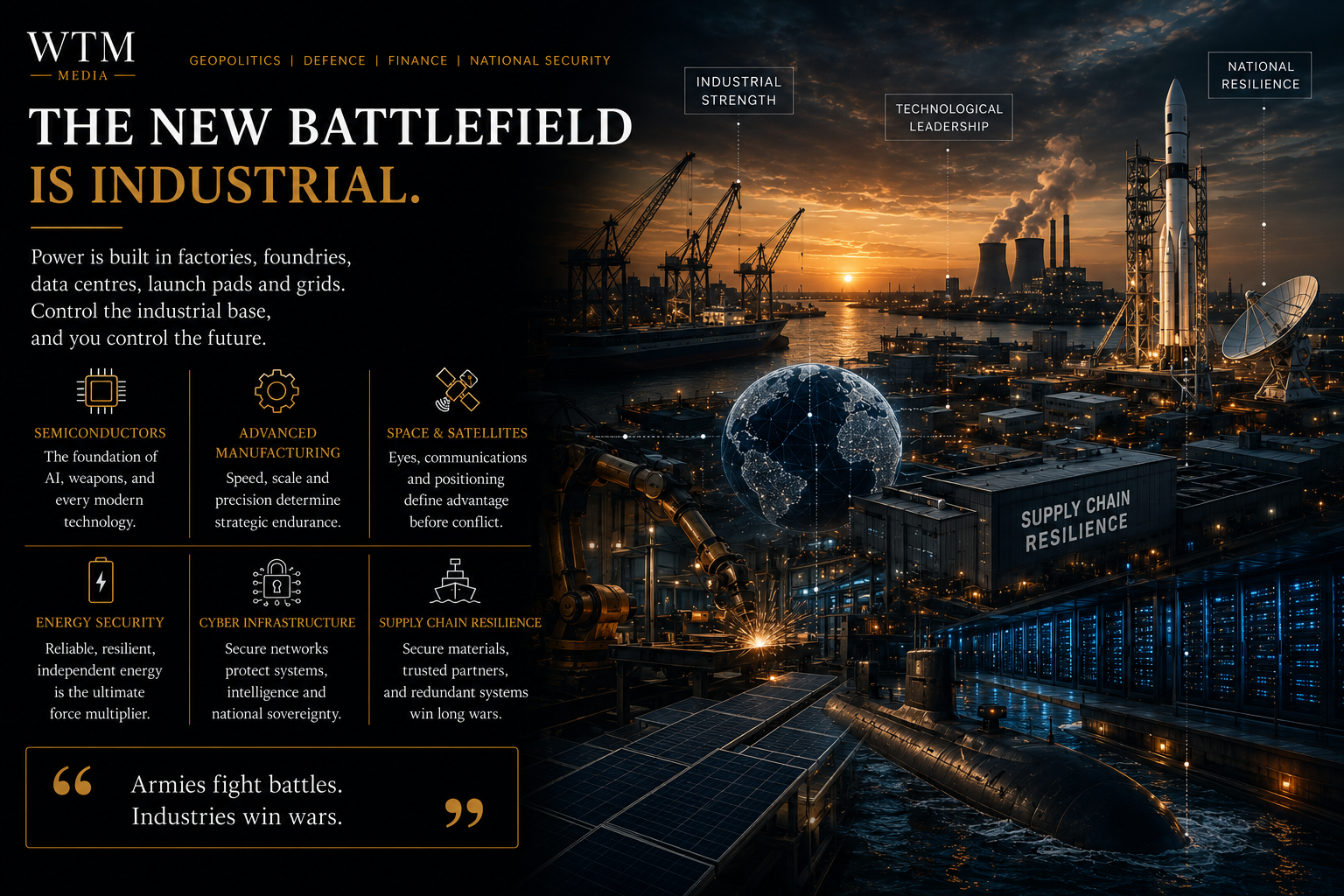
Modern conflict extends far beyond conventional battlefields. It now encompasses semiconductor fabrication facilities, battery manufacturing plants, satellite launch infrastructure, rare-earth mineral processing, cloud computing networks, energy resilience, and secure telecommunications. These systems determine whether military capabilities can be sustained over decades rather than months.
Industrial capacity once appeared unfashionable within many advanced economies. Efficiency, outsourcing, and globalisation encouraged companies to optimise for cost rather than resilience. Recent geopolitical disruptions—from pandemics to wars—have exposed the vulnerabilities embedded within those assumptions. Resilience has become a strategic asset.
Financial expertise therefore becomes increasingly relevant. Building resilient manufacturing ecosystems requires patient investment rather than quarterly optimisation. Infrastructure projects demand sophisticated financing structures. Public-private partnerships require careful alignment between commercial incentives and national objectives. None of these challenges can be solved through military planning alone.
The Pentagon’s recruitment strategy reflects recognition that economic ecosystems cannot simply be commanded into existence. They must be financed, coordinated, incentivised, and sustained over time. Bankers, investment professionals, and financial strategists become architects of industrial capability rather than merely managers of capital.
This also changes how alliances function. NATO partnerships, Indo-Pacific cooperation, and transatlantic industrial initiatives increasingly depend upon shared investment rather than shared military exercises alone. Financial interoperability may eventually become as strategically important as operational interoperability.
Power, therefore, is becoming multidimensional. Military strength, technological leadership, industrial resilience, and financial sophistication increasingly reinforce one another. Nations unable to integrate these domains may discover that traditional measures of strength no longer guarantee strategic influence.
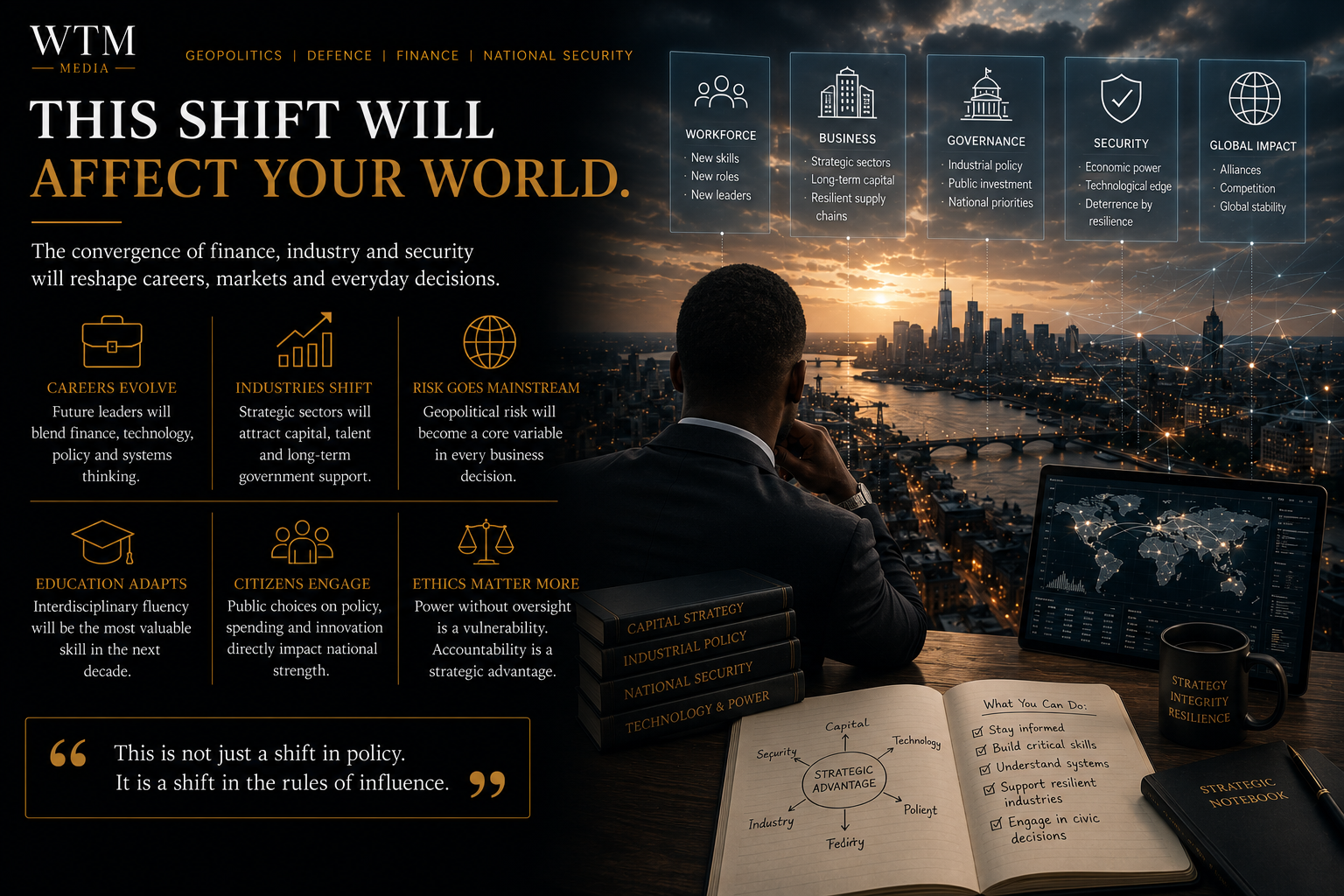
Whether you work in finance, engineering, manufacturing, consulting, government, technology, or higher education, the boundaries separating these professions are becoming increasingly porous. Skills once considered purely commercial may acquire national strategic importance. Likewise, careers traditionally associated with public service increasingly demand commercial literacy.
Business leaders should expect governments to become more active participants in industrial development. Strategic sectors may receive greater public investment, regulatory attention, and financial support. Understanding geopolitical risk will become an executive competency rather than a specialist discipline.
Investors may increasingly evaluate companies through dual lenses: commercial performance and strategic significance. Industries supporting energy security, advanced manufacturing, semiconductors, aerospace, cybersecurity, and critical infrastructure could experience sustained structural demand extending well beyond traditional economic cycles.
Students and young professionals should recognise that future leadership careers may require interdisciplinary capabilities. Finance, technology, engineering, economics, public policy, and systems thinking will increasingly converge. Specialists remain valuable, but integrators may become indispensable.
Citizens should also understand the broader implications. Public spending on strategic industries will likely increase. Debates surrounding industrial policy, taxation, infrastructure, and research funding will become more consequential because they increasingly influence national resilience rather than economic growth alone.
Most importantly, readers should abandon outdated assumptions separating economics from security. Those domains have merged. Understanding one increasingly requires understanding the other.
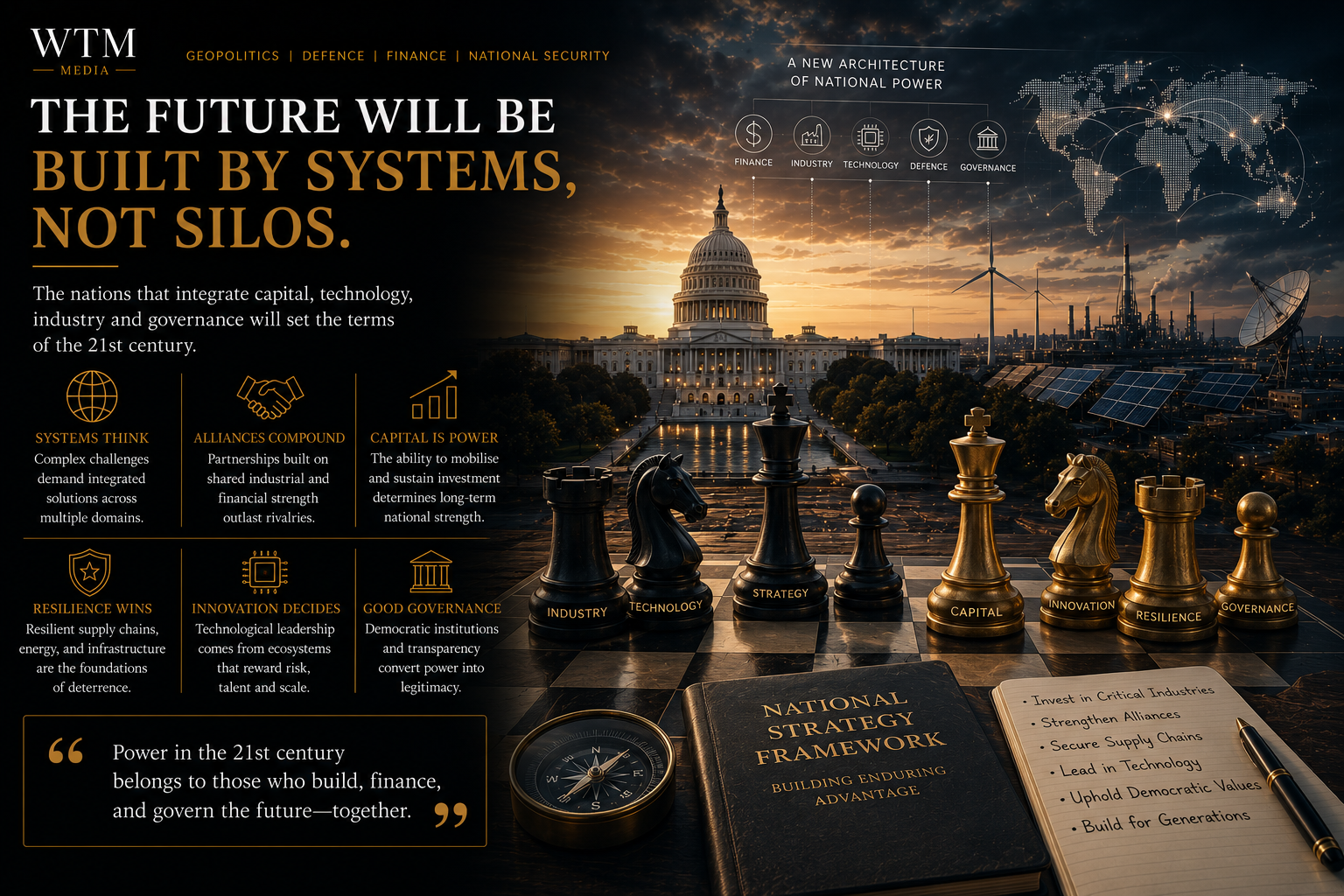
The Pentagon is not simply hiring bankers. It is signalling that capital itself has become an instrument of national power. That distinction fundamentally changes how we interpret both finance and defence.
Throughout history, societies that adapted fastest to changing architectures of power consistently outperformed those that defended outdated institutions. Naval power displaced cavalry. Air power transformed naval strategy. Digital networks redefined intelligence. Today, financial systems are becoming operational infrastructure rather than supporting administration.
The nations most likely to shape the twenty-first century will not necessarily possess the largest militaries. They will possess the greatest capacity to coordinate governments, private capital, technology companies, universities, manufacturers, entrepreneurs, and democratic institutions into coherent strategic ecosystems.
This transformation also demands careful governance. Concentrating financial and strategic power without accountability risks undermining the democratic principles such systems are intended to protect. Transparency, ethical oversight, and institutional trust remain essential competitive advantages.
For WTM readers, this story represents something larger than defence policy. It illustrates a recurring pattern that appears across technology, business, healthcare, climate, and geopolitics: boundaries between previously separate systems are dissolving. Competitive advantage increasingly belongs to those capable of seeing these emerging connections before they become obvious.
The future will not be shaped simply by those who build the most sophisticated weapons. It will be shaped by those who understand that the decisive contest increasingly concerns how societies organise intelligence, capital, institutions, and industry into resilient systems capable of adapting faster than the world around them.
Editorial Intelligence: WTM Anonymous Author
Visual Intelligence: Noir Spider Atelier™ – A Division of WTM Media
Editorial Direction: Kelly Dowd, MBA, MA – Editor-in-chief
Copyright: © 2026 WTM Media. All rights reserved.
Why These Matter - WTM MEDIA is an independent editorial platform exploring the forces shaping our world—through people, culture, commerce, design, systems, and governance. Connecting the dots between today’s headlines and tomorrow’s realities.