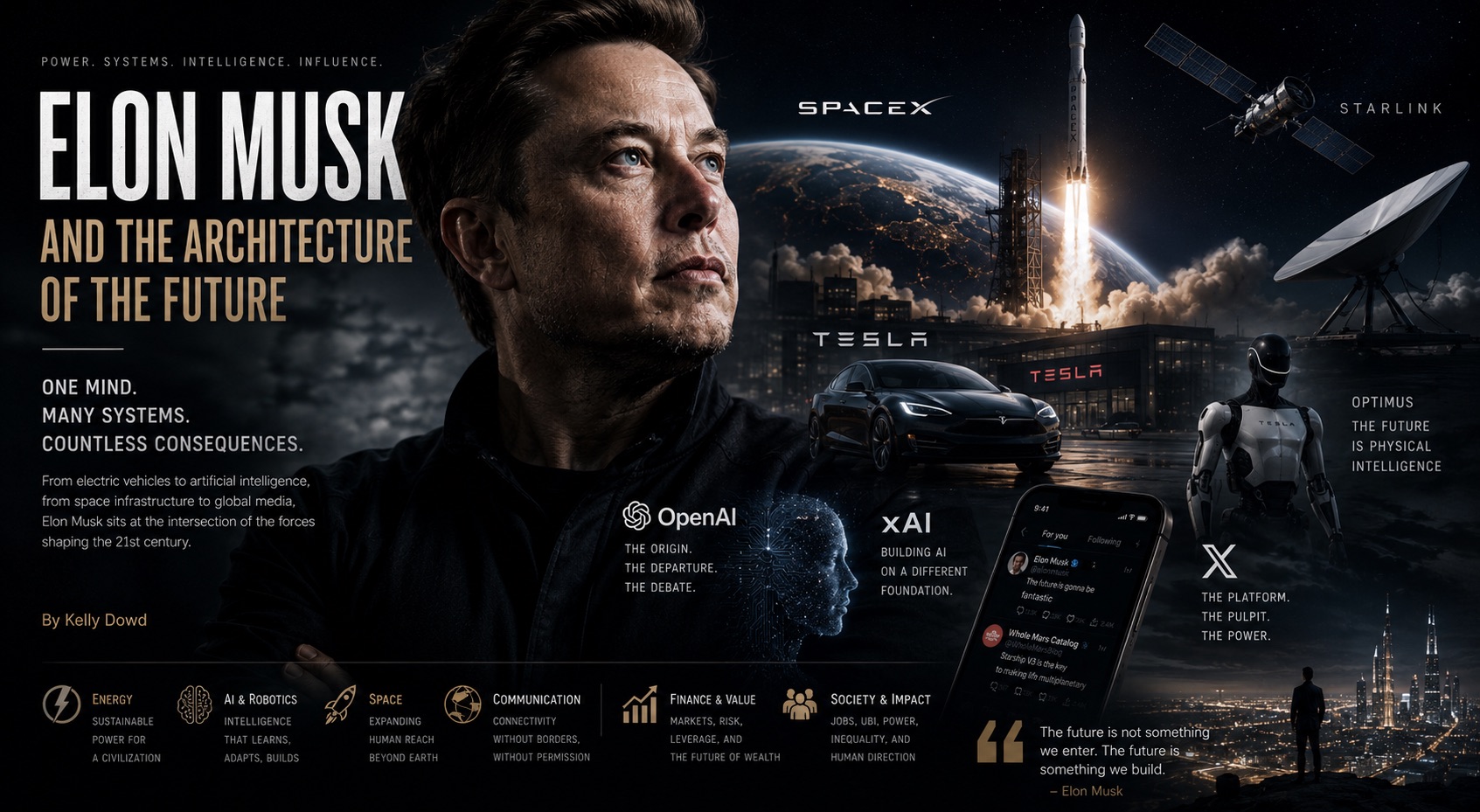
Most discussions about Elon Musk focus on personality. Admirers describe a visionary. Critics describe a provocateur. Both perspectives miss the larger story. Musk matters not because of who he is, but because of the systems he sits inside simultaneously. Electric vehicles. Space infrastructure. Artificial intelligence. Digital media. Financial engineering. Robotics. Energy systems. Demographic change. Human enhancement. Free speech. Information warfare. The future of work. The future of government. The future of civilisation itself. Few individuals in modern history have occupied so many strategic intersections at once. Understanding Musk therefore requires moving beyond celebrity and ideology. He is best understood as a living case study in how power is evolving in the twenty-first century. The real question is not whether one likes Elon Musk. The real question is why a single individual has become so relevant to so many systems that will shape humanity’s future.
Most influential people become associated with a single industry. Henry Ford became synonymous with automobiles. Steve Jobs became synonymous with personal computing. Warren Buffett became synonymous with investing. Musk occupies an unusual position because his influence extends across multiple strategic domains simultaneously. Electric vehicles through Tesla. Space launch systems through SpaceX. Satellite communications through Starlink. Artificial intelligence through xAI and his early involvement with OpenAI. Social infrastructure through X. Robotics through Tesla Optimus. Energy systems through battery technologies and grid storage. Each of these industries independently influences the future. Collectively they form a blueprint for an entirely different civilisation.
This convergence matters because power is increasingly shifting away from individual industries toward interconnected systems. Cars are becoming computers. Satellites are becoming communications networks. AI is becoming infrastructure. Media is becoming geopolitics. Energy is becoming national security. Musk’s businesses often appear disconnected until viewed through a systems lens. Then the pattern becomes visible. Each company operates as a component within a larger architecture.
His biography partially explains this orientation. Born in apartheid-era South Africa, educated partly in Canada before moving to the United States, Musk experienced multiple systems of governance, culture, and economic organisation. His father, Errol Musk, represented engineering, technical thinking, and controversy. His mother, Maye Musk represented discipline, branding, visibility, and entrepreneurship. One side reflected construction. The other reflected presentation. Together they created a framework visible throughout Musk’s career: build aggressively, then shape the narrative around what is being built.
This combination helps explain why Musk consistently gravitates toward industries requiring unusually long time horizons. Electric vehicles were considered commercially unrealistic. Private spaceflight was dismissed as fantasy. Reusable rockets were ridiculed. AI safety discussions were niche. Satellite internet was viewed as prohibitively expensive. Yet Musk repeatedly enters sectors where the dominant assumption is that success is unlikely. His operating principle appears less concerned with probability than with strategic necessity.
This behaviour attracts both admiration and criticism because it violates conventional management logic. Traditional executives minimise risk. Musk frequently concentrates it. Traditional organisations optimise existing systems. Musk often attempts to redesign them entirely. Whether successful or not, this approach generates disproportionate influence because it forces institutions to respond.
The result is that Musk has become less a businessman and more a strategic node within multiple future scenarios. Understanding him therefore requires understanding the systems around him rather than the individual alone.
The most valuable asset Musk possesses may not appear on any balance sheet. It is attention.
For centuries, economic power largely followed physical assets. Land created wealth. Factories created wealth. Oil fields created wealth. The digital era introduced a different reality. Attention became a strategic resource capable of influencing markets, politics, culture, investment flows, and public perception. Musk intuitively understood this transition earlier than many institutional leaders.
His acquisition of X demonstrated this principle. Financially, the acquisition remains controversial. Strategically, it positioned him at the centre of global information flows. Media is no longer merely a reporting mechanism. It functions as a battlefield where narratives shape economic behaviour, political movements, and public trust. Control of communication infrastructure increasingly resembles control of railroads during the nineteenth century or oil pipelines during the twentieth.
This reality explains why Musk’s relationship with journalists, regulators, investors, and critics generates such intense reactions. He operates simultaneously as a business leader, media owner, influencer, and public figure. These roles traditionally remained separate. Today they increasingly overlap. The consequence is that every statement becomes interpreted through multiple lenses at once: economic, political, technological, and cultural.
The controversies surrounding public gestures, political associations, online commentary, and media appearances illustrate this complexity. Supporters and critics often focus on symbolic events. The deeper issue concerns narrative power itself. Modern societies increasingly struggle to distinguish between information, influence, performance, and persuasion. Musk operates directly within that ambiguity.
This dynamic also intersects with neurodiversity. Musk has publicly discussed being on the autism spectrum. While neurodivergence should never be romanticised, it often produces cognitive approaches that differ from conventional social expectations. Systems thinking, intense focus, pattern recognition, and unconventional communication styles frequently create both advantages and challenges. Understanding Musk requires recognising that some behaviours interpreted as strategic may also reflect genuinely different cognitive processing.
The result is a public figure who simultaneously functions as entrepreneur, engineer, communicator, provocateur, and systems architect. This combination makes him unusually difficult to categorise—and unusually difficult to ignore.
The most important questions surrounding Musk may not concern cars, social media, or stock prices. They concern civilisation itself.
SpaceX is often described as a rocket company. In reality, it is building transportation infrastructure beyond Earth. Starlink is often described as satellite internet. In reality, it is becoming a global communications layer. Tesla is often described as an automotive company. Increasingly, it resembles an energy, robotics, and AI company. Each initiative points toward a future in which infrastructure extends beyond traditional national boundaries.
Mars occupies a particularly symbolic role in this vision. Musk frequently describes becoming a multiplanetary species as a form of existential insurance. The argument contains merit. Concentrating civilisation on a single planet creates vulnerabilities. Yet it also raises difficult historical questions. Humanity’s previous eras of expansion often involved extraction, domination, displacement, and unequal power structures. The language of colonising Mars inevitably echoes earlier forms of colonial thinking on Earth.
The challenge therefore is not whether humanity expands into space. It is whether it carries its historical mistakes with it. Future settlements, resource extraction systems, and space economies will require governance frameworks unlike anything currently existing. Musk has accelerated this conversation, but civilisation has not yet answered it.
Artificial intelligence introduces similar questions. Musk helped found OpenAI before later becoming one of its most vocal critics and competitors. His disagreements with Sam Altman reflect more than personal conflict. They represent competing visions of how advanced intelligence should be developed, governed, and distributed. The underlying issue concerns power. Who controls the most powerful technologies in human history? Governments? Corporations? Open ecosystems? A handful of individuals?
These questions become increasingly urgent as AI capabilities advance. Superintelligence, automation, robotics, and machine autonomy are no longer theoretical discussions. They are active engineering projects. The future may be determined less by who builds AI first and more by who governs it wisely.
Musk sits at the centre of these debates because he simultaneously influences multiple technologies shaping the next century. Whether history ultimately judges his contributions positively or negatively, their significance is difficult to dispute.
One of the least understood aspects of modern wealth involves leverage.
Many observers assume billionaires maintain vast amounts of cash. In reality, individuals such as Musk often hold wealth primarily through ownership of appreciating assets, particularly stock. Rather than selling shares and triggering significant tax liabilities, wealthy individuals frequently borrow against their holdings. Loans provide liquidity while preserving ownership.
This strategy reveals a broader truth about modern finance. Wealth increasingly functions as access rather than cash. Ownership creates borrowing power. Borrowing power creates optionality. Optionality creates influence. The distinction matters because it demonstrates how contemporary economic systems reward asset ownership more than labour participation.
Tesla’s valuation history illustrates this phenomenon dramatically. For years, critics argued that Tesla’s market value exceeded traditional automotive fundamentals. Supporters argued that Tesla represented a technology platform rather than a car company. Regardless of perspective, the episode revealed how modern markets increasingly price narratives about the future rather than present realities alone.
This dynamic intersects directly with conversations surrounding automation and Universal Basic Income. If AI, robotics, and autonomous systems generate extraordinary productivity gains, who captures the value? Workers? Investors? Governments? Technology companies? The answer will shape the economic architecture of the twenty-first century.
Musk’s career repeatedly forces these questions into public view. Not because he provides definitive answers, but because his companies operate precisely where these tensions emerge.

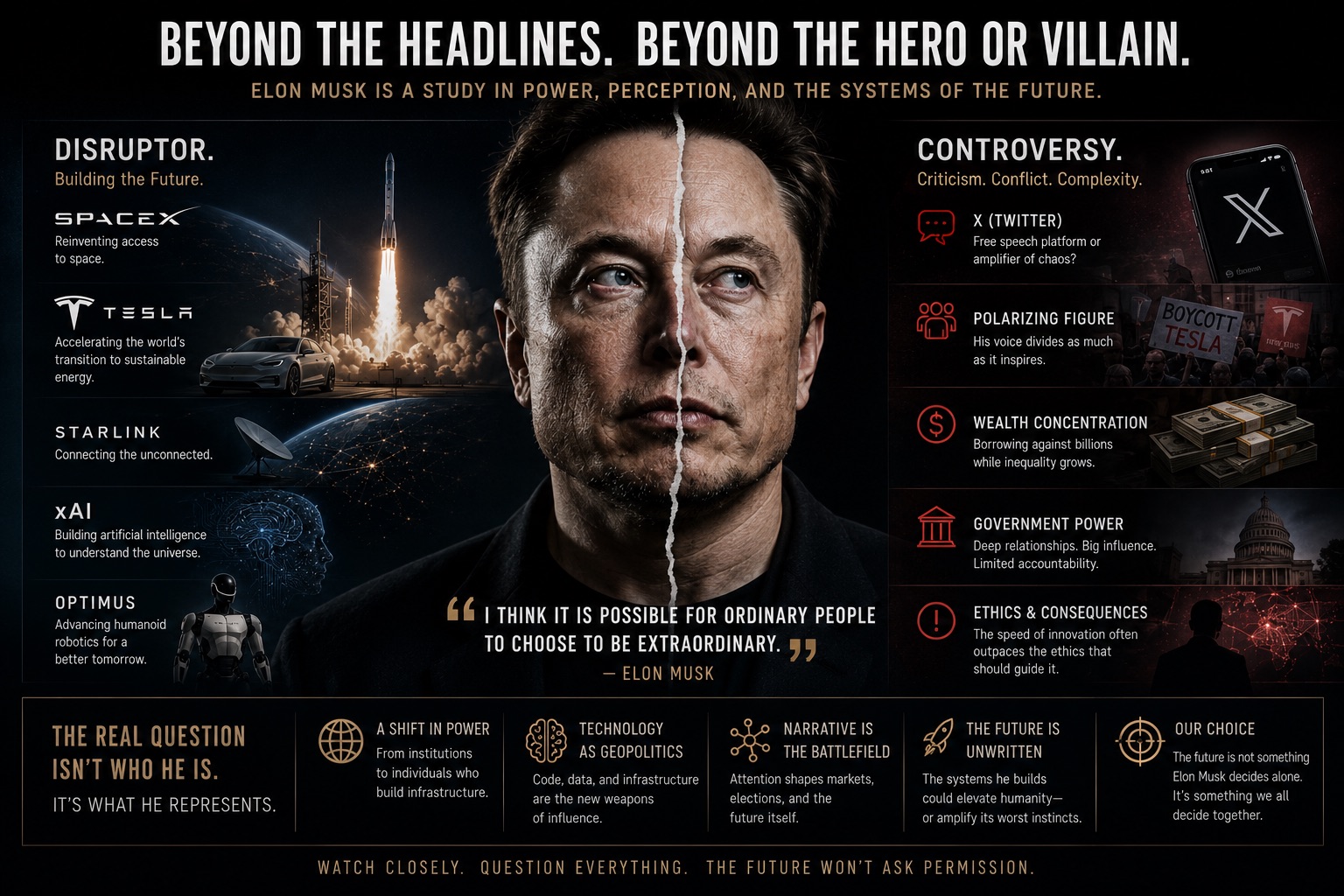
Elon Musk is one of the most discussed individuals on Earth. That fact alone is not important. What matters is why.
He sits at the intersection of nearly every major force shaping the coming century: artificial intelligence, robotics, energy, transportation, media, communications, finance, space exploration, demographic change, automation, and human adaptation. Few individuals occupy so many strategic intersections simultaneously.
The temptation is to reduce him to hero or villain. Both interpretations are intellectually insufficient. The more useful question is what Musk reveals about the future itself. He reveals that power is becoming increasingly concentrated around infrastructure. He reveals that technology is becoming geopolitics. He reveals that intelligence is becoming capital. He reveals that media is becoming governance. He reveals that the future will be shaped less by isolated industries and more by interconnected systems.
Whether Elon Musk succeeds or fails is ultimately a secondary question. The primary question is what civilisation learns from the experiment. Because beneath every headline about Musk lies a larger story. The story is not about one man. It is about the architecture of the future.
Visual Intelligence by Noir Spider Studios
A division of WTM Media
Why These Matter - WTM MEDIA is an independent editorial platform exploring the forces shaping our world—through people, culture, commerce, design, systems, and governance. Connecting the dots between today’s headlines and tomorrow’s realities.