Conceptual illuminated world map and compass connecting global regions.

WTM Visual Intelligence · Conceptual imagery

Geopolitics

Trace the relationships between power, territory, institutions and the choices that shape global consequences.

America Is Voting Inside A World That Has Already Changed

America Is Voting Inside A World That Has Already Changed

On 3 November, Americans will elect all 435 members of the House of Representatives and decide 35 Senate contests: 33 regularly scheduled Class II elections and two special elections. Yet describing the event as 470 congressional races understates what is actually being allocated. Congress is not simply another arena for the country’s political arguments. It is part of the machinery through which those arguments become law, money, appointments, investigations, military authority and international commitments. Its constitutional powers include appropriations and war authorities; the Senate participates in treaties and confirmations; and congressional committees oversee executive operations. The numerical paradox is striking. Every House district will vote, yet Reuters identifies only about 50 of 435 House contests as meaningfully competitive and reports that Democrats require a net gain of three seats to take the chamber. In the Senate, Reuters identifies nine especially consequential contests, with Democrats needing four additional seats for control. These are not predictions. They reveal something structurally important: enormous national power can turn on comparatively small electorates. And the country holding this election is operating in a world that is not waiting for the result. War and instability are affecting energy markets. Treasury yields have approached 5%. Russia’s war against Ukraine continues. Gulf states are pursuing diplomatic calculations of their own. Trade partners are developing leverage against American policy. WTM therefore treats the 2026 midterms not principally as a referendum on a president, party or ideology, but as an institutional allocation event. The relevant question is larger than who wins. What governing capacity will America possess after the votes are counted — and what will the rest of the world conclude from the answer?

Trump, the $5,000 Promise and the New Attention Economy of American Power

Trump, the $5,000 Promise and the New Attention Economy of American Power

President Donald Trump’s proposal to send every American adult a $5,000 “Trump dividend” if Republicans retain control of Congress is striking partly because of its scale. Trump described the payment at the Republican midterm convention in Dallas. Reuters calculates that payments to roughly 240 million adult citizens would cost about $1.2 trillion; the Associated Press has placed the likely cost above $1 trillion, depending on eligibility. Congress controls federal appropriations, and neither a financing mechanism nor enacted legislative authority currently exists for such payments. Yet the cheque is not the most interesting part of the story. The more consequential development may be the communications architecture surrounding it. Political persuasion increasingly exists inside the same attention environment as advertising, entertainment, influencers, ecommerce and algorithmically distributed media. A policy no longer competes only against another policy. It competes against every other object seeking a person’s attention. Under those conditions, abstraction struggles. A phrase such as “long-term economic prosperity” must compete with something immediately understandable: $5,000. That does not make citizens irrational. Nor does it make every tangible political benefit improper. Democratic governments routinely tax, transfer, subsidise, insure and redistribute resources, and research shows that voters reasonably update their assessments of governments when policies materially affect their lives. The deeper problem appears when the distinction between governing and marketing becomes difficult to see. A political proposition can simultaneously possess economic value, perceived value, attention value and electoral value. Those values are not identical. The citizen therefore needs a new kind of literacy. Not merely: Do I like the offer? But: What exactly is being offered, who has authority to deliver it, what does it cost, what behaviour is the communication attempting to produce, and what remains persuasive after the spectacle disappears? That is where democratic judgement begins.


Ireland’s Election Reflects a Changing Western Democracy

Ireland’s Election Reflects a Changing Western Democracy

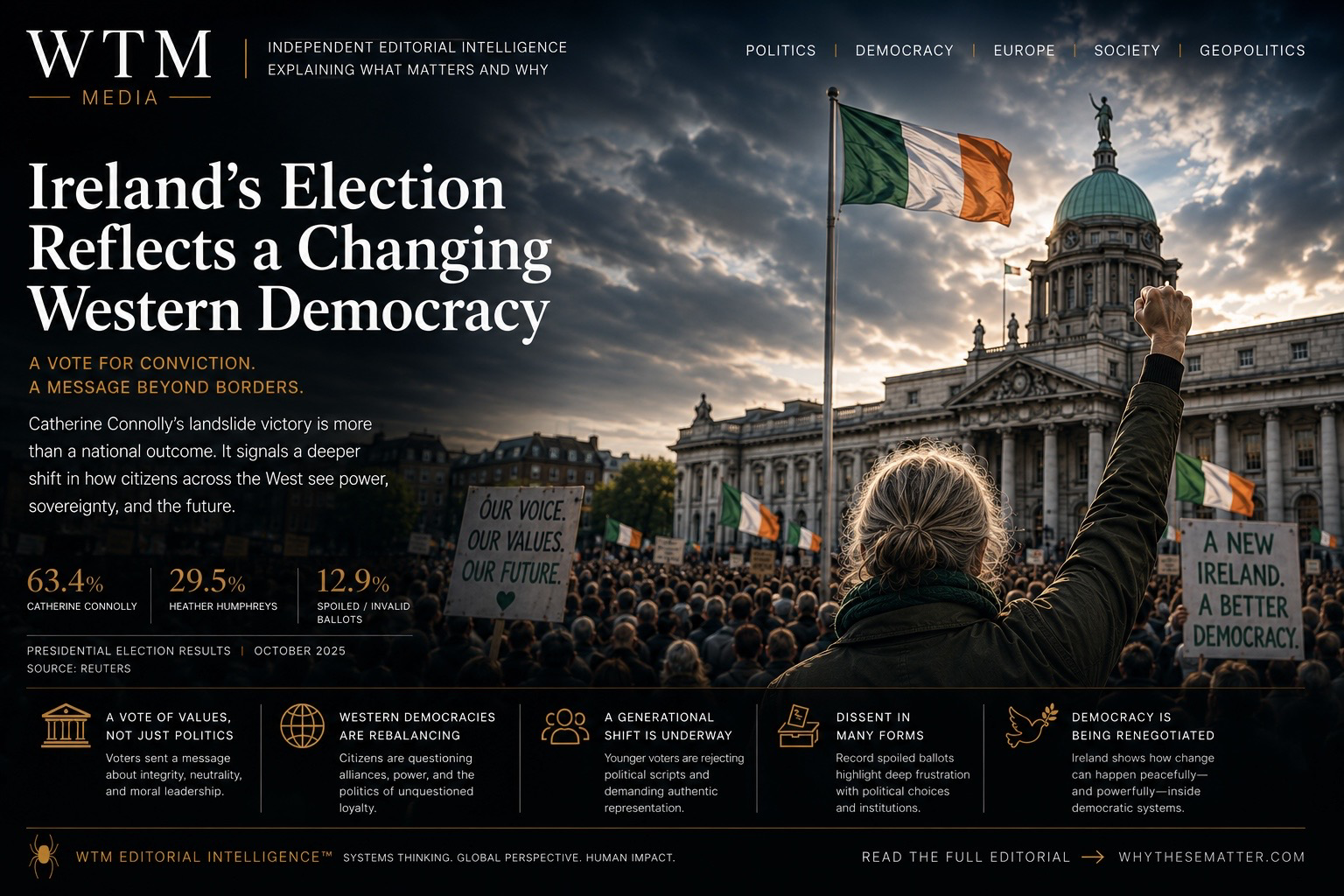
Catherine Connolly’s landslide election as President of Ireland can easily be reduced to the language contemporary politics understands best: left versus right, establishment versus insurgency, Palestine versus Israel, or populism versus institutionalism. That would miss the more consequential story. Ireland has elected an independent, outspoken critic of militarisation and Western foreign policy to an office whose formal executive powers are limited, but whose symbolic authority is substantial. Connolly secured 63.4% of the vote against Heather Humphreys’s 29.5%, after building support among younger voters and receiving backing from a broad collection of opposition parties. Yet the same election produced an unusually high level of spoiled ballots. Ireland did not deliver one uncomplicated political message; it delivered several simultaneously. That contradiction makes the election useful. Across Western democracies, political legitimacy is becoming increasingly detached from traditional party loyalty. Voters may remain committed to democracy while becoming considerably less deferential towards the institutions, parties, geopolitical assumptions, and political vocabularies that have historically organised it. Ireland offers a particularly revealing case because its transformation is occurring inside a prosperous, highly globalised, overwhelmingly pro-European democracy. Connolly’s victory therefore does not prove that Ireland has rejected the West, the European Union, capitalism, or representative democracy. It suggests something subtler: Western citizens increasingly want the right to question the architecture of the Western consensus without being treated as though questioning it amounts to abandoning democracy itself.